Ever paused while writing and wondered whether Tie vs. Tye is the correct choice? You’re not alone. These two words may look similar, but one is a common English word with multiple meanings, while the other is typically used as a proper name or surname.
This confusion often leads to spelling mistakes, grammar errors, and awkward writing in emails, essays, and professional documents. And here’s the kicker: using the wrong word can make your writing appear less polished and even change the intended meaning of your sentence.
But don’t worry—you’re in the right place.
In this guide, you’ll learn the difference between Tie vs. Tye, how each word is used in written communication, and the simple usage rules that help you choose the correct spelling every time. You’ll also discover clear examples, common mistakes to avoid, and easy memory tricks to make the distinction stick.
Whether you’re improving your vocabulary, checking your word choice, or trying to write with greater confidence, this article will help you understand exactly when to use “tie” and when “Tye” is appropriate.
Let’s break it down and eliminate the confusion once and for all.
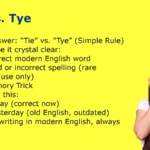
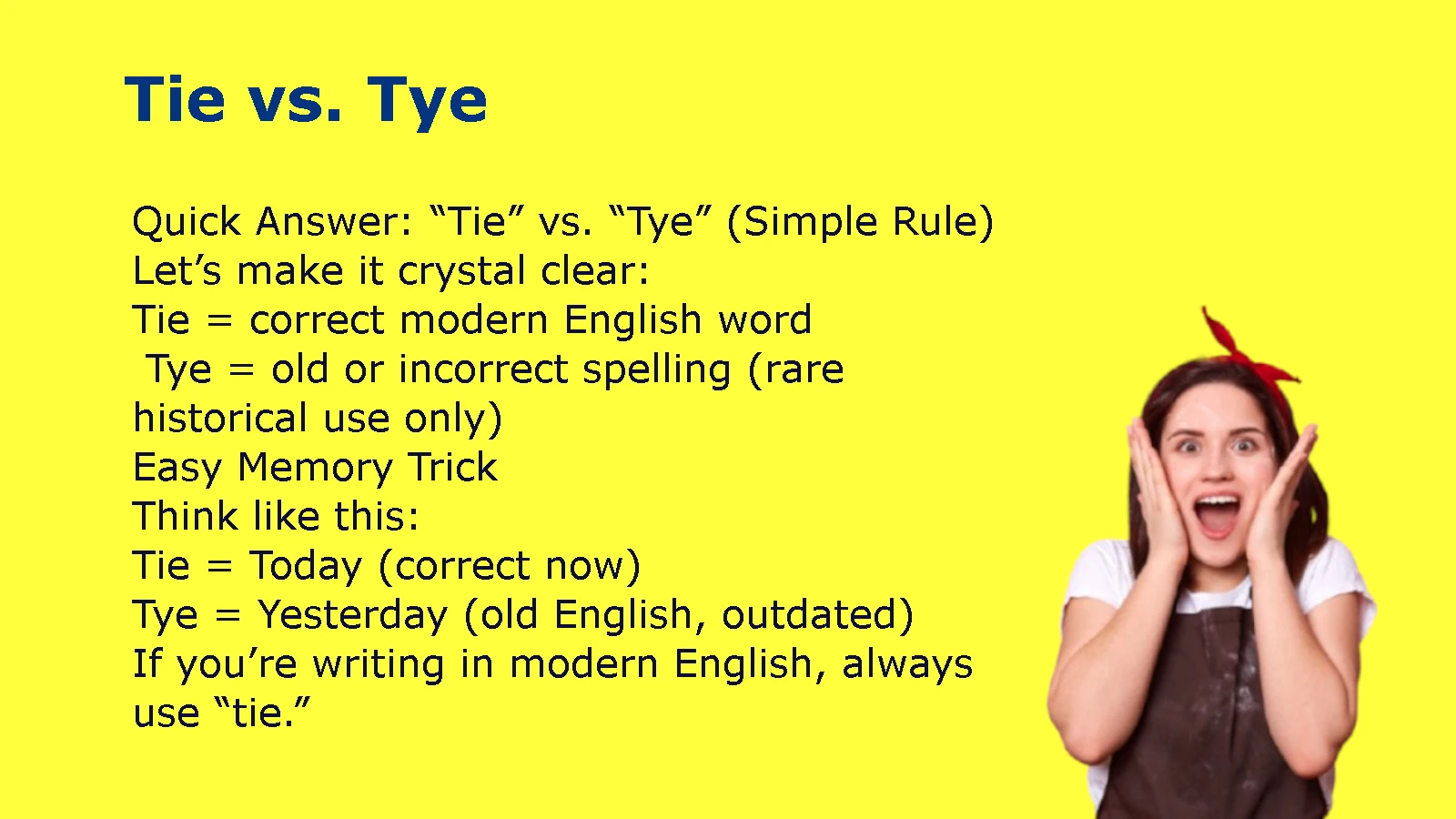
Quick Answer: “Tie” vs. “Tye” (Simple Rule)
Let’s make it crystal clear:
Tie = correct modern English word
Tye = old or incorrect spelling (rare historical use only)
Easy Memory Trick
Think like this:
- Tie = Today (correct now)
- Tye = Yesterday (old English, outdated)
If you’re writing in modern English, always use “tie.”
What Does “Tie” Mean? (Modern Usage Explained)
The word “tie” is widely used in English and has multiple meanings depending on context.
Main meanings of “tie”
- To fasten or bind something
- Tie your shoes
- Tie a rope
- Tie your hair
- A connection or relationship
- Family ties
- Emotional ties
- A draw in competition
- The match ended in a tie
What About “Tye”? (Why You See It Sometimes)
Here’s where confusion comes in.
1. Old English Spelling
“Ty(e)” appears in older texts, but it is no longer standard.
2. Rare Surname or Proper Name
You might see “Tye” as:
- A last name (e.g., John Tye)
- A place name
3. Common Mistake
Most of the time, people simply mistype “tie” as “tye.”
The Key Difference Between “Tie” and “Tye”
Here’s a simple comparison:
| Word | Status | Meaning | Usage |
| Tie | Correct modern English | Fasten, connect, or draw | Everyday writing |
| Tye | Old/rare/proper noun | Historical or name use | Not standard |
Why People Confuse “Tie” and “Tye”
This confusion happens for a few simple reasons:
1. Pronunciation is identical
Both sound exactly the same → /taɪ/
2. Keyboard proximity
“Y” and “I” are close on keyboards → easy typo
3. Exposure to names
People see “Tye” as a name and assume it’s a spelling variant
4. Lack of grammar awareness
English doesn’t always visually show correctness clearly
Real-Life Examples of “Tie”
Let’s look at correct usage:
Everyday Sentences
- I will tie my shoes before leaving.
- She helped me tie the ribbon.
- They tied the game in the final minute.
Emotional Meaning
- Strong family ties are important.
- There is a deep tie between them.
Where “Tye” Appears (Rare Cases)
You might see it in:
Proper Names
- Tye Sheridan (actor)
- Tye River (place name)
Historical or Stylized Text
- Old manuscripts or poetic spelling
Important Note
Even in these cases, it is not interchangeable with “tie.”
The Biggest Mistake People Make
Here’s the real issue:
People assume “tye” is just an alternative spelling of “tie.”
What goes wrong
- Students write “tye your shoes”
- Auto-correct sometimes doesn’t catch it
- Learners memorize incorrect spelling patterns
Result
- Spelling mistakes in exams
- Unprofessional writing
- Miscommunication in formal contexts
Side-by-Side Comparison Table
Here’s a quick overview:
| Feature | Tie | Tye |
| Modern usage | Yes | No |
| Dictionary standard | Yes | Rare/Proper noun |
| Verb form | Yes | No |
| Common spelling | Correct | Mistake |
| Should you use it? | Always | Avoid |
Real-Life Examples: “Tie” in Action
Correct Usage
- “Please tie the package securely.”
- “The match ended in a tie.”
- “He wore a red tie to the meeting.”
What NOT to write
- ❌ “Tye your shoes”
- ❌ “They tye the score”
- ❌ “A formal tye”
Why “Tie” Is Always the Safe Choice
English spelling rules often feel messy, but this one is simple:
👉 If you mean fastening, connecting, or equal result—use tie
There is no modern grammar situation where “tye” is correct.
How to Never Confuse “Tie” vs. “Tye” Again
Use these simple tricks:
1. Think “I = Important”
“I” in tie reminds you it’s the correct form
2. Ignore “tye” unless it’s a name
If it’s not a name, don’t use it
3. Use spell-check wisely
If your editor underlines “tye,” trust it
Quick Decision Guide
Use this every time:
- Fastening or connection → Tie
- Competition result → Tie
- Anything else → Still Tie
- Seeing “tye” → likely incorrect or a name
FAQ: “Tie” vs. “Tye”
Is “tye” ever correct in modern English?
No. It is not used in standard modern spelling.
Why do some people write “tye”?
Usually because of typos or confusion with names.
Can “tye” and “tie” be used interchangeably?
No. Only “tie” is grammatically correct.
Is “tye” in the dictionary?
Only as a rare proper noun or historical reference.
Final Takeaway: The One Rule That Never Fails
Here’s the truth:
English may have many confusing spellings, but this one is not complicated.
👉 “Tie” is correct English.
👉 “Tye” is not standard usage.
So whenever you’re unsure, remember this:
If it’s not a name, it’s always “tie.”
Simple. Clean. No confusion.