
Ever stopped while writing and wondered whether Bearable vs. Bareable is the correct spelling? You’re not alone. These two words are frequently confused because they look and sound similar, but here’s the catch: only one is considered a standard word in modern English.
This confusion often leads to spelling mistakes, grammar errors, and uncertainty in professional writing, academic papers, and everyday communication. A single misplaced letter can affect your credibility and make your message appear less polished.
But don’t worry—there’s an easy way to remember the difference.
In this guide, you’ll learn the meaning of Bearable vs. Bareable, discover which spelling is correct, and see how each word is used in real-world English grammar and vocabulary examples. We’ll also cover common word usage mistakes, pronunciation tips, and simple memory tricks to help you avoid this confusion in the future.
And it gets better: by the end, you’ll be able to confidently choose the right word every time you write.
Let’s break down Bearable vs. Bareable and settle the confusion once and for all.
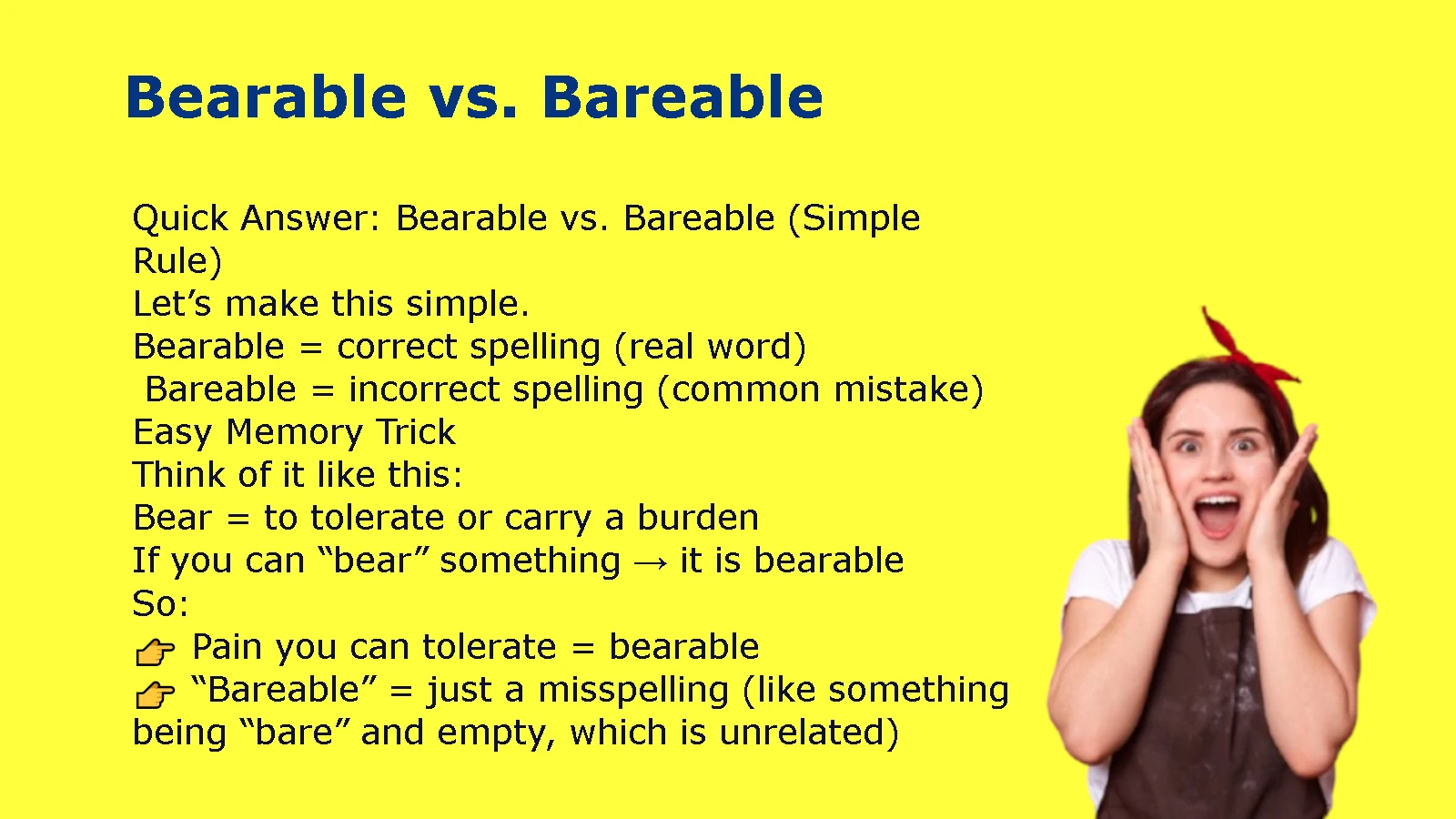
Quick Answer: Bearable vs. Bareable (Simple Rule)
Let’s make this simple.
Bearable = correct spelling (real word)
Bareable = incorrect spelling (common mistake)
Easy Memory Trick
Think of it like this:
- Bear = to tolerate or carry a burden
- If you can “bear” something → it is bearable
So:
👉 Pain you can tolerate = bearable
👉 “Bareable” = just a misspelling (like something being “bare” and empty, which is unrelated)
Why “Bareable” Feels Correct (But Isn’t)
Here’s the tricky part.
Many people write “bareable” because:
- It sounds natural when spoken
- The word “bare” is already familiar (bare hands, bare skin)
- English pronunciation doesn’t clearly show spelling differences
But grammatically and historically, it’s wrong.
The Real Meaning of “Bearable”
Let’s break down the correct word.
Bearable comes from the verb “bear”, which means:
- to tolerate
- to endure
- to carry emotionally or physically
Meaning
👉 Bearable = something you can handle or endure, even if it’s unpleasant
Simple Examples of “Bearable”
Let’s make it real.
- “The pain was hard, but still bearable.”
- “The heat today is barely bearable.”
- “Without music, the silence is not bearable.”
Mini Scenario
You’re sitting in a noisy room:
“The noise is annoying, but it’s bearable.”
Meaning:
You don’t like it, but you can still handle it.
Why “Bareable” Is Wrong
Now let’s clear the confusion.
Bareable is NOT a word in standard English.
If you break it down:
- “Bare” = uncovered, empty, exposed
- “-able” = capable of
So “bareable” would logically mean “able to be bare” — but that has nothing to do with pain, stress, or endurance.
👉 That’s why dictionaries do not recognize it.
Bearable vs Bareable: Side-by-Side Comparison
| Word | Correct? | Meaning | Usage Example |
| Bearable | ✅ Yes | Able to be endured or tolerated | “The pain is bearable.” |
| Bareable | ❌ No | Not a real word | Incorrect spelling (avoid using) |
Common Situations Where People Get Confused
1. Pain or discomfort
- Correct: “The headache is bearable.”
- Incorrect: “The headache is bareable.”
2. Emotional stress
- Correct: “Life became more bearable after support.”
- Incorrect: “Life became more bareable.”
3. Weather conditions
- Correct: “The heat is barely bearable.”
- Incorrect: “The heat is barely bareable.”
Why This Mistake Happens So Often
There are three main reasons:
1. Sound confusion
Both words sound identical when spoken.
2. Familiarity with “bare”
People already know “bare,” so they assume it fits.
3. Fast typing
Autocorrect sometimes doesn’t catch it in casual writing.
Real-Life Example (Common Mistake Case)
A student writes:
“The exam stress was bareable after revision.”
What went wrong:
- Teacher marks it incorrect
- Student loses grammar points
- Meaning becomes unclear in formal writing
Correct version:
“The exam stress was bearable after revision.”
Small spelling mistake → big impact in academic writing.
Simple Rule to Never Forget
Here’s the easiest way to remember it:
👉 If it involves tolerance or endurance, always use bearable
👉 If it’s “bare,” it has nothing to do with feelings or pain
Or even simpler:
Bear = endure → Bearable = correct
Quick Decision Guide
When you’re unsure:
- Pain or stress? → Bearable
- Emotional or physical tolerance? → Bearable
- Thinking “bare”? → Stop. It’s wrong in this context
Still unsure? Just think:
👉 Can I “bear” it?
If yes → bearable
FAQ: Bearable vs Bareable
Is “bareable” ever correct?
No. It is always considered a spelling mistake in standard English.
Why do people write “bareable”?
Because it sounds like “bare” when spoken, but spelling does not match pronunciation.
What is the correct spelling?
Bearable
What does bearable mean?
Something that can be endured or tolerated.
Key Facts You Should Remember
- Bearable = correct word
- Bareable = incorrect spelling
- Comes from “bear” (to endure)
- Used for pain, stress, conditions, or situations
Final Takeaway: The One Rule That Never Fails
Here’s the simplest truth:
👉 If you can “bear” it, it is bearable
👉 If it’s spelled “bareable,” it’s wrong every time
English often plays tricks with sound and spelling, but this one is easy once you lock in the rule.
So next time you write about pain, stress, or anything difficult to handle, remember:
It’s not “bareable.” It’s always “bearable.”