Usage is the correct spelling and refers to the way something is used or the accepted practice of using a word or phrase. Useage is a misspelling and is not recognized in standard English. When comparing usage vs useage, always use usage.
The confusion often comes from similar-looking words and inconsistent spelling patterns. But here’s the kicker: using the wrong version can make your writing appear less professional, whether you’re drafting an email, writing an essay, or creating online content.
In this guide, you’ll learn the difference between Usage vs Useage, discover the correct spelling of usage, understand why “useage” is incorrect, and see usage examples in real sentences. You’ll also learn how to spell usage correctly, explore its meaning and pronunciation, and find an easy memory trick to avoid this common spelling mistake in the future.
By the end, you’ll know exactly when to use usage, why useage is a misspelling, and how to write with greater confidence and accuracy.
Usage vs Useage: The Quick Answer
Here’s the short answer:
- Usage ✅ is the correct spelling.
- Useage ❌ is a misspelling.
- Every major English dictionary recognizes usage.
- Standard English does not recognize useage as a valid word.
| Word | Correct? | Meaning |
| Usage | ✅ Yes | The way something is used or the amount of something consumed |
| Useage | ❌ No | Incorrect spelling of usage |
Whenever you’re writing an email, report, essay, blog post, research paper, or social media update, choose usage. Doing so keeps your writing accurate and professional.
Quick Tip: If your spell checker underlines useage, it’s because the word isn’t part of standard English.
What Does “Usage” Mean?
The word usage is a noun with several related meanings. At its core, it refers to how something is used or the customary way people use words, objects, or services.
Depending on the context, usage can describe:
- the manner in which something is used
- accepted language practices
- consumption of a resource
- frequency of use
- historical or customary practices
Although these meanings vary slightly, they all revolve around the idea of using something.
Dictionary Definition of Usage
The word usage generally means:
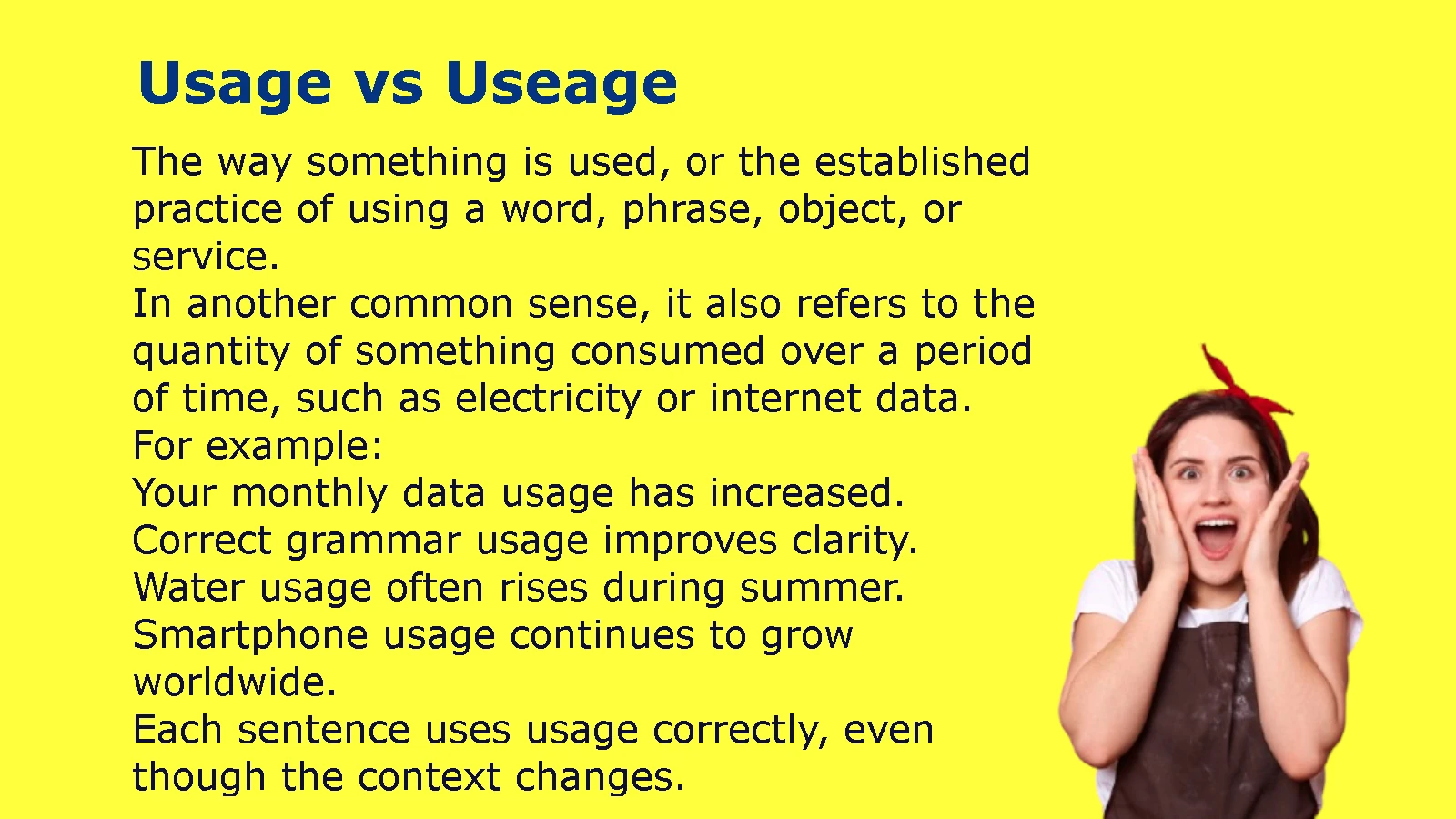
The way something is used, or the established practice of using a word, phrase, object, or service.
In another common sense, it also refers to the quantity of something consumed over a period of time, such as electricity or internet data.
For example:
- Your monthly data usage has increased.
- Correct grammar usage improves clarity.
- Water usage often rises during summer.
- Smartphone usage continues to grow worldwide.
Each sentence uses usage correctly, even though the context changes.
Origin and Etymology of “Usage”
The history of usage explains why the spelling often surprises people.
The word entered English through Middle English, which borrowed it from Old French. The French word usage ultimately traces back to the Latin verb uti, meaning to use.
Interestingly, the spelling usage has remained remarkably consistent throughout its history. English never adopted useage as an accepted variation.
Timeline
| Period | Development |
| Latin | uti (“to use”) |
| Old French | usage |
| Middle English | usage enters English |
| Modern English | usage remains the standard spelling |
This long history helps explain why dictionaries consistently reject useage.
Pronunciation of Usage
Many spelling mistakes happen because people write words exactly as they hear them.
Usage is pronounced:
YOO-sij
IPA pronunciation:
/ˈjuː.sɪdʒ/
Notice that although use ends with the letter e, that extra letter disappears when forming usage.
Examples:
- correct word usage
- internet usage
- energy usage
- proper language usage
The pronunciation stays consistent regardless of context.
Part of Speech
Usage functions exclusively as a noun.
It is not:
- a verb
- an adjective
- an adverb
Examples:
| Sentence | Correct? |
| The usage has increased. | ✅ |
| Data usage is high. | ✅ |
| Please usage the program. | ❌ |
| We usage the software daily. | ❌ |
If you need a verb, choose use instead.
Common Meanings of Usage
Although dictionaries list multiple definitions, most examples fall into several major categories.
The Way Something Is Used
This is the most common meaning.
Examples:
- Proper tool usage prevents accidents.
- Good password usage improves security.
- Correct grammar usage makes writing easier to understand.
Consumption of Resources
Businesses, utilities, and technology companies frequently use usage when measuring consumption.
Examples include:
- electricity usage
- water usage
- battery usage
- memory usage
- CPU usage
- storage usage
- internet usage
- fuel usage
For example:
Your electricity usage increased by 12% compared to last month.
Accepted Language Practices
Linguists use usage when discussing grammar, vocabulary, pronunciation, and writing conventions.
Examples:
- modern English usage
- formal usage
- informal usage
- regional usage
- historical usage
Sentence example:
Modern usage accepts many expressions that were once considered informal.
Established Customs
Sometimes usage refers to traditional or accepted practices.
For example:
Local usage required guests to remove their shoes before entering the home.
Although this meaning appears less frequently today, you’ll still encounter it in legal and historical writing.
Is “Useage” a Real Word?
The short answer is no.
Useage is not a recognized English word.
It doesn’t appear as a valid entry in respected dictionaries, nor is it accepted in formal writing.
Whenever you see useage, you’re almost certainly looking at a spelling mistake.
Why Does “Useage” Appear So Often?
Even though it’s incorrect, useage appears surprisingly often online.
Several factors explain this.
People Assume Every Word Keeps the Silent “E”
Many English words retain the final e before adding a suffix.
For example:
- courage
- mileage
- acreage
Writers sometimes expect use to follow the same pattern.
It doesn’t.
The silent e disappears.
Pronunciation Doesn’t Reveal the Spelling
English spelling isn’t perfectly phonetic.
Because usage sounds like it could contain an extra e, many people guess the spelling.
That guess often becomes useage.
Typing Quickly
Simple typing errors happen.
Someone may accidentally write:
- usegae
- useaeg
- useage
Spell-check software usually catches these errors immediately.
Non-Native English Learners
People learning English often rely on pronunciation or familiar spelling patterns.
Since English contains many exceptions, usage becomes one of those commonly misspelled words.
Usage vs Useage: Side-by-Side Comparison
The easiest way to remember the difference is to compare the two spellings directly.
| Feature | Usage | Useage |
| Correct spelling | ✅ Yes | ❌ No |
| Found in dictionaries | ✅ Yes | ❌ No |
| Accepted in schools | ✅ Yes | ❌ No |
| Used in business writing | ✅ Yes | ❌ No |
| Accepted in academic papers | ✅ Yes | ❌ No |
| Used by publishers | ✅ Yes | ❌ No |
| Should you use it? | ✅ Always | ❌ Never |
The comparison is straightforward.
There isn’t a situation in standard English where useage becomes the preferred spelling.
How to Spell “Usage” Correctly
Fortunately, remembering the correct spelling isn’t difficult once you understand why it works.
The word contains only five letters:
U-S-A-G-E
There is no extra “e” after use.
Why There’s No Extra “E”
Many English words drop the silent e before adding another ending.
Consider these examples:
| Base Word | New Word |
| use | usage |
| argue | arguing |
| judge | judgment |
| true | truly |
English spelling often removes letters when they are no longer needed for pronunciation.
Usage follows that pattern.
Understanding the Word Formation
Although usage comes from the idea of using, it isn’t created by simply adding -age to the modern English verb use.
Instead, the word entered English as an established borrowing from French.
That’s why the spelling stayed usage instead of becoming useage.
Understanding its history makes the spelling much easier to remember.
Easy Spelling Rule
A simple rule helps prevent mistakes:
If you’re talking about the way something is used, always write “usage.” Never add another “e.”
This rule works in every situation.
Examples:
✅ language usage
battery usage
data usage
software usage
❌ language useage
battery useage
data useage
Memory Tricks That Actually Work
Here are a few easy ways to remember the correct spelling.
Think of the Ending
The word already ends in -age.
You don’t need another e before it.
Remember the Phrase
Say this sentence aloud:
“Good usage uses fewer letters.”
Because usage has one fewer e, the sentence reinforces the correct spelling.
Trust Your Spell Checker
Modern writing tools immediately recognize usage.
If useage appears with a red underline, that’s a strong clue you’ve added an unnecessary letter.
Definition of Usage in Different Contexts
One reason usage is such a valuable word is its flexibility. It appears in everyday conversations, technical documents, academic writing, legal texts, and business reports. While the core meaning stays the same, the context shapes how the word is understood.
Understanding these different uses helps you choose the right word every time.
Everyday English
In daily conversation, usage usually refers to the way someone uses an object, service, or habit.
Examples include:
- phone usage
- social media usage
- water usage
- computer usage
- time usage
Example sentences:
- Your screen usage has doubled this week.
- Reducing water usage can lower your monthly bill.
- Healthy smartphone usage starts with setting daily limits.
These examples show how usage often describes patterns, habits, or amounts rather than a single action.
Grammar and Linguistics
In grammar, usage refers to the accepted way people use words, phrases, punctuation, and sentence structures. Unlike strict grammar rules, usage evolves over time as language changes.
For example, dictionaries regularly update entries because common language usage shifts from one generation to the next. Words that were once considered informal may eventually become accepted in formal writing.
Examples:
- Correct word usage improves readability.
- Modern English usage differs from that of the 19th century.
- Editors review grammar usage before publication.
Quote:
“Grammar tells you what is possible. Usage tells you what people actually say and write.”
This distinction explains why language experts often discuss grammar and usage together even though they are not the same thing.
Technology and Software
Technology companies rely on usage to measure how customers interact with products. You’ll find the word throughout software dashboards, mobile apps, analytics reports, and cloud platforms.
Common examples include:
- CPU usage
- Memory usage
- Storage usage
- Data usage
- API usage
- Application usage
- Feature usage
- User usage statistics
For example:
- High CPU usage may slow your computer.
- Monitor storage usage before installing large applications.
- The dashboard displays weekly feature usage trends.
Technology professionals often analyze usage metrics to improve software performance and user experience.
Business and Finance
Businesses use usage to understand customer behavior and allocate resources efficiently.
Examples include:
- service usage
- customer usage reports
- subscription usage
- product usage
- resource usage
- license usage
Imagine a company that offers cloud storage. Instead of charging every customer the same amount, it may bill users according to storage usage.
This approach, known as usage-based pricing, has become increasingly common in software services.
Utilities and Services
Utility companies regularly measure consumption through usage reports.
Examples include:
- electricity usage
- gas usage
- water usage
- internet usage
- mobile data usage
A monthly utility bill often contains information such as:
| Utility | Example Usage |
| Electricity | 865 kWh |
| Water | 4,900 gallons |
| Natural Gas | 61 therms |
| Internet | 780 GB |
| Mobile Data | 34 GB |
These numbers help households track consumption and reduce unnecessary expenses.
Legal and Formal Writing
In legal English, usage may refer to customary practices or long-established traditions.
Examples include:
- commercial usage
- local usage
- trade usage
- customary usage
Legal contracts sometimes define industry-specific trade usage to clarify how certain terms should be interpreted.
Although this meaning isn’t common in everyday conversation, it remains important in business law and contract interpretation.
Common Examples of “Usage” in Sentences
Seeing usage in real sentences is one of the fastest ways to remember its correct spelling and meaning.
Below are examples from different situations.
Everyday Conversation
People naturally use usage when discussing habits or consumption.
Examples:
- My phone usage has increased since I started working remotely.
- Weekend internet usage is always higher.
- Excessive screen usage can affect sleep quality.
- Water usage usually rises during the summer.
- Responsible energy usage saves money.
Academic Writing
Researchers frequently discuss patterns, frequency, and accepted language practices.
Examples:
- The study analyzed smartphone usage among teenagers.
- Researchers compared internet usage across age groups.
- Proper citation usage strengthens academic writing.
- The survey measured daily social media usage.
Workplace Communication
Businesses use the word in reports, emails, and presentations.
Examples:
- Please review last month’s software usage report.
- Employee VPN usage increased by 18%.
- Cloud storage usage exceeded the allocated limit.
- Customer portal usage continues to improve.
Technical Documentation
Software manuals often include usage instructions.
Examples:
- Review the API usage guidelines before integrating the service.
- Monitor CPU usage during performance testing.
- Memory usage should remain below recommended limits.
- The application records feature usage automatically.
Customer Support
Support teams commonly discuss account activity.
Examples:
- Your account usage appears normal.
- Recent usage exceeded your monthly plan.
- We noticed unusual login usage.
- Review your usage history in the account dashboard.
Utility Bills
Consumers see usage almost every month.
Examples:
- Your electricity usage decreased by 11%.
- Water usage remained consistent.
- Natural gas usage increased during winter.
- Mobile data usage exceeded your monthly allowance.
Common Collocations with “Usage”
A collocation is a combination of words that naturally appear together. Learning these combinations makes your writing sound more fluent and professional.
| Collocation | Meaning |
| Word usage | Correct use of words |
| Language usage | Accepted language practices |
| Data usage | Amount of data consumed |
| Battery usage | Battery consumption |
| Memory usage | RAM consumption |
| CPU usage | Processor workload |
| Storage usage | Disk space consumed |
| Resource usage | Consumption of computing resources |
| Internet usage | Internet consumption |
| Water usage | Water consumption |
| Electricity usage | Electrical consumption |
| Energy usage | Amount of energy used |
| Feature usage | Frequency of using a software feature |
| Usage statistics | Measured usage data |
| Usage report | Detailed record of use |
| Usage limits | Maximum allowed use |
| Usage policy | Rules governing use |
| Usage guidelines | Instructions for proper use |
| Usage rights | Permissions regarding use |
| Usage patterns | Recurring trends in use |
These collocations appear frequently in business documents, technical manuals, educational resources, and online services.
Grammar Rules for “Usage”
Although usage is a simple noun, understanding its grammar helps you avoid awkward sentences.
Is “Usage” Countable or Uncountable?
Most of the time, usage functions as an uncountable noun.
Examples:
- Water usage has increased.
- Internet usage continues to grow.
- Proper usage matters.
However, when discussing several different types or instances, the plural usages becomes appropriate.
Examples:
- Regional usages vary across English-speaking countries.
- Historical usages differ from modern conventions.
Although usages is grammatically correct, it appears much less frequently.
Singular and Plural Forms
| Form | Example |
| Usage | Battery usage is high. |
| Usages | Several usages have changed over time. |
In everyday writing, you’ll almost always use the singular form.
Using Articles with “Usage”
Articles depend on the context.
Examples:
- The usage has increased.
- A usage unique to this region exists.
- Usage varies across industries.
Notice that the article sometimes disappears when speaking generally.
Common Prepositions Used with “Usage”
Certain prepositions commonly accompany usage.
| Preposition | Example |
| of | Usage of mobile phones |
| in | Usage in academic writing |
| for | Usage for commercial purposes |
| by | Usage by employees |
| among | Usage among teenagers |
Using the correct preposition improves clarity and natural flow.
Usage vs Use in English
One of the biggest sources of confusion isn’t usage vs useage. Instead, it’s knowing when to choose usage instead of use.
Although both words relate to employing something, they serve different purposes.
What Does “Use” Mean?
Use can function as both a verb and a noun.
As a verb:
- I use my laptop every day.
- She uses a digital planner.
As a noun:
- This tool has many uses.
- The machine is no longer in use.
What Does “Usage” Mean?
Usage refers to:
- the manner in which something is used
- accepted language practices
- patterns of use
- measured consumption
It does not describe the action itself.
Side-by-Side Comparison
| Feature | Use | Usage |
| Part of speech | Verb and noun | Noun only |
| Describes action | Yes | No |
| Describes patterns | No | Yes |
| Describes consumption | Rarely | Yes |
| Used in grammar discussions | Sometimes | Frequently |
Example Sentences
Use
- I use this keyboard daily.
- Please use your account password.
- This tool has many practical uses.
Usage
- Keyboard usage has increased.
- Password usage should follow company policies.
- Internet usage peaks during the evening.
Notice how use focuses on doing something, while usage describes the broader pattern or practice.
Related Words
Understanding related vocabulary strengthens your overall command of English.
| Word | Meaning |
| Use | Employ something |
| Useful | Helpful or practical |
| User | Person who uses something |
| User-friendly | Easy to use |
| Usable | Fit for use |
| Utilize | Use effectively, often in formal contexts |
| Utilization | The act or rate of using something |
| Misuse | Incorrect or improper use |
| Reuse | Use again |
| Overuse | Use too much |
| Underuse | Use too little |
Each word shares the same general idea of using something but serves a different grammatical purpose.
Common Mistakes Writers Make
Even experienced writers occasionally confuse usage with useage or misuse the word in context. Fortunately, these mistakes are easy to avoid once you recognize the patterns.
Adding an Unnecessary “E”
This is by far the most common error.
❌ useage
✅ usage
Always remember that the extra e doesn’t belong.
Confusing “Usage” with “Use”
These words are related but not interchangeable.
Incorrect:
The software usage this feature every day.
Correct:
The software uses this feature every day.
Likewise:
Incorrect:
Internet use has increased significantly.
Better:
Internet usage has increased significantly.
The first sentence isn’t grammatically wrong, but usage is more precise because it emphasizes the overall pattern or amount of use rather than the act itself.
Using “Usage” as a Verb
Because usage is a noun, it cannot replace use as a verb.
❌ Please usage this template.
✅ Please use this template.
This mistake occasionally appears in informal online writing, especially among English learners.
Mixing Technical and Everyday Meanings
Technical documents often use usage to describe measurable consumption, while everyday speech may focus on habits or accepted practices.
For example:
- CPU usage refers to processor workload.
- Word usage refers to the accepted way a word is used.
- Water usage refers to consumption over time.
Understanding the context helps you choose the most accurate meaning.
Why the Misspelling “Useage” Happens
Although useage is incorrect, it’s a very common mistake. Knowing why it happens makes it easier to avoid.
Pronunciation Influence
English pronunciation doesn’t always reflect spelling. Since usage sounds like it could contain an extra e, many people spell it the way they think it should look.
Familiar Spelling Patterns
English contains many words ending in -age, such as:
- package
- message
- village
- marriage
Because of these familiar patterns, writers often assume use should become useage, even though it doesn’t.
Fast Typing and Autocorrect
Typing quickly increases the likelihood of spelling errors. While modern spell checkers usually flag useage, mistakes can still slip into emails, blog posts, or social media updates if they aren’t proofread carefully.
Challenges for English Learners
English includes many exceptions to spelling rules. Learners often rely on pronunciation or analogy, which can lead to mistakes like useage.
The good news is that once you memorize the correct spelling—usage—the error rarely comes back.
Case Study: A Small Spelling Error with a Big Impact
A software startup published a pricing page that referred to “monthly API useage.” Although the product itself was well designed, several potential customers noticed the mistake immediately.
After correcting the spelling to “monthly API usage,” the company updated its documentation, help center, and marketing materials. The change didn’t transform the product overnight, but it improved professionalism and reinforced trust in the brand.
The lesson is simple: small spelling mistakes can affect credibility, especially in technical, academic, and business writing.
British vs American English
One of the most common questions about usage vs useage is whether the spelling changes between British and American English.
The answer is simple: it doesn’t.
Unlike words such as color/colour, organize/organise, or center/centre, the spelling usage remains exactly the same in every major variety of English.
Whether you’re writing for readers in the United States, the United Kingdom, Canada, Australia, New Zealand, or other English-speaking regions, usage is always the correct spelling.
Comparison Across English Variants
| English Variant | Correct Spelling | Accepted? |
| American English | Usage | ✅ Yes |
| British English | Usage | ✅ Yes |
| Canadian English | Usage | ✅ Yes |
| Australian English | Usage | ✅ Yes |
| New Zealand English | Usage | ✅ Yes |
| Irish English | Usage | ✅ Yes |
No respected style guide or dictionary recognizes useage as a regional spelling.
Does Pronunciation Change?
Although accents vary slightly around the world, the pronunciation remains very similar.
IPA:
/ˈjuː.sɪdʒ/
Examples:
- American English: YOO-sij
- British English: YOO-sij
- Australian English: YOO-sij
The pronunciation differences are subtle and do not affect the spelling.
Usage in Major Dictionaries and Style Guides
One of the easiest ways to confirm a spelling is to check authoritative dictionaries.
Every major English dictionary lists usage as the correct word.
None recognizes useage as a standard English spelling.
Dictionary Comparison
| Dictionary | Usage | Useage |
| Merriam-Webster | ✅ Listed | ❌ Not recognized |
| Oxford English Dictionary | ✅ Listed | ❌ Not recognized |
| Cambridge Dictionary | ✅ Listed | ❌ Not recognized |
| Collins Dictionary | ✅ Listed | ❌ Not recognized |
| Dictionary.com | ✅ Listed | ❌ Not recognized |
These references consistently define usage as the accepted noun referring to the way something is used or the amount consumed.
Editorial Style Guides
Professional editors rely on established style manuals to maintain consistency.
Major style guides all use usage without exception.
These include:
- The Chicago Manual of Style
- The Associated Press (AP) Stylebook
- MLA Style
- APA Style
- The Oxford Style Manual
Whether you’re writing a research paper, business proposal, news article, or website content, usage is the correct choice.
Educational Standards
Schools and universities also teach usage as the standard spelling.
Students are expected to write:
- language usage
- grammar usage
- internet usage
- energy usage
Writing useage on exams or assignments is generally marked as a spelling error.
Real-World Examples of “Usage”
Because usage appears in many industries, you’ll encounter it in everyday life more often than you might realize.
Technology
- CPU usage
- Memory usage
- Network usage
- Disk usage
- Application usage
Example:
High CPU usage may reduce overall system performance.
Healthcare
Hospitals and researchers often discuss:
- medication usage
- antibiotic usage
- healthcare usage
- patient portal usage
Example:
Responsible antibiotic usage helps reduce antimicrobial resistance.
Education
Teachers commonly refer to:
- vocabulary usage
- grammar usage
- citation usage
- language usage
Example:
Correct vocabulary usage improves academic writing.
Business
Companies analyze:
- customer usage
- subscription usage
- product usage
- service usage
Example:
Monthly customer usage increased by 22%.
Utilities
Consumers regularly monitor:
- electricity usage
- water usage
- gas usage
- internet usage
Example:
Lower electricity usage reduced the family’s annual energy costs.
Commonly Confused Words
Although usage is straightforward once you know the correct spelling, several related words often create confusion.
| Word Pair | Correct Difference |
| Usage vs Use | Pattern of use vs act of using |
| Usage vs Utilization | Everyday word vs formal/business term |
| Usage vs Consumption | Broader meaning vs quantity consumed |
| Usage vs Practice | Accepted convention vs repeated action |
Choosing the most precise word improves clarity and makes your writing more natural.
Tips to Never Misspell “Usage” Again
If you’ve accidentally typed useage before, these simple techniques will help you remember the correct spelling.
Remember the Five-Letter Rule
The correct spelling contains only five letters after the initial u:
U S A G E
There isn’t an extra e after use.
Associate It With Familiar Phrases
You’ll often see expressions such as:
- battery usage
- internet usage
- water usage
- language usage
- proper usage
The more you read these phrases, the more natural the spelling becomes.
Read Professional Writing
Books, newspapers, academic journals, and trusted websites consistently use usage.
Repeated exposure reinforces the correct spelling naturally.
Trust Proofreading Tools
Modern spell checkers identify useage almost immediately.
Even so, proofreading remains essential because automated tools aren’t perfect.
Quick Practice Quiz
Test your understanding before moving on.
Choose the Correct Answer
1. Which spelling is correct?
A. Useage
B. Usage
✅ Answer: B
2. Which sentence is correct?
A. Your monthly data useage is high.
B. Your monthly data usage is high.
✅ Answer: B
3. Which word refers to the accepted way language is used?
A. Usage
B. Useage
✅ Answer: A
4. Which sentence is correct?
A. Please usage this software carefully.
B. Please use this software carefully.
✅ Answer: B
5. Which spelling appears in major dictionaries?
A. Usage
B. Useage
✅ Answer: A
If you answered all five correctly, you’ve mastered one of the most commonly misspelled English words.
Frequently Asked Questions
Is “useage” ever correct?
No. Useage is considered a spelling mistake in standard English. It isn’t accepted in academic writing, business communication, publishing, or reputable dictionaries.
Why do people write “useage”?
Most people add the extra e because they assume the word follows familiar spelling patterns. Others simply type quickly or rely on pronunciation when guessing the spelling.
Is “usage” singular or plural?
The word usage is usually singular and uncountable.
Example:
Internet usage continues to grow.
The plural usages exists but is used mainly in linguistic, historical, or specialized contexts.
What is the plural of “usage”?
The plural form is usages.
Example:
Different regional usages developed over several centuries.
How do you pronounce “usage”?
It is pronounced:
YOO-sij
IPA:
/ˈjuː.sɪdʒ/
Is “usage” a noun?
Yes.
Usage functions only as a noun.
The verb form is use.
What’s the difference between “use” and “usage”?
Use refers to the act of employing something.
Usage refers to the manner, frequency, pattern, or accepted way something is used.
Examples:
- I use this laptop every day.
- My laptop usage has increased this month.
Is “usage” used in computing?
Absolutely.
Technology professionals frequently use terms such as:
- CPU usage
- RAM usage
- storage usage
- bandwidth usage
- API usage
- network usage
Is “usage” used in grammar?
Yes.
In linguistics, usage refers to accepted language practices rather than strict grammatical rules.
Editors frequently discuss:
- word usage
- punctuation usage
- grammar usage
- regional usage
Why does spell check mark “useage” as incorrect?
Because useage isn’t a recognized English word.
Spell checkers compare words against dictionaries, and usage is the only accepted spelling.
Key Takeaways
Before you finish, here’s a quick summary of the most important points.
| Question | Correct Answer |
| Is usage correct? | ✅ Yes |
| Is useage correct? | ❌ No |
| Is useage in dictionaries? | ❌ No |
| Should you ever write useage? | ❌ Never |
| Does British English use useage? | ❌ No |
| Does American English use usage? | ✅ Yes |
| Is usage a noun? | ✅ Yes |
| Is use the verb? | ✅ Yes |
Final Thoughts
The debate over usage vs useage has a clear answer. Usage is the only correct spelling recognized in modern English. Whether you’re writing an academic paper, preparing a business report, creating website content, or sending a simple email, choosing usage demonstrates attention to detail and strong language skills.
Although useage appears online from time to time, it remains a spelling mistake rather than an accepted variant. Fortunately, it’s also one of the easiest errors to fix. Once you remember that usage drops the extra e, you’ll rarely make the mistake again.
When in doubt, think of familiar phrases like data usage, battery usage, language usage, or water usage. You’ll see the same spelling every time because standard English has never recognized useage. Master this distinction, and you’ll write with greater confidence, accuracy,