Forward is the correct spelling used to describe direction, movement, or progress, while foward is a common misspelling and is not accepted in standard English. When comparing forward vs. foward, always use forward.
The confusion often leads people to search for forward spelling, foward spelling, how to spell forward, or is foward a word. And here’s the kicker: using the incorrect spelling can make emails, assignments, and professional documents appear less polished.
In this guide, you’ll learn the difference between Forward vs Foward, discover the correct spelling of forward, understand why “foward” is a misspelling, and see real forward examples in sentences. You’ll also learn how to pronounce forward, common usage mistakes, and an easy memory trick to help you spell it correctly every time.
By the end, you’ll know exactly why forward is the only accepted spelling and how to avoid one of the most common English spelling errors.
Forward vs. Foward: Quick Answer
Here’s the short answer.
Forward is the correct spelling.
Foward is simply a misspelling of forward. Although you’ll occasionally see it online, no major English dictionary recognizes it as a standard word.
| Word | Correct? | Meaning |
| Forward | ✅ Yes | Toward the front, ahead, onward, or to send something |
| Foward | ❌ No | Incorrect spelling of forward |
The Bottom Line
Whenever you’re writing an email, essay, report, social media post, or text message, use forward.
Is Forward or Foward Correct?
Many English spelling mistakes happen because words don’t always sound exactly the way they’re written. Forward is a perfect example.
People often pronounce it quickly, making the first r difficult to hear. As a result, many writers accidentally type foward instead.
The correct spelling has always been forward.
Why Is Forward Correct?
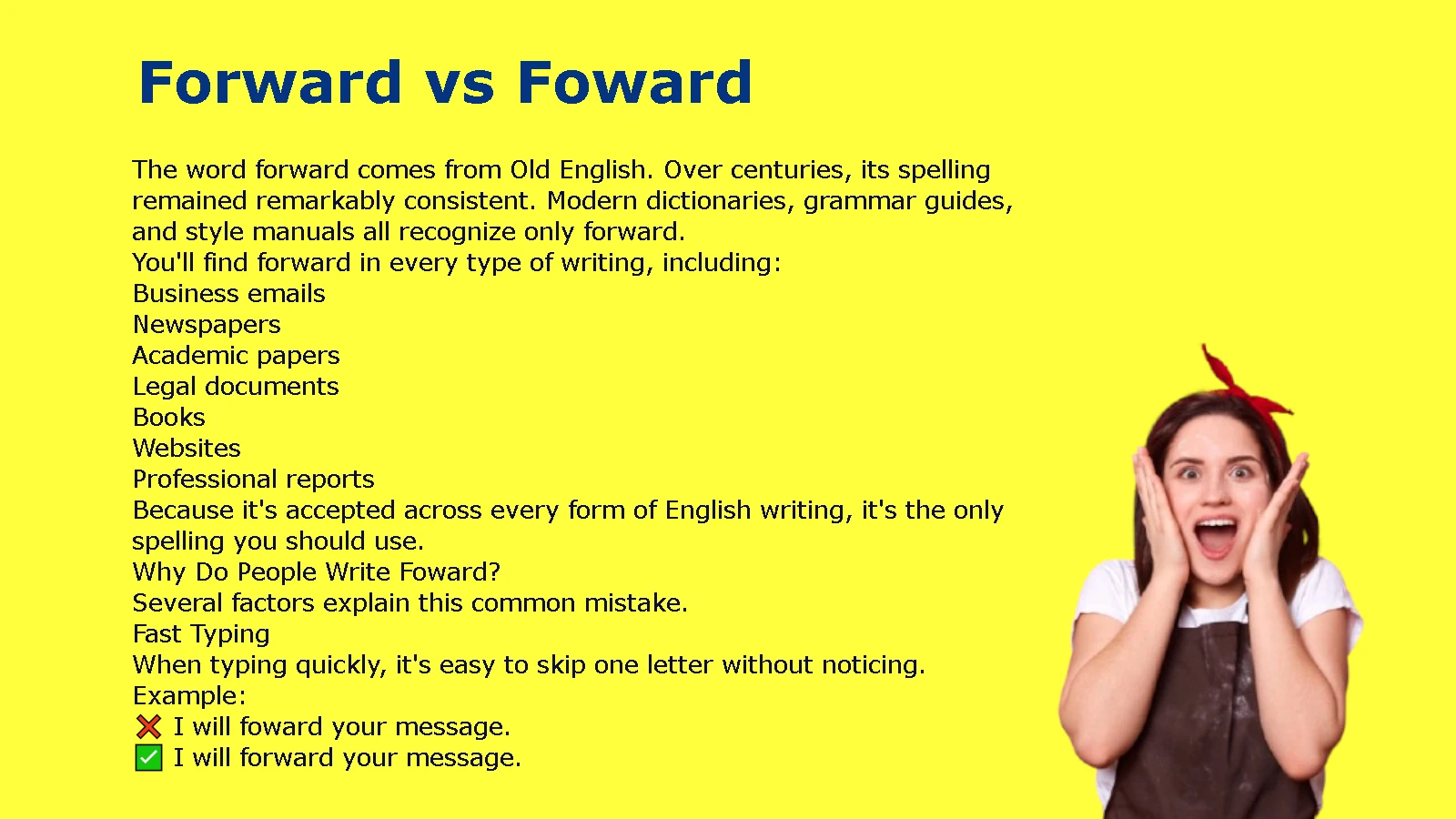
The word forward comes from Old English. Over centuries, its spelling remained remarkably consistent. Modern dictionaries, grammar guides, and style manuals all recognize only forward.
You’ll find forward in every type of writing, including:
- Business emails
- Newspapers
- Academic papers
- Legal documents
- Books
- Websites
- Professional reports
Because it’s accepted across every form of English writing, it’s the only spelling you should use.
Why Do People Write Foward?
Several factors explain this common mistake.
Fast Typing
When typing quickly, it’s easy to skip one letter without noticing.
Example:
❌ I will foward your message.
✅ I will forward your message.
Pronunciation
In everyday conversation, people rarely pronounce every letter clearly.
For example:
“I’ll forward the email.”
When spoken naturally, the first r may sound almost silent, causing writers to omit it.
Muscle Memory
Sometimes your fingers simply move faster than your brain.
Because forward appears so frequently, your keyboard habits can produce foward without you realizing it.
Lack of Proofreading
Many spelling mistakes survive because people don’t reread what they’ve written.
A quick proofread often catches errors like:
- recieve
- seperate
- occured
- foward
What Does Forward Mean?
One reason forward causes confusion is that it serves several grammatical roles. Depending on the sentence, it can function as a noun, verb, adjective, or adverb.
Despite these different uses, the spelling never changes.
Let’s examine each meaning.
Forward as an Adverb
As an adverb, forward describes movement toward the front or ahead.
Examples
- Please step forward.
- She leaned forward to hear better.
- The car rolled forward slowly.
- Everyone moved forward after the doors opened.
- Keep looking forward, not backward.
Notice that forward explains how or where the action happens.
Common Expressions
You’ll frequently hear phrases such as:
- move forward
- look forward
- push forward
- drive forward
- lean forward
- walk forward
Each one uses forward as an adverb describing direction.
Forward as an Adjective
As an adjective, forward describes something positioned in front or relating to future progress.
Examples
- The forward cabin remained empty.
- She’s known for her forward thinking.
- We need a forward strategy.
- The company adopted a forward approach.
- His forward attitude impressed the interview panel.
In business writing, you’ll often encounter phrases like:
- forward planning
- forward vision
- forward strategy
- forward momentum
These expressions emphasize preparation and future growth.
Forward as a Verb
One of the most common modern uses appears in digital communication.
When used as a verb, forward means to send something to another person.
Examples
- I’ll forward your email.
- Please forward the invoice.
- She forwarded the documents yesterday.
- Could you forward this message to HR?
- He forwarded the attachment immediately.
This meaning has become especially common because of email.
For example:
“Please forward this email to everyone on the team.”
The word also appears in messaging apps, customer support systems, and collaboration software.
Common Business Examples
Here are a few sentences you’ll see in workplaces every day.
- I’ll forward your request to the manager.
- Please forward the meeting invitation.
- Can you forward today’s agenda?
- We have already forwarded the contract.
- I’ll forward the tracking information once it arrives.
These examples show why learning the correct spelling matters. Misspelling forward in professional communication can leave a poor impression.
Forward as a Noun
Less commonly, forward functions as a noun.
In sports, a forward is an attacking player responsible for scoring or creating scoring opportunities.
Examples
- The forward scored twice.
- She’s one of the team’s best forwards.
- Every coach wants a reliable forward.
- The center forward controlled the match.
You’ll hear this term regularly in:
- Soccer
- Hockey
- Basketball
- Rugby
- Handball
Although the meaning changes, the spelling remains forward.
Common Meanings of Forward
The table below summarizes each grammatical role.
| Part of Speech | Meaning | Example |
| Adverb | Toward the front | Move forward carefully. |
| Adjective | Positioned ahead or future-focused | A forward-looking company. |
| Verb | Send to another person | Please forward the email. |
| Noun | Attacking sports player | The forward scored the winning goal. |
This versatility explains why forward appears so frequently across different types of writing.
Everyday Expressions That Use Forward
Even if you don’t notice it, you probably use forward several times each day.
Here are some familiar examples.
| Expression | Meaning |
| Looking forward to | Feeling excited about something |
| Move forward | Continue making progress |
| Step forward | Volunteer or come ahead |
| Push forward | Continue despite obstacles |
| Fast forward | Skip ahead in audio or video |
| Bring forward | Move to an earlier time |
| Put forward | Suggest an idea |
| Go forward | Continue progressing |
These expressions appear in conversations, emails, meetings, classrooms, and news articles.
For example:
- I’m looking forward to the weekend.
- Let’s move forward with the proposal.
- She decided to step forward as a volunteer.
- The committee put forward a new policy.
- Can you fast forward to the next chapter?
Because these phrases are so common, using the correct spelling helps your writing look polished and professional.
Why Learning the Correct Spelling Matters
At first glance, missing one letter may not seem like a big deal. However, spelling affects how readers perceive your writing.
Imagine receiving these two emails.
❌ I’ll foward the proposal tomorrow.
✅ I’ll forward the proposal tomorrow.
The second sentence immediately looks more professional. Small spelling errors can distract readers and reduce your credibility, especially in business, education, and formal communication.
That’s why proofreading is worth the extra few seconds. Catching a typo like foward before you hit send can make your writing stronger and more polished.
Is Foward a Real Word?
The short answer is no.
Foward isn’t recognized as a standard English word by major dictionaries. If you search for it, you’ll usually find one of two results:
- A suggestion to use forward instead.
- Examples taken from websites or social media where someone accidentally misspelled the word.
In other words, foward exists because people make typing mistakes—not because it’s an accepted spelling.
Why Does Foward Appear Online?
You might wonder why search engines return results for foward if it’s incorrect.
There are a few simple reasons.
Typing Errors
Millions of people type quickly every day. Missing the first r is easy, especially on a keyboard.
For example:
- I’ll foward your message.
- Please foward the email.
- Can you foward the document?
Each sentence contains the same spelling mistake.
Search Engine Queries
Search engines don’t ignore misspellings. Instead, they often show results that correct them.
That’s why you’ll frequently see messages like:
Did you mean: forward?
This feature helps users find the information they intended to search for.
Copy-and-Paste Mistakes
Once a typo appears online, other people sometimes copy it without noticing. Over time, the incorrect spelling spreads across blogs, forums, and social media posts.
That doesn’t make it correct. It simply means the mistake has been repeated.
Forward Definition and Pronunciation
Understanding how a word sounds can help you remember how to spell it.
Definition
Forward generally means toward the front, ahead, onward, or to send something to another person. The exact meaning depends on how the word is used in a sentence.
Pronunciation
Forward is commonly pronounced as:
FOR-werd
Although the first r may sound subtle in fast speech, it is still part of the correct spelling.
Syllable Breakdown
for-ward
Many people accidentally hear it as:
fo-ward
That small difference explains why foward is such a common typo.
Forward vs. Foward: Side-by-Side Comparison
A quick comparison makes the difference easy to remember.
| Feature | Forward | Foward |
| Correct spelling | ✅ Yes | ❌ No |
| Found in dictionaries | Yes | No |
| Used in professional writing | Yes | No |
| Accepted in school assignments | Yes | No |
| Suitable for emails | Yes | No |
| Standard English | Yes | No |
The comparison couldn’t be simpler. Whenever you’re choosing between forward vs. foward, forward wins every time.
Common Phrases That Use Forward
Because forward has several meanings, it appears in dozens of everyday expressions. Learning these phrases helps you recognize the correct spelling more quickly.
Looking Forward To
This phrase expresses excitement about something in the future.
Examples:
- I’m looking forward to our vacation.
- She’s looking forward to meeting the new team.
- We’re looking forward to hearing from you.
Move Forward
This phrase means to continue making progress.
Examples:
- Let’s move forward with the project.
- The company decided to move forward despite the delays.
- It’s time to move forward after the discussion.
Bring Forward
This expression means to move something to an earlier date or time.
Examples:
- We decided to bring forward the meeting.
- The court brought forward the hearing.
- Can we bring forward the deadline?
Put Forward
This phrase means to suggest or present an idea.
Examples:
- She put forward an interesting proposal.
- Several employees put forward new ideas.
- The committee put forward a recommendation.
Step Forward
People use this phrase when someone volunteers or comes forward to help.
Examples:
- One witness stepped forward.
- Several volunteers stepped forward after the announcement.
- Thank you for stepping forward to lead the project.
Fast Forward
You’ll often hear this phrase when talking about videos, movies, or recordings.
Examples:
- Please fast forward five minutes.
- He accidentally fast forwarded the interview.
- I had to fast forward through the advertisements.
Forward Thinking
This expression describes someone who plans for the future.
Examples:
- She’s a forward-thinking entrepreneur.
- The organization values forward-thinking leadership.
- Their forward-thinking policies improved productivity.
Forward Slash
In computing, the forward slash ( / ) appears in URLs, programming languages, and file paths.
Examples:
- Type a forward slash after the domain.
- The website address contains a forward slash.
- Don’t confuse a forward slash with a backslash.
Examples of Forward in Sentences
Seeing real examples makes grammar much easier to understand.
Everyday Conversation
- Please walk forward slowly.
- He leaned forward to whisper.
- Don’t look back. Keep moving forward.
- She stepped forward with confidence.
- We pushed forward despite the rain.
- Everyone moved forward together.
- I can’t wait to move forward.
- Please come forward if you recognize this item.
- They continued forward without stopping.
- Looking forward always feels more hopeful than looking back.
Business Examples
Professional writing uses forward constantly.
Examples include:
- I’ll forward your resume today.
- Please forward the signed agreement.
- The manager forwarded your feedback.
- Could you forward the invoice?
- We’ll move forward after approval.
- HR will forward the onboarding documents.
- Please forward this email to your department.
- The proposal has been forwarded to the client.
- We plan to move forward next week.
- Thank you for forwarding the information.
Academic Examples
Students also encounter forward in essays and classroom discussions.
Examples:
- The research moves forward existing theories.
- Scientists continue to move forward with new discoveries.
- The professor put forward an interesting argument.
- Education continues to move forward through innovation.
- New evidence helped the discussion move forward.
Grammar Rule: Why Forward Is Correct
Unlike some English words that have multiple accepted spellings, forward has only one standard form.
There’s no grammatical situation where foward becomes correct.
The Missing Letter Matters
Notice the spelling carefully.
Correct:
F O R W A R D
Incorrect:
F O W A R D
One missing r completely changes the spelling.
Similar Words Follow Consistent Patterns
Many English words keep their historical spelling, even when pronunciation changes slightly.
Examples include:
| Correct Word | Common Misspelling |
| Forward | Foward |
| Tomorrow | Tommorow |
| Separate | Seperate |
| Receive | Recieve |
| Beginning | Begining |
These mistakes happen often because English spelling doesn’t always match pronunciation perfectly.
Easy Trick to Remember the Correct Spelling
Simple memory tricks can prevent future mistakes.
Think of the Word “For”
The word forward begins with for.
- FOR + WARD
- FORward
If you remember the word for, you’ll naturally include the missing r.
Remember the Phrase
Think about this sentence:
Move FORward, never backward.
Both words contain the r, making them easier to remember together.
Picture an Arrow
Imagine an arrow pointing forward.
Now imagine writing the word beneath it.
The visual connection helps reinforce the correct spelling every time you type it.
Common Mistakes to Avoid
Even experienced writers occasionally make spelling mistakes. Fortunately, they’re easy to fix once you know what to watch for.
Dropping the First R
This is by far the most common error.
❌ foward
✅ forward
Relying Only on Pronunciation
English contains many words that aren’t spelled exactly the way they sound.
Don’t spell forward based only on pronunciation.
Ignoring Spell Check
Modern word processors usually underline foward immediately.
Instead of ignoring the warning, correct it before sending your document.
Copying Incorrect Online Examples
Not everything you read online follows standard English.
Always verify unfamiliar spellings with a trusted dictionary rather than assuming they’re correct.
Quick Recap
Before moving on, here’s what you’ve learned:
- Forward is the only correct spelling.
- Foward is a common typo.
- Forward works as a noun, verb, adjective, and adverb.
- It appears in everyday phrases like looking forward to, move forward, and put forward.
- The first r should never be omitted.
- A simple memory trick—FOR + ward—can help you avoid the mistake.
Words Commonly Confused with Forward
English has plenty of words that look or sound similar. Forward is no exception. While foward is simply a misspelling, several other words cause genuine confusion because they’re real words with different meanings.
Understanding these differences will help you write more confidently.
| Word | Meaning | Example |
| Forward | Toward the front, ahead, or to send something | Please forward the email. |
| Foreword | An introduction at the beginning of a book | I enjoyed the author’s foreword. |
| Toward | In the direction of something | She walked toward the door. |
| Backward | Toward the rear or behind | He took a backward step. |
| Onward | Continuing ahead or progressing | The team moved onward after the victory. |
Forward vs. Foreword
These two words sound exactly alike, but they have completely different meanings.
Forward relates to movement, progress, or sending something.
Foreword refers to the introductory section of a book, usually written by the author or a guest contributor.
Examples
- I’ll forward the presentation this afternoon.
- The famous scientist wrote the foreword for the textbook.
Although they share the same pronunciation, their meanings aren’t connected.
Forward vs. Toward
These words often appear together because both describe direction.
Forward focuses on movement ahead.
Toward shows the direction of movement.
Examples
- Keep moving forward.
- She walked toward the entrance.
Forward vs. Backward
These words are natural opposites.
| Forward | Backward |
| Ahead | Behind |
| Progress | Reverse |
| Future-focused | Returning or retreating |
Examples
- The business continued to move forward.
- The vehicle rolled backward on the hill.
British vs. American English
Many English words have different spellings depending on the country. For example:
- color / colour
- organize / organise
- center / centre
Fortunately, forward isn’t one of them.
Both American English and British English use the same spelling:
Forward ✅
Neither variety accepts foward.
Whether you’re writing for readers in the United States, Canada, the United Kingdom, Australia, or New Zealand, the correct spelling remains exactly the same.
Why Is Forward Such a Common Misspelling?
If forward has only one correct spelling, why do so many people write foward?
The answer lies in how our brains process language.
Your Brain Predicts Words
When you read or type familiar words, your brain doesn’t analyze every single letter. Instead, it recognizes patterns.
That’s why small mistakes often slip by unnoticed.
For example, many people instantly recognize these words even though they’re incorrect:
- recieve
- definately
- seperately
- tommorow
- foward
Your brain fills in the missing information automatically.
Fast Typing Increases Errors
Most people type much faster than they write by hand.
The quicker you type, the easier it becomes to skip letters without realizing it.
Fortunately, modern spell checkers catch most of these mistakes before you send your message.
Pronunciation Can Be Misleading
English spelling isn’t perfectly phonetic.
For instance, people commonly pronounce forward as:
FOR-werd
Because the first r isn’t strongly emphasized, some writers mistakenly omit it.
The pronunciation hasn’t changed the spelling, though. Forward has always kept both r letters.
Tips to Avoid Spelling Forward Incorrectly
Good spelling becomes easier when you build simple habits.
Proofread Before You Send
Take a few seconds to reread emails, reports, or assignments.
A quick review catches many common mistakes before someone else notices them.
Use Spell Check
Most browsers, word processors, and email apps highlight foward immediately.
Don’t ignore the red underline. It’s there for a reason.
Read More
Regular reading naturally improves spelling.
When you repeatedly see forward written correctly, your brain begins to recognize it automatically.
Learn Word Patterns
Many English words keep consistent spelling patterns.
Examples include:
- forward
- afterward
- backward
- onward
Recognizing these patterns makes similar words easier to remember.
Common Mistakes Related to Forward
Here are a few mistakes people make besides writing foward.
Using the Wrong Homophone
❌ The foreword the email.
✅ Forward the email.
Confusing Movement with Direction
❌ Walk forward the building.
✅ Walk toward the building.
Forgetting the Second Meaning
Many learners only know forward as a direction.
Remember that it also means to send something, especially in emails.
Example:
- Please forward today’s meeting notes.
Frequently Asked Questions
Is Foward Ever Correct?
No.
Foward isn’t accepted in standard English. It’s simply a misspelling of forward.
Why Do People Spell Forward as Foward?
Most writers accidentally drop the first r because of fast typing or pronunciation.
Is Forward One Word?
Yes.
Forward is always written as a single word.
Examples:
- move forward
- forward thinking
- forward email
Can Forward Be Used as a Verb?
Absolutely.
As a verb, forward means to send something to another person.
Example:
Please forward this message to the finance department.
Is Looking Forward To Grammatically Correct?
Yes.
Looking forward to is a standard English expression.
Examples:
- I’m looking forward to your reply.
- We’re looking forward to working with you.
Remember that to is part of the preposition in this phrase, so it’s followed by a noun or a gerund.
Correct:
- Looking forward to meeting you.
Incorrect:
- Looking forward to meet you.
Why Doesn’t Foward Appear in Dictionaries?
Because dictionaries include accepted words, not common spelling mistakes.
Since foward isn’t recognized as a legitimate English word, reputable dictionaries list only forward.
Quick Reference: Forward vs. Foward
If you need a fast reminder, use this table.
| Question | Answer |
| Which spelling is correct? | Forward |
| Is foward a real word? | No |
| Can forward be a verb? | Yes |
| Can forward be a noun? | Yes |
| Can forward be an adjective? | Yes |
| Can forward be an adverb? | Yes |
| Should you ever write foward? | No |
Final Verdict: Forward vs. Foward
The difference between forward and foward is straightforward.
Forward is the correct spelling in every context. You can use it as a noun, verb, adjective, or adverb, and you’ll find it in everything from business emails to sports commentary.
Foward, on the other hand, isn’t a standard English word. It appears because people accidentally leave out the first r while typing or rely too heavily on pronunciation.
Whenever you pause and wonder which spelling to choose, remember one simple rule:
If you’re deciding between forward vs. foward, always choose forward.
Conclusion
Spelling mistakes happen to everyone. The important part is recognizing them before they become habits.
Now that you understand forward vs. foward, you’ll know exactly which spelling belongs in your writing. Whether you’re sending an email, writing an essay, updating a report, or posting online, forward is always the right choice.
A single missing letter might seem insignificant, yet correct spelling strengthens your credibility and makes your writing easier to read. Keep this rule in mind, proofread your work, and you’ll never have to second-guess forward again.