Me is the correct object pronoun in most sentences, while myself is a reflexive pronoun used when the subject and object are the same person or for emphasis. Knowing the difference helps you avoid common grammar mistakes. When comparing myself vs. me, choose the word that fits the sentence’s grammar and meaning.
The confusion usually happens because “myself” is often used where “me” should be, making sentences sound unnatural or grammatically incorrect. But here’s the kicker: using the wrong pronoun can make your writing appear less polished and may even change the tone of your message.
In this guide, you’ll learn the difference between Myself vs Me, discover when to use myself, when to use me, and understand the correct usage of myself and me with clear explanations and real-life examples. You’ll also see myself vs me examples, common grammar mistakes to avoid, and easy memory tips to help you choose the right word every time.
By the end, you’ll know exactly which pronoun fits each situation and feel confident using myself and me correctly in both speaking and writing.
Myself vs Me: The Short Answer
If you’re looking for a quick answer, here’s the rule:
- Use me when you need an object pronoun.
- Use myself when the action comes back to the subject “I” or when you want to add emphasis.
Here’s a simple comparison.
| Situation | Correct Word | Example |
| Object of a verb | Me | She called me yesterday. |
| Object of a preposition | Me | He spoke to me after class. |
| Reflexive action | Myself | I blamed myself for the mistake. |
| Adding emphasis | Myself | I painted the room myself. |
Quick Rule to Remember
Think of it this way:
- If someone else does something to you, use me.
- If you do something to yourself, use myself.
For example:
- She helped me. ✅
- I helped myself. ✅
Those two sentences follow different grammar rules even though they both involve the same person.
What Does “Me” Mean?
The word me is an object pronoun. It receives the action of the verb or follows a preposition.
Simply put, me tells us who receives an action.
Look at this sentence:
Emma called me.
Emma performs the action. Me receives it.
That’s why me is called an object pronoun.
When to Use “Me”
You’ll use me in three common situations.
After Action Verbs
Whenever someone or something acts upon you, use me.
Examples:
- She invited me to dinner.
- They thanked me for volunteering.
- My teacher praised me for the project.
- The coach selected me for the team.
- Everyone recognized me at the event.
Notice that me always receives the action.
After Prepositions
Prepositions include words like:
- to
- with
- for
- between
- beside
- near
- about
- after
- before
- from
Whenever your pronoun follows one of these words, me is usually correct.
Examples:
- The gift is for me.
- Sit beside me.
- She agreed with me.
- Keep this between you and me.
- Everyone waited for me.
These examples sound natural because me functions as the object of the preposition.
In Compound Objects
Many people become confused when another person’s name appears in the sentence.
For example:
Sarah invited Jake and me.
Because another name appears before the pronoun, some writers mistakenly choose myself.
The easiest way to check is to remove the other person.
Original:
Sarah invited Jake and me.
Remove Jake.
Sarah invited me.
The sentence still works perfectly.
Now try myself.
Sarah invited myself.
That sounds incorrect because myself isn’t functioning as a reflexive pronoun.
Examples of “Me” in Everyday English
You’ll hear me in conversations all day long.
Work
- My supervisor asked me to join the meeting.
- Please send the invoice to me.
- They copied me on the email.
School
- My teacher congratulated me.
- The principal called me into the office.
Home
- Mom reminded me to lock the door.
- My brother surprised me with tickets.
While Traveling
- The airline upgraded me to first class.
- The hotel welcomed me warmly.
Every one of these examples follows the same principle:
Someone else performs the action. You receive it.
What Does “Myself” Mean?
Unlike me, myself belongs to a special group called reflexive pronouns.
Reflexive pronouns refer back to the subject of the sentence.
Here’s the list:
| Subject Pronoun | Reflexive Pronoun |
| I | myself |
| You | yourself |
| He | himself |
| She | herself |
| It | itself |
| We | ourselves |
| They | themselves |
Notice that every reflexive pronoun points back to the person or thing performing the action.
When to Use “Myself”
There are two correct uses.
Reflexive Use
A reflexive pronoun appears when the subject and object are the same person.
Examples:
- I introduced myself.
- I blamed myself.
- I reminded myself to stay calm.
- I taught myself how to cook.
- I challenged myself to improve.
The action begins with I and returns to the same person.
That’s exactly what reflexive means.
Intensive Use
Sometimes myself simply adds emphasis.
Removing it doesn’t change the sentence’s basic meaning.
Example:
I baked the cake.
Now add emphasis.
I baked the cake myself.
The sentence now stresses that nobody else helped.
Here are more examples:
- I built the bookshelf myself.
- I fixed the computer myself.
- I wrote the report myself.
- I cleaned the garage myself.
The word myself adds emphasis but isn’t required for the sentence to make sense.
Examples of Correct Reflexive Usage
These examples all follow the same rule.
| Sentence | Correct? | Reason |
| I cut myself while cooking. | ✅ | Subject and object are the same person. |
| I introduced myself. | ✅ | Action comes back to the speaker. |
| I prepared myself for the interview. | ✅ | Reflexive action. |
| I enjoyed myself at the concert. | ✅ | Common reflexive expression. |
| I blamed myself. | ✅ | Subject acts upon itself. |
Myself vs Me: Side-by-Side Comparison
The easiest way to understand the difference is to compare both pronouns directly.
| Feature | Me | Myself |
| Pronoun Type | Object pronoun | Reflexive pronoun |
| Used after most verbs | ✅ | Only if the subject is “I” |
| Used after prepositions | ✅ | Only when reflexive |
| Adds emphasis | ❌ | ✅ |
| Refers back to the subject | ❌ | ✅ |
| Used in everyday conversation | Very common | Less common |
| Often misused in business writing | Rarely | Frequently |
This comparison highlights an important point.
Many people replace me with myself because they think it sounds more educated. In reality, doing so often creates a grammatical error.
The Grammar Rule You Should Always Remember
Here’s the rule professional editors follow.
A reflexive pronoun must refer back to an earlier subject.
Look at this sentence.
I congratulated myself.
Subject:
I
Object:
Myself
The action returns to the same person.
Now compare it with this sentence.
Sarah congratulated myself.
This sentence doesn’t work.
Why?
Because myself has no subject (I) to refer back to.
The correct sentence is:
Sarah congratulated me.
That one follows standard English grammar.
Visual Sentence Diagram
Using Me
Subject → Verb → Object
Sarah → thanked → me
The action moves from Sarah to another person.
Using Myself
Subject → Verb → Reflexive Object
I → thanked → myself
The action starts and ends with the same person.
That simple difference explains nearly every case of myself vs me.
Why People Say “Myself” Instead of “Me”
If me is usually correct, why do so many people choose myself?
The answer has more to do with psychology than grammar.
People often believe myself sounds:
- More professional
- More respectful
- More formal
- More intelligent
As a result, they substitute myself even when grammar says otherwise.
This habit appears frequently in offices, customer service, meetings, and corporate emails.
For example:
Please contact James or myself.
Many people assume this sounds polished.
However, standard grammar says:
Please contact James or me.
The second sentence is both simpler and correct.
Hypercorrection: A Common Grammar Trap
Linguists call this mistake hypercorrection.
Hypercorrection happens when someone over-applies a grammar rule in an attempt to sound more educated.
For instance, many people learn that:
Me and Sarah went to lunch.
is incorrect.
The correct sentence is:
Sarah and I went to lunch.
Later, they begin avoiding me almost entirely.
Eventually, they write:
Please email Sarah or myself.
Ironically, they’ve created another grammar mistake.
Hypercorrection explains why incorrect uses of myself appear in business emails, advertisements, presentations, and even official documents.
A Real-World Workplace Example
Imagine you’re reading this email:
If you have any questions, please contact David or myself.
It sounds professional at first glance.
Now apply the simple removal test.
Remove David.
Please contact myself.
The sentence immediately sounds unnatural.
Now replace it with me.
Please contact me.
That’s the correct version.
Professional editors use this test every day because it’s fast and reliable.
Why This Mistake Keeps Spreading
Language changes over time, but some errors spread simply because people hear them often.
Business communication has helped popularize incorrect uses of myself.
People copy phrases from coworkers, managers, and email templates without checking the grammar. Over time, those patterns become familiar even though they’re still incorrect in standard English.
The good news is that once you understand the role of me and myself, you’ll spot these mistakes almost instantly and write with greater confidence.
Common Mistakes With Myself
Many grammar mistakes happen because people choose myself when they really need me. The sentence may sound formal, but grammar depends on function, not style.
Let’s look at some of the most common errors.
| Incorrect | Correct | Why? |
| Please contact John or myself. | Please contact John or me. | Me is the object of the verb. |
| The report was sent to myself. | The report was sent to me. | Me follows the preposition to. |
| Sarah and myself attended the meeting. | Sarah and I attended the meeting. | The pronoun is part of the subject. |
| The manager thanked David and myself. | The manager thanked David and me. | Me receives the action. |
| Between you and myself. | Between you and me. | Me follows a preposition. |
The pattern becomes clear once you recognize the job each pronoun performs.
Can Myself Replace Me?
In almost every case, the answer is no.
Some people think myself is simply a more polite version of me. English grammar doesn’t work that way.
Consider these examples.
❌ She called myself.
✅ She called me.
❌ Please email myself.
✅ Please email me.
❌ The package arrived for myself.
✅ The package arrived for me.
The word myself isn’t an upgraded version of me. It serves a completely different grammatical purpose.
Why This Matters
Using the wrong pronoun can distract readers, especially in professional writing.
Imagine reading this sentence in a job application:
Please contact myself with any questions.
A hiring manager may notice the mistake immediately. While one grammar error won’t always determine the outcome, writing correctly helps create a stronger impression.
When Myself Is Correct
Although myself is often overused, it is perfectly correct in the right context.
There are two main situations where you should use it.
Reflexive Use
A reflexive pronoun refers back to the subject.
The person performing the action also receives it.
Examples:
- I blamed myself for missing the deadline.
- I introduced myself before the presentation.
- I reminded myself to stay focused.
- I asked myself an important question.
- I prepared myself for the interview.
- I encouraged myself to keep going.
Each sentence follows the same structure.
Subject: I
Object: Myself
The action comes full circle.
Intensive Use
Sometimes myself simply emphasizes that you alone performed the action.
Examples:
- I built the deck myself.
- I repaired the bicycle myself.
- I designed the website myself.
- I cooked dinner myself.
- I finished the project myself.
Notice what happens if you remove myself.
I built the deck.
The sentence still makes sense.
Adding myself simply stresses that nobody else helped.
Reflexive vs Intensive
| Sentence | Type |
| I hurt myself. | Reflexive |
| I introduced myself. | Reflexive |
| I prepared myself. | Reflexive |
| I wrote the article myself. | Intensive |
| I cleaned the house myself. | Intensive |
| I solved the problem myself. | Intensive |
Understanding this distinction makes choosing the correct pronoun much easier.
When Me Is Always Correct
Many grammar guides spend so much time explaining reflexive pronouns that they overlook a simple fact.
Most of the time, you’ll use me.
Here are the situations where me is almost always the correct choice.
After Action Verbs
Examples:
- She invited me.
- They congratulated me.
- My friend called me.
- The teacher praised me.
- The customer thanked me.
The action moves toward you.
After Prepositions
Examples:
- Come with me.
- Sit beside me.
- The letter is for me.
- Keep this between you and me.
- Everyone agreed with me.
Whenever a preposition appears, me usually follows.
During Everyday Conversation
Native English speakers naturally use me dozens of times every day.
Examples:
- Can you help me?
- Wait for me.
- Tell me the story.
- Nobody told me.
- They invited me yesterday.
Because these phrases appear so often, they become second nature.
Understanding Other Reflexive Pronouns
Once you understand myself, the rest of the reflexive pronouns follow the same pattern.
| Subject | Reflexive Pronoun | Example |
| I | Myself | I taught myself. |
| You | Yourself | You hurt yourself. |
| He | Himself | He blamed himself. |
| She | Herself | She introduced herself. |
| It | Itself | The machine shut itself off. |
| We | Ourselves | We enjoyed ourselves. |
| They | Themselves | They prepared themselves. |
Every reflexive pronoun points back to its subject.
If the sentence doesn’t have the matching subject, the reflexive pronoun usually doesn’t belong there.
Everyday Examples of Myself vs Me
Seeing the grammar in real situations makes it much easier to remember.
Workplace
Correct:
- Please send the contract to me.
- My supervisor promoted me.
- I completed the proposal myself.
- I introduced myself to the new clients.
Incorrect:
- Please send the contract to myself.
School
Correct:
- My teacher called me after class.
- I challenged myself to study every day.
- My classmates helped me.
- I taught myself basic coding.
Friends and Family
Correct:
- My cousin surprised me.
- I bought the gift myself.
- Everyone waited for me.
- I reminded myself to call Grandma.
Customer Service
Correct:
- The representative assisted me.
- Please contact me if you need help.
- I solved the issue myself before calling support.
Social Media
Correct:
- My followers tagged me.
- I edited the video myself.
- Everyone messaged me after the announcement.
These examples reflect the kinds of sentences you’ll encounter every day.
Formal vs Informal Usage
Some writers believe myself sounds more professional.
It doesn’t.
The grammar rules remain the same regardless of the setting.
Whether you’re writing:
- a business email,
- a college essay,
- a legal document,
- a blog post,
- or a text message,
you should still choose the pronoun based on its grammatical role.
Formal Example
❌ Please direct all inquiries to Jane or myself.
✅ Please direct all inquiries to Jane or me.
Informal Example
❌ Can you send the pictures to myself?
✅ Can you send the pictures to me?
The second version is correct in both situations.
Myself vs Me in Email Writing
Business emails are one of the biggest sources of confusion.
Many professionals unintentionally replace me with myself because they think it sounds courteous.
Let’s correct some common examples.
| Incorrect Email | Correct Email |
| Please contact John or myself. | Please contact John or me. |
| Feel free to email myself. | Feel free to email me. |
| The invoice was sent to myself. | The invoice was sent to me. |
| Contact Sarah or myself if you have questions. | Contact Sarah or me if you have questions. |
These corrections make your writing both simpler and grammatically accurate.
Mini Case Study: A Workplace Email
Imagine two employees sending similar messages.
Employee A
If you require additional information, please contact myself.
Employee B
If you require additional information, please contact me.
Both writers are polite.
However, Employee B uses standard English grammar.
Small improvements like this make professional communication clearer and easier to read.
Tricky Sentences That Confuse Almost Everyone
Some expressions cause confusion because they combine multiple grammar rules.
Let’s break them down.
Between You and Me
✅ Between you and me.
The word between is a preposition.
Prepositions take object pronouns.
She Invited Tom and Me
Correct:
She invited Tom and me.
Remove Tom.
She invited me.
The sentence still works.
He Thanked My Wife and Me
Correct:
He thanked my wife and me.
Again, remove the other person.
He thanked me.
Perfect.
I Introduced Myself
Correct:
I introduced myself.
The action comes back to the speaker.
I Completed the Work Myself
Correct:
I completed the work myself.
Here, myself emphasizes that nobody else completed it.
A Simple Test You Can Use Every Time
Whenever you’re unsure which pronoun to choose, try this quick test.
Step 1
Remove the other person’s name.
Original:
Please call Sarah or me.
Becomes:
Please call me.
Correct.
Original:
Please call Sarah or myself.
Becomes:
Please call myself.
That sounds wrong immediately.
Step 2
Ask yourself one question.
Does the action return to “I”?
If yes, myself may be correct.
If no, use me.
This simple method works in almost every situation.
An Easy Memory Trick
Here’s a quick way to remember the difference.
If someone else does something to you, use me. If you do something to yourself, use myself.
Think of myself as a mirror.
The action reflects back to the same person.
If there’s no reflection, me is probably the correct choice.
Quick Practice Quiz
Choose the correct word to complete each sentence.
- Sarah invited John and ______ to dinner.
- I introduced ______ before the meeting.
- Please send the package to ______.
- I repaired the computer ______.
- Between you and ______, the movie was disappointing.
- My coach congratulated ______ after the game.
- I challenged ______ to finish the marathon.
- The teacher asked Jake and ______ to stay after class.
- I completed the assignment ______.
- Everyone waited for ______ before starting.
Answers
- me
- myself
- me
- myself
- me
- me
- myself
- me
- myself
- me
Frequently Asked Questions About Myself vs Me
Is myself more formal than me?
No. Many people believe myself sounds more professional or polite, but that’s a common misconception.
Grammar determines which pronoun you should use, not the level of formality.
For example:
- ✅ Please contact me if you have questions.
- ❌ Please contact myself if you have questions.
Even in business writing, me is the correct choice because it functions as the object of the verb.
Why do people say “John and myself”?
Most people aren’t intentionally breaking a grammar rule. Instead, they’re trying to sound formal.
This is a classic example of hypercorrection. Writers know that phrases like “Me and John went to lunch” are incorrect, so they begin avoiding me altogether. Eventually, they replace it with myself, even when grammar doesn’t support that choice.
The correct sentence depends on its role.
As the subject:
- ✅ John and I attended the meeting.
As the object:
- ✅ The manager thanked John and me.
Is “between you and myself” correct?
No.
The word between is a preposition, and prepositions take object pronouns.
Correct:
- ✅ Between you and me
Incorrect:
- ❌ Between you and myself
A good test is to remove between you and.
You wouldn’t say:
- ❌ Myself.
You would naturally say:
- ✅ Me.
Can myself ever be an object pronoun?
No.
Myself is a reflexive pronoun, not an object pronoun.
Use myself only when:
- The subject and object are the same person.
- You want to add emphasis.
Examples:
- I blamed myself.
- I completed the project myself.
If someone else performs the action, use me instead.
Why is myself common in business emails?
Many professionals associate longer or more formal-sounding words with better writing.
For example, you may see:
Please contact Sarah or myself.
Although this sentence appears frequently, it’s still grammatically incorrect.
Professional writing values clarity, accuracy, and simplicity more than unnecessary formality.
The correct version is:
Please contact Sarah or me.
Is “me and John” ever correct?
Yes—but not as the subject of a sentence.
As a subject:
- ❌ Me and John went shopping.
- ✅ John and I went shopping.
As an object:
- The coach congratulated John and me.
- The invitation was addressed to John and me.
The pronoun changes because its grammatical role changes.
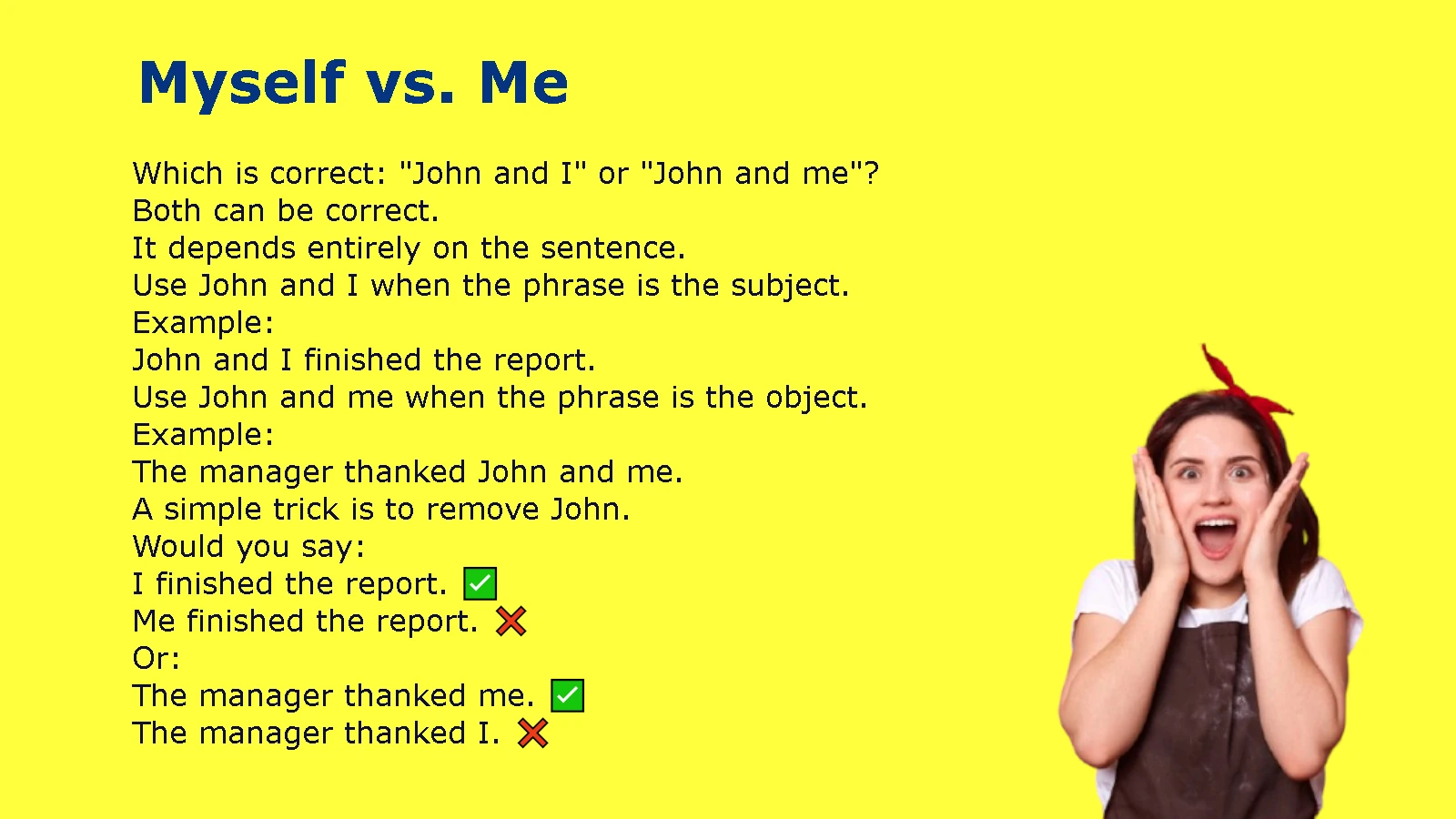
Which is correct: “John and I” or “John and me”?
Both can be correct.
It depends entirely on the sentence.
Use John and I when the phrase is the subject.
Example:
- John and I finished the report.
Use John and me when the phrase is the object.
Example:
- The manager thanked John and me.
A simple trick is to remove John.
Would you say:
- I finished the report. ✅
- Me finished the report. ❌
Or:
- The manager thanked me. ✅
- The manager thanked I. ❌
The answer becomes obvious.
Is “myself” always wrong after a preposition?
Not always.
Most of the time, me follows a preposition.
However, myself is correct if the sentence is genuinely reflexive.
For example:
- I kept the secret to myself.
- I talked to myself while practicing my speech.
In both cases, the action refers back to the subject I, so the reflexive pronoun is appropriate.
Can I use myself for emphasis?
Absolutely.
This is one of its two correct grammatical uses.
Examples:
- I wrote the entire proposal myself.
- I assembled the furniture myself.
- I solved the puzzle myself.
If removing myself leaves the sentence grammatically correct, then it’s acting as an intensive pronoun that adds emphasis.
Key Takeaways: Myself vs Me
Here’s a quick summary you can remember whenever you’re unsure which pronoun to use.
| Rule | Example |
| Use me as the object of a verb. | She called me. |
| Use me after a preposition. | Sit next to me. |
| Use myself when the action comes back to I. | I blamed myself. |
| Use myself for emphasis. | I completed it myself. |
| Don’t replace me with myself just to sound formal. | Contact John or me. |
Remember These Simple Rules
- Me receives an action.
- Myself reflects an action back to the speaker.
- Myself can also emphasize that you did something without help.
- Formal writing follows the same grammar rules as casual conversation.
- If removing another person’s name leaves myself sounding awkward, me is almost certainly the correct choice.
Common Grammar Patterns to Remember
The table below highlights some of the most common situations you’ll encounter.
| Sentence Pattern | Correct Choice | Example |
| Someone does something to you | Me | They invited me. |
| You do something to yourself | Myself | I introduced myself. |
| After a preposition | Me | The package is for me. |
| Adding emphasis | Myself | I built it myself. |
| Compound object | Me | She thanked David and me. |
| Compound subject | I | David and I arrived early. |
Learning these patterns is more useful than memorizing dozens of isolated examples because you’ll recognize the grammar behind every sentence.
Common Myths About Myself vs Me
Let’s clear up a few myths that continue to circulate.
Myth: Myself is always more polite.
Reality: Politeness doesn’t determine grammar. Use the pronoun that fits the sentence.
Myth: Me sounds too casual for business writing.
Reality: Professional editors prefer clear, grammatically correct language. In many cases, me is the right choice.
Myth: You should avoid me whenever another person’s name appears.
Reality: Remove the other person’s name and test the sentence. This simple trick almost always reveals the correct pronoun.
Myth: Myself can replace me whenever you want.
Reality: Reflexive pronouns have specific grammatical functions. They aren’t interchangeable with object pronouns.
A Quote Worth Remembering
“Good grammar isn’t about sounding smarter. It’s about making your meaning clear.”
That idea perfectly captures the difference between myself and me.
Choosing the correct pronoun helps your writing sound natural, confident, and easy to understand.
Conclusion
The difference between myself vs me becomes simple once you focus on grammar instead of formality.
Use me whenever you’re the object of a verb or preposition. It’s the correct choice in most everyday conversations, emails, essays, and professional documents.
Use myself only when the action returns to the subject I or when you want to emphasize that you completed an action without anyone else’s help.
Whenever you’re uncertain, try the removal test. Take the other person’s name out of the sentence and read it again. If myself sounds awkward, me is almost certainly the correct answer.
Mastering this small distinction will make your writing clearer, more polished, and grammatically accurate. More importantly, you’ll avoid one of the most common pronoun mistakes in modern English and communicate with greater confidence in every situation.