Feed is the base form of the verb meaning to give food or supply something, while fed is its past tense and past participle. Knowing the difference helps you use the correct verb form in speaking and writing. When comparing Fed vs Feed, use feed for the present tense and fed for the past tense.
Choosing between fed and feed seems simple until you have to write a sentence. Should you say, “I feed the dog yesterday” or “I fed the dog yesterday”? What about “have fed” and “have feed”? These small differences cause big grammar mistakes for students, writers, and even native English speakers.
The confusion often comes from knowing when to use fed, when to use feed, or understanding the difference between the past tense of feed and its present form. But here’s the kicker: using the wrong word can change the meaning of your sentence and make your writing seem less accurate.
The good news? It’s an easy distinction once you know the rule.
In this guide, you’ll learn the difference between Fed vs Feed, explore the meaning of fed and feed, discover fed vs feed examples, and understand how to use fed and feed in a sentence. You’ll also find simple grammar tips and memory tricks to help you choose the correct word with confidence every time.
By the end, you’ll never have to second-guess whether to write fed or feed again
Feed vs. Fed: The Quick Answer
If you’re wondering about feed vs. fed, here’s the simplest explanation:
- Feed is the base form of the verb. You use it for the present tense, future tense, commands, and after modal verbs such as can, should, and will.
- Fed is the simple past tense and past participle of feed. You use it to describe actions that already happened or after helping verbs such as has, have, and had.
Examples
- I feed my fish every morning.
- I fed my fish before leaving home.
- She has fed the baby.
- Please feed the cat while I’m away.
A simple way to remember the difference is this:
Feed = present or future
Fed = past
Feed vs. Fed at a Glance
| Word | Part of Speech | Verb Form | Time | Example |
| Feed | Verb | Base form | Present or future | I feed the chickens every day. |
| Feeds | Verb | Third-person singular | Present | She feeds the horses each morning. |
| Feeding | Verb | Present participle | Ongoing action | They are feeding the ducks. |
| Fed | Verb | Simple past | Completed action | They fed the ducks yesterday. |
| Fed | Verb | Past participle | Perfect tenses | They have fed the ducks already. |
Quick Tip
If the action happened yesterday, last week, or earlier, you’ll almost always use fed.
If you’re talking about a routine, instruction, or future action, you’ll usually use feed.
What Does “Feed” Mean?
The word feed is one of the most versatile verbs in English. At its core, it means to give food to a person or animal. Over time, its meaning has expanded to include supplying, providing, or delivering something that keeps another person, machine, or system functioning.
Because of this flexibility, you’ll find feed in everyday conversations, agriculture, technology, healthcare, education, and even psychology.
Feed as a Verb
As a verb, feed means to provide nourishment or supply something necessary.
Basic definition
Feed means:
- To give food to someone or something.
- To provide fuel or energy.
- To supply information or materials.
- To support or encourage growth.
Examples
- I feed my dog twice a day.
- Farmers feed their livestock every morning.
- Parents feed their newborn babies every few hours.
- We feed fresh data into the computer system.
- Wind helps feed the wildfire.
Notice how feed isn’t always about food. It can describe supplying almost anything that keeps something running.
Literal Meaning of Feed
The most common meaning involves providing food.
Examples
- Birds feed their chicks until they can fly.
- Volunteers feed homeless families every weekend.
- The zoo staff feed each animal according to its diet.
- Ranchers feed cattle throughout the winter.
- Children learn how to feed pets responsibly.
In these examples, feed refers to the physical act of giving food.
Figurative Meanings of Feed
English often uses feed in a figurative sense.
Instead of supplying food, it means supplying something else.
Examples
| Expression | Meaning |
| Feed curiosity | Encourage someone to learn more |
| Feed fear | Make fear stronger |
| Feed an addiction | Continue supporting a harmful habit |
| Feed creativity | Inspire new ideas |
| Feed the economy | Help economic growth |
| Feed a rumor | Help a rumor spread |
Example sentences
- Reading books helps feed your imagination.
- Social media can feed misinformation if people don’t verify facts.
- Positive feedback helps feed confidence.
- Regular practice will feed your progress over time.
These expressions appear frequently in news articles, business writing, and everyday conversation.
Common Situations Where “Feed” Is Used
Understanding common contexts makes the word much easier to remember.
Feeding People
Examples include:
- Feed the family.
- Feed hungry children.
- Feed guests at a party.
- Feed patients in a hospital.
Example
We always feed our guests before starting the celebration.
Feeding Animals
Examples include:
- Feed the dog.
- Feed the horses.
- Feed aquarium fish.
- Feed farm animals.
Example
Please feed the rabbits before school.
Feeding Machines
Machines also receive materials through a process called feeding.
Examples include:
- Feed paper into a printer.
- Feed wood into a chipper.
- Feed fabric into a sewing machine.
- Feed fuel into an engine.
Example
Carefully feed the paper into the scanner.
Feeding Information
Modern technology uses feed in many ways.
Examples include:
- Feed information into software.
- Feed customer data into a database.
- Feed commands into a computer.
- Feed numbers into a spreadsheet.
Example
The accountant feeds monthly sales data into the reporting system.
Feeding Growth
Sometimes feed means helping something develop.
Examples
- Feed innovation.
- Feed success.
- Feed ambition.
- Feed confidence.
- Feed motivation.
Example
Constructive criticism can feed long-term improvement.
Common Phrases with “Feed”
Many everyday expressions include the word feed.
| Phrase | Meaning |
| Feed the baby | Give food or milk to a baby |
| Feed the birds | Provide food for birds |
| Feed the cat | Give food to a cat |
| Feed livestock | Give food to farm animals |
| Feed data | Enter information into a computer |
| Feed a machine | Supply material to equipment |
| Feed the fire | Make a fire stronger |
| Feed the imagination | Encourage creative thinking |
These phrases appear in conversations, books, news reports, and technical writing.
Grammar Patterns with “Feed”
You’ll most often see feed used in these sentence structures.
Present Simple
Used for routines and habits.
Examples
- I feed my dog every morning.
- They feed the chickens before sunrise.
- We feed our fish twice a day.
Future Tense
Examples
- I will feed the cat tonight.
- We will feed the horses later.
- They’ll feed everyone after the meeting.
Imperative Form
Commands begin with the base verb.
Examples
- Feed the baby carefully.
- Feed the animals before noon.
- Don’t feed the wildlife.
After Modal Verbs
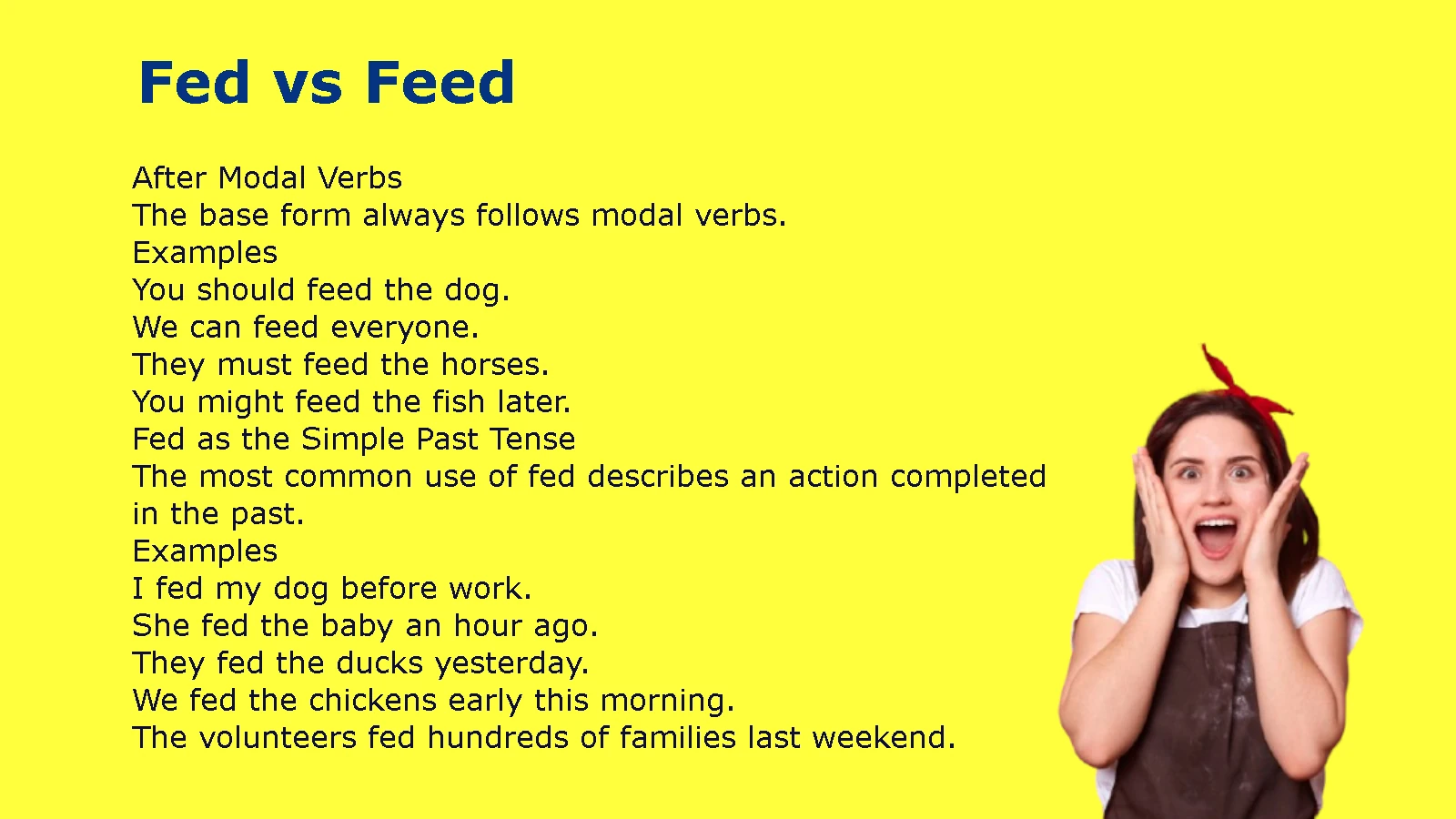
The base form always follows modal verbs.
Examples
- You should feed the dog.
- We can feed everyone.
- They must feed the horses.
- You might feed the fish later.
This rule is easy to remember because modal verbs never take the past tense immediately after them.
What Does “Fed” Mean?
While feed describes present or future actions, fed tells us the action has already happened.
Fed is an irregular verb form. Unlike regular verbs that simply add -ed, the verb feed changes spelling completely in the past tense.
- Feed → Fed
This pattern is similar to:
- Meet → Met
- Lead → Led
- Bleed → Bled
Learning these irregular verbs together often makes them easier to remember.
Fed as the Simple Past Tense
The most common use of fed describes an action completed in the past.
Examples
- I fed my dog before work.
- She fed the baby an hour ago.
- They fed the ducks yesterday.
- We fed the chickens early this morning.
- The volunteers fed hundreds of families last weekend.
Each sentence describes an action that has already finished.
Fed as the Past Participle
The past participle works with helping verbs.
These include:
- has
- have
- had
Examples
- I have fed the cat.
- She has fed the baby.
- They had fed the horses before sunset.
- We have already fed everyone.
Notice that have feed is never correct.
Always write:
- have fed
- has fed
- had fed
Why “Fed” Is an Irregular Verb
Most English verbs form the past tense by adding -ed.
Examples include:
- Walk → Walked
- Play → Played
- Jump → Jumped
However, feed belongs to a group of irregular verbs that change spelling.
| Base Verb | Past Tense | Past Participle |
| Feed | Fed | Fed |
| Meet | Met | Met |
| Lead | Led | Led |
| Keep | Kept | Kept |
| Sleep | Slept | Slept |
Irregular verbs don’t follow one predictable pattern, so the best way to master them is through regular reading and practice.
Examples of “Fed” in Everyday Life
At Home
- Dad fed the dog before leaving.
- Mom fed the baby lunch.
School
- The class fed the rabbits in the science lab.
- Students fed information into the survey.
Work
- The technician fed paper into the copier.
- The analyst fed new data into the system.
On the Farm
- Farmers fed the cattle before sunrise.
- Workers fed the chickens every evening.
In Technology
- The operator fed commands into the computer.
- Engineers fed updated software into the device.
These examples show that fed works anywhere the action happened in the past, whether you’re talking about food, information, machinery, or ideas.
Feed vs. Fed: Side-by-Side Comparison
Understanding fed vs. feed becomes much easier when you compare them directly.
| Feature | Feed | Fed |
| Verb type | Base form | Past tense and past participle |
| Time | Present or future | Past |
| Used after modal verbs | Yes | No |
| Used after has, have, had | No | Yes |
| Used for commands | Yes | No |
| Describes completed actions | No | Yes |
Compare these sentences
| Incorrect | Correct |
| Yesterday I feed the dog. | Yesterday I fed the dog. |
| I have feed the dog. | I have fed the dog. |
| I fed my dog every morning. | I feed my dog every morning. |
| Please fed the cat. | Please feed the cat. |
Reading the two forms side by side makes the grammar pattern much easier to recognize.
The Verb Forms of “Feed”
Every English verb changes form depending on tense. Learning all forms together helps prevent common grammar mistakes.
| Verb Form | Word | Example |
| Base Form | Feed | I feed my dog daily. |
| Third-Person Singular | Feeds | She feeds the birds every morning. |
| Present Participle | Feeding | They are feeding the animals now. |
| Simple Past | Fed | We fed the horses yesterday. |
| Past Participle | Fed | We have fed the horses already. |
How to Remember the Forms
A simple memory trick is to think about time.
- Feed = happening now, happens regularly, or will happen.
- Feeds = present tense with he, she, or it.
- Feeding = happening right now.
- Fed = already happened.
- Have fed = completed before now.
When Should You Use Feed?
Choosing feed becomes easy when you remember one simple rule: use it when you’re talking about the present, the future, commands, or actions after modal verbs. In other words, if the action hasn’t already happened, feed is usually the right choice.
Let’s look at each situation in detail.
Use Feed for Present Habits
The present simple tense describes routines, habits, facts, and repeated actions. Since these actions happen regularly, you should use the base form feed.
Examples
- I feed my dog every morning.
- We feed our chickens before sunrise.
- They feed the fish twice a day.
- Parents feed young children healthy meals.
- Farmers feed cattle throughout the year.
These sentences describe actions that happen regularly rather than once.
Use Feed for Future Actions
The base form also appears after will when talking about future events.
Examples
- I will feed the cat tonight.
- We’ll feed everyone after the ceremony.
- She will feed the baby when she wakes up.
- They will feed the horses this evening.
Use Feed After Modal Verbs
Modal verbs never take the past tense immediately after them. Instead, they require the base form of the verb.
Common modal verbs include:
- Can
- Could
- May
- Might
- Must
- Shall
- Should
- Will
- Would
Examples
- You should feed the dog before leaving.
- We can feed everyone without rushing.
- They must feed the livestock daily.
- You might feed the ducks later.
- She would feed the stray cats whenever she visited.
A common mistake is writing should fed or can fed. These forms are always incorrect.
Use Feed for Commands
Imperative sentences begin with the base verb because they give instructions or commands.
Examples
- Feed the baby carefully.
- Feed the dog before you leave.
- Please feed the birds.
- Don’t feed wild animals.
Notice that commands never use fed.
Use Feed in Infinitive Phrases
The infinitive form always uses to feed.
Examples
- I want to feed the kittens.
- She hopes to feed every guest.
- They forgot to feed the fish.
- We need to feed more data into the system.
When Should You Use Fed?
Use fed whenever you’re referring to an action that already happened. Since fed serves as both the simple past tense and the past participle, it appears in several common sentence patterns.
Use Fed for Completed Past Actions
If the action happened yesterday, last week, or at another completed time in the past, use fed.
Examples
- I fed the dog before work.
- She fed the baby an hour ago.
- We fed the birds yesterday.
- They fed the horses before sunset.
- The volunteers fed hundreds of families last weekend.
Use Fed After Helping Verbs
Perfect tenses require the past participle, which is fed.
Present Perfect
Examples
- I have fed the cat.
- She has fed the baby.
- We have fed everyone.
Past Perfect
Examples
- They had fed the animals before the storm arrived.
- We had fed the guests before the meeting started.
- She had fed her dog before leaving for vacation.
Future Perfect
Examples
- By noon, I will have fed the horses.
- They will have fed every child before lunchtime.
Passive Voice Examples
Although active voice usually sounds stronger, passive constructions are grammatically correct when the focus is on the receiver of the action.
Examples
- The animals were fed before sunrise.
- Every child was fed a healthy breakfast.
- The livestock has been fed regularly.
Feed vs. Fed in Real-Life Situations
Seeing both words in context makes the difference much easier to understand.
At Home
| Present | Past |
| I feed my cat every morning. | I fed my cat before work. |
| We feed the dog twice a day. | We fed the dog last night. |
School
| Present | Past |
| Students feed the class rabbit daily. | Students fed the class rabbit yesterday. |
Work
| Present | Past |
| We feed sales data into the system. | We fed last month’s figures into the system. |
On the Farm
| Present | Past |
| Farmers feed livestock every day. | Farmers fed the cattle before sunrise. |
In Healthcare
| Present | Past |
| Nurses feed patients who need assistance. | Nurses fed the patient after surgery. |
Common Expressions with Feed
The verb feed appears in many common expressions. Sometimes it refers to food, while other times it means supplying, encouraging, or strengthening something.
Feed the Family
Meaning: Provide meals for family members.
Example
Working two jobs helped him feed the family.
Feed the Baby
Meaning: Give food or milk to a baby.
Example
She woke early to feed the baby.
Feed the Birds
Meaning: Give food to birds.
Example
Many people feed the birds during winter.
Feed the Dog
Meaning: Give food to a dog.
Example
Don’t forget to feed the dog before leaving.
Feed the Fire
This expression has both literal and figurative meanings.
Literal
Adding wood keeps a fire burning.
Example
He added more logs to feed the fire.
Figurative
It means making a situation stronger.
Example
Arguing online only feeds the fire.
Feed Someone’s Curiosity
Meaning: Encourage someone to learn more.
Example
The documentary fed my curiosity about space exploration.
Feed the Economy
Meaning: Support economic growth.
Example
Small businesses help feed the local economy.
Feed an Addiction
Meaning: Continue supporting an unhealthy habit.
Example
Easy access to gambling can feed an addiction.
Feed Creativity
Meaning: Inspire new ideas.
Example
Travel often feeds creativity.
Feed Information Into a System
A common phrase in business and technology.
Example
Employees feed customer information into the database.
Common Expressions with Fed
Unlike feed, fed often appears in descriptive phrases because it refers to something that has already received food or another resource.
Well Fed
Meaning: Properly nourished.
Examples
- The children looked healthy and well fed.
- A well-fed pet usually has plenty of energy.
Grass Fed
Used mainly in agriculture.
Meaning: Animals raised primarily on grass instead of grain.
Examples
- The store sells grass-fed beef.
- Many consumers choose grass-fed products because of their farming practices.
Grain Fed
Meaning: Animals primarily raised on grain.
Example
Some cattle are grain-fed before processing.
Spoon Fed
This expression has both literal and figurative meanings.
Literal
A caregiver feeds someone with a spoon.
Figurative
Someone receives information without making an effort.
Example
Good teachers encourage critical thinking instead of spoon-feeding students every answer.
Force Fed
Meaning: Someone or something receives food against their will.
Example
The rescued bird had to be force-fed during recovery.
Fed Up vs. Fed
Many learners confuse fed with the expression fed up, but they aren’t the same thing.
What Does “Fed Up” Mean?
Fed up is an idiom that means annoyed, frustrated, or tired of something.
It has nothing to do with eating.
Examples
- I’m fed up with traffic.
- She’s fed up with constant delays.
- They’re fed up with broken promises.
Why the Confusion?
Although fed appears in the phrase, fed up functions as a complete idiom. You can’t understand its meaning by looking at the individual word fed.
Compare these examples:
| Sentence | Meaning |
| I fed the dog. | I gave food to the dog. |
| I’m fed up with the noise. | I’m tired of the noise. |
Feed vs. Fed in Everyday Conversation
You’ll hear these words almost every day because they appear in many situations.
Family Life
- Did you feed the dog?
- Yes, I fed him an hour ago.
Parenting
- Can you feed the baby?
- I already fed her.
Cooking
- We usually feed guests before dessert.
- We fed everyone by six o’clock.
Traveling
- Remember to feed the cat before leaving.
- Our neighbor fed the cat while we were away.
School
- Teachers feed students’ curiosity through engaging lessons.
- The science club fed the turtles yesterday.
Technology
- Please feed these numbers into the spreadsheet.
- The assistant fed the updated information into the software.
Feed vs. Fed in Business and Technology
The word feed has developed several specialized meanings in the digital world. In most cases, it refers to supplying or continuously delivering information.
Data Feed
A data feed automatically transfers information between systems.
Examples
- Stock market data feed
- Weather data feed
- Inventory feed
News Feed
A news feed displays updated content on websites and social media platforms.
Examples include:
- Facebook News Feed
- LinkedIn Feed
- Instagram Feed
- X (formerly Twitter) Feed
Live Feed
A live feed broadcasts video or audio in real time.
Examples include:
- Security camera feed
- Live sports feed
- Wildlife camera feed
- Traffic camera feed
Audio Feed
An audio stream delivered continuously.
Example
The podcast provides a live audio feed during major events.
Video Feed
Continuous video transmitted from one source to another.
Example
The newsroom monitored several video feeds during the breaking story.
Important Grammar Tip
Notice that these are noun phrases using feed, not the past tense fed.
Compare them:
- The camera feed stopped working. ✅
- The technician fed new software into the system. ✅
One is a noun, while the other is a verb.
Feed vs. Fed in Agriculture
Agriculture uses both words regularly, although each serves a different purpose.
Feed as a Noun
In farming, feed often refers to food prepared for livestock.
Common types include:
- Cattle feed
- Poultry feed
- Horse feed
- Pig feed
- Fish feed
- Sheep feed
Example
The farmer purchased fresh feed for the chickens.
Feed as a Verb
Farmers also use feed to describe the action.
Examples
- We feed cattle twice daily.
- Ranchers feed horses before sunrise.
Fed as the Past Tense
When the action is complete, use fed.
Examples
- The workers fed the chickens before breakfast.
- We fed the sheep yesterday afternoon.
Grass Fed vs. Grain Fed
These labels describe how animals were raised.
| Term | Meaning |
| Grass-fed | Animals primarily ate grass and forage. |
| Grain-fed | Animals primarily ate grain during part or all of their lives. |
These terms commonly appear on food labels, restaurant menus, and grocery packaging.
Feed vs. Fed: Feed as a Noun, Common Mistakes, Quiz, and FAQs
Understanding fed vs. feed becomes much easier when you look beyond basic verb forms. While most people learn feed as a verb meaning “to give food,” it can also work as a noun. Meanwhile, fed appears in many phrases and verb structures that describe completed actions.
This final section covers the remaining important details, including how feed works as a noun, mistakes to avoid, practice exercises, and frequently asked questions about feed vs. fed.
Feed as a Noun vs. Feed as a Verb
The word feed has more than one job in English. It can act as both a verb and a noun depending on the sentence.
When feed acts as a verb, it describes an action.
When feed acts as a noun, it describes something that is provided, delivered, or consumed.
Understanding the difference helps you recognize the meaning from context.
Feed as a Verb
As a verb, feed means to provide food, information, energy, or support.
Examples
- I feed my dog every morning.
- They feed the animals at noon.
- The company feeds data into its software.
- Reading books feeds your imagination.
In each example, feed describes an action.
Feed as a Noun
As a noun, feed refers to a source of food, information, or content.
Examples
- The farmer bought animal feed.
- I checked my social media feed this morning.
- The camera provides a live feed from the building.
- The website receives a news feed from different sources.
Here, feed is not an action. It is a thing.
Common Types of “Feed” as a Noun
| Type of Feed | Meaning | Example |
| Animal feed | Food given to animals | The farmer stored extra animal feed. |
| News feed | A stream of articles or updates | I saw the story on my news feed. |
| Social media feed | A collection of online posts | Her social media feed is full of travel photos. |
| Live feed | Real time video or audio | The reporter watched the live feed. |
| Data feed | Automatic transfer of information | The company uses a data feed for updates. |
Common Grammar Mistakes With Feed and Fed
Many mistakes happen because feed is an irregular verb. Unlike regular verbs, it doesn’t become feeded in the past. It changes to fed.
Let’s look at the most common errors.
Mistake: Using “Feed” for Past Actions
❌ Incorrect:
I feed the dog yesterday.
✅ Correct:
I fed the dog yesterday.
Why?
The word yesterday shows that the action happened in the past. Therefore, you need the past tense fed.
Mistake: Using “Fed” for Regular Habits
❌ Incorrect:
I fed my cat every morning.
✅ Correct:
I feed my cat every morning.
Why?
The phrase every morning describes a routine. Regular habits use the present tense feed.
Mistake: Saying “Have Feed”
❌ Incorrect:
I have feed the animals.
✅ Correct:
I have fed the animals.
Why?
After have, has, or had, English requires the past participle. The past participle of feed is fed.
Mistake: Saying “Feeded”
❌ Incorrect:
She feeded the birds.
✅ Correct:
She fed the birds.
Why?
Feed is an irregular verb. It does not follow the normal verb + ed pattern.
Similar examples:
- Lead → Led (not leaded)
- Meet → Met (not meeted)
- Keep → Kept (not keeped)
Mistake: Using “Fed” After Modal Verbs
❌ Incorrect:
You should fed the dog.
✅ Correct:
You should feed the dog.
Why?
Modal verbs always use the base form.
Examples:
- Can feed
- Should feed
- Must feed
- Will feed
Never:
- Can fed
- Should fed
- Must fed
Feed vs. Fed Practice Table
| Incorrect Sentence | Correct Sentence | Reason |
| I feed my dog yesterday. | I fed my dog yesterday. | Past action needs “fed.” |
| She has feed the baby. | She has fed the baby. | Use past participle after “has.” |
| They feeded the horses. | They fed the horses. | Feed is irregular. |
| You should fed the fish. | You should feed the fish. | Modal verbs need base form. |
| I fed my cat every day. | I feed my cat every day. | Habit needs present tense. |
Feed vs. Fed Quiz
Test your understanding of feed vs. fed by choosing the correct word.
Choose the Correct Answer
I ___ my dog every morning.
A) fed
B) feed
Answer: B) feed
Explanation: “Every morning” shows a repeated habit.
She ___ the baby before going to work yesterday.
A) feed
B) fed
Answer: B) fed
Explanation: “Yesterday” shows a completed past action.
We have already ___ the chickens.
A) feed
B) fed
Answer: B) fed
Explanation: “Have” requires the past participle.
Please ___ the fish before you leave.
A) feed
B) fed
Answer: A) feed
Explanation: Commands use the base verb.
They will ___ everyone at the event.
A) feed
B) fed
Answer: A) feed
Explanation: “Will” requires the base form.
Fill in the Blanks: Feed or Fed
Complete each sentence with the correct word.
- I usually ______ my cat before breakfast.
- She ______ the birds yesterday afternoon.
- We have already ______ the guests.
- Please ______ the baby carefully.
- They will ______ the animals tomorrow.
- The farmer ______ the cows every evening.
- The workers ______ the horses before sunset.
- You should ______ the fish twice a day.
Answers
- feed
- fed
- fed
- feed
- feed
- feeds
- fed
- feed
Sentence Correction Practice
Find and fix the mistakes.
Incorrect:
I have feed my dog.
Correct:
I have fed my dog.
Incorrect:
Yesterday, we feed the birds.
Correct:
Yesterday, we fed the birds.
Incorrect:
She should fed the baby.
Correct:
She should feed the baby.
Incorrect:
They feeded the animals last night.
Correct:
They fed the animals last night.
How to Remember the Difference Between Feed and Fed
Grammar rules become easier when you connect them to simple memory tricks.
Think About Time
Ask yourself:
Did it already happen?
- Yes → Use fed
- No → Use feed
Examples:
- I feed my dog every day.
(A regular action) - I fed my dog this morning.
(A finished action)
Remember the Pattern
The verb forms follow this pattern:
Feed → Fed → Fed
Examples:
- I feed.
- I fed.
- I have fed.
The second and third forms are identical.
Associate “Fed” With “Finished”
A helpful trick:
Fed starts with F, and Finished starts with F.
When something is already finished, think:
“The animal has been fed.”
Frequently Asked Questions About Feed vs. Fed
Is “Fed” the Past Tense of “Feed”?
Yes. Fed is the simple past tense of feed.
Examples:
- Present: I feed the dog.
- Past: I fed the dog.
What Is the Past Participle of Feed?
The past participle of feed is also fed.
Examples:
- I have fed the dog.
- She has fed the birds.
- They had fed the horses.
Is “Feeded” a Word?
No. Feeded is not the correct past tense of feed.
The correct form is:
- Feed → Fed
Not:
- Feed → Feeded
Can Feed Be a Noun?
Yes. Feed can be a noun.
Examples:
- The farmer bought animal feed.
- I checked my social media feed.
- The camera showed a live feed.
Is Fed an Adjective?
Yes, fed can function as an adjective in some expressions.
Examples:
- A well-fed child.
- A well-fed animal.
- Grass-fed beef.
In these cases, fed describes something that has received food.
What Is the Difference Between Feed and Feeding?
Feed is the base form.
Feeding is the present participle or gerund form.
Examples:
- I feed my dog every day.
- I am feeding my dog right now.
- Feeding animals requires responsibility.
What Is a News Feed?
A news feed is a constantly updated collection of stories, posts, or information.
Examples:
- Social media news feeds.
- Website news feeds.
- App content feeds.
The word feed here means a stream of new information.
What Does “Feed Up” Mean?
The correct phrase is fed up, not feed up.
Fed up means annoyed, frustrated, or tired of something.
Examples:
- I’m fed up with waiting.
- She is fed up with the noise.
Final Thoughts on Feed vs. Fed
The difference between feed and fed comes down to one important idea: time.
Use feed when the action happens now, happens regularly, or will happen in the future.
Examples:
- I feed my dog every morning.
- I will feed the cat later.
Use fed when the action already happened or when you use perfect tenses.
Examples:
- I fed the dog yesterday.
- I have fed the cat already.
The verb pattern is simple:
Feed → Fed → Fed
Once you remember that feed connects with the present and fed connects with the past, choosing the correct word becomes much easier. Whether you’re talking about pets, farming, technology, data, or everyday life, this small grammar difference helps your English sound clearer and more natural.