In Over Your Head Meaning refers to being involved in a situation that is too difficult or challenging to handle successfully. This common idiom is used when someone has taken on more responsibility, work, or problems than they can manage and often appears in everyday conversations and professional settings.
It’s an easy phrase to hear in conversations, movies, and the workplace, but its figurative meaning isn’t always obvious. Here’s the kicker: taking the idiom literally can lead to confusion, especially for English learners or anyone unfamiliar with idiomatic expressions.
In this guide, you’ll learn the In Over Your Head Meaning, explore the definition of in over your head, discover what does in over your head mean, and see in over your head examples used in everyday conversations. You’ll also learn how to use in over your head in a sentence, when it’s appropriate to say it, and similar expressions that convey the same idea.
By the end, you’ll know exactly what “in over your head” means and feel confident using this common idiom naturally in both spoken and written English.
What Does “In Over Your Head” Mean?
The idiom “in over your head” means being involved in a situation that is too difficult, complicated, or demanding for your current skills, experience, or resources.
It often suggests that someone underestimated the challenge before getting involved. The person isn’t necessarily incapable forever. Instead, they’ve reached a point where the task has become overwhelming.
Simple Definition
In over your head: Being involved in something that is beyond your ability to manage successfully.
This expression appears frequently in conversations about work, education, business, finances, relationships, sports, and personal challenges.
Quick Example
After agreeing to manage three major projects at once, Maria realized she was in over her head.
In this example, Maria accepted more work than she could realistically handle.
Another example:
When Jake bought a restaurant without any business experience, he quickly found himself in over his head.
Here, the idiom highlights that Jake’s lack of experience made the situation difficult to manage.
“In Over Your Head” Meaning at a Glance
| Feature | Details |
| Idiom | In over your head |
| Meaning | Taking on more than you can successfully handle |
| Literal meaning | Being underwater beyond the level of your head |
| Figurative meaning | Feeling overwhelmed by responsibilities or challenges |
| Tone | Usually negative or cautionary, though sometimes humorous |
| Common contexts | Work, school, business, relationships, finances, sports |
| Opposite expressions | On top of things, in control, up to the task |
Literal vs. Figurative Meaning
Understanding both meanings makes the idiom easier to remember.
Literal Meaning
Literally, being “in over your head” describes standing in water that is deeper than your height.
Imagine walking into a lake. At first, the water reaches your ankles. Then your knees. Soon it’s at your waist.
Eventually, the water rises above your head.
At that point, you’re no longer able to stand comfortably or breathe normally. Unless you can swim, you’re in serious trouble.
This physical image inspired the modern idiom.
Figurative Meaning
Figuratively, the phrase refers to any situation where someone has accepted responsibilities or challenges beyond what they can comfortably manage.
Unlike the literal meaning, no water is involved.
Instead, people use the idiom to describe feeling overwhelmed because:
- The workload is too large.
- The task is too complex.
- The responsibility is too great.
- The risk is higher than expected.
- They lack the necessary experience.
For example:
- A new manager supervising fifty employees for the first time.
- A student taking six advanced courses simultaneously.
- A homeowner attempting major electrical repairs without proper knowledge.
- A startup founder expanding the business too quickly.
Each person may feel in over their head because the challenge exceeds their current capabilities.
Why Context Matters
Like many English idioms, context determines the exact meaning.
Consider these examples:
“He’s in over his head with debt.”
Here, the problem is financial.
“She’s in over her head at work.”
Now the challenge involves career responsibilities.
“We’re in over our heads planning this event.”
This time, the difficulty comes from organizing a large project.
Although the situations differ, the core meaning remains the same: the demands exceed the person’s ability to cope comfortably.
Origin and History of “In Over Your Head”
Many English idioms come from everyday experiences, and “in over your head” is no exception.
The phrase originates from the very real danger of entering water that is too deep to stand in safely.
Long before swimming became a common skill, people recognized that deep water represented risk. Once the water rose above a person’s head, they could lose control, struggle to breathe, or even drown.
Because this image was so vivid and easy to understand, English speakers gradually adopted it as a metaphor for life’s challenges.
Instead of describing physical danger, the phrase began describing emotional, financial, or professional situations where someone felt overwhelmed.
Today, the idiom appears in:
- Daily conversations
- News articles
- Movies
- Television shows
- Business discussions
- Books
- Motivational speeches
- Podcasts
Its popularity has endured because the imagery is universal. Almost everyone understands what it feels like to face something larger than themselves.
Why the Water Metaphor Works So Well
Water naturally symbolizes uncertainty and danger.
Think about these related expressions:
- Keep your head above water
- Sink or swim
- Drowning in work
- Making waves
- Test the waters
Each uses water to represent challenges or uncertainty.
Similarly, “in over your head” suggests that the situation has become deeper and more difficult than expected.
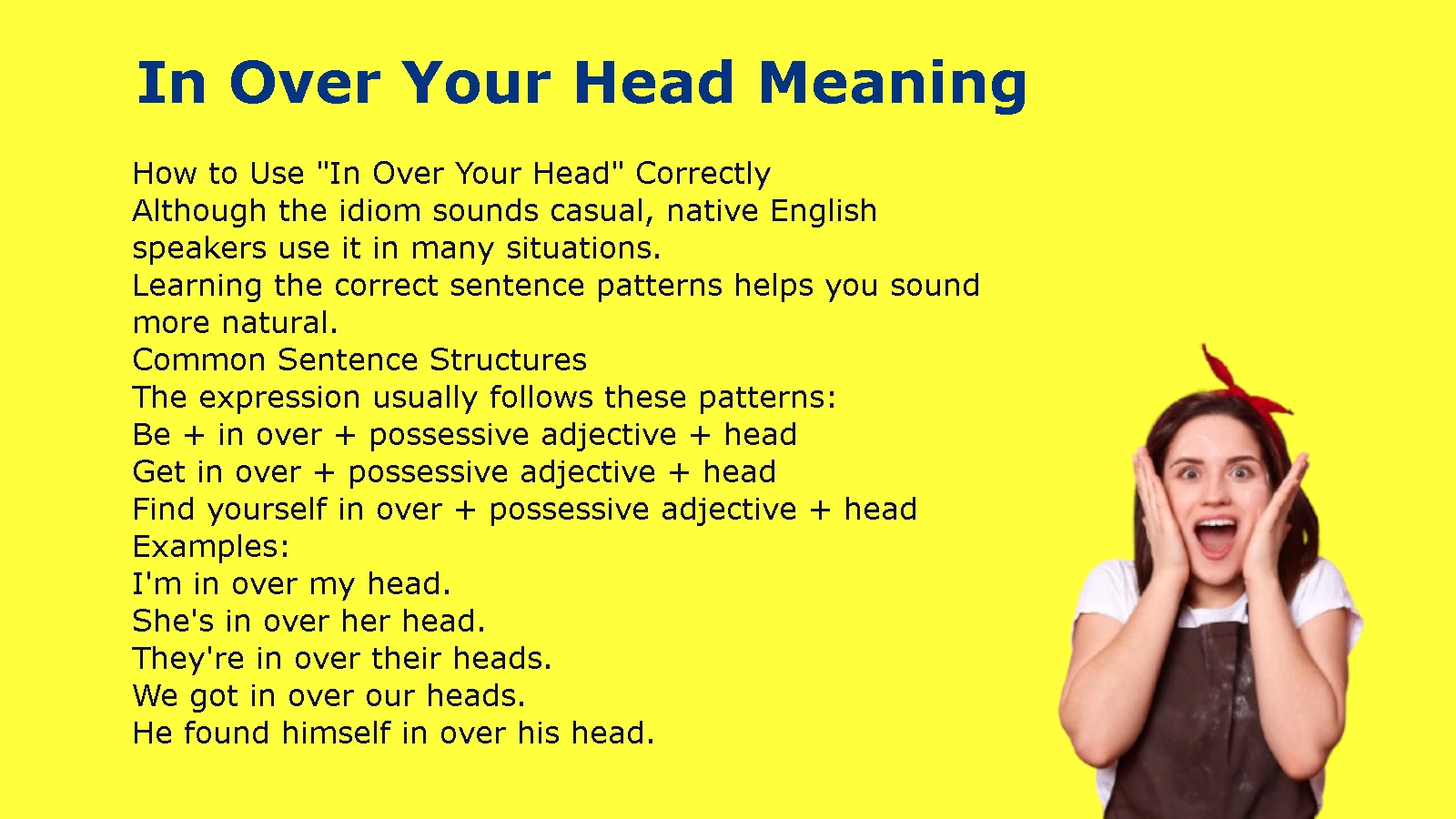
How to Use “In Over Your Head” Correctly
Although the idiom sounds casual, native English speakers use it in many situations.
Learning the correct sentence patterns helps you sound more natural.
Common Sentence Structures
The expression usually follows these patterns:
- Be + in over + possessive adjective + head
- Get in over + possessive adjective + head
- Find yourself in over + possessive adjective + head
Examples:
- I’m in over my head.
- She’s in over her head.
- They’re in over their heads.
- We got in over our heads.
- He found himself in over his head.
Grammar Patterns
Notice how the possessive adjective changes with the subject.
| Subject | Correct Usage |
| I | In over my head |
| You | In over your head |
| He | In over his head |
| She | In over her head |
| We | In over our heads |
| They | In over their heads |
When referring to more than one person, “heads” becomes plural.
Example:
The two business partners were in over their heads after expanding too quickly.
Formal vs. Informal Usage
This idiom is considered informal to neutral.
It’s perfectly appropriate for:
- Everyday conversations
- Interviews
- Workplace discussions
- Newspapers
- Blog posts
- Books
- Business meetings
However, highly technical or legal documents usually favor more precise language.
Instead of saying:
The company was in over its head.
A formal report might say:
The company lacked sufficient operational capacity to manage the project.
Both communicate a similar idea, but the wording matches different audiences.
Spoken vs. Written English
Native speakers use this idiom frequently in speech because it’s concise and expressive.
You’ll also find it in:
- Magazine articles
- Online forums
- Opinion pieces
- Fiction
- Business blogs
- Career advice
- News reporting
Writers often choose it because readers immediately understand the emotional impact.
Common Collocations
These combinations appear frequently with the idiom.
- Realize you’re in over your head
- Find yourself in over your head
- Get in over your head
- Be completely in over your head
- Way in over your head
- Immediately in over your head
- Financially in over your head
- Emotionally in over your head
- Professionally in over your head
Examples:
- She realized she was in over her head after accepting the promotion.
- They got in over their heads with the renovation.
- The investor admitted he was way in over his head.
Examples of “In Over Your Head” in Sentences
Seeing the idiom in context makes it much easier to understand and use naturally.
Everyday Conversations
- I thought I could renovate the kitchen myself, but now I’m in over my head.
- He’s in over his head trying to organize the entire wedding alone.
- We were in over our heads after agreeing to host fifty guests.
- She admitted she was in over her head and asked for help.
School and College
- Taking seven advanced classes left Ethan in over his head by mid-semester.
- The research project became far more difficult than the students expected, and they quickly found themselves in over their heads.
- Many first-year college students feel in over their heads during their first few weeks as they adjust to new expectations.
- Joining multiple academic clubs while working part-time can leave even organized students in over their heads.
Workplace and Career
The workplace is one of the most common settings where you’ll hear the idiom “in over your head.” Promotions, new responsibilities, tight deadlines, and unfamiliar technology can all create situations where someone feels overwhelmed.
Examples:
- After becoming the department manager, Sophia realized she was in over her head.
- The new employee accepted responsibilities that required years of experience, leaving him in over his head.
- Our team took on too many clients at once, and we quickly found ourselves in over our heads.
- The engineer admitted she was in over her head and asked a senior colleague for guidance.
In professional environments, recognizing you’re in over your head isn’t a weakness. It often shows self-awareness and a willingness to seek help before small problems become major ones.
Business and Entrepreneurship
Running a business requires balancing finances, operations, marketing, customer service, and leadership. Entrepreneurs often underestimate how quickly those responsibilities grow.
Examples:
- The startup expanded too quickly, and the founders were suddenly in over their heads.
- Opening three locations in one year left the business owner in over his head financially.
- The company’s rapid growth pushed management in over their heads.
- Without a clear business plan, the entrepreneur became in over her head within months.
Many successful business owners admit they experienced this feeling during the early stages of building their companies. The difference lies in recognizing the problem early and adapting.
Financial Situations
Money-related problems frequently inspire this idiom because financial commitments can become overwhelming.
Examples:
- Buying an expensive home without a stable income left the couple in over their heads.
- He borrowed more money than he could repay and ended up in over his head with debt.
- Unexpected medical bills pushed the family in over their heads financially.
- The investor took unnecessary risks and found himself in over his head.
Financial experts often recommend creating realistic budgets to avoid taking on obligations that become difficult to manage.
Relationships
Relationships sometimes become emotionally demanding, especially when communication breaks down or expectations differ.
Examples:
- He realized he was in over his head after agreeing to solve everyone’s problems.
- They moved too fast and soon felt in over their heads emotionally.
- Taking responsibility for another person’s happiness can leave anyone in over their head.
- She became in over her head trying to keep peace between two families.
In these cases, the idiom reflects emotional pressure rather than physical or financial challenges.
Parenting
Parenthood brings constant learning. Even experienced parents occasionally feel overwhelmed.
Examples:
- New parents often feel in over their heads during the first few weeks.
- Balancing work, school schedules, and childcare left them in over their heads.
- He laughed and admitted he was in over his head after volunteering to coach three youth teams.
- Many parents discover they’re in over their heads when unexpected challenges arise.
The phrase acknowledges that parenting doesn’t come with a perfect instruction manual.
Sports and Competition
Athletes sometimes compete against opponents whose skills exceed their own.
Examples:
- The rookie realized she was in over her head competing against Olympic champions.
- Our team was in over its head during the national tournament.
- He entered the professional league before he was ready and quickly found himself in over his head.
- The underdog stayed competitive even after appearing in over its head.
Here, the idiom highlights a gap between preparation and competition.
Technology and AI
Modern technology changes quickly, making it easy to feel overwhelmed.
Examples:
- The small company became in over its head after adopting several complex AI systems at once.
- Without cybersecurity training, the organization was in over its head responding to the attack.
- Learning advanced programming without understanding the basics left the student in over her head.
- The project became so technical that even experienced developers felt in over their heads.
Emergency or High-Pressure Situations
Stress often makes challenges feel even larger.
Examples:
- The volunteer found himself in over his head during the disaster response effort.
- The inexperienced leader was suddenly in over her head managing the crisis.
- Emergency responders knew when a situation became in over their heads and called for additional support.
- The negotiations grew so complicated that both sides admitted they were in over their heads.
Real-Life Scenarios Where People Become In Over Their Heads
This idiom applies to many everyday situations. Although the circumstances differ, they all share one characteristic: the challenge exceeds the person’s current ability or resources.
| Situation | Why Someone Feels In Over Their Head |
| Starting a new job | Responsibilities exceed experience |
| Launching a business | Too many decisions and financial risks |
| Managing debt | Payments become difficult to afford |
| Buying a home | Unexpected maintenance and expenses |
| Leading a large team | Leadership skills still developing |
| College coursework | Academic workload becomes overwhelming |
| Parenting | New responsibilities arrive quickly |
| Learning a technical skill | Information becomes difficult to absorb |
| Managing multiple projects | Limited time and attention |
| Organizing a major event | Too many moving parts to coordinate |
Case Study: A New Manager Learns to Delegate
Situation
Emma earned a promotion after consistently performing well as a software developer. Within weeks, however, she was supervising twelve employees, handling budgets, conducting performance reviews, and meeting with executives.
She soon realized she wasn’t struggling with programming anymore. Instead, leadership demanded an entirely different skill set.
Emma admitted she was in over her head.
What Changed?
Instead of trying to solve every problem herself, she:
- Delegated routine tasks.
- Sought advice from experienced managers.
- Took leadership training.
- Held regular team meetings.
- Prioritized the most important work.
Within six months, her confidence improved significantly.
Lesson
Feeling in over your head doesn’t always mean you’re unqualified. Sometimes it simply means you’re growing into a larger role.
“The first step toward mastery is recognizing what you still need to learn.”
Common Synonyms
Although “in over your head” is one of the most vivid English idioms, several words and expressions communicate similar ideas.
| Word or Phrase | Meaning | Best Context |
| Overwhelmed | Unable to cope with demands | General situations |
| Overextended | Taking on too many commitments | Work, finances |
| Outmatched | Facing stronger competition | Sports, business |
| Unequipped | Lacking needed skills or resources | Education, careers |
| Overloaded | Carrying excessive work | Workplace |
| Outclassed | Facing someone with superior ability | Competition |
| Inexperienced | Lacking practical knowledge | Learning situations |
| Overcommitted | Agreeing to too many responsibilities | Personal or professional life |
Each synonym has its own nuance. Overwhelmed focuses on emotion, while in over your head emphasizes entering a situation beyond your ability to manage.
Idioms Similar to “In Over Your Head”
English includes many idioms that describe difficult situations. While they overlap, each carries a slightly different meaning.
Bite Off More Than You Can Chew
This idiom emphasizes accepting more work or responsibility than you can realistically handle.
Example
She bit off more than she could chew by accepting four freelance projects at once.
Out of Your Depth
This expression focuses on lacking the experience or knowledge needed for a situation.
Example
The intern felt out of his depth during the executive meeting.
Drowning in Work
Unlike “in over your head,” this phrase specifically refers to having too much work.
Example
I’m drowning in work this week.
Out of Your League
This usually describes competing against someone or something significantly stronger or more advanced.
Example
The amateur boxer was clearly out of his league.
In a Tight Spot
This idiom describes a difficult situation that requires a solution.
Example
We’re in a tight spot after losing our biggest client.
On Thin Ice
This expression suggests someone is close to serious consequences because of risky behavior.
Example
He’s on thin ice after missing several deadlines.
Between a Rock and a Hard Place
This idiom describes choosing between two difficult options.
Example
She was between a rock and a hard place after receiving conflicting instructions.
“In Over Your Head” vs. Similar Idioms
Although these expressions seem alike, they aren’t interchangeable in every situation.
In Over Your Head vs. Out of Your Depth
| In Over Your Head | Out of Your Depth |
| Focuses on overwhelming responsibility | Focuses on limited knowledge or experience |
| Can involve finances, emotions, or workload | Usually highlights lack of expertise |
| Common in American English | Common in British English |
| Suggests responsibility became unmanageable | Suggests the challenge exceeds current skill |
In Over Your Head vs. Bite Off More Than You Can Chew
| In Over Your Head | Bite Off More Than You Can Chew |
| Describes the current situation | Describes the decision that caused it |
| Can happen unexpectedly | Usually results from accepting too much |
| Focuses on being overwhelmed | Focuses on overcommitting |
For example:
She bit off more than she could chew, and now she’s in over her head.
The first idiom explains how the problem started. The second explains the result.
Antonyms and Opposite Expressions
When someone is not in over their head, they usually feel capable, prepared, and confident.
| Expression | Meaning |
| On top of things | Managing responsibilities effectively |
| In control | Handling a situation confidently |
| Up to the task | Fully capable of succeeding |
| Well-prepared | Ready for upcoming challenges |
| Competent | Having the required skills |
| Confident | Trusting one’s own ability |
| Comfortable with the workload | Not overwhelmed |
| Ahead of schedule | Progressing better than expected |
Common Mistakes When Using the Idiom
Even though “in over your head” is common in everyday English, learners sometimes misuse it. Understanding these mistakes will help you sound more natural.
Taking the Idiom Literally
The phrase almost always has a figurative meaning unless someone is actually talking about deep water.
❌ Incorrect
The rain was in over my head.
✅ Correct
I accepted too many responsibilities and ended up in over my head.
Using It for Minor Problems
The idiom describes significant challenges, not everyday inconveniences.
❌ Less Natural
I couldn’t find my keys, so I was in over my head.
✅ Natural
I agreed to lead an international project without prior experience, and I quickly realized I was in over my head.
Using the Wrong Preposition
The correct phrase is:
- In over your head
Not:
- ❌ Over your head in
- ❌ Above your head
- ❌ Under your head
- ❌ Beyond your head
Forgetting to Match the Possessive Pronoun
Always match the possessive adjective with the subject.
| Subject | Correct Form |
| I | In over my head |
| You | In over your head |
| He | In over his head |
| She | In over her head |
| We | In over our heads |
| They | In over their heads |
Confusing It With Similar Idioms
These expressions are related but not identical.
| Idiom | Main Meaning |
| In over your head | Facing responsibilities beyond your ability |
| Bite off more than you can chew | Accepting too much work |
| Out of your depth | Lacking enough knowledge or experience |
| Drowning in work | Having an excessive workload |
Choosing the right idiom makes your writing and speech more precise.
Is “In Over Your Head” Positive or Negative?
The phrase usually carries a negative or cautionary tone, but context matters.
When It’s Negative
It often describes situations involving:
- Stress
- Anxiety
- Poor planning
- Financial difficulty
- Emotional pressure
- Professional challenges
Example:
The company expanded too quickly and found itself in over its head financially.
When It Reflects Personal Growth
Sometimes the idiom simply describes stepping outside your comfort zone.
Many successful people have admitted they felt in over their heads during major career transitions.
Examples include:
- Starting a business
- Becoming a parent
- Leading a large team
- Pursuing an advanced degree
- Moving to another country
In these cases, the phrase highlights a temporary learning curve rather than permanent failure.
“Growth often begins where comfort ends.”
Feeling overwhelmed doesn’t necessarily mean you’ve made the wrong decision. It may simply mean you’re developing new skills.
How Native English Speakers Use This Idiom
One reason this idiom remains popular is its flexibility. Native speakers use it in casual conversations, professional discussions, books, movies, and news articles.
American English
In the United States, “in over your head” is extremely common.
You’ll hear it in conversations about:
- Careers
- Business
- Sports
- Politics
- Relationships
- Education
Examples:
- He’s in over his head at work.
- The governor may be in over her head.
- I think we’re in over our heads with this renovation.
British English
British speakers understand the phrase perfectly, although they may also prefer “out of your depth” in many situations.
Examples:
- She’s out of her depth in that role.
- He’s in over his head financially.
Both expressions sound natural.
Canadian English
Canadian English uses both American and British expressions.
Depending on the region, you’ll hear:
- In over your head
- Out of your depth
Both appear regularly in conversation and media.
Australian English
Australians also use both idioms, although “out of your depth” is especially common.
Regardless of the wording, the meaning remains nearly identical.
Everyday Usage
Native speakers often combine the idiom with words like:
- Completely
- Totally
- Way
- Already
- Clearly
- Obviously
Examples:
- I’m completely in over my head.
- We’re way in over our heads.
- She realized she was already in over her head.
- They’re clearly in over their heads.
These modifiers make the sentence sound even more natural.
When Not to Use “In Over Your Head”
Although this idiom works well in most conversations, there are situations where more precise language is better.
Academic Writing
Research papers typically avoid idioms because they can introduce ambiguity.
Instead of:
The researchers were in over their heads.
A formal paper might say:
The researchers lacked sufficient resources to complete the study.
Legal Documents
Legal writing values precision over figurative language.
Clear wording reduces the chance of misunderstanding.
Technical Documentation
Instruction manuals and technical reports should describe situations directly.
Instead of saying someone is in over their head, explain the exact limitation or risk.
Scientific Publications
Scientific writing generally favors measurable facts over colorful expressions.
Specific language improves accuracy.
Professional Policies
Employee handbooks and company policies typically use straightforward wording rather than idioms.
Related Expressions Worth Learning
Expanding your vocabulary helps you express different shades of meaning.
Keep Your Head Above Water
Meaning: To survive a difficult situation, especially financially.
Example:
After losing two major clients, the company struggled to keep its head above water.
Sink or Swim
Meaning: Succeed through your own efforts or fail.
Example:
The new manager had to sink or swim during her first month.
Learn the Ropes
Meaning: Become familiar with a new job or activity.
Example:
It took him several weeks to learn the ropes.
Under Pressure
Meaning: Experiencing stress because of demanding circumstances.
Example:
Everyone was under pressure before the product launch.
Backed Into a Corner
Meaning: Left with very few good options.
Example:
The negotiations backed both companies into a corner.
In a Bind
Meaning: Facing a difficult problem that requires a solution.
Example:
I’m in a bind because two important meetings overlap.
On Thin Ice
Meaning: Close to facing serious consequences.
Example:
He’s on thin ice after missing several deadlines.
Frequently Asked Questions
What does “in over your head” mean?
It means you’re dealing with a situation that exceeds your current skills, knowledge, experience, or resources. In other words, you’ve taken on more than you can comfortably manage.
Is “in over your head” an idiom?
Yes. It’s a well-established English idiom that uses deep water as a metaphor for overwhelming challenges.
Where did the phrase “in over your head” originate?
The expression comes from the literal experience of standing in water that rises above your head. Over time, English speakers adopted it as a metaphor for difficult situations that become overwhelming.
Is the idiom formal or informal?
It’s generally considered informal to neutral. It’s appropriate for conversations, articles, business discussions, interviews, and most everyday writing, but it’s less suitable for legal or highly technical documents.
Can you use “in over your head” at work?
Absolutely. It’s common in workplace conversations when discussing heavy workloads, unfamiliar responsibilities, or challenging projects.
Example:
I was in over my head during my first month as a project manager.
What is another way to say “in over your head”?
Depending on the context, you could say:
- Overwhelmed
- Out of your depth
- Overextended
- Outmatched
- Overcommitted
- Bite off more than you can chew (closely related idiom)
What is the opposite of “in over your head”?
Common opposites include:
- On top of things
- In control
- Up to the task
- Well-prepared
- Capable
- Confident
Is “in over your head” always negative?
Not necessarily.
Although it often describes stressful situations, it can also reflect personal growth. Many people feel in over their heads when learning new skills, starting businesses, or taking on leadership roles. With preparation and support, those challenges often become valuable learning experiences.
How do you use “in over your head” in a sentence?
Here are a few natural examples:
- I thought I could finish the renovation alone, but I’m in over my head.
- They were in over their heads after accepting too many clients.
- She admitted she was in over her head and asked for help.
- The company got in over its head after expanding too quickly.
What’s the difference between “in over your head” and “out of your depth”?
Both idioms describe feeling overwhelmed, but they emphasize different aspects.
- In over your head often focuses on taking on too much responsibility.
- Out of your depth usually highlights lacking the experience or knowledge needed to handle a situation.
In many conversations, native speakers use them interchangeably.
Key Takeaways
The idiom “in over your head” describes a situation where you’ve accepted responsibilities, challenges, or risks that exceed your current abilities or resources. Inspired by the image of water rising above a person’s head, the phrase vividly captures the feeling of being overwhelmed and struggling to stay in control.
Whether you’re discussing work, school, business, finances, relationships, or personal growth, this expression remains one of the most useful and recognizable idioms in modern English. It fits naturally into everyday conversations because nearly everyone has experienced moments when life felt bigger than expected.
Quick Summary
| Topic | Key Point |
| Meaning | Taking on more than you can comfortably manage |
| Type | English idiom |
| Literal Image | Water deeper than your height |
| Figurative Meaning | Feeling overwhelmed by responsibilities or challenges |
| Common Contexts | Work, education, business, finances, relationships, parenting |
| Closest Synonyms | Overwhelmed, out of your depth, overextended |
| Related Idioms | Bite off more than you can chew, keep your head above water, sink or swim |
| Opposite Expressions | On top of things, in control, up to the task |
| Tone | Usually cautionary, but sometimes reflects growth and learning |