Roll call is the correct term for checking attendance by names, while role call is usually a misspelling unless referring to someone’s role or function. Roll Call or Role Call can be confusing because the phrases look similar.Knowing the difference helps you choose the correct expression with confidence.
The confusion often happens because roll call and role call are pronounced the same but have different meanings and spellings. But here’s the kicker: a single misplaced letter can change the meaning of your sentence and make your writing appear less accurate.
In this guide, you’ll learn the difference between Roll Call vs Role Call, discover the correct spelling of roll call, understand the meaning of roll call, and see roll call examples in real sentences. You’ll also find out why “role call” is usually incorrect, when to use roll call, and simple memory tips to help you avoid this common spelling mistake.
By the end, you’ll know exactly which phrase to use and feel confident using it correctly in school, work, and everyday writing.
Roll Call or Role Call: Quick Answer
If you’re looking for the short answer, here it is:
- Roll call is the correct phrase when checking attendance or reading names from a list.
- Role call is correct only when talking about someone’s role, duty, character, or responsibility.
- If you’re referring to a classroom, military formation, meeting, conference, or legislative session, roll call is almost always the phrase you need.
Quick Comparison Table
| Feature | Roll Call | Role Call |
| Meaning | Reading names from a list to confirm attendance | Referring to roles, responsibilities, or characters |
| Common Usage | Schools, military, government, meetings | Theater, workplaces, organizational planning |
| Standard English Expression | ✅ Yes | Only in specific contexts |
| Refers to Attendance | ✅ Yes | ❌ No |
| Refers to Responsibilities | ❌ No | ✅ Yes |
What Does Roll Call Mean?
Roll call is the process of reading names from an official list and asking each person to confirm that they are present. The phrase has been part of English for centuries and remains widely used across education, government, the military, workplaces, and emergency management.
The word roll originally referred to a rolled-up list or register made from parchment or paper. Long before modern notebooks and digital databases existed, official records were written on long sheets that were rolled for storage. During attendance, someone would unroll the document and read each name aloud.
Although physical scrolls disappeared long ago, the expression roll call remained.
Today, the phrase refers to any systematic process of checking who is present or recording participation.
Common Situations Where Roll Call Is Used
- School classrooms
- College lectures
- Military formations
- Government assemblies
- Corporate meetings
- Conferences
- Sports teams
- Emergency evacuations
- Volunteer organizations
Because attendance is essential in so many environments, roll call has become one of the most widely recognized administrative expressions in English.
The History and Origin of Roll Call
Understanding the origin of the phrase makes it much easier to remember.
Centuries ago, officials kept lists of names on rolled manuscripts, commonly called rolls. These documents served as official records for taxes, military service, legal matters, and public administration.
When an official needed to confirm who was present, they literally called the names from the roll.
Eventually, people shortened the expression to roll call.
The phrase survived major changes in record-keeping technology. Even though schools now use tablets and governments use digital databases, the traditional expression remains unchanged.
Historical Timeline
| Period | Development |
| Medieval Europe | Names recorded on rolled parchments called rolls |
| Military Expansion | Soldiers identified through roll calls |
| Early Schools | Teachers adopted roll calls for attendance |
| Modern Era | Digital attendance systems still use the term “roll call” |
This long history explains why the word is roll, not role.
How Roll Call Works Today
Modern roll calls look different from historical ones, but the purpose remains identical: confirming attendance.
Depending on the setting, the process may involve:
- Reading names aloud
- Responding with “Present”
- Checking names digitally
- Scanning ID cards
- Recording attendance through software
- Confirming participation online
Even virtual meetings often include a form of roll call when participants introduce themselves or confirm they’re present.
Example
A teacher says:
“Emma?”
Emma replies:
“Here.”
The teacher continues until every student’s attendance has been confirmed.
That’s a classic roll call.
Examples of Roll Call in Everyday Life
Seeing the phrase in context helps remove any confusion.
Education
Teachers conduct roll call at the beginning of class to record attendance.
Example:
“The substitute teacher completed roll call before starting the lesson.”
Military
Military organizations rely on roll call to ensure every service member is accounted for.
Example:
“Morning roll call begins promptly at 0600 hours.”
Government
Legislative bodies often conduct roll call before voting or opening official sessions.
Each member’s name is read individually.
Their attendance becomes part of the official public record.
Business Meetings
Large organizations sometimes perform a quick roll call before important meetings begin.
This helps verify attendance, especially in remote meetings.
Emergency Situations
After evacuations caused by fires or natural disasters, supervisors perform roll call to ensure everyone has reached safety.
This can literally save lives.
What Does Role Call Mean?
Unlike roll call, role call isn’t a fixed English expression with a standard dictionary meaning.
Instead, it’s simply the combination of two ordinary words:
- Role = someone’s function, responsibility, or character.
- Call = an announcement, request, or discussion.
Because of this, role call can occasionally make sense when talking about assigning or reviewing roles.
However, it does not mean taking attendance.
Examples Where Role Call Makes Sense
A theater director may hold a meeting to discuss acting roles.
A project manager might organize a session to clarify each employee’s responsibilities.
A sports coach may explain every player’s role before a championship game.
In these situations, someone could describe the discussion informally as a role call, although phrases like role assignment, role review, or role briefing are generally more natural.
When Is Role Call Actually Correct?
Although uncommon, role call isn’t automatically incorrect.
It simply depends on context.
You may legitimately use it when discussing:
Theater
- Casting characters
- Reviewing acting responsibilities
- Assigning speaking parts
Example
“The director held a role call before rehearsals to explain each actor’s character.”
Business
Organizations frequently define employee responsibilities.
Example
“Today’s meeting included a role call to clarify everyone’s responsibilities during the product launch.”
Sports
Teams often assign leadership roles.
Example
“The coach’s role call identified captains, defenders, and attacking responsibilities.”
Although understandable, many editors would still choose expressions like role assignment, team briefing, or responsibility review because they’re more established.
Roll Call or Role Call: Which One Should You Use?
This is where many writers hesitate.
Fortunately, there’s a simple rule.
If you’re talking about attendance, use roll call.
If you’re discussing responsibilities, characters, or functions, use role call only when it genuinely fits the context.
Use Roll Call For
- Attendance
- Presence
- Official registers
- Meetings
- Schools
- Government
- Military
- Conferences
Use Role Call For
- Character assignments
- Job responsibilities
- Team duties
- Organizational roles
- Leadership functions
Decision Table
| You’re Talking About… | Correct Phrase |
| Students present in class | Roll call |
| Employees attending a meeting | Roll call |
| Soldiers reporting for duty | Roll call |
| Assigning characters in a play | Role call (rare but possible) |
| Reviewing workplace responsibilities | Role call (context-specific) |
Why Do People Confuse Roll Call and Role Call?
At first glance, the mistake seems understandable.
After all, the two phrases differ by just one letter.
However, several factors contribute to the confusion.
They Sound Nearly Identical
In American English, roll and role are perfect homophones. They share the same pronunciation, making it impossible to distinguish them by sound alone.
As a result, many people spell the phrase based on what they hear instead of what it actually means.
The Words Have Different Meanings
The confusion comes from assuming that role somehow relates to people being called.
While that sounds logical, English preserves the historical meaning of roll, referring to an official list of names.
Context—not pronunciation—determines the correct spelling.
Autocorrect Doesn’t Always Help
Spell-check tools often overlook this mistake because both roll and role are correctly spelled words.
These tools check spelling, not meaning.
That’s why proofreading remains important.
People Rarely Learn the Origin
Most English speakers know what roll call means, but few know why it’s called that.
Once you learn that roll originally referred to a written register of names, the phrase becomes much easier to remember.
Memory Trick
Remember this simple association:
- Roll = Roster = Attendance
- Role = Responsibility = Job
If names are being checked, think roster, which leads directly to roll call.
Roll Call in Different Contexts
Although the phrase roll call always centers on confirming attendance or accountability, the way it is carried out varies from one setting to another. Some organizations still call out names individually. Others rely on digital systems, ID cards, or biometric scanners. Regardless of the method, the purpose remains the same: ensuring the right people are present at the right time.
Let’s look at how roll call is used in real-world situations.
Roll Call in Schools and Universities
For most people, the first encounter with roll call happens in the classroom. Teachers use it to verify attendance, identify absent students, and maintain official records. Schools often require accurate attendance records because they influence funding, academic reporting, and student safety.
In younger grades, teachers typically read every student’s name aloud. Larger universities may use electronic attendance systems, but instructors still refer to the process as taking roll or conducting roll call.
Why Schools Conduct Roll Call
- Record daily attendance
- Identify absent or late students
- Meet state or district attendance requirements
- Ensure student safety
- Monitor participation
Example
“Before beginning today’s science lesson, the teacher completed roll call and noted three absences.”
Case Study: Improving Classroom Attendance
A middle school introduced a digital attendance platform that allowed teachers to complete roll call using tablets instead of paper registers. The school reduced attendance reporting errors, saved administrative time, and improved communication with parents by sending automated absence notifications.
Key takeaway: Technology changed the process, but educators still referred to it as roll call.
Roll Call in the Military
The military has relied on roll call for centuries. Every branch uses attendance checks to verify that personnel are present, prepared, and accounted for before training, deployment, or daily operations.
Military roll calls are often conducted at scheduled times and follow standardized procedures.
Common Military Roll Calls
- Morning formations
- Evening accountability checks
- Deployment preparations
- Training exercises
- Barracks inspections
A missing service member during roll call requires immediate investigation because accountability directly affects operational readiness and safety.
Example
“The platoon assembled for morning roll call before beginning field exercises.”
Interesting Fact
Many military traditions surrounding roll call date back hundreds of years, long before modern communication systems existed.
Roll Call in Government and Politics
Legislative bodies around the world use roll call to verify attendance and record official votes. During a roll call vote, each member’s name is called individually, and their vote becomes part of the permanent public record.
This process promotes transparency because citizens can see exactly how elected officials voted on specific legislation.
Where Roll Call Is Used
- Congress
- State legislatures
- City councils
- School boards
- Parliamentary sessions
Example
“The bill passed after a roll call vote revealed broad bipartisan support.”
Why Roll Call Matters
- Creates official records
- Confirms voting eligibility
- Promotes accountability
- Preserves legislative history
Roll Call in Business and Corporate Meetings
Businesses also use roll call, especially during large meetings, virtual conferences, or compliance training sessions. While employees may simply check in through software, managers often conduct a quick attendance confirmation before discussing important topics.
Remote work has expanded the meaning of roll call beyond reading names aloud. Today, participants may confirm their presence by joining a video conference, responding in chat, or checking into meeting software.
Business Uses
- Team meetings
- Board meetings
- Employee training
- Safety briefings
- Company conferences
- Virtual events
Example
“The project manager began the meeting with a brief roll call to confirm every department was represented.”
Roll Call During Emergencies
Perhaps no setting highlights the importance of roll call more than emergency response. Schools, factories, hospitals, and businesses use attendance checks after evacuations to ensure everyone has reached a safe location.
Fire drills, severe weather events, and natural disasters all rely on accurate accountability procedures.
Emergency Roll Call Checklist
- Confirm everyone exited safely.
- Compare names with attendance records.
- Report missing individuals immediately.
- Notify emergency responders if necessary.
- Document the results.
Case Study: Fire Drill Accountability
A manufacturing company conducted quarterly evacuation drills. During each drill, supervisors completed roll call at designated assembly points. The practice consistently identified communication gaps and helped reduce evacuation times over several months.
Lesson learned: Effective roll calls improve emergency preparedness and can save lives.
Roll Call in Conferences and Public Events
Large conferences, volunteer organizations, and nonprofit groups sometimes conduct roll call before workshops or committee meetings. Organizers use attendance records to allocate resources, verify membership, or issue participation certificates.
Although digital check-in systems are increasingly common, many organizations still refer to the attendance process as roll call.
Roll Call in Sports Teams
Sports teams frequently verify attendance before practices, tournaments, and travel. Coaches need to know exactly who is available before creating lineups or assigning drills.
Example
“Coach Ramirez completed roll call before announcing the starting lineup.”
Professional organizations may use digital attendance systems, but youth teams often continue using traditional verbal roll calls.
Role Call in Different Contexts
Unlike roll call, role call isn’t a widely recognized fixed phrase. Instead, it appears occasionally when discussing responsibilities, character assignments, or organizational roles.
While some writers use role call informally, many editors prefer more precise alternatives such as:
- Role assignment
- Responsibility review
- Position briefing
- Character assignment
- Team role discussion
Still, understanding where role call can logically fit helps prevent confusion.
Role Call in Theater and Film
Actors receive specific roles before rehearsals begin. Directors often meet with the cast to explain characters, expectations, and relationships between performers.
Someone might casually refer to this meeting as a role call, although cast meeting or role assignment session is more common.
Example
“Before rehearsals started, the director held a role call to explain each character’s motivations.”
Role Call in the Workplace
Businesses regularly assign responsibilities for projects. Managers define who leads each task, who provides support, and who approves final decisions.
Although “role assignment meeting” is more common, role call could describe an informal discussion focused entirely on responsibilities.
Example
“During the planning meeting, the department conducted a role call so every employee understood their responsibilities.”
Role Call in Project Management
Large projects often involve specialists from different departments.
Before work begins, project leaders clarify:
- Team leaders
- Technical experts
- Designers
- Quality assurance staff
- Client representatives
Clarifying roles early reduces misunderstandings later.
Role Call in Sports
Athletic teams assign captains, defenders, attackers, goalkeepers, and substitute players before competitions.
Example
“The coach’s preseason role call clarified leadership responsibilities for every player.”
Even here, many coaches would simply say team meeting or position assignments.
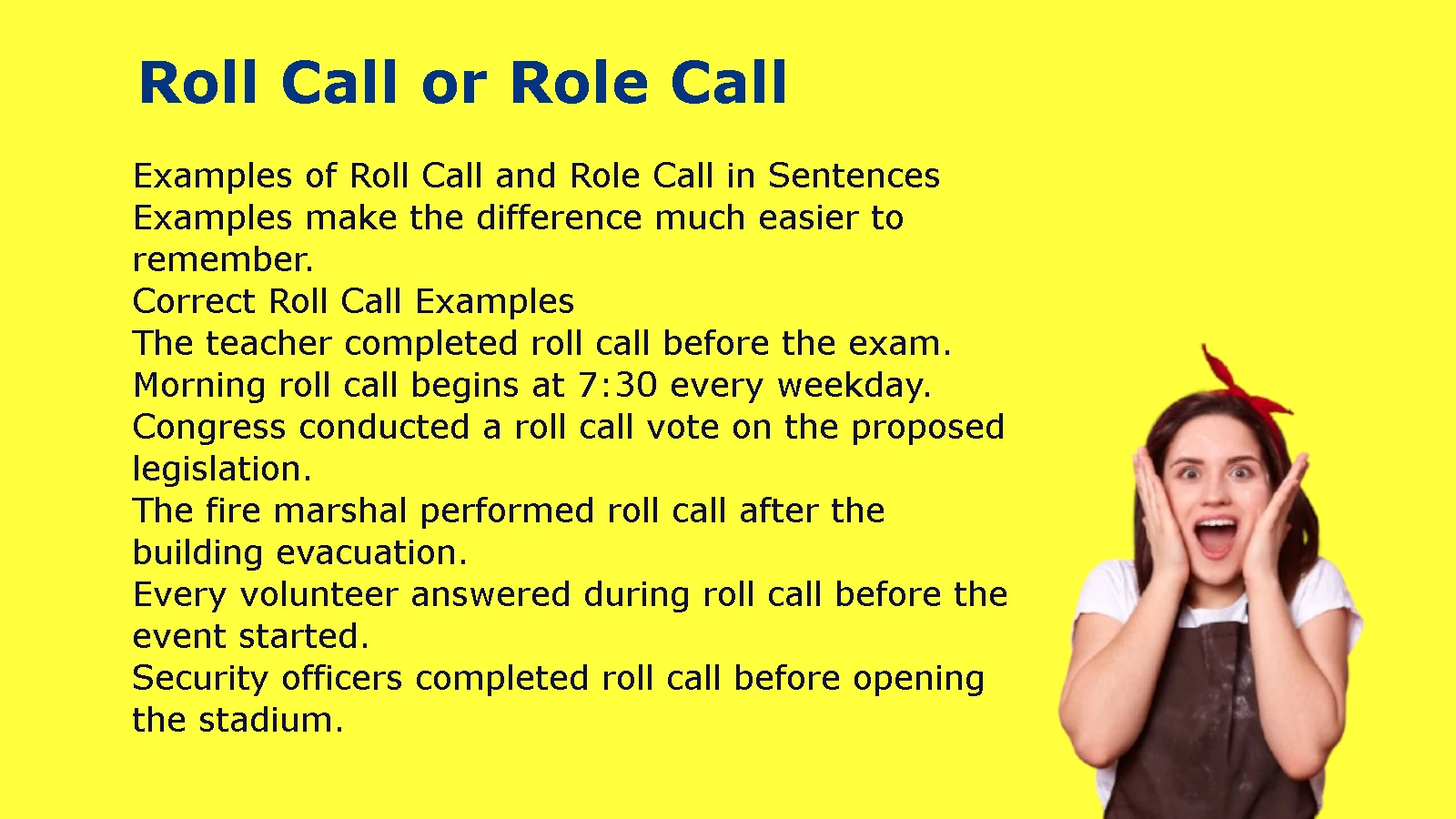
Examples of Roll Call and Role Call in Sentences
Examples make the difference much easier to remember.
Correct Roll Call Examples
- The teacher completed roll call before the exam.
- Morning roll call begins at 7:30 every weekday.
- Congress conducted a roll call vote on the proposed legislation.
- The fire marshal performed roll call after the building evacuation.
- Every volunteer answered during roll call before the event started.
- Security officers completed roll call before opening the stadium.
Correct Role Call Examples
- The theater director organized a role call to explain each actor’s character.
- Our project manager held a role call to review everyone’s responsibilities.
- The coaching staff used a role call to define player leadership positions.
Notice how these examples focus on roles, not attendance.
Common Mistakes to Avoid
Even experienced writers occasionally mix up these expressions. Fortunately, the errors are easy to spot once you know what each phrase means.
Mistake: Using “Role Call” for Attendance
❌ The teacher started class with role call.
✅ The teacher started class with roll call.
Mistake: Assuming Similar Pronunciation Means Similar Meaning
Because roll and role sound identical, many people choose the wrong spelling based on pronunciation alone.
Always ask yourself:
Are names being checked, or are responsibilities being discussed?
Mistake: Trusting Spell Check
Spell check recognizes both words as correct English.
It won’t tell you whether the phrase matches the context.
Always proofread for meaning—not just spelling.
Mistake: Forgetting the Historical Meaning
Remember that roll originally referred to a rolled register of names.
That historical connection explains why attendance uses roll, not role.
Simple Memory Tricks
Learning a quick association can prevent future mistakes.
Memory Trick #1: Roll = Roster
Both words begin with R.
Roll → Roster → Attendance
If you’re checking a roster, you’re conducting roll call.
Memory Trick #2: Role = Responsibility
Think about workplace roles.
Role → Responsibility
If people are discussing duties, role is the correct word.
Memory Trick #3: Ask One Question
Before writing either phrase, ask yourself:
Am I checking who is present?
If the answer is yes, choose roll call.
If you’re assigning duties or discussing characters, role may fit.
Quick Reference Table
| Situation | Correct Phrase | Why? |
| Classroom attendance | Roll call | Names are checked. |
| Military formation | Roll call | Personnel accountability. |
| Emergency evacuation | Roll call | Confirms everyone is safe. |
| Legislative voting | Roll call | Officials respond to their names. |
| Corporate attendance | Roll call | Confirms meeting participants. |
| Theater character discussion | Role call | Focuses on acting roles. |
| Employee responsibility review | Role call | Discusses assigned roles. |
| Sports leadership assignments | Role call | Defines player responsibilities. |
Roll Call vs. Role Call: Side-by-Side Comparison
Now that you’ve seen both phrases in context, comparing them directly makes the distinction even easier to remember. While roll call is a well-established English expression, role call is a literal combination of words that only fits certain situations involving responsibilities or assigned functions.
The following table highlights the most important differences.
| Feature | Roll Call | Role Call |
| Primary meaning | Checking attendance by reading names | Discussing or assigning roles and responsibilities |
| Standard English expression | ✅ Yes | Only in limited contexts |
| Used in schools | ✅ Yes | ❌ No |
| Used in the military | ✅ Yes | ❌ No |
| Used in government | ✅ Yes | ❌ No |
| Used in meetings | ✅ Attendance checks | Occasionally for role discussions |
| Related word | Roll (official register or roster) | Role (function or responsibility) |
| Common mistake | Rarely misspelled | Often mistakenly used instead of roll call |
How to Choose the Right Phrase Every Time
When deciding between roll call or role call, don’t focus on how the words sound. Instead, think about the situation.
Ask yourself one simple question:
Are people being counted, or are responsibilities being discussed?
If names are being read to confirm attendance, the answer is always roll call.
If the discussion is about assigning duties, explaining responsibilities, or reviewing acting characters, role call may fit, although more precise alternatives are usually better.
Quick Decision Guide
| Situation | Correct Choice |
| Teacher checking attendance | Roll call |
| Military accountability check | Roll call |
| Board meeting attendance | Roll call |
| Emergency headcount | Roll call |
| Assigning theater characters | Role call |
| Explaining employee duties | Role call |
| Reviewing leadership responsibilities | Role call |
Real-World Writing Examples
Sometimes, seeing correct and incorrect sentences side by side is the easiest way to understand the difference.
Correct Examples
- The professor completed roll call before beginning the lecture.
- Every firefighter answered during roll call after the evacuation.
- The city council held a roll call vote on the proposed budget.
- Before rehearsals, the director organized a role call to explain every character’s responsibilities.
- The project manager conducted a role call to clarify each team member’s duties.
Incorrect Examples
❌ The teacher started class with role call.
✅ The teacher started class with roll call.
❌ The soldiers gathered for role call at sunrise.
✅ The soldiers gathered for roll call at sunrise.
❌ Congress held a role call vote.
✅ Congress held a roll call vote.
Case Study: A Common Workplace Mistake
A company’s human resources department prepared an internal memo announcing a mandatory training session. The email stated:
“All employees must attend the role call at 9:00 a.m.”
Several employees assumed the meeting would focus on job responsibilities instead of attendance.
The corrected version read:
“All employees must attend the roll call at 9:00 a.m.”
That small correction immediately clarified the purpose of the meeting.
Lesson
Choosing the correct phrase prevents confusion and makes communication more professional.
Case Study: Classroom Communication
An elementary school teacher created a classroom newsletter for parents. One section explained the daily schedule.
The original sentence said:
“Every morning begins with role call.”
A parent pointed out the wording because attendance—not classroom responsibilities—was being described.
The teacher revised the sentence to:
“Every morning begins with roll call, followed by announcements and the first lesson.”
The updated version accurately reflected standard English usage.
Commonly Confused Word Pairs Like Roll Call or Role Call
English contains many word pairs that sound alike or look similar but have different meanings. Learning them helps improve both writing and proofreading skills.
| Word Pair | Difference |
| Affect vs. Effect | Affect is usually a verb. Effect is usually a noun. |
| Principal vs. Principle | Principal refers to a person or primary importance. Principle means a rule or belief. |
| Complement vs. Compliment | Complement completes something. Compliment expresses praise. |
| Stationary vs. Stationery | Stationary means not moving. Stationery refers to writing materials. |
| Bear vs. Bare | Bear can mean carry or the animal. Bare means uncovered. |
| Everyday vs. Every Day | Everyday means ordinary. Every day means each day. |
| Accept vs. Except | Accept means receive. Except means excluding. |
| Then vs. Than | Then relates to time. Than is used for comparisons. |
| Loose vs. Lose | Loose means not tight. Lose means fail to keep something. |
| Who’s vs. Whose | Who’s means who is. Whose shows possession. |
Like roll call and role call, these pairs remind us that pronunciation alone isn’t enough. Context determines the correct choice.
Tips for Remembering the Difference
You don’t need to memorize complicated grammar rules. A few simple associations are enough.
Think About a Roster
A roll was historically an official list of names written on a rolled sheet of parchment.
Today, attendance lists are digital, but the expression remains.
Roll = Roster = Attendance
Think About Responsibilities
A role describes what someone does.
Examples include:
- Team leader
- Teacher
- Project manager
- Lead actor
- Goalkeeper
Role = Responsibility
Remember This Sentence
You answer a roll call. You perform a role.
Many writers find this one sentence enough to eliminate the confusion forever.
Frequently Asked Questions
Is “roll call” or “role call” correct?
If you’re referring to attendance, the correct expression is roll call. It means reading names from an official list to confirm who is present.
Role call is appropriate only when discussing roles, responsibilities, or character assignments.
Why is it called roll call instead of role call?
The word roll comes from historical rolls or registers that listed people’s names. Officials literally read names from a rolled document.
Although records are now digital, the traditional phrase has remained unchanged.
Can I use role call when talking about attendance?
No.
Attendance should always be described as roll call.
Using role call in that context is considered a spelling mistake because it changes the meaning of the phrase.
Is role call a real phrase?
Yes, but it isn’t a common fixed expression.
It can describe discussions about responsibilities or assigned functions, although alternatives such as role assignment, responsibility review, or team briefing are often clearer.
What does “take roll” mean?
To take roll means to conduct a roll call by checking attendance.
Teachers, military officers, coaches, and meeting leaders commonly use this expression.
What is a roll call vote?
A roll call vote is a formal voting method in which each member’s name is called individually. Every vote is recorded, creating a permanent public record of how each person voted.
This process is widely used in legislatures, governing boards, and other official organizations.
Is roll call still used with digital attendance systems?
Yes.
Even when attendance is recorded using tablets, smartphones, ID cards, or biometric systems, educators and organizations still commonly refer to the process as roll call.
The technology has changed, but the terminology has remained the same.
Why do so many people confuse roll call and role call?
There are several reasons:
- They sound exactly alike.
- Both words are correctly spelled.
- Spell-check software usually won’t detect the mistake.
- Many people don’t know the historical origin of roll call.
Understanding the difference in meaning makes the correct choice much easier.
Key Takeaways
If you remember only a few points from this guide, make them these:
- Roll call is the correct expression for checking attendance or reading names from a roster.
- The word roll originally referred to an official register or list of names.
- Role call relates to roles, responsibilities, or character assignments and is much less common.
- In schools, government, the military, businesses, and emergency situations, roll call is almost always the correct choice.
- Pronunciation can be misleading because roll and role are homophones.
- Spell-check software may not catch the mistake, so always proofread for context.
- The easiest memory trick is: Roll = Roster = Attendance. Role = Responsibility.
Final Thoughts
The debate over roll call or role call isn’t really about pronunciation—it’s about meaning. Once you understand the history behind roll call, the correct choice becomes obvious. The phrase has described attendance checks for centuries because officials originally read names from a roll, or official register. That historical connection continues today, even though paper lists have largely been replaced by digital systems.
Whenever you’re writing about classrooms, meetings, military formations, government sessions, conferences, or emergency headcounts, choose roll call with confidence. Reserve role call for the rare occasions when you’re genuinely discussing roles or responsibilities. Keeping that simple distinction in mind will help you write more accurately, communicate more clearly, and avoid one of the most common word-choice mistakes in English.