Storys vs. Stories: Stories is the correct spelling and the proper plural of story, while storys is a misspelling. Storys vs. Stories: If you’re unsure which form to use, remember that nouns ending in -y typically change to -ies in the plural, making stories the only correct choice in standard English.
The confusion usually happens when people aren’t sure how to spell stories, what the plural of story is, or whether “storys” is ever correct. But here’s the kicker: using the wrong spelling can make your writing look unprofessional, whether you’re writing an email, school assignment, social media post, or business document.
The good news? The rule is surprisingly simple.
In this guide, you’ll learn the difference between Storys vs Stories, discover the correct spelling of stories, understand why “stories” is the correct plural form, and see plenty of stories examples in sentences. You’ll also learn how to use stories correctly, common plural noun mistakes to avoid, and an easy trick to remember the right spelling every time.
By the end, you’ll know exactly why stories is correct, why storys is a misspelling, and how to use the word confidently in everyday writing.
Storys vs Stories: Which One Is Correct?
The short answer is simple:
- ✅ Stories — Correct
- ❌ Storys — Incorrect
Whenever you need the plural of story, write stories.
Quick Comparison
| Word | Correct? | Meaning |
| Story | ✅ Yes | One narrative, tale, news report, or building level (US English) |
| Stories | ✅ Yes | More than one story |
| Storys | ❌ No | Incorrect spelling |
Examples
✅ She wrote three stories during summer vacation.
The newspaper published several stories about the election.
We shared funny stories around the campfire.
❌ She wrote three storys.
The last sentence contains a spelling error because English grammar requires story to become stories, not storys.
What Does “Story” Mean?
The word story has more than one meaning. Understanding these meanings helps you recognize why the plural stories appears so often in books, newspapers, websites, and everyday conversations.
Story as a Narrative
The most common meaning refers to a tale or account of events. Stories can be true, fictional, historical, educational, or entertaining.
Examples include:
- A bedtime story
- A fairy tale
- A detective story
- A love story
- A science fiction story
- A personal story
Example Sentences
- My grandmother tells wonderful stories about her childhood.
- Every novel contains many memorable stories within its chapters.
- Children often enjoy imaginative stories before bedtime.
Story as a News Report
Journalists also use the word story to describe a news article or report covering an event.
Examples include:
- Breaking news story
- Political story
- Sports story
- Business story
- Weather story
Example Sentences
- The newspaper covered several important stories this morning.
- Reporters worked overnight to finish their stories before publication.
- The editor selected the top stories for the front page.
Story as a Building Level (American English)
In American English, story also means one level or floor of a building.
Examples:
- One-story house
- Two-story home
- Five-story apartment building
- Twenty-story office tower
Example Sentences
- They bought a beautiful two-story home.
- The hotel has twelve stories.
- Firefighters rescued residents from the upper stories.
In British English, the building-related word is usually spelled storey, while story continues to refer to narratives.
Story Has Different Meanings, but the Same Plural
No matter which meaning you use, the plural remains stories.
| Singular | Plural |
| Story (book) | Stories |
| Story (news) | Stories |
| Story (building level, US) | Stories |
That consistency makes the word easy to remember once you know the grammar rule.
Why Is the Plural “Stories” Instead of “Storys”?
This question comes down to one of the most important spelling rules in English.
When a noun ends with a consonant followed by the letter Y, you don’t simply add -s. Instead, you replace the Y with I and then add -ES.
Since story ends with the consonant R followed by Y, it follows this rule.
Story → Stories
The incorrect spelling storys ignores this grammar rule.
The Rule Explained Step by Step
Start with the singular noun.
Story
Notice the ending.
…ry
The letter immediately before Y is R, which is a consonant.
Because the word ends in consonant + Y, remove the Y.
Stor-
Replace Y with I.
Stori-
Finally, add ES.
Stories
That’s why stories is correct every time.
Why Doesn’t English Simply Add -S?
Many English nouns do become plural by adding -s.
Examples include:
- Book → Books
- Chair → Chairs
- Dog → Dogs
- Car → Cars
However, English spelling also tries to keep words easy to pronounce and visually consistent.
Changing story to stories creates a smoother spelling pattern that readers instantly recognize.
Although English contains many irregular forms, this isn’t one of them. It’s actually a regular spelling rule that applies to thousands of words.
A Simple Trick to Remember
Whenever you see a word ending with:
Consonant + Y
Ask yourself:
“Does the letter before Y sound like a consonant?”
If the answer is yes:
- Remove Y
- Add IES
Examples:
- Story → Stories
- Baby → Babies
- Lady → Ladies
- Country → Countries
- City → Cities
Once you recognize this pattern, you’ll spot it almost automatically.
The Grammar Rule: Nouns Ending in Y
English nouns ending in Y follow one of two different plural rules.
Knowing which one applies can eliminate dozens of common spelling mistakes.
When Y Changes to I Before Adding -ES
This rule applies whenever a word ends in:
Consonant + Y
Formula
Singular + Consonant + Y = Replace Y with I + ES
Examples:
| Singular | Plural |
| Story | Stories |
| Baby | Babies |
| City | Cities |
| Country | Countries |
| Family | Families |
| Library | Libraries |
| Party | Parties |
| Lady | Ladies |
| Cherry | Cherries |
| Enemy | Enemies |
| Trophy | Trophies |
| Puppy | Puppies |
These words all follow exactly the same spelling pattern.
Example Sentences
- The library contains thousands of fascinating stories.
- Many families enjoy reading together every evening.
- Several cities celebrated the holiday with fireworks.
- The bakery sold fresh cherries all weekend.
- Rescue teams found several lost puppies.
Notice how naturally the -ies ending appears across different words.
Case Study: Why Students Often Write “Storys”
Imagine a fifth-grade classroom learning plural nouns.
The teacher writes three words on the board:
- Dog
- Book
- Story
Students already know:
- Dog → Dogs
- Book → Books
One student assumes the third word follows the same rule.
They write:
Story → Storys
At first glance, the logic seems reasonable because many nouns simply take -s.
However, the teacher points out that story ends with a consonant followed by Y, which activates a different spelling rule.
Once students learn the pattern, they quickly recognize similar words like:
- City → Cities
- Baby → Babies
- Library → Libraries
Instead of memorizing individual words, they understand the underlying grammar. That makes spelling easier across hundreds of nouns.
Grammar at a Glance
| Word Ending | Plural Rule | Example |
| Consonant + Y | Change Y to I + ES | Story → Stories |
| Consonant + Y | Change Y to I + ES | Country → Countries |
| Consonant + Y | Change Y to I + ES | Family → Families |
This is one of the most dependable pluralization rules in English.
Expert Insight
“Good spelling isn’t about memorizing every word. It’s about recognizing reliable patterns.”
That’s exactly why understanding storys vs stories matters. Once you master this rule, you’ll automatically apply it to countless other nouns without stopping to think.
Quick Practice
Choose the correct plural.
| Singular | Correct Plural |
| Story | ✅ Stories |
| Baby | ✅ Babies |
| City | ✅ Cities |
| Lady | ✅ Ladies |
| Family | ✅ Families |
| Country | ✅ Countries |
If you answered stories for story, you’ve already mastered the most important rule in this guide.
When You Simply Add -S
Not every word ending in Y changes to -ies. That’s where many learners get confused.
If a word ends in a vowel + Y, you simply add -S. The Y stays exactly where it is.
This rule exists because the vowel before Y already creates a smooth pronunciation. There’s no need to change the spelling.
Formula
Vowel + Y = Add -S
Common Examples
| Singular | Plural |
| Boy | Boys |
| Toy | Toys |
| Day | Days |
| Key | Keys |
| Journey | Journeys |
| Monkey | Monkeys |
| Valley | Valleys |
| Donkey | Donkeys |
| Essay | Essays |
| Holiday | Holidays |
Notice that every word keeps the letter Y.
Example Sentences
- The children picked up their toys after dinner.
- Two boys won the science competition.
- She keeps her spare keys in the kitchen.
- They planned several exciting journeys this year.
- The hikers explored beautiful valleys during their trip.
Side-by-Side Comparison
This simple comparison makes the difference easy to remember.
| Word Ending | Plural Rule | Example |
| Consonant + Y | Change Y to IES | Story → Stories |
| Consonant + Y | Change Y to IES | Baby → Babies |
| Vowel + Y | Add S | Boy → Boys |
| Vowel + Y | Add S | Toy → Toys |
| Vowel + Y | Add S | Journey → Journeys |
A quick way to remember this rule is to look at the letter before Y. If it’s a vowel (A, E, I, O, U), add -S. If it’s a consonant, change Y to IES.
Why People Write “Storys”
Although stories is the only correct spelling, storys still appears in emails, online comments, school assignments, and even business documents.
Most of these mistakes happen because people apply the wrong grammar rule rather than because they don’t know the word.
Applying the Wrong Plural Rule
English has many nouns that become plural by adding -S.
For example:
- Cat → Cats
- House → Houses
- Flower → Flowers
- River → Rivers
After seeing hundreds of examples like these, it’s easy to assume every noun works the same way.
However, story belongs to a different spelling pattern.
Learning English as a Second Language
Many English learners first memorize vocabulary before learning spelling rules.
As a result, they may naturally write:
Story → Storys
Only later do they discover that nouns ending in consonant + Y require -IES instead.
This mistake is common because similar spelling rules don’t exist in every language.
Typing Too Quickly
Fast typing often leads to simple errors.
Someone may know that stories is correct but accidentally type storys because they skip a letter.
Proofreading usually catches this mistake before publication.
Autocorrect Isn’t Perfect
Most modern spell checkers recognize stories immediately.
Still, mistakes can slip through when:
- Spell check is turned off.
- A document isn’t proofread.
- The software doesn’t flag every error.
- Someone ignores spelling suggestions.
Technology helps, but it doesn’t replace a solid understanding of grammar.
Confusion With Possessive Forms
Another reason people write storys is that they confuse plurals with possessives.
Compare these forms carefully.
| Form | Meaning |
| Story | One story |
| Stories | More than one story |
| Story’s | Something belongs to one story |
| Stories’ | Something belongs to multiple stories |
| Storys | Incorrect |
Examples
- The story’s ending surprised everyone.
- The stories’ themes were similar.
- The stories inspired millions of readers.
Understanding apostrophes can prevent another common writing mistake.
Examples of “Stories” in Sentences
Seeing words in context makes grammar much easier to remember.
Below are examples from everyday situations.
Narrative Examples
Stories entertain, educate, and preserve history.
Examples include novels, memoirs, fairy tales, biographies, and short fiction.
Example Sentences
- My grandfather tells amazing stories about growing up on a farm.
- The author published several award-winning stories last year.
- Every culture passes down traditional stories from one generation to the next.
- Children’s stories often teach valuable lessons.
- Mystery stories keep readers guessing until the final page.
News Examples
Journalists use story to describe a report covering current events.
Example Sentences
- The newspaper published several breaking stories this morning.
- Reporters investigated multiple political stories throughout the year.
- Local television stations covered weather stories all weekend.
- Editors selected the most important stories for the homepage.
Building Examples
In American English, story also refers to a building level.
Example Sentences
- They live in a three-story townhouse.
- The office tower rises forty stories above the city.
- Firefighters evacuated people from the upper stories.
- The hotel has twelve stories and two underground parking levels.
Academic Examples
Teachers frequently use stories when discussing literature.
Example Sentences
- Students compared several short stories by American authors.
- The assignment required reading five historical stories.
- These stories explore themes of courage and resilience.
Business Examples
Businesses increasingly use storytelling in marketing.
Example Sentences
- Customer success stories build trust with potential buyers.
- The company published employee stories on its website.
- Brand stories help businesses connect emotionally with audiences.
Story vs Stories: Singular and Plural Usage
One of the easiest ways to avoid mistakes is to compare singular and plural forms side by side.
| Singular | Plural |
| One story | Two stories |
| This story | These stories |
| That story | Those stories |
| A short story | Several short stories |
| A news story | News stories |
| A success story | Success stories |
| A bedtime story | Bedtime stories |
Notice how every plural form ends with -ies.
When to Use “Story”
Use story when referring to one item.
Examples:
- I read one fascinating story.
- That story made everyone laugh.
- Each story has a different ending.
When to Use “Stories”
Use stories when referring to two or more.
Examples:
- We shared funny stories during dinner.
- These stories inspired young readers.
- Several stories appeared in today’s newspaper.
Common Expressions Using “Stories”
The plural stories appears in countless everyday phrases.
Knowing these expressions makes your writing sound more natural.
Popular Expressions
- Bedtime stories
- Success stories
- Short stories
- Funny stories
- True stories
- Love stories
- Ghost stories
- Adventure stories
- Origin stories
- News stories
- Cover stories
- Customer stories
- Brand stories
- User stories
- Inspirational stories
- Travel stories
- Family stories
- Childhood stories
- Personal stories
- Survival stories
These phrases appear regularly in books, magazines, blogs, newspapers, podcasts, and conversations.
Examples in Context
- Grandparents often share family stories during holiday gatherings.
- Many companies publish customer success stories on their websites.
- Children love bedtime stories before falling asleep.
- Travel stories inspire people to explore new places.
- News stories spread quickly across digital platforms.
Words Commonly Confused Like Storys vs Stories
Once you understand story → stories, many other English words become easier to spell.
They all follow the same grammar rule.
| Incorrect | Correct |
| Storys | Stories |
| Babys | Babies |
| Citys | Cities |
| Familys | Families |
| Countrys | Countries |
| Partys | Parties |
| Ladys | Ladies |
| Librarys | Libraries |
| Cherrys | Cherries |
| Puppys | Puppies |
Learning these words together helps reinforce the spelling pattern.
Practice Exercise
Choose the correct spelling.
| Singular | Correct Plural |
| Story | Stories |
| Baby | Babies |
| Cherry | Cherries |
| Library | Libraries |
| Family | Families |
| Country | Countries |
| Trophy | Trophies |
| Enemy | Enemies |
If you can spell these correctly, you’ve mastered one of English’s most reliable pluralization rules.
Mini Case Study: A Real Editing Example
A marketing agency prepared a blog post featuring customer testimonials. The original headline read:
Customer Storys That Changed Our Business
During editing, the copy editor corrected it to:
Customer Stories That Changed Our Business
The correction did more than fix a spelling error. It improved the company’s professionalism and credibility. Readers often judge a brand by small details, and consistent grammar signals attention to quality.
This example highlights an important lesson: even a single misspelled word in a headline can affect how trustworthy your content appears. Using stories instead of storys ensures your writing meets standard English conventions and leaves a stronger impression on your audience.
Common Mistakes to Avoid
Even experienced writers occasionally make spelling mistakes. Fortunately, the storys vs stories error is easy to avoid once you know the rule. The key is recognizing why the mistake happens instead of simply memorizing the correct spelling.
Below are the most common errors people make and the easiest ways to prevent them.
Writing “Storys” Instead of “Stories”
This is by far the most common mistake.
Incorrect
- I wrote several storys last month.
- These storys are interesting.
Correct
- I wrote several stories last month.
- These stories are interesting.
Whenever story refers to more than one narrative, news report, or building level, always write stories.
Forgetting the Consonant + Y Rule
Many spelling mistakes happen because writers forget to look at the letter before Y.
Remember this simple formula:
- Consonant + Y → Change Y to I + ES
- Vowel + Y → Add S
Once this becomes second nature, you’ll spell hundreds of English nouns correctly.
Applying the Rule to Every Word Ending in Y
The opposite mistake also happens.
Some people incorrectly change every Y into IES.
For example:
| Incorrect | Correct |
| Toies | Toys |
| Boies | Boys |
| Daies | Days |
| Keies | Keys |
| Journeies | Journeys |
Always check whether the letter before Y is a consonant or a vowel.
Confusing Plurals With Possessives
Plural words and possessive words serve different purposes.
| Word | Function |
| Story | Singular noun |
| Stories | Plural noun |
| Story’s | Singular possessive |
| Stories’ | Plural possessive |
Examples
- The story’s ending surprised everyone.
- The stories’ characters shared similar goals.
- Those stories became bestsellers.
Apostrophes never create ordinary plural nouns.
Story vs Storey: Don’t Mix Them Up
One reason people become confused is that story has a different spelling in British English when referring to a building level.
Although both words sound alike, they aren’t always interchangeable.
Story
In American English, story has three common meanings.
It can mean:
- A narrative
- A news report
- A building floor
Examples
- She published three short stories.
- The newspaper covered several political stories.
- They moved into a two-story house.
Storey
In British English, storey refers only to the floors of a building.
Examples include:
- A three-storey house
- A ten-storey apartment block
- A twenty-storey office tower
The plural is storeys.
American vs British Comparison
| Meaning | American English | British English |
| Narrative | Story | Story |
| News report | Story | Story |
| Building level | Story | Storey |
| Plural (building level) | Stories | Storeys |
This distinction matters when writing for an international audience.
If you’re writing primarily for readers in the United States, story is the standard spelling for a building level. If your audience is in the United Kingdom, storey is the preferred choice for architecture and construction.
American vs British English Usage
Although spelling differences exist, the plural stories remains correct whenever you’re referring to narratives or news reports.
Narrative Meaning
American English:
I enjoy reading mystery stories.
British English:
I enjoy reading mystery stories.
No difference exists.
News Meaning
American English:
Today’s top stories cover the economy.
British English:
Today’s leading stories discuss Parliament.
Again, both dialects use stories.
Building Meaning
American English:
The office building has fifteen stories.
British English:
The office building has fifteen storeys.
Only the architectural meaning changes.
Pronunciation
Fortunately, pronunciation isn’t nearly as complicated as spelling.
Story
IPA (American English)
/ˈstɔːri/
Sounds like:
STOR-ee
Stories
IPA (American English)
/ˈstɔːriz/
Sounds like:
STOR-eez
The plural simply adds the “eez” sound.
Pronunciation Tips
- Stress stays on the first syllable.
- The plural ending doesn’t change the rhythm.
- Native speakers pronounce both words naturally in everyday conversation.
Examples
- Story → STOR-ee
- Stories → STOR-eez
Listening to audiobooks, podcasts, and news broadcasts is a great way to hear these words used naturally.
Word Origin and Etymology
The word story has a long and fascinating history.
It entered Middle English through Old French, where estoire referred to an account of events or history.
The French word itself came from the Latin historia, meaning:
- Investigation
- Narrative
- Record of events
- Historical account
Over time, English shortened the spelling and broadened the meaning.
Today, story can refer to:
- Fiction
- Personal experiences
- Historical accounts
- Journalism
- Building levels (American English)
Despite these expanded meanings, the plural has consistently remained stories according to standard English spelling conventions.
Frequently Asked Questions
Is “storys” ever correct?
No. Storys is not a correct spelling in standard English.
The proper plural is always stories.
Why is the plural of story “stories”?
Because story ends with a consonant followed by Y.
English grammar requires replacing Y with I before adding -ES.
Is “stories” singular or plural?
Stories is the plural form of story.
Examples:
- One story
- Two stories
- Several stories
How do you spell multiple stories?
Always write:
Stories
Never:
Storys
What’s the difference between “story’s” and “stories”?
Story’s is singular possessive.
Example:
The story’s message inspired readers.
Stories is plural.
Example:
Those stories became classics.
Is “stories'” correct?
Yes.
Stories’ is the plural possessive form.
Example:
The stories’ endings were unforgettable.
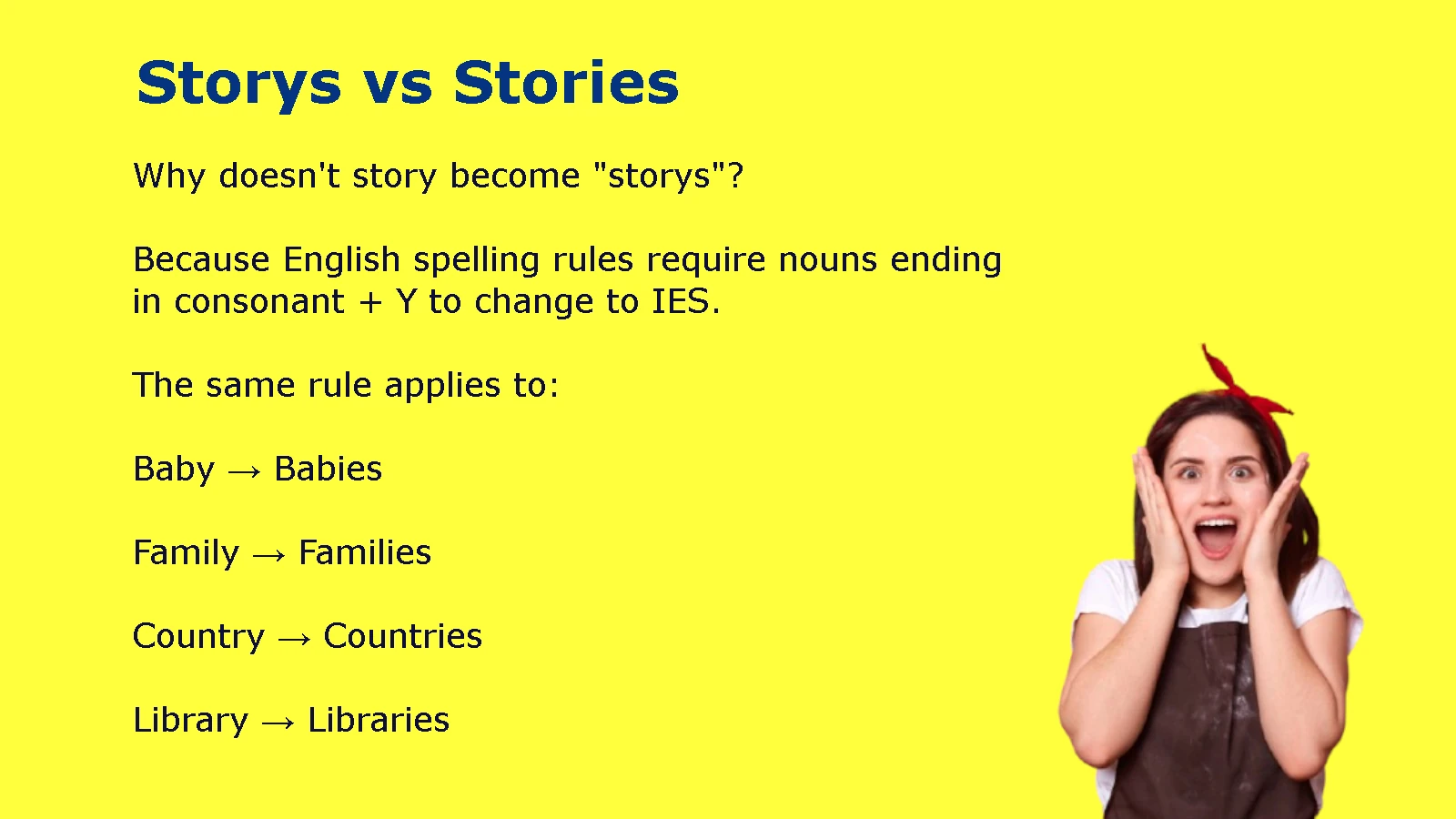
Why doesn’t story become “storys”?
Because English spelling rules require nouns ending in consonant + Y to change to IES.
The same rule applies to:
- Baby → Babies
- Family → Families
- Country → Countries
- Library → Libraries
Is “storeys” the same as “stories”?
No.
Stories refers to narratives, news reports, or building levels in American English.
Storeys refers only to building levels in British English.
Quick Grammar Cheat Sheet
Plural Rules
| Singular | Correct Plural | Incorrect |
| Story | Stories | Storys |
| Baby | Babies | Babys |
| City | Cities | Citys |
| Family | Families | Familys |
| Country | Countries | Countrys |
| Library | Libraries | Librarys |
| Party | Parties | Partys |
| Cherry | Cherries | Cherrys |
Plural Rule Summary
| Word Ending | What to Do | Example |
| Consonant + Y | Change Y to IES | Story → Stories |
| Vowel + Y | Add S | Toy → Toys |
| Vowel + Y | Add S | Boy → Boys |
| Vowel + Y | Add S | Journey → Journeys |
Memory Trick
Remember this sentence:
“If a consonant guards the Y, replace it with I before adding ES.”
It’s a simple way to recall the rule whenever you’re unsure.
Real-World Case Study: Why Correct Spelling Matters
A publishing company launched an online collection of children’s books. One category page displayed the title:
Popular Storys for Kids
Although the content was excellent, visitors quickly noticed the spelling mistake. Several readers mentioned it in comments, and the page appeared less polished than competing websites.
After the editor corrected the heading to:
Popular Stories for Kids
the page looked more professional, aligned with standard English grammar, and better reflected the publisher’s attention to detail.
This example illustrates an important point. A single spelling error may seem minor, yet it can influence how readers perceive the quality and credibility of your writing. Whether you’re creating blog posts, academic papers, marketing copy, or social media updates, correct grammar helps build trust.
Expert Quote
“Good grammar doesn’t make writing great, but poor grammar can keep great writing from being taken seriously.”
This principle explains why mastering simple rules like storys vs stories has lasting value. Clear, accurate writing lets your ideas shine without distracting readers.
Key Takeaways
If you remember only a few points from this guide, make them these:
- Stories is the only correct plural of story.
- Storys is a spelling mistake and should never appear in standard English.
- Words ending in a consonant + Y change Y to IES when forming the plural.
- Words ending in a vowel + Y simply add -S, as in boys, toys, and journeys.
- Don’t confuse stories with story’s or stories’. Apostrophes indicate possession, not plurality.
- In American English, a building level is a story, while British English uses storey for that meaning.
- Reading widely and practicing common plural patterns will help you recognize correct spellings naturally.
By understanding the grammar behind storys vs stories, you’re doing more than fixing one spelling mistake. You’re learning a dependable English rule that applies to hundreds of everyday words. Once this pattern becomes familiar, you’ll write with greater confidence, communicate more clearly, and avoid one of the most common pluralization errors in English.