Qué is generally used to ask for a definition, explanation, or identification, while cuál is used to ask someone to choose from specific options or identify something from a known group. When comparing que vs cuál, choose the word that best fits the question and its context.
The confusion comes from knowing when to use qué, when to use cuál, and understanding the difference between qué and cuál in everyday conversations. But here’s the good news: once you learn a few simple rules, choosing the correct word becomes much easier.
In this guide, you’ll discover the difference between Qué vs Cuál, learn how to use qué and cuál, explore their meaning, pronunciation, and grammar rules, and see plenty of example sentences. You’ll also find practical tips to help you remember the correct usage and avoid one of the most common mistakes made by Spanish learners.
By the end, you’ll know exactly when to use qué and cuál with confidence in both spoken and written Spanish.
What Does “Qué” Mean?
The Spanish word qué is an interrogative word used to ask about something unknown. Depending on the sentence, it usually translates as what or sometimes which in English.
Unlike English, Spanish often uses qué when asking for information, definitions, explanations, identities, or descriptions. It introduces questions where the answer isn’t selected from a limited list but instead requires new information.
What Is the Grammatical Role of Qué?
Qué can function in two different ways:
Interrogative Pronoun
As a pronoun, qué replaces the thing you’re asking about.
Examples:
- ¿Qué pasó? — What happened?
- ¿Qué quieres? — What do you want?
- ¿Qué ocurrió ayer? — What happened yesterday?
In each sentence, qué stands in place of unknown information.
Interrogative Adjective
When qué comes before a noun, it acts as an adjective that modifies the noun.
Examples:
- ¿Qué libro estás leyendo? — What book are you reading?
- ¿Qué película viste? — What movie did you watch?
- ¿Qué color prefieres? — What color do you prefer?
Notice that qué directly introduces the noun.
Common English Meanings of Qué
Depending on context, qué may translate as:
| Spanish | English Meaning |
| Qué | What |
| Qué + noun | What |
| Qué clase de | What kind of |
| Qué tipo de | What type of |
| Qué tan | How (degree or extent) |
When Native Speakers Use Qué
Spanish speakers naturally choose qué when asking:
- What something is
- What happened
- What someone wants
- What something means
- What type of object something is
- What someone’s profession is
- What name something has
- What explanation applies
Think of qué as requesting new information, not selecting from known choices.
Examples of Qué in Everyday Conversation
| Spanish | English |
| ¿Qué haces? | What are you doing? |
| ¿Qué comes? | What are you eating? |
| ¿Qué significa esta palabra? | What does this word mean? |
| ¿Qué quieres beber? | What do you want to drink? |
| ¿Qué hora es? | What time is it? |
| ¿Qué pasó anoche? | What happened last night? |
| ¿Qué estudias? | What do you study? |
| ¿Qué idioma hablas? | What language do you speak? |
| ¿Qué necesitas? | What do you need? |
| ¿Qué piensas? | What do you think? |
Common Expressions with Qué
You’ll hear these expressions almost every day in Spanish-speaking countries.
| Expression | Meaning |
| ¿Qué pasa? | What’s happening? |
| ¿Qué tal? | How’s it going? |
| ¿Qué dices? | What are you saying? |
| ¿Qué hay? | What’s up? |
| ¿Qué ocurre? | What’s going on? |
| ¿Qué importa? | What does it matter? |
| ¿Qué más? | What else? |
| ¿Qué sigue? | What’s next? |
These phrases are common in casual conversations and help learners sound more natural.
What Does “Cuál” Mean?
The word cuál also appears in questions, but its purpose is different. Instead of asking for completely new information, cuál usually asks someone to identify one option from a known group.
English often translates cuál as which, although it sometimes becomes what depending on the sentence.
For example:
- ¿Cuál prefieres? — Which do you prefer?
- ¿Cuál quieres comprar? — Which one do you want to buy?
The answer comes from an existing set of possibilities.
Singular and Plural Forms
Unlike qué, cuál changes for number.
| Form | Meaning |
| Cuál | Which one |
| Cuáles | Which ones |
Examples:
- ¿Cuál es tu favorito?
- ¿Cuáles son tus libros favoritos?
Grammatical Function of Cuál
Unlike qué, cuál almost always functions as an interrogative pronoun.
It usually replaces the noun instead of describing it.
Examples:
- ¿Cuál eliges?
- ¿Cuál funciona mejor?
- ¿Cuál necesitas?
Notice there’s no noun immediately after cuál.
When Native Speakers Use Cuál
Spanish speakers naturally choose cuál when:
- Choosing between alternatives
- Asking someone to identify one option
- Asking for preferences
- Referring to known possibilities
- Asking someone to specify one person or object
Imagine several books sitting on a table.
Instead of asking:
❌ ¿Qué quieres?
A native speaker is more likely to ask:
✅ ¿Cuál quieres?
The available options already exist.
Examples of Cuál
| Spanish | English |
| ¿Cuál prefieres? | Which do you prefer? |
| ¿Cuál es tu favorito? | Which is your favorite? |
| ¿Cuál quieres? | Which one do you want? |
| ¿Cuál es la respuesta? | Which is the answer? |
| ¿Cuál compraste? | Which one did you buy? |
| ¿Cuál recomendamos? | Which one do we recommend? |
| ¿Cuál funciona mejor? | Which works better? |
| ¿Cuál elegiste? | Which did you choose? |
Common Expressions with Cuál
Some frequently used phrases include:
| Expression | Meaning |
| ¿Cuál es…? | Which is…? |
| ¿Cuál prefieres? | Which do you prefer? |
| ¿Cuál quieres? | Which one do you want? |
| ¿Cuál recomiendas? | Which do you recommend? |
| ¿Cuál sería mejor? | Which would be better? |
Qué vs Cuál: The Main Difference
Understanding que vs cual becomes much easier when you stop translating directly from English.
Instead, ask yourself one simple question:
Am I asking for completely new information or selecting from existing options?
If you’re requesting information that hasn’t been identified yet, use qué.
If you’re asking someone to choose from possibilities already understood by both speakers, use cuál.
Simple Rule to Remember
| Situation | Use |
| Asking “What is it?” | Qué |
| Asking for a definition | Qué |
| Asking before a noun | Qué |
| Choosing among options | Cuál |
| Asking which one | Cuál |
| Asking for preferences | Cuál |
Think About a Restaurant Menu
Imagine you’re sitting in a restaurant.
The waiter asks:
¿Qué quieres comer?
This works because you haven’t said what food you want yet.
Now imagine you’ve narrowed your choices to pizza or pasta.
The waiter may ask:
¿Cuál prefieres?
Now you’re selecting from known options.
That single change explains much of the difference between qué and cuál.
Side-by-Side Comparison
| Question | Why It Uses That Word |
| ¿Qué es un eclipse? | Asking for a definition |
| ¿Cuál es tu color favorito? | Selecting one preference |
| ¿Qué idioma estudias? | Asking for new information |
| ¿Cuál eliges? | Choosing from options |
| ¿Qué pasó? | Asking what happened |
| ¿Cuál funciona mejor? | Comparing alternatives |
The Biggest Translation Mistake
Many English speakers assume:
- What = Qué
- Which = Cuál
Unfortunately, Spanish doesn’t always follow that pattern.
Consider these examples:
¿Cuál es tu nombre?
English:
What is your name?
Spanish still uses cuál, not qué.
Likewise:
¿Qué es eso?
English:
What is that?
Here, qué is the only natural choice.
That’s why memorizing translations isn’t enough. Understanding the intention behind the question leads to much more accurate Spanish.
When to Use Qué
Although qué has several uses, they all share one idea: asking for information that hasn’t yet been identified.
Use Qué to Ask for Definitions
Whenever you’re asking what something is, qué is almost always correct.
Examples:
- ¿Qué es una galaxia?
- ¿Qué es la inteligencia artificial?
- ¿Qué significa democracia?
- ¿Qué es un volcán?
These questions ask someone to explain or define a concept.
Use Qué Before Nouns
This is one of the strongest grammar rules.
Whenever a question word directly modifies a noun, Spanish almost always uses qué.
Examples:
- ¿Qué coche compraste?
- ¿Qué camisa prefieres?
- ¿Qué canción escuchas?
- ¿Qué restaurante recomiendas?
- ¿Qué ciudad visitas?
Notice how the noun immediately follows qué.
Use Qué for Occupations
Spanish commonly asks about professions with qué.
Examples:
- ¿Qué haces?
- ¿Qué profesión tienes?
- ¿Qué estudias?
- ¿Qué trabajo buscas?
These questions seek information rather than choosing from options.
Use Qué for Names
Examples:
- ¿Qué nombre tiene?
- ¿Qué calle es esta?
- ¿Qué empresa desarrolló esta aplicación?
- ¿Qué país visitaste?
Again, the speaker wants new information rather than selecting from choices.
Use Qué for Explanations
Whenever someone asks for clarification, qué usually appears.
Examples:
- ¿Qué ocurrió?
- ¿Qué pasó?
- ¿Qué significa eso?
- ¿Qué quieres decir?
- ¿Qué sucedió después?
These questions invite detailed answers instead of simple selections.
Qué vs Cuál with the Verb “Ser”
The verb ser creates one of the biggest challenges when comparing que vs cual because both words sometimes appear before it.
Fortunately, there’s a logical distinction.
Use Qué es… for Definitions
Whenever you’re asking someone to define or explain something, choose qué.
Examples:
- ¿Qué es un satélite?
- ¿Qué es la inflación?
- ¿Qué es una hipótesis?
- ¿Qué es una oración subordinada?
Each question asks for a definition or explanation.
Use Cuál es… for Identification
When asking someone to identify one option among known possibilities, cuál is usually correct.
Examples:
- ¿Cuál es tu dirección?
- ¿Cuál es tu número de teléfono?
- ¿Cuál es la respuesta correcta?
- ¿Cuál es la capital de Australia?
- ¿Cuál es tu comida favorita?
The answer identifies a specific item rather than defining a concept.
A Helpful Way to Think About It
Compare these two questions:
- ¿Qué es un ordenador?
- ¿Cuál es tu ordenador?
The first asks for a definition.
The second asks someone to identify one computer from several possibilities.
Qué vs Cuál Before Nouns
One of the easiest grammar rules to remember is this:
Use qué directly before nouns. Avoid using cuál directly before nouns in standard Spanish.
This rule solves many of the mistakes English speakers make because English often uses which before a noun, while Spanish usually prefers qué in those same situations.
For example:
- ✅ ¿Qué libro estás leyendo? (What book are you reading?)
- ✅ ¿Qué película quieres ver? (What movie do you want to watch?)
- ✅ ¿Qué restaurante recomiendas? (What restaurant do you recommend?)
Notice that libro, película, and restaurante come immediately after qué.
By contrast, these sentences are incorrect in standard Spanish:
- ❌ ¿Cuál libro estás leyendo?
- ❌ ¿Cuál película viste?
- ❌ ¿Cuál restaurante prefieres?
Although you may occasionally hear regional variations in informal speech, grammar references and educated usage overwhelmingly favor qué before nouns.
Why Doesn’t Cuál Usually Come Before a Noun?
Think of cuál as replacing the noun instead of describing it.
Compare these examples:
| Correct Sentence | Why It Works |
| ¿Qué coche compraste? | The noun follows qué. |
| ¿Cuál compraste? | Cuál replaces “car.” |
| ¿Qué color te gusta? | Color follows qué. |
| ¿Cuál te gusta más? | Cuál stands for one option. |
This distinction helps conversations sound natural.
For example:
Person A: Tenemos tres apartamentos disponibles. (We have three apartments available.)
Person B: ¿Cuál recomiendas? (Which one do you recommend?)
Since everyone already knows the apartments being discussed, there’s no need to repeat the noun.
Qué vs Cuál in Everyday Conversations
Grammar rules matter, but everyday conversations show how native speakers naturally use these question words. Once you see them in context, choosing the correct word becomes much easier.
At School
Students constantly ask questions involving both qué and cuál.
Examples:
- ¿Qué tarea tenemos hoy?
- ¿Qué capítulo estudiaremos?
- ¿Cuál fue la respuesta correcta?
- ¿Cuál es tu materia favorita?
- ¿Qué significa esta palabra?
Notice the pattern:
- Qué introduces new information.
- Cuál identifies one answer or preference.
At Work
Professional conversations follow the same logic.
Examples:
- ¿Qué proyecto estás desarrollando?
- ¿Qué departamento dirige María?
- ¿Cuál propuesta aprobó el cliente?
- ¿Cuál reunión empieza primero?
- ¿Qué software utilizan?
While Traveling
Travel provides countless opportunities to practice que vs cual.
Examples:
- ¿Qué hotel recomiendas?
- ¿Qué documentos necesito?
- ¿Cuál es la salida correcta?
- ¿Cuál autobús va al aeropuerto?
- ¿Qué atracciones son imprescindibles?
At Restaurants
Restaurants create excellent examples because some questions ask for information while others ask diners to choose.
Examples:
- ¿Qué desea ordenar?
- ¿Qué especial tienen hoy?
- ¿Cuál prefiere, pollo o pescado?
- ¿Cuál vino recomienda?
- ¿Qué postre es casero?
Shopping
Shopping conversations often alternate between qué and cuál.
Examples:
- ¿Qué talla necesita?
- ¿Qué modelo busca?
- ¿Cuál le gusta más?
- ¿Cuál cuesta menos?
- ¿Qué garantía incluye?
Talking with Friends
Casual conversations rely heavily on both words.
Examples:
- ¿Qué hiciste ayer?
- ¿Qué planes tienes?
- ¿Cuál película te gustó más?
- ¿Cuál prefieres para cenar?
- ¿Qué opinas de la idea?
Phone Conversations
Even simple phone calls demonstrate the difference.
Examples:
- ¿Qué necesita?
- ¿Qué ocurrió?
- ¿Cuál extensión debo marcar?
- ¿Cuál número es correcto?
Regional Differences Across Spanish-Speaking Countries
Spanish is spoken by hundreds of millions of people across more than 20 countries. Naturally, vocabulary and pronunciation vary from one region to another. Fortunately, the core distinction between qué and cuál remains remarkably consistent.
Whether you’re speaking with someone from Spain, Mexico, Colombia, Argentina, Peru, or Chile, the same grammatical principles generally apply.
Spain
Speakers in Spain typically follow standard grammar closely in formal settings. You’ll frequently hear:
- ¿Qué haces?
- ¿Cuál prefieres?
- ¿Qué libro lees?
In casual speech, pronunciation and expressions differ by region, but the grammar stays stable.
Mexico
Mexican Spanish follows the same rules.
Examples include:
- ¿Qué quieres comer?
- ¿Cuál eliges?
- ¿Qué color buscas?
Because Mexican Spanish appears in many television shows and online resources, learners often become familiar with these patterns early.
Argentina
Argentine Spanish is famous for using vos instead of tú, but this doesn’t affect qué and cuál.
Examples:
- ¿Qué hacés?
- ¿Cuál elegís?
Only the verb changes.
Colombia
Colombian Spanish is often recommended for learners because of its relatively clear pronunciation.
Examples:
- ¿Qué necesitas?
- ¿Cuál prefieres?
The distinction remains unchanged.
Chile
Chilean Spanish can sound faster than other varieties, but grammar still follows the same principles.
Examples:
- ¿Qué pasó?
- ¿Cuál es el problema?
Caribbean Spanish
Countries such as Cuba, Puerto Rico, and the Dominican Republic often feature rapid speech and unique pronunciation patterns. Even so, native speakers continue using qué and cuál according to standard grammar.
Spoken vs. Written Spanish
Everyday speech sometimes includes shortcuts, omissions, or regional habits. Written Spanish, especially in books, newspapers, academic writing, and professional communication, follows standard grammatical conventions more consistently.
For learners, mastering standard usage first provides the strongest foundation.
Examples of Qué and Cuál Side by Side
The fastest way to master que vs cual is to compare them in similar situations.
| Situation | Correct Question | English Translation | Why It Uses That Word |
| Definition | ¿Qué es un eclipse? | What is an eclipse? | Requests a definition. |
| Identity | ¿Cuál es tu dirección? | What is your address? | Identifies specific information. |
| Preference | ¿Cuál prefieres? | Which do you prefer? | Chooses from options. |
| Description | ¿Qué color tiene? | What color is it? | The noun follows qué. |
| Explanation | ¿Qué ocurrió? | What happened? | Requests new information. |
| Selection | ¿Cuál compraste? | Which one did you buy? | Selects one item. |
| Food | ¿Qué quieres comer? | What do you want to eat? | Requests information. |
| Menu Choice | ¿Cuál quieres? | Which one do you want? | Selects from available dishes. |
| Education | ¿Qué estudias? | What do you study? | Requests information. |
| Exam | ¿Cuál fue la respuesta correcta? | Which was the correct answer? | Identifies one option. |
More Real-Life Examples
Family
- ¿Qué hace tu hermano?
- ¿Cuál de tus hermanos vive en Texas?
- ¿Qué regalo compraste?
- ¿Cuál fue el mejor regalo?
Travel
- ¿Qué país visitarás?
- ¿Cuál destino prefieres?
- ¿Qué documentos llevas?
- ¿Cuál vuelo sale primero?
Technology
- ¿Qué computadora compraste?
- ¿Cuál funciona más rápido?
- ¿Qué aplicación usas?
- ¿Cuál recomiendas?
Healthcare
- ¿Qué síntomas tienes?
- ¿Cuál medicamento tomó efecto?
- ¿Qué especialista necesitas?
- ¿Cuál tratamiento eligió el médico?
Daily Life
- ¿Qué desayunaste?
- ¿Cuál fue tu parte favorita del día?
- ¿Qué planes tienes para mañana?
- ¿Cuál elegirías otra vez?
The Most Common Mistakes Learners Make
Every Spanish learner makes mistakes. Fortunately, most follow predictable patterns. Recognizing them early helps you build confidence much faster.
Translating Directly from English
This is the most common mistake.
English often uses what and which differently than Spanish. Translating word for word leads to errors.
Instead of translating, focus on whether you’re requesting information or identifying one option.
Using Cuál Before Nouns
Many learners say:
- ❌ ¿Cuál libro?
- ❌ ¿Cuál película?
- ❌ ¿Cuál restaurante?
Standard Spanish uses:
- ✅ ¿Qué libro?
- ✅ ¿Qué película?
- ✅ ¿Qué restaurante?
Remember this rule whenever a noun immediately follows the question word.
Confusing “Qué es” with “Cuál es”
Compare these questions:
- ¿Qué es una computadora? → Requests a definition.
- ¿Cuál es tu computadora? → Identifies one computer.
Understanding the purpose behind each question prevents confusion.
Forgetting the Plural Form
Another common error involves cuáles.
Examples:
- ✅ ¿Cuáles son tus libros favoritos?
- ✅ ¿Cuáles prefieres?
Using singular cuál with plural nouns is incorrect.
Assuming Both Words Are Interchangeable
Although both words appear in questions, they don’t mean the same thing.
Replacing one with the other changes the meaning or makes the sentence sound unnatural.
Native speakers notice this immediately.
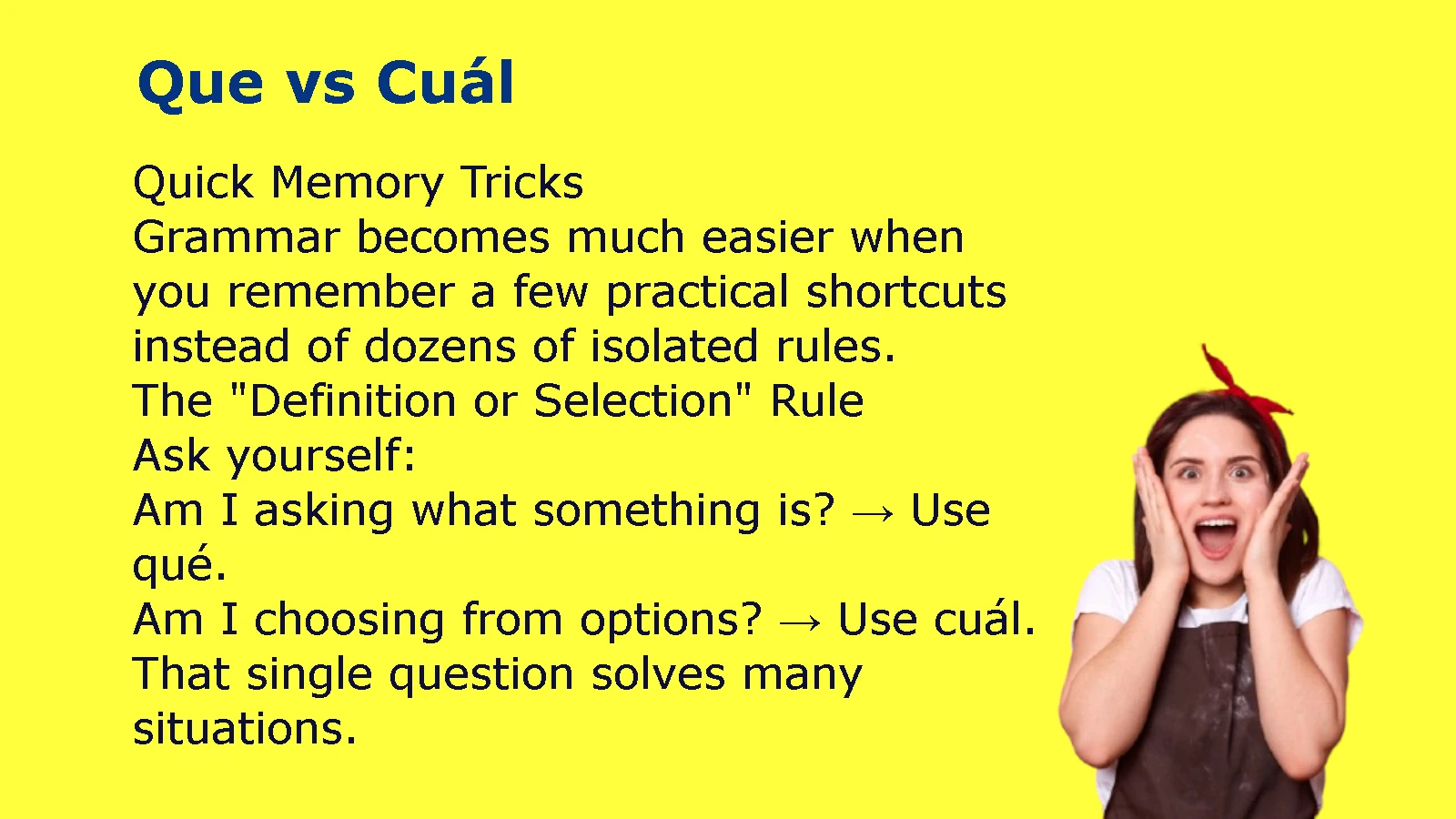
Quick Memory Tricks
Grammar becomes much easier when you remember a few practical shortcuts instead of dozens of isolated rules.
The “Definition or Selection” Rule
Ask yourself:
- Am I asking what something is? → Use qué.
- Am I choosing from options? → Use cuál.
That single question solves many situations.
The “Noun Test”
Look at the next word.
If a noun immediately follows, choose qué.
Examples:
- ¿Qué libro…?
- ¿Qué comida…?
- ¿Qué ciudad…?
- ¿Qué problema…?
If the noun is missing because you’re referring to an already known item, cuál often fits.
Examples:
- ¿Cuál quieres?
- ¿Cuál compraste?
- ¿Cuál prefieres?
Think of a Multiple-Choice Exam
Imagine an exam with four answers.
The teacher asks:
¿Cuál es la respuesta correcta?
You’re choosing one answer from several options.
Now imagine opening a textbook and asking:
¿Qué significa esta palabra?
You’re requesting an explanation, not making a selection.
This simple mental picture makes the difference between qué and cuál much easier to remember.
A Simple Mnemonic
You can remember the distinction with this phrase:
“Qué asks for knowledge. Cuál asks for choice.”
It’s not a perfect rule for every sentence, but it works well in the vast majority of everyday conversations and gives beginners a reliable starting point before tackling more advanced grammar.
Qué vs Cuál Cheat Sheet
If you only remember one section from this guide, make it this one. The table below summarizes the most important rules you’ll use in everyday Spanish.
| If You Want To… | Use | Example |
| Ask what something is | Qué | ¿Qué es un planeta? |
| Ask for a definition | Qué | ¿Qué significa esta palabra? |
| Ask before a noun | Qué | ¿Qué libro lees? |
| Ask what happened | Qué | ¿Qué pasó? |
| Ask for a profession | Qué | ¿Qué haces? |
| Ask which one | Cuál | ¿Cuál quieres? |
| Choose from known options | Cuál | ¿Cuál prefieres? |
| Ask for a favorite | Cuál | ¿Cuál es tu color favorito? |
| Identify one item | Cuál | ¿Cuál es tu asiento? |
| Use the plural form | Cuáles | ¿Cuáles son tus llaves? |
Decision Tree: Should You Use Qué or Cuál?
Start
│
Are you asking for a definition?
│ │
Yes No
│ │
Use QUÉ Are there known options?
│ │
Yes No
│ │
Use CUÁL Use QUÉ
Keep this flowchart in mind whenever you’re unsure. It covers the vast majority of real-life situations.
Practice Exercises
Reading rules is helpful, but using them is what builds confidence. Try answering these questions before checking the solutions.
Fill in the Blanks
Choose qué, cuál, or cuáles.
- _____ es una biblioteca?
- _____ libro compraste?
- _____ prefieres, café o té?
- _____ significa “amistad”?
- _____ son tus zapatos?
- _____ película viste ayer?
- _____ quieres hacer hoy?
- _____ de estos teléfonos comprarías?
- _____ ocurrió anoche?
- _____ es tu restaurante favorito?
Multiple-Choice Questions
Question 1
_____ color te gusta más?
A. Cuál
B. Qué
Correct Answer: B. Qué
Because color is a noun that follows the question word.
Question 2
Tenemos tres hoteles.
_____ prefieres?
A. Qué
B. Cuál
Correct Answer: B. Cuál
The speaker is choosing among known options.
Question 3
_____ significa “felicidad”?
A. Qué
B. Cuál
Correct Answer: A. Qué
The speaker wants a definition.
Question 4
_____ es tu número de teléfono?
A. Qué
B. Cuál
Correct Answer: B. Cuál
The answer identifies one specific piece of information.
Correct the Mistakes
Rewrite these sentences correctly.
| Incorrect | Correct |
| ¿Cuál libro quieres? | ¿Qué libro quieres? |
| ¿Cuál película viste? | ¿Qué película viste? |
| ¿Qué prefieres, rojo o azul?* | ¿Cuál prefieres, rojo o azul? |
| ¿Cuál significa esta palabra? | ¿Qué significa esta palabra? |
| ¿Qué es tu dirección? | ¿Cuál es tu dirección? |
*Note: If you’re choosing between clearly stated options, cuál is the more natural choice.
Translate into Spanish
Try translating these questions.
| English | Spanish |
| What happened? | ¿Qué pasó? |
| Which one do you want? | ¿Cuál quieres? |
| What book are you reading? | ¿Qué libro estás leyendo? |
| Which apartment is yours? | ¿Cuál es tu apartamento? |
| What does this mean? | ¿Qué significa esto? |
| Which is your favorite? | ¿Cuál es tu favorito? |
| What country are you visiting? | ¿Qué país visitas? |
| Which shoes should I buy? | ¿Cuáles zapatos debería comprar?* |
Note: In standard Spanish, it’s more natural to say ¿Qué zapatos debería comprar? when the noun follows directly. If the shoes have already been identified, you would typically say ¿Cuáles debería comprar?
Answer Key Summary
| Question | Correct Answer |
| 1 | Qué |
| 2 | Qué |
| 3 | Cuál |
| 4 | Qué |
| 5 | Cuáles |
| 6 | Qué |
| 7 | Qué |
| 8 | Cuál |
| 9 | Qué |
| 10 | Cuál |
Case Study: Learning from a Real Conversation
Imagine Sofia is shopping for a laptop.
Incorrect Conversation
Salesperson: ¿Cuál computadora busca?
Sofia: Estoy buscando una para trabajar.
Although understandable, ¿Cuál computadora busca? sounds unnatural because computadora directly follows the question word.
Correct Conversation
Salesperson: ¿Qué computadora busca?
Sofia: Necesito una con 16 GB de memoria.
The salesperson first asks for information.
After showing three laptops, the conversation changes.
Salesperson: Tenemos estos tres modelos.
¿Cuál prefiere?
Now cuál is correct because Sofia is choosing from known options.
This simple scenario illustrates why context matters more than literal translation.
Frequently Asked Questions
Can Qué and Cuál Ever Both Be Correct?
Sometimes, yes.
In a few situations, both words are grammatically possible, but they emphasize different ideas.
For example:
- ¿Qué quieres? asks generally what someone wants.
- ¿Cuál quieres? assumes several options are already available.
Native speakers often choose one based on context rather than strict grammar alone.
Why Do Native Speakers Sometimes Break the Rules?
Language changes over time, and spoken Spanish isn’t always identical to textbook Spanish.
Regional expressions, informal speech, and local habits occasionally produce variations. However, standard grammar remains the safest choice for learners, academic writing, business communication, and proficiency exams.
Is Cuál the Same as “Which” in English?
Usually, but not always.
Many English sentences beginning with what translate naturally with cuál.
For example:
- What is your phone number?
- ¿Cuál es tu número de teléfono?
Instead of memorizing translations, think about the purpose of the question.
Why Can’t Cuál Usually Come Before Nouns?
Because cuál generally replaces a noun instead of modifying it.
Spanish uses qué as the interrogative adjective before nouns.
Examples:
- ¿Qué libro?
- ¿Qué ciudad?
- ¿Qué idioma?
When the noun has already been established, cuál replaces it.
Does Latin American Spanish Use These Words Differently?
Not significantly.
Although pronunciation, vocabulary, and slang vary across countries, the distinction between qué and cuál remains consistent throughout the Spanish-speaking world.
Which Word Should Beginners Learn First?
Start with qué because you’ll encounter it constantly in everyday conversations.
Once you’re comfortable asking questions and requesting information, add cuál for situations involving choices, preferences, and identification.
Related Spanish Grammar Comparisons
If you’re studying Spanish grammar, mastering que vs cual is only one step. These related topics help reinforce the same decision-making process.
| Topic | Main Difference |
| Qué vs Cómo | What vs How |
| Qué vs Quién | What vs Who |
| Qué vs Dónde | What vs Where |
| Qué vs Cuándo | What vs When |
| Cuál vs Quién | Which vs Who |
| Cuál vs Qué tal | Which vs How’s it going |
| Interrogative Pronouns vs Interrogative Adjectives | Replacing nouns vs Modifying nouns |
Studying these comparisons together helps you recognize patterns instead of memorizing isolated grammar rules.
Common Expressions to Memorize
Learning complete phrases often feels easier than memorizing grammar rules.
Useful Questions with Qué
- ¿Qué haces?
- ¿Qué pasa?
- ¿Qué quieres?
- ¿Qué significa?
- ¿Qué necesitas?
- ¿Qué hora es?
- ¿Qué opinas?
- ¿Qué estudias?
- ¿Qué buscas?
- ¿Qué recuerdas?
Useful Questions with Cuál
- ¿Cuál prefieres?
- ¿Cuál quieres?
- ¿Cuál funciona mejor?
- ¿Cuál recomiendas?
- ¿Cuál es tu favorito?
- ¿Cuál eliges?
- ¿Cuál necesitas?
- ¿Cuál compraste?
- ¿Cuál fue la respuesta?
- ¿Cuáles son tus planes?
Practicing these expressions regularly will help you internalize the patterns behind each word.
Key Takeaways
Understanding que vs cual doesn’t require memorizing dozens of grammar rules. Instead, focus on the purpose of your question.
Remember these essential points:
- Qué usually asks for new information, explanations, or definitions.
- Qué almost always comes before a noun.
- Cuál usually asks someone to identify or choose from known options.
- Cuál typically replaces the noun instead of modifying it.
- Use cuáles when referring to more than one option.
- Avoid translating directly from English. Instead, think about the context and the kind of answer you’re expecting.
Here’s a final comparison you can revisit whenever you’re unsure:
| Question Type | Use | Example |
| Definition | Qué | ¿Qué es un satélite? |
| Explanation | Qué | ¿Qué significa esta palabra? |
| Before a noun | Qué | ¿Qué ciudad visitas? |
| Preference | Cuál | ¿Cuál prefieres? |
| Selection | Cuál | ¿Cuál quieres? |
| Identification | Cuál | ¿Cuál es tu dirección? |
Mastering qué and cuál is less about memorizing vocabulary and more about recognizing intent. Once you begin thinking in Spanish instead of translating from English, the correct choice becomes far more intuitive. With consistent practice, real-world conversations, and exposure to native speakers, you’ll find yourself using both question words naturally and confidently.