Drank is the simple past tense of drink, while drunk is the past participle used with helping verbs like has, have, or had. Drunk vs Drank is a common grammar question because each word has a different role in English sentences.
The confusion usually happens because drank and drunk are different verb forms, and using the wrong one can make your writing or speech sound incorrect. But here’s the kicker: once you understand a simple grammar rule, choosing the right word becomes surprisingly easy.
The good news? You don’t have to memorize complicated grammar lessons.
In this guide, you’ll learn the difference between Drunk vs Drank, discover the correct usage of drank and drunk, understand when to use drank or drunk, and see plenty of drank vs drunk examples in everyday sentences. You’ll also learn how to use drunk and drank correctly, common mistakes to avoid, and easy memory tricks to remember the difference.
By the end, you’ll know exactly when to use drank, when to use drunk, and how to avoid one of the most common verb mistakes in English.
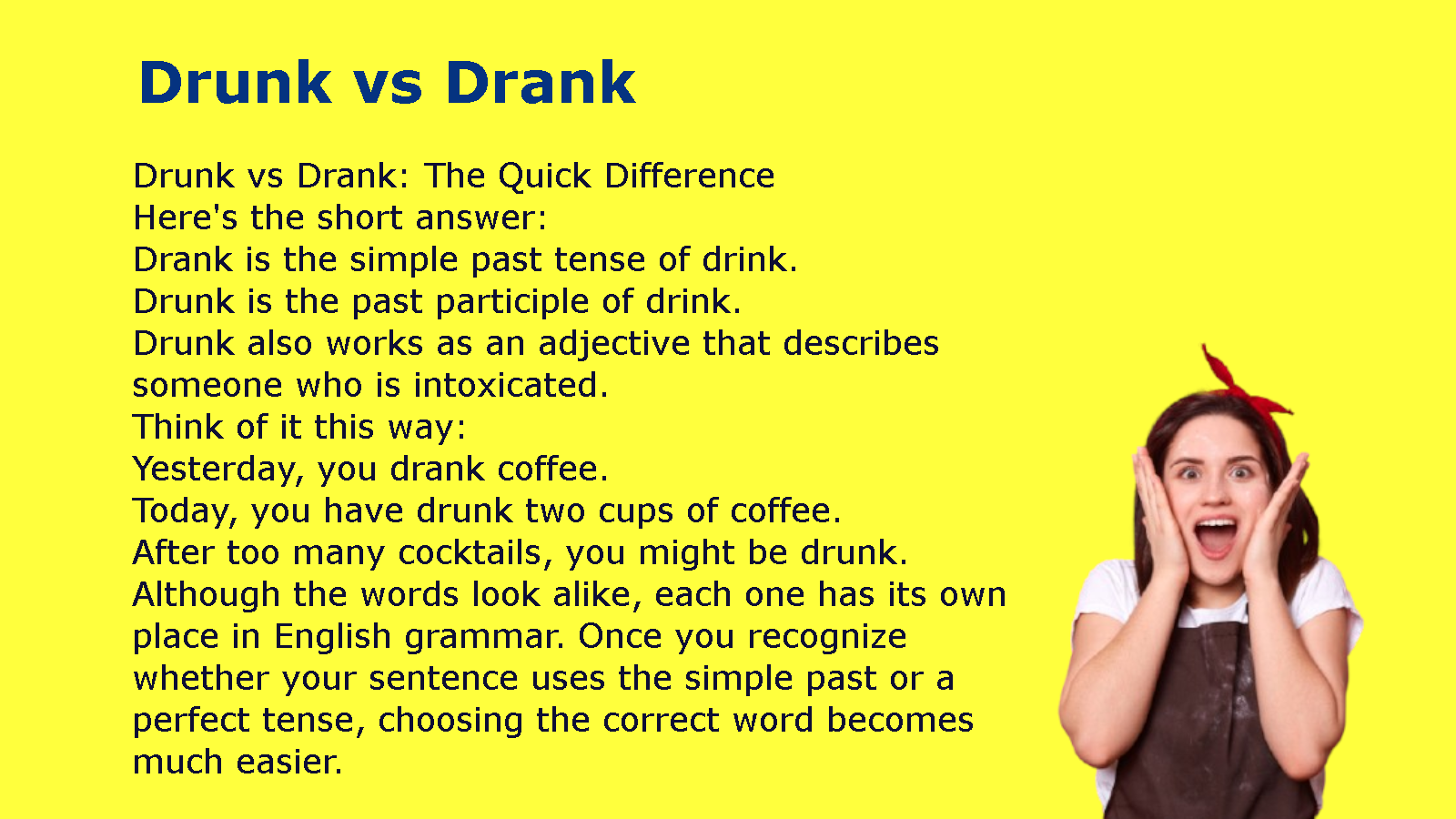
Drunk vs. Drank: The Quick Difference
Here’s the short answer:
- Drank is the simple past tense of drink.
- Drunk is the past participle of drink.
- Drunk also works as an adjective that describes someone who is intoxicated.
Think of it this way:
- Yesterday, you drank coffee.
- Today, you have drunk two cups of coffee.
- After too many cocktails, you might be drunk.
Although the words look alike, each one has its own place in English grammar. Once you recognize whether your sentence uses the simple past or a perfect tense, choosing the correct word becomes much easier.
Drunk vs. Drank Comparison Table
| Feature | Drank | Drunk |
| Verb form | Simple past | Past participle |
| Used alone | Yes | Usually no |
| Used with have, has, or had | No | Yes |
| Can describe intoxication | No | Yes |
| Example | I drank water. | I have drunk water. |
| Adjective | No | Yes |
What Does “Drank” Mean?
Definition of Drank
Drank is the simple past tense of the verb drink. It describes an action that started and finished in the past.
The action is complete. Nothing else is needed.
Examples include:
- I drank orange juice this morning.
- She drank tea after dinner.
- They drank bottled water during the hike.
- We drank coffee before work.
Notice that each sentence talks about a finished event.
When to Use Drank
Use drank whenever you’re talking about something someone consumed in the past.
You’ll often see it with time expressions like:
- yesterday
- last night
- last week
- earlier today
- this morning
- in 2024
- before lunch
- after work
Examples:
- He drank three glasses of water before practice.
- They drank lemonade at the picnic.
- Sarah drank milk with breakfast.
- We drank hot chocolate during the snowstorm.
The verb stands alone because the sentence is in the simple past tense.
Sentence Patterns Using Drank
Positive Sentences
- I drank enough water.
- She drank green tea.
- They drank fresh juice.
Negative Sentences
In negative sentences, English uses did not (didn’t) plus the base verb drink, not drank.
Correct:
- I didn’t drink coffee.
- She didn’t drink soda.
- They didn’t drink enough water.
Incorrect:
- ❌ I didn’t drank coffee.
Questions
Questions also use the base verb.
Correct:
- Did you drink the milk?
- Did they drink enough water?
- Did she drink tea yesterday?
Incorrect:
- ❌ Did you drank coffee?
This happens because did already marks the sentence as past tense.
Examples of Drank in Everyday Life
You’ll hear drank in conversations every day.
For example:
At breakfast:
“I drank orange juice instead of coffee.”
After exercising:
“We drank plenty of water.”
At school:
“Everyone drank from reusable bottles.”
Talking about vacation:
“We drank fresh coconut water on the beach.”
Storytelling:
“He drank the last bottle without realizing it belonged to someone else.”
What Does “Drunk” Mean?
Unlike drank, drunk has two different jobs in English.
It can be:
- a past participle
- an adjective
Understanding these two roles eliminates most grammar mistakes.
Drunk as a Past Participle
The past participle works with helping verbs such as:
- have
- has
- had
- will have
Examples:
- I have drunk enough water.
- She has drunk all the juice.
- They had drunk coffee before arriving.
- By noon, we will have drunk two liters of water.
Notice that drunk never appears by itself in these examples.
It follows a helping verb.
Why English Uses a Past Participle
Perfect tenses connect past actions with another point in time.
For example:
“I have drunk three cups of coffee.”
The speaker doesn’t simply describe yesterday’s action.
Instead, they’re explaining something that matters now.
Likewise:
“They had drunk all the milk before the guests arrived.”
The drinking happened before another event in the past.
Examples of Drunk as a Verb
Present Perfect
- I have drunk enough water today.
- She has drunk every flavor available.
- They have drunk herbal tea for years.
Past Perfect
- He had drunk the coffee before leaving.
- We had drunk all the lemonade before dinner.
Future Perfect
- By tomorrow, I will have drunk eight bottles of water.
Can “Drunk” Also Be an Adjective?
Yes.
This is where many learners become confused.
As an adjective, drunk describes someone who has consumed enough alcohol to become intoxicated.
Examples:
- He is drunk.
- She looks drunk.
- They became drunk after the celebration.
Here, drunk doesn’t function as a verb.
Instead, it describes a person’s condition.
Verb vs. Adjective
Compare these sentences.
Verb
She has drunk all the coffee.
Here, drunk is part of the verb phrase.
Adjective
She is drunk.
Now drunk describes her state.
The meanings are completely different even though the spelling stays the same.
Comparison Table
| Sentence | Function of Drunk |
| I have drunk coffee. | Past participle |
| She has drunk enough water. | Past participle |
| He looks drunk. | Adjective |
| They became drunk. | Adjective |
| The driver was drunk. | Adjective |
Drank vs. Drunk: Side-by-Side Grammar Comparison
Although these words come from the same verb, their grammar roles never overlap.
| Grammar Rule | Drank | Drunk |
| Simple past | ✔ | ✘ |
| Past participle | ✘ | ✔ |
| Needs helping verb | ✘ | ✔ |
| Used after have, has, or had | ✘ | ✔ |
| Can describe intoxication | ✘ | ✔ |
The easiest way to decide is to look for a helping verb.
If your sentence contains have, has, had, or will have, you’ll almost always need drunk.
If there’s no helping verb and you’re describing a completed action in the past, drank is usually the correct choice.
How to Use “Drank” Correctly
Many grammar mistakes disappear once you recognize that drank belongs only to the simple past tense.
Ask yourself one question:
Did the action happen and finish in the past?
If the answer is yes, drank is likely correct.
Rule One: Use Drank for Completed Past Actions
Examples:
- I drank coffee before work.
- She drank lemonade at lunch.
- They drank bottled water during the trip.
- We drank hot tea because it was cold outside.
Each action happened once and finished.
Rule Two: Don’t Use Drank After Helping Verbs
This is the most common mistake.
Incorrect:
- ❌ I have drank coffee.
- ❌ She has drank enough water.
- ❌ They had drank everything.
Correct:
- ✔ I have drunk coffee.
- ✔ She has drunk enough water.
- ✔ They had drunk everything.
Remember:
Helping verbs require the past participle, not the simple past tense.
Rule Three: Use the Base Verb After “Did”
When using did, always return to the base form drink.
Examples:
- Did you drink enough water?
- I didn’t drink soda.
- Did she drink the juice?
Never write:
- ❌ Did you drank water?
- ❌ I didn’t drank coffee.
Real-Life Examples
Imagine these everyday situations.
At a Restaurant
Customer:
“I drank sparkling water with dinner.”
Server:
“Great choice.”
At the Gym
Trainer:
“Did you drink enough water today?”
Client:
“Yes, I drank nearly three liters.”
At Work
Coworker:
“Have you drunk your coffee yet?”
Reply:
“Yes, I drank it about an hour ago.”
Notice how both words appear naturally in the same conversation because they serve different grammatical purposes.
Quick Memory Tip
Remember the three principal parts of the verb:
| Base Verb | Past Tense | Past Participle |
| Drink | Drank | Drunk |
This pattern matches many other irregular English verbs:
| Base | Past | Past Participle |
| Sing | Sang | Sung |
| Ring | Rang | Rung |
| Begin | Began | Begun |
| Swim | Swam | Swum |
| Shrink | Shrank | Shrunk |
How to Use “Drunk” Correctly
Now that you know when to use drank, let’s look at drunk in more detail. This is the form that causes the most confusion because it has two different grammatical functions.
As a past participle, drunk always appears with a helping verb such as have, has, had, or will have. As an adjective, it describes someone who is intoxicated.
Learning to recognize these two uses will help you avoid one of the most common grammar mistakes in English.
Rule One: Use “Drunk” With Helping Verbs
Whenever your sentence includes a perfect tense, use drunk.
Examples:
- I have drunk enough water today.
- She has drunk two cups of coffee.
- They had drunk all the lemonade before lunch.
- By tonight, we will have drunk every bottle.
Notice that drunk never replaces the helping verb. The helping verb carries the tense, while drunk completes the verb phrase.
Rule Two: Use “Drunk” in Perfect Tenses
English has three common perfect tenses that require the past participle.
Present Perfect
The present perfect connects a past action with the present.
Examples:
- I have drunk plenty of water today.
- She has drunk enough coffee already.
- They have drunk from that spring before.
This tense doesn’t focus on when something happened. Instead, it emphasizes the result or experience.
Past Perfect
The past perfect describes an action that happened before another past action.
Examples:
- We had drunk the coffee before the meeting began.
- He had drunk all the milk before anyone else woke up.
- They had drunk the last bottle before the store opened.
Future Perfect
The future perfect refers to an action that will be completed before a future point.
Examples:
- By noon, I will have drunk three liters of water.
- She will have drunk enough fluids before the race.
- By next week, they will have drunk every sample.
Rule Three: Use “Drunk” as an Adjective
When drunk describes a person’s condition instead of an action, it functions as an adjective.
Examples:
- He is drunk.
- They looked drunk.
- The driver appeared drunk.
- She became drunk after several cocktails.
Here, drunk tells you something about the subject. It doesn’t describe the act of drinking.
Examples in Everyday Situations
At home:
“I’ve already drunk enough coffee for today.”
At work:
“She has drunk three bottles of water since this morning.”
At the doctor’s office:
“Have you drunk any fluids today?”
At a family dinner:
“We had drunk tea before dessert arrived.”
These examples show how naturally drunk fits into perfect tenses.
Drank vs. Drunk in Every English Tense
One of the easiest ways to master drunk vs. drank is to see where each form belongs.
| Tense | Example |
| Simple Present | I drink water every day. |
| Present Continuous | I am drinking water now. |
| Simple Past | I drank water yesterday. |
| Past Continuous | I was drinking water when you called. |
| Present Perfect | I have drunk enough water today. |
| Past Perfect | I had drunk the coffee before leaving. |
| Future Simple | I will drink more water tomorrow. |
| Future Perfect | I will have drunk two liters by evening. |
| Present Perfect Continuous | I have been drinking more water lately. |
Notice that drank appears only in the simple past tense, while drunk appears in perfect tenses.
Why People Confuse Drank and Drunk
If you’ve ever hesitated before choosing drank or drunk, you’re not alone. Native speakers make this mistake too.
Several factors contribute to the confusion.
They’re Forms of the Same Verb
English irregular verbs don’t follow predictable spelling rules.
Compare:
- Drink → Drank → Drunk
- Sing → Sang → Sung
- Ring → Rang → Rung
Since these forms change vowels instead of adding -ed, they’re harder to memorize.
Everyday Speech Isn’t Always Grammatically Correct
People sometimes say:
- “I’ve drank enough.”
- “He had drank too much.”
Although these phrases appear in casual conversation, they’re considered nonstandard in formal English.
Professional writing, academic papers, journalism, and business communication all use have drunk instead.
Regional Dialects
Certain regional dialects use drank where standard grammar requires drunk.
For example:
- “I’ve drank plenty.”
You may hear this in everyday speech, but most grammar guides classify it as incorrect in standard American and British English.
Learners Translate From Their Native Language
Many languages don’t distinguish between simple past and past participle forms.
As a result, English learners often assume one word works everywhere.
English, however, assigns different grammatical roles to drank and drunk.
Common Mistakes and How to Fix Them
Even experienced writers occasionally choose the wrong form.
Here’s how to spot the most common errors.
| Incorrect | Correct | Explanation |
| I have drank coffee. | I have drunk coffee. | Present perfect requires the past participle. |
| She has drank enough. | She has drunk enough. | Use drunk after has. |
| They had drank everything. | They had drunk everything. | Past perfect uses the past participle. |
| Did you drank water? | Did you drink water? | After did, use the base verb. |
| I didn’t drank anything. | I didn’t drink anything. | Use the base form after didn’t. |
| He drunk three bottles yesterday. | He drank three bottles yesterday. | Simple past requires drank. |
A quick grammar check often catches these mistakes before you publish or submit your writing.
Memory Trick to Remember the Difference
Many learners find grammar easier when they connect it to a pattern.
Here’s one that works well.
The Three-Step Formula
Drink → Drank → Drunk
Think of it as a timeline.
- Today, you drink.
- Yesterday, you drank.
- You have drunk.
Repeat this sequence several times until it feels natural.
Remember the Helping Verb Rule
Ask yourself one simple question:
Does my sentence include have, has, had, or will have?
If the answer is yes, use drunk.
Examples:
- I have drunk enough water.
- She has drunk tea.
- They had drunk coffee.
No helping verb?
Use drank.
Examples:
- I drank coffee yesterday.
- We drank lemonade at lunch.
Compare Similar Irregular Verbs
English has several irregular verbs that follow nearly the same pattern.
| Base Verb | Past Tense | Past Participle |
| Drink | Drank | Drunk |
| Sing | Sang | Sung |
| Ring | Rang | Rung |
| Begin | Began | Begun |
| Swim | Swam | Swum |
| Shrink | Shrank | Shrunk |
| Spring | Sprang | Sprung |
Once you recognize this family of verbs, remembering the correct form becomes much easier.
Irregular Verb Pattern: Drink
Unlike regular verbs, drink doesn’t add -ed to form the past tense.
Instead, it changes internally.
| Verb Form | Word |
| Base Form | Drink |
| Simple Past | Drank |
| Past Participle | Drunk |
| Present Participle | Drinking |
This pattern dates back to Old English, where many strong verbs changed their vowel sounds instead of adding endings. Modern English still preserves this historical pattern in common verbs like drink, sing, ring, and begin.
Drunk vs. Drank in American and British English
A common question is whether American English and British English treat these words differently.
The answer is simple.
No.
Standard American English and standard British English follow exactly the same grammar rule.
| English Variety | Simple Past | Past Participle |
| American English | Drank | Drunk |
| British English | Drank | Drunk |
| Canadian English | Drank | Drunk |
| Australian English | Drank | Drunk |
You’ll find the same usage in newspapers, books, academic writing, and dictionaries across English-speaking countries.
The only noticeable difference is that some regional dialects may use drank in places where standard grammar requires drunk. That’s a feature of informal speech, not a difference in official grammar.
Examples in Everyday Conversation
Seeing drank and drunk in realistic situations makes the distinction much easier to remember.
At a Coffee Shop
Customer:
“I drank an iced latte this morning.”
Friend:
“I’ve drunk coffee every day this week.”
At School
Teacher:
“Did everyone drink enough water during the field trip?”
Student:
“Yes, we drank plenty.”
At the Gym
Trainer:
“Have you drunk enough water after your workout?”
Client:
“Yes. I drank almost a liter.”
At Home
Parent:
“Who drank the last glass of juice?”
Child:
“I did.”
At a Restaurant
Server:
“Have you drunk everything, or would you like another refill?”
Guest:
“I drank it all. Another glass would be great.”
Examples in Literature and Published Writing
Professional writers carefully distinguish between drank and drunk because each word communicates a different grammatical meaning.
You’ll commonly see:
- He drank deeply from the stream.
- She had drunk enough to feel confident.
- The travelers drank from the river before continuing their journey.
- By sunrise, they had drunk every drop of clean water.
Editors routinely correct errors such as “have drank” because they violate standard English grammar.
“Grammar is the framework that gives language clarity.”
Common Expressions Using “Drink,” “Drank,” and “Drunk”
English includes dozens of everyday expressions that use forms of the verb drink. Some are literal, while others are idioms with figurative meanings. Knowing these expressions will help you understand native speakers and sound more natural in conversation.
Common Expressions With “Drink”
These phrases appear frequently in everyday English.
| Expression | Meaning | Example |
| Have a drink | Consume a beverage, often alcohol | Let’s have a drink after work. |
| Drink up | Finish your drink | Drink up before we leave. |
| Grab a drink | Get a beverage | We grabbed a drink after the movie. |
| Drink plenty of water | Stay hydrated | Doctors recommend drinking plenty of water daily. |
| Take a sip | Drink a small amount | Take a sip before it’s too hot. |
Common Idioms With “Drink”
Idioms don’t always mean exactly what the individual words suggest.
Drink Like a Fish
Meaning: To drink a large amount of alcohol.
Example:
He drank like a fish during college, but he rarely drinks now.
Drink to Someone’s Health
Meaning: Raise a glass in celebration or honor.
Example:
Everyone drank to the newly married couple’s health.
Drink Someone Under the Table
Meaning: Consume more alcohol than another person without becoming as intoxicated.
Example:
He joked that his grandfather could drink anyone under the table.
Drink in Something
Meaning: To enjoy or absorb a sight, sound, or experience.
Example:
They stood quietly and drank in the beautiful sunset.
Expressions Using “Drunk” as an Adjective
When drunk describes intoxication, it appears in many common expressions.
Examples include:
- Drunk driving
- Drunk driver
- Drunk tank
- Stone drunk
- Blind drunk (informal)
- Fall-down drunk (informal)
Remember that these expressions use drunk as an adjective, not as the past participle of drink.
Drank vs. Drunk Quiz
Test your understanding before moving on.
Choose the correct word to complete each sentence.
Questions
Question 1
Yesterday, I _____ two cups of coffee.
- A. drank
- B. drunk
Question 2
She has _____ enough water today.
- A. drank
- B. drunk
Question 3
We _____ hot chocolate after skiing.
- A. drank
- B. drunk
Question 4
Have you _____ the orange juice?
- A. drank
- B. drunk
Question 5
By the time we arrived, they had _____ all the lemonade.
- A. drank
- B. drunk
Question 6
The guests _____ tea after dinner.
- A. drank
- B. drunk
Question 7
He looks _____ after the party.
- A. drank
- B. drunk
Question 8
I have never _____ coconut water before.
- A. drank
- B. drunk
Answer Key
| Question | Correct Answer | Reason |
| 1 | Drank | Simple past tense |
| 2 | Drunk | Present perfect |
| 3 | Drank | Completed past action |
| 4 | Drunk | Present perfect question |
| 5 | Drunk | Past perfect |
| 6 | Drank | Simple past |
| 7 | Drunk | Adjective |
| 8 | Drunk | Present perfect |
If you answered all eight correctly, you’ve already mastered the biggest grammar rule behind drunk vs. drank.
Practice Sentences
Practice helps you remember grammar rules long after you’ve finished reading them.
Beginner Practice
Choose the correct word.
- I _____ a bottle of water after my run.
- She has _____ three cups of tea.
- They _____ lemonade yesterday.
- Have you _____ enough today?
- We had _____ everything before the guests arrived.
Intermediate Practice
Correct the mistakes.
- I have drank too much coffee.
- She had drank all the milk.
- Did you drank enough water?
- They didn’t drank anything.
- He drunk orange juice yesterday.
Advanced Practice
Rewrite these sentences correctly.
- I’ve drank coffee every morning this week.
- Did she drank the entire bottle?
- They had drank all the juice before lunch.
- He drunk enough water yesterday.
- We didn’t drank anything during the trip.
Suggested Answers
- I’ve drunk coffee every morning this week.
- Did she drink the entire bottle?
- They had drunk all the juice before lunch.
- He drank enough water yesterday.
- We didn’t drink anything during the trip.
Real-Life Grammar Case Studies
Looking at real-world situations makes grammar rules easier to apply.
Case Study: A Student Essay
Original sentence:
I have drank more water since joining the soccer team.
Corrected sentence:
I have drunk more water since joining the soccer team.
Why?
The helping verb have requires the past participle drunk.
Case Study: A Workplace Email
Original sentence:
We drank all the coffee before the meeting started.
Result:
No correction needed.
Why?
The action happened and finished in the past, so drank is correct.
Case Study: Everyday Conversation
Person A:
Have you drunk enough water today?
Person B:
Yes. I drank nearly two liters this morning.
Both sentences are correct because each follows a different grammar rule.
Frequently Asked Questions About Drunk vs. Drank
Is “I have drank” ever correct?
No. In standard English, have must be followed by the past participle drunk.
Correct:
- I have drunk enough water.
Incorrect:
- I have drank enough water.
Is “drunk” a verb or an adjective?
It can be both.
As a past participle:
- She has drunk coffee.
As an adjective:
- She is drunk.
The sentence structure tells you which role it plays.
Why does “drunk” follow “have,” “has,” and “had”?
Those helping verbs form the perfect tenses, which always require the past participle.
Examples:
- have eaten
- has written
- had begun
- have drunk
This rule applies to all standard English grammar.
Is “drank” grammatically correct?
Yes. It’s the correct simple past form of drink.
Examples:
- I drank tea yesterday.
- They drank coffee after lunch.
Can “drunk” describe a person?
Yes.
Examples:
- He looks drunk.
- They became drunk after celebrating.
- The police arrested a drunk driver.
In these examples, drunk functions as an adjective.
Do American English and British English use different rules?
No.
Standard American English, British English, Canadian English, Australian English, and most other varieties of English follow the same grammatical distinction:
- Drink → Drank → Drunk
Regional speech patterns may differ, but formal grammar remains the same.
Which word is more common in everyday English?
Both are common because they serve different purposes.
You’ll often hear:
- I drank coffee this morning.
- I’ve drunk enough coffee today.
The correct choice depends on the sentence structure, not on which word is more popular.
What’s the easiest way to remember the difference?
Remember one simple rule:
No helping verb? Use drank.
Helping verb? Use drunk.
It’s a quick check that works in almost every situation.
Quick Reference Chart
Save this table if you need a fast reminder.
| Sentence Pattern | Correct Word |
| Yesterday I ___ coffee. | Drank |
| I have ___ coffee. | Drunk |
| She had ___ tea. | Drunk |
| They ___ water after lunch. | Drank |
| Have you ___ enough today? | Drunk |
| He is ___ after the party. | Drunk (adjective) |
Key Takeaways
If you remember only a few points from this guide, make them these:
- Drank is the simple past tense of drink.
- Drunk is the past participle used with have, has, had, and will have.
- Drunk also functions as an adjective that describes someone who is intoxicated.
- Never write “I have drank.” The correct form is “I have drunk.”
- After did or didn’t, always use the base verb drink, not drank.
- The complete verb pattern is drink → drank → drunk.
- Standard American English and British English follow the same grammar rules.
- Reading your sentences aloud can help you spot mistakes before you publish or submit your work.
Grammar Rule to Remember: If your sentence includes have, has, had, or will have, use drunk. If you’re simply describing a completed action in the past, use drank.
Mastering drunk vs. drank isn’t about memorizing dozens of rules. It’s about recognizing the sentence pattern. Once you know whether you’re writing in the simple past or a perfect tense, the correct choice becomes almost automatic. With a little practice, you’ll use both forms confidently in everyday conversations, professional writing, academic assignments, and formal communication.