Later refers to a time that comes after the present or another event, while latter refers to the second of two people or things mentioned. Later vs Latter is a common comparison because the words look similar but have different meanings and uses.
The challenge is that later refers to a future time, while latter means the second of two people, things, or ideas. And here’s the kicker: mixing them up can confuse your readers and make your writing seem less polished.
The good news? The distinction is much easier than it appears.
In this guide, you’ll learn the difference between Later vs Latter, understand later meaning, latter meaning, and later vs latter usage, and discover when to use later, when to use latter, and later vs latter examples in real sentences. You’ll also find simple memory tricks, later vs latter pronunciation, and tips to help you choose the correct word every time.
By the end, you’ll know exactly how to use later and latter correctly and avoid one of the most common word mix-ups in English.
Later vs Latter: Quick Comparison
| Feature | Later | Latter |
| Meaning | At a future time | The second of two people, things, or ideas |
| Part of Speech | Adverb, adjective | Adjective, pronoun |
| Refers To | Time | Position or order |
| Opposite | Earlier | Former |
| Common Usage | Daily conversations, schedules, future events | Formal writing, comparisons, essays |
| Example | See you later. | Of the two books, I preferred the latter. |
The Simple Rule
Remember this easy distinction:
- Use later when you’re talking about time.
- Use latter when you’re talking about the second of two things.
That single rule covers nearly every situation.
What Does “Later” Mean?
Definition of Later
The word later means after the present time or at a subsequent point. It indicates that something happens in the future compared with another event or the current moment.
Unlike latter, which compares two things, later always relates to time.
For example:
- I’ll finish the report later.
- We can discuss it later today.
- She moved to New York and later became an editor.
In each sentence, later tells you when something happens.
Origin and Etymology
Later comes from the Old English word lǣtra, which developed from the adjective late. Over centuries, English speakers used it as the comparative form of late, meaning “more late” or “after another time.”
Today, it has become one of the most frequently used time-related words in English.
When to Use “Later”
Use later whenever your sentence answers questions like:
- When?
- At what time?
- After what event?
It can refer to:
- The same day
- The next day
- The future in general
- A later stage in life
- A future chapter in a book
- A later version of software
- Historical periods
Examples:
- We’ll eat later.
- Call me later tonight.
- The company released a better model later.
- Scientists confirmed the theory later through additional research.
Common Situations Where “Later” Appears
Daily Conversations
Most people use later several times every day.
Examples:
- See you later.
- Talk later.
- Maybe later.
- I’ll text you later.
These expressions sound natural because they postpone an action without specifying the exact time.
Scheduling
Whether you’re planning a meeting or arranging dinner, later helps describe future events.
Examples:
- Let’s meet later this afternoon.
- We’ll review the proposal later.
- The appointment was moved to a later date.
Businesses frequently use later in calendars, emails, and meeting invitations.
Future Events
When discussing plans, later keeps the focus on the future.
Examples:
- She’ll start college later this year.
- We’ll decide later.
- They announced more details later in the conference.
Storytelling
Authors often use later to move readers forward in time.
Example:
The explorer left the village at sunrise. Three hours later, he reached the mountain pass.
This technique creates smooth transitions without explaining every moment between events.
Emails and Messages
Professional communication often includes later because it sounds polite and flexible.
Examples:
- I’ll reply later today.
- Let’s revisit this later.
- We can discuss the budget later this week.
Examples of “Later” in Sentences
Seeing later in different contexts makes its meaning easier to understand.
Everyday Examples
- I’ll see you later.
- We can leave later if traffic improves.
- She finished her homework later than expected.
- I’ll explain everything later.
Workplace Examples
- The manager scheduled another meeting later.
- We’ll finalize the contract later this month.
- Please send the revised document later today.
Academic Examples
- Later chapters explain the concept in greater detail.
- Scientists later discovered additional evidence.
- The author later revised the original edition.
Historical Examples
- The empire expanded later in the century.
- Historians later confirmed the dates.
- Later generations preserved the tradition.
Common Phrases Using “Later”
Many English expressions include later. Learning them helps you sound more natural.
| Phrase | Meaning | Example |
| See you later | Goodbye for now | See you later after work. |
| Talk later | Speak again soon | I’m busy now. Talk later. |
| Later today | Before the day ends | We’ll announce it later today. |
| Later tonight | During the evening | Let’s watch the movie later tonight. |
| Later this week | Before the week ends | The package should arrive later this week. |
| Later on | At a future time | You’ll understand later on. |
| Sooner or later | Eventually | Sooner or later, practice pays off. |
| Until later | Goodbye until another time | Take care until later. |
Case Study: How “Later” Changes Meaning
Imagine two coworkers discussing a presentation.
Incorrect:
We’ll review the slides latter.
This sentence doesn’t make sense because latter doesn’t describe time.
Correct:
We’ll review the slides later.
Now the sentence clearly means the review will happen in the future.
One small spelling change completely alters the meaning.
Interesting Facts About “Later”
- Later is among the most frequently used time-related words in everyday English.
- It functions as both an adverb and an adjective.
- It commonly appears in spoken English because it’s short, flexible, and easy to understand.
- Expressions like “see you later” have become standard farewells in English-speaking countries.
- Unlike latter, later works comfortably in both formal and informal writing.
“Sooner or later, those who win are those who think they can.” — Richard Bach
Although the quote focuses on perseverance, it also demonstrates how naturally later fits into everyday English.
What Does “Latter” Mean?
Definition of Latter
The word latter refers to the second of two people, objects, ideas, or choices that have already been mentioned.
Unlike later, latter has nothing to do with time. Instead, it identifies which item you’re talking about after introducing two possibilities.
For example:
- Tea and coffee are both popular drinks, but I prefer the latter.
- Between driving and flying, the latter is usually faster.
- The article discussed education and healthcare. The latter received more attention.
In every example, latter points to the second item.
Origin and Etymology
The word latter comes from the Old English lætra, meaning later or slower, but over time its meaning shifted. Modern English uses latter primarily to identify the second of two previously mentioned things, while later retained the time-related meaning.
This historical split explains why the two words look alike but serve different purposes today.
When to Use “Latter”
Use latter only when you’ve already mentioned exactly two people, places, objects, events, or ideas.
For example:
- Cats and dogs are wonderful pets, but the latter usually require more outdoor exercise.
- We can travel by train or by plane. The latter is faster but usually costs more.
- The professor explained both supply and demand. The latter proved more difficult for students to understand.
If you’ve listed three or more items, avoid using latter, because readers won’t know which one you mean. Instead, name the specific item again for clarity.
How “Latter” Refers to the Second of Two Things
A simple pattern makes latter easy to remember.
First item → Former
Second item → Latter
For example:
| First Mentioned | Second Mentioned |
| Summer | Winter |
| Apples | Oranges |
| Reading | Writing |
| Walking | Running |
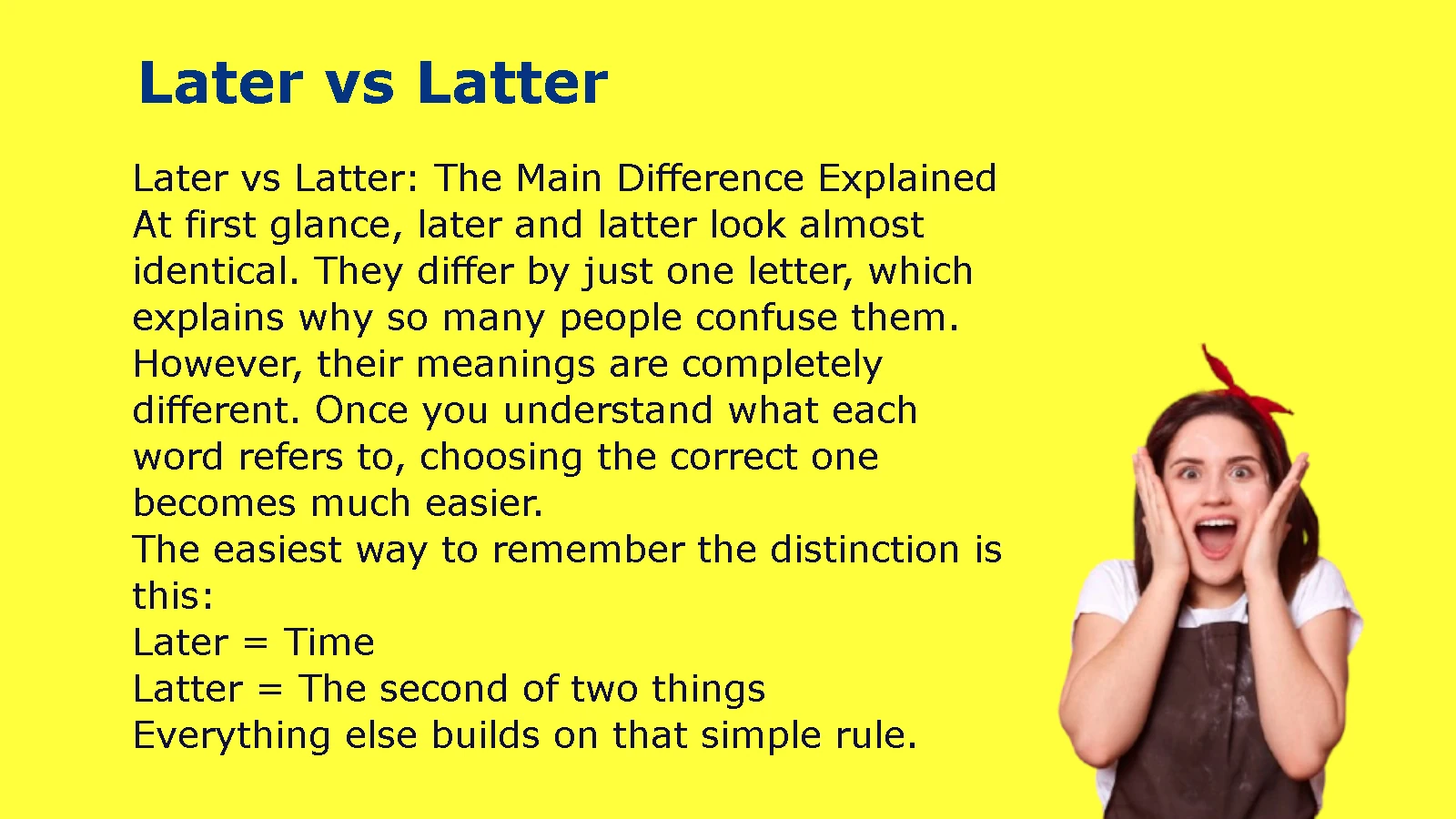
Later vs Latter: The Main Difference Explained
At first glance, later and latter look almost identical. They differ by just one letter, which explains why so many people confuse them. However, their meanings are completely different. Once you understand what each word refers to, choosing the correct one becomes much easier.
The easiest way to remember the distinction is this:
- Later = Time
- Latter = The second of two things
Everything else builds on that simple rule.
Time vs. Order
The biggest difference between later vs latter is what each word describes.
Later tells you when something happens. It always relates to time, whether that’s a few minutes from now, next week, or years into the future.
Latter tells you which person, object, or idea you’re referring to. Specifically, it identifies the second of two previously mentioned items.
Compare these examples:
| Sentence | Correct Word | Why |
| I’ll finish the project _____ today. | later | Refers to time |
| We discussed marketing and sales. The _____ needs a larger budget. | latter | Refers to the second item |
| She moved to Boston and later accepted a new job. | later | Indicates a future event |
| Between the blue jacket and the black jacket, I bought the latter. | latter | Identifies the second jacket |
Notice how later never replaces a noun, while latter often does.
Future vs. Second Mentioned
Another helpful way to think about the difference is this:
Later always points forward in time.
Examples:
- We’ll talk later.
- She arrived later than expected.
- The company expanded later that year.
Latter always points backward to something you’ve already mentioned.
Examples:
- Pizza and pasta are both popular. I prefer the latter.
- The article compared inflation and unemployment. The latter received more attention.
One word looks ahead. The other looks back.
Why the Meanings Never Overlap
Although later and latter share similar spellings and historical roots, modern English uses them for completely different purposes.
Consider these sentences:
Correct
- I’ll call you later.
- Between spring and autumn, I enjoy the latter more.
Now swap the words.
Incorrect
- I’ll call you latter.
- Between spring and autumn, I enjoy the later more.
Neither sentence works because each word belongs in a different grammatical role.
A Simple Rule to Remember
Whenever you’re unsure, ask yourself one question:
Am I talking about time or comparing two things?
If your answer is time, use later.
If your answer is the second of two, use latter.
That quick mental check solves almost every later vs latter question.
Side-by-Side Examples of Later vs Latter
Looking at both words together makes the distinction much clearer.
| Situation | Correct Sentence | Explanation |
| Future event | I’ll see you later. | Refers to time. |
| Comparing two books | I enjoyed the latter novel more. | Refers to the second book. |
| Meeting schedule | Let’s discuss it later today. | Future time. |
| Two vacation spots | Between Italy and Greece, the latter is warmer in October. | Second option. |
| School assignment | The professor explained the answer later in the lecture. | Time sequence. |
| Two proposals | The committee accepted the latter proposal. | Second proposal. |
Conversation Examples
Everyday speech usually calls for later because people often talk about future plans.
Examples:
- I’ll text you later.
- Let’s grab lunch later this week.
- Can we continue this conversation later?
- I’ll explain everything later tonight.
By contrast, latter appears when you’re comparing two options.
Examples:
- Between coffee and tea, I’ll choose the latter.
- We considered two apartments. The latter had more natural light.
- I liked both movies, although the latter had a stronger ending.
Academic Writing Examples
Formal writing uses latter more often than casual conversation.
Examples:
- The study examined anxiety and depression. The latter affected a larger percentage of participants.
- Researchers analyzed climate and biodiversity. The latter became the primary focus.
- The essay compares democracy and monarchy before evaluating the latter.
Meanwhile, later still appears whenever discussing chronology.
Examples:
- The experiment was repeated later.
- Scientists later published updated findings.
- Later editions corrected several factual errors.
Business Communication Examples
Professional emails frequently use both words correctly.
Using Later
- I’ll send the revised proposal later today.
- Let’s schedule another meeting later this week.
- We’ll review the quarterly report later.
Using Latter
- We can launch in June or July. The latter gives us more preparation time.
- We considered hiring internally or externally. The latter offers a broader talent pool.
News Writing Examples
Journalists often rely on later to describe events in chronological order.
Examples:
- Officials later confirmed the reports.
- The storm weakened later that evening.
- Police later released additional details.
Editorial writers may use latter while comparing ideas.
Example:
- The article examined taxation and government spending. The latter received stronger public support.
Literature Examples
Authors use both words differently depending on the context.
Later
Later that evening, the village fell silent.
Latter
Hope and fear competed within him. The latter eventually disappeared.
Notice how later moves the story forward while latter identifies the second emotion.
How to Decide Between Later and Latter
Even experienced writers occasionally pause before choosing between these words. Fortunately, a simple decision-making process removes the guesswork.
Step 1: Are You Talking About Time?
If your sentence describes when something happens, choose later.
Examples:
- We’ll eat later.
- She arrived later than everyone else.
- I’ll finish it later tonight.
- The announcement came later.
If the sentence answers “When?”, later is almost certainly correct.
Step 2: Are You Referring to the Second of Two Things?
If you’ve mentioned two people, places, objects, or ideas, choose latter.
Examples:
- Between skiing and hiking, I enjoy the latter.
- The article discussed health and education. The latter occupied most of the discussion.
- We compared two software platforms. The latter performed better.
If you can replace the word with “the second one,” then latter fits.
Step 3: Replace the Word to Check Your Meaning
A quick substitution often reveals the correct answer.
Replace later with:
- afterward
- subsequently
- at a future time
If the sentence still makes sense, later is correct.
Example:
I’ll call you afterward.
That works.
Replace latter with:
- the second one
Example:
Between baseball and basketball, I prefer the second one.
That also works.
This simple test helps eliminate mistakes.
Later vs Latter in Grammar
Although these words resemble each other, they belong to different grammatical categories.
Parts of Speech
Later
Later commonly functions as:
- Adverb
- Adjective
Examples:
Adverb
- I’ll finish later.
- She arrived later.
Adjective
- A later version fixed the problem.
- We discussed it at a later meeting.
Latter
Latter functions as:
- Adjective
- Pronoun (usually in the phrase the latter)
Examples:
Adjective
- The latter chapters are easier.
Pronoun
- Of the two proposals, I chose the latter.
Comparative Forms
Many learners mistakenly assume later and latter are simply different spellings of the same comparative adjective.
They’re not.
Here’s the correct relationship:
| Word | Function |
| Late | Base adjective |
| Later | Comparative form referring to time |
| Latest | Superlative form |
Meanwhile:
| Word | Function |
| Latter | Identifies the second of two things |
| Latterly | Adverb meaning “recently,” though now uncommon in everyday American English |
Adjective vs. Adverb Usage
Later can modify verbs.
Examples:
- I’ll arrive later.
- She responded later.
It can also modify nouns.
Examples:
- Later versions solved the issue.
- Later chapters explain the theory.
Latter, however, never functions as an adverb.
Instead, it modifies nouns or replaces the second noun already mentioned.
Examples:
- The latter choice.
- The latter explanation.
- The latter proved more accurate.
Using “The Latter” as a Pronoun
One of the most common uses of latter is as the phrase the latter.
Example:
We visited Chicago and Seattle. The latter had cooler weather.
Instead of repeating Seattle, the sentence simply says the latter.
This technique improves flow and avoids unnecessary repetition.
Common Sentence Structures
Here are some reliable sentence patterns.
Later
- I’ll ___ later.
- We met later.
- Later that day…
- Later in life…
- At a later stage…
Latter
- Between A and B, the latter…
- The former…, while the latter…
- In the latter case…
- The latter option…
- The latter half…
These structures appear frequently in books, newspapers, research papers, and professional writing.
Later vs Latter in British and American English
One question often comes up: Do British English and American English use these words differently?
The answer is no.
Both varieties of English use later and latter with the same meanings and grammar.
Whether you’re writing for readers in the United States, Canada, the United Kingdom, or Australia, the distinction remains the same:
- Later refers to time.
- Latter refers to the second of two previously mentioned things.
Pronunciation Guide
Although later and latter differ in meaning, many English learners also confuse them because they sound similar. Understanding their pronunciation makes them easier to recognize in conversations and helps you use each word with confidence.
How to Pronounce “Later”
IPA (American English): /ˈleɪ.t̬ɚ/
The first syllable sounds like the word “lay.” The second syllable is soft, and the t often becomes a quick flap sound in American English, making it sound close to “lay-der.”
Examples:
- I’ll call you later.
- See you later.
- We can finish this later.
How to Pronounce “Latter”
IPA (American English): /ˈlæt̬ɚ/
The first syllable rhymes with “cat.” Like later, the t usually becomes a flap in American English, but the vowel sound is completely different.
Examples:
- I preferred the latter option.
- The latter chapter was more interesting.
- Of the two, choose the latter.
Common Pronunciation Mistakes
Many learners pronounce both words with the same first vowel sound. That’s the most common mistake.
Remember:
- Later → LAY-ter
- Latter → LAT-er
Listening to native speakers and practicing aloud can help you hear the distinction more clearly.
Memory Tricks to Remember the Difference
If you struggle with later vs latter, these memory techniques can help.
The Time Trick
Think of the letter E in later as standing for eventually.
Both words relate to time.
- Later → Eventually
- Later → Future
- Later → Time
The Two Items Trick
The word latter contains two T’s.
Think of those two T’s as representing two choices.
Example:
- Pizza
- Pasta ← Latter
The Former–Latter Pair
Whenever you see former, expect latter.
Example:
The former answer was shorter, while the latter explained the concept in more detail.
They naturally work together.
The Alphabet Trick
Imagine two items labeled:
- A
- B
The second item is latter.
Visual Association
Picture a timeline.
Past —————- Now —————- Later
Now picture two boxes.
Box 1 (Former)
Box 2 (Latter)
One represents time. The other represents position.
Common Mistakes People Make
Even fluent English speakers occasionally misuse these words.
Understanding the most common mistakes helps you avoid them.
Using “Later” Instead of “Latter”
Incorrect:
Between coffee and tea, I prefer the later.
Correct:
Between coffee and tea, I prefer the latter.
The sentence compares two drinks rather than discussing time.
Using “Latter” When Talking About Time
Incorrect:
I’ll finish the project latter.
Correct:
I’ll finish the project later.
Whenever you’re talking about when, choose later.
Misunderstanding “Former and Latter”
Some writers accidentally reverse the meanings.
Remember:
- Former = First item
- Latter = Second item
Example:
We visited New York and Boston. The former has Times Square.
Here, former refers to New York because it was mentioned first.
Using “Latter” for More Than Two Things
Incorrect:
We visited Paris, Rome, and Madrid. The latter was my favorite.
Although many people say this informally, it creates ambiguity because there are three cities.
Better:
We visited Paris, Rome, and Madrid. Madrid was my favorite.
Repeating the noun improves clarity.
Creating Ambiguous References
Avoid making readers guess.
Instead of writing:
The latter was expensive.
Write:
Of the two laptops, the latter model cost $300 more.
Specific writing is always stronger.
Examples in Real-Life Writing
Understanding grammar is useful, but seeing the words in realistic situations makes the difference easier to remember.
Workplace Emails
Later
- I’ll send the updated report later today.
- Let’s discuss pricing later this afternoon.
- We’ll revisit this issue later.
Latter
- We can extend the deadline or reduce the project scope. The latter seems more practical.
- Between remote work and hybrid work, management chose the latter.
School Assignments
Students frequently use latter in essays.
Example:
Shakespeare explores both revenge and justice. The latter becomes the dominant theme during the final act.
Meanwhile, later appears when discussing chronology.
Example:
The author later revised the manuscript.
Text Messages
Most text messages include later, not latter.
Examples:
- Talk later!
- See you later.
- I’ll call later tonight.
- Catch you later.
Books and Articles
Professional writers often prefer latter because it avoids repetition.
Example:
The report compares renewable energy and fossil fuels. The latter produces significantly higher carbon emissions.
Professional Documents
Business reports commonly include sentences like:
We evaluated two software platforms. The latter reduced operating costs by 18%.
Instead of repeating the software name, the latter keeps the writing concise.
Case Study: How One Letter Changes Meaning
Imagine a hiring manager sends this email:
We interviewed Sarah and Emily. We’ll hire the later.
Employees would likely pause because later suggests time rather than identifying a candidate.
The correct sentence is:
We interviewed Sarah and Emily. We’ll hire the latter.
One letter completely changes the meaning.
Later vs Latter in Literature and Formal Writing
Both words appear regularly in published writing, but they serve different purposes.
Why Authors Use “Latter”
Writers use latter to avoid repeating nouns.
Instead of writing:
Dogs and wolves share common ancestors. Wolves are generally larger than dogs.
They can write:
Dogs and wolves share common ancestors. The latter are generally larger.
This creates smoother, more polished prose.
Why “Later” Appears More Often
Because everyday communication revolves around time, later appears far more frequently than latter.
You’ll hear it in:
- Conversations
- Movies
- Television
- Podcasts
- News reports
- Emails
- Social media
Expressions like “See you later” have become part of everyday English.
Words Commonly Confused with Later and Latter
Several English words create similar confusion.
Former vs Latter
| Former | Latter |
| First of two | Second of two |
Example:
We considered renting and buying. The former costs less initially, while the latter builds equity over time.
Latest vs Last
- Latest = Most recent
- Last = Final or previous
Examples:
- The latest software update fixed several bugs.
- Last week was unusually busy.
Late vs Later
- Late describes something that is behind schedule.
- Later compares time.
Examples:
- The train is late.
- The train arrived later than expected.
After vs Later
Although similar, they aren’t always interchangeable.
Example:
- We’ll eat after the meeting.
- We’ll eat later.
The first specifies after what. The second simply indicates a future time.
Subsequent vs Later
Subsequent sounds more formal.
Example:
- Subsequent investigations confirmed the findings.
In everyday English, later is usually the more natural choice.
Following vs Latter
Following refers to what comes next.
Latter identifies the second of two previously mentioned things.
Formerly vs Previously
These words describe something that existed in the past.
Examples:
- The building was formerly a train station.
- She previously worked as an engineer.
Neither word replaces later or latter.
Related Word Forms
Understanding related words helps expand your vocabulary.
| Word | Meaning |
| Late | Behind schedule |
| Later | At a future time |
| Latest | Most recent |
| Lately | Recently |
| Lateness | The state of being late |
| Latter | The second of two |
| Latterly | Recently (formal and uncommon) |
Synonyms and Similar Words
Synonyms for “Later”
Depending on the context, you can use:
- Afterward
- Afterwards
- Subsequently
- Eventually
- Thereafter
- In due course
- At a later time
- Down the road
- In the future
Synonyms for “Latter”
Because latter has a very specific meaning, it has fewer true synonyms.
Possible alternatives include:
- The second
- The second one
- The last-mentioned
- The final of the two
When Synonyms Don’t Work
Not every synonym fits every sentence.
Example:
I’ll see you eventually.
This changes the tone slightly compared with:
I’ll see you later.
Likewise:
I chose the second one.
This is correct, but the latter often sounds more concise in formal writing.
Antonyms
Antonyms of Later
- Earlier
- Before
- Previously
- Formerly (in some contexts)
Antonyms of Latter
- Former
- First
- Earlier (depending on context)
Practice Exercises
Fill in the Blank
Choose later or latter.
- I’ll finish my homework ________.
- Between baseball and soccer, I enjoy the ________ more.
- Scientists ________ discovered additional evidence.
- We compared two proposals. The ________ was approved.
- See you ________!
Choose the Correct Word
- We can discuss it (later / latter) this afternoon.
- Between tea and coffee, I chose the (later / latter).
- The company (later / latter) announced a new policy.
- The (later / latter) chapters explain the theory in detail.
- I’ll reply (later / latter) tonight.
Rewrite the Sentence
Correct each sentence.
- I’ll see you latter.
- Between cats and dogs, I like the later.
- The latter meeting starts tomorrow.
- We’ll review the report latter this week.
- Between science and history, the later interests me more.
Answer Key
Fill in the Blank
- later
- latter
- later
- latter
- later
Choose the Correct Word
- later
- latter
- later
- latter
- later
Rewritten Sentences
- I’ll see you later.
- Between cats and dogs, I like the latter.
- The later meeting starts tomorrow.
- We’ll review the report later this week.
- Between science and history, the latter interests me more.
Frequently Asked Questions About Later vs Latter
Is it later or latter?
Use later when referring to time. Use latter when referring to the second of two previously mentioned people, things, or ideas.
What is the difference between later and latter?
Later relates to a future time, while latter identifies the second item in a pair.
What does “the latter” mean?
The latter means the second of two people, objects, or ideas already mentioned.
Can later and latter be used interchangeably?
No. They have different meanings and grammatical functions.
Is “the latter” formal English?
Yes. It’s common in academic writing, journalism, business communication, and formal documents, though it’s also acceptable in everyday speech when comparing two things.
What is the opposite of “the latter”?
The opposite is the former, which refers to the first of two mentioned items.
Can “latter” refer to more than two things?
Standard English uses latter for two items. When discussing three or more, repeat the specific noun instead of using latter to avoid ambiguity.
Is “later” always related to time?
Yes. Later always expresses a point in time that comes after another.
What does “later on” mean?
Later on means at a future time. It functions much like later, often adding a slightly more conversational tone.
Is “former and latter” still commonly used?
Yes. The pair remains widely used in academic, legal, business, and editorial writing because it avoids unnecessary repetition.
What is the difference between “late,” “later,” and “latest”?
- Late means behind schedule.
- Later is the comparative form referring to a future time.
- Latest means the most recent.
Can “the latter” be used without “the former”?
Yes. As long as two items have already been mentioned, the latter can stand alone if the reference is clear.
Why do people confuse later and latter?
They look similar, differ by only one letter, and are pronounced somewhat alike. Despite these similarities, they serve different purposes.
Which word is more common in everyday conversation?
Later is far more common because people frequently talk about future events. Latter appears more often in comparisons, formal writing, and academic contexts.
Key Takeaways: Later vs Latter
The difference between later vs latter becomes simple once you focus on what each word refers to.
- Later always relates to time. Use it when something happens after the present moment or after another event.
- Latter always refers to the second of two previously mentioned people, things, or ideas.
- If your sentence answers “When?”, choose later.
- If your sentence identifies “Which of the two?”, choose latter.
- Remember the pair former and latter. Former points to the first item, while latter points to the second.
Keep one easy memory aid in mind:
| If You’re Talking About… | Use… |
| Time or the future | Later |
| The second of two items | Latter |
Once you apply this rule, you’ll use later and latter correctly in conversations, emails, academic writing, and professional documents with confidence.