Unjust is the correct English word used to describe something unfair or lacking justice. Injust vs Unjust is a common spelling comparison because injust is a misspelling and unjust is the only correct form in standard English.
The confusion is understandable because English spelling isn’t always predictable. Many people mistakenly assume injust is a valid word simply because other adjectives begin with the in- prefix. But here’s the kicker: only one of these spellings is recognized in standard English.
In this guide, you’ll learn the difference between Injust vs Unjust, discover the correct spelling of unjust, understand why “injust” is incorrect, and see unjust meaning, unjust pronunciation, and unjust examples in a sentence. You’ll also learn how to use unjust correctly and a simple trick to remember the right spelling every time.
By the end, you’ll know exactly which word belongs in your writing and how to avoid this common spelling mistake with confidence.
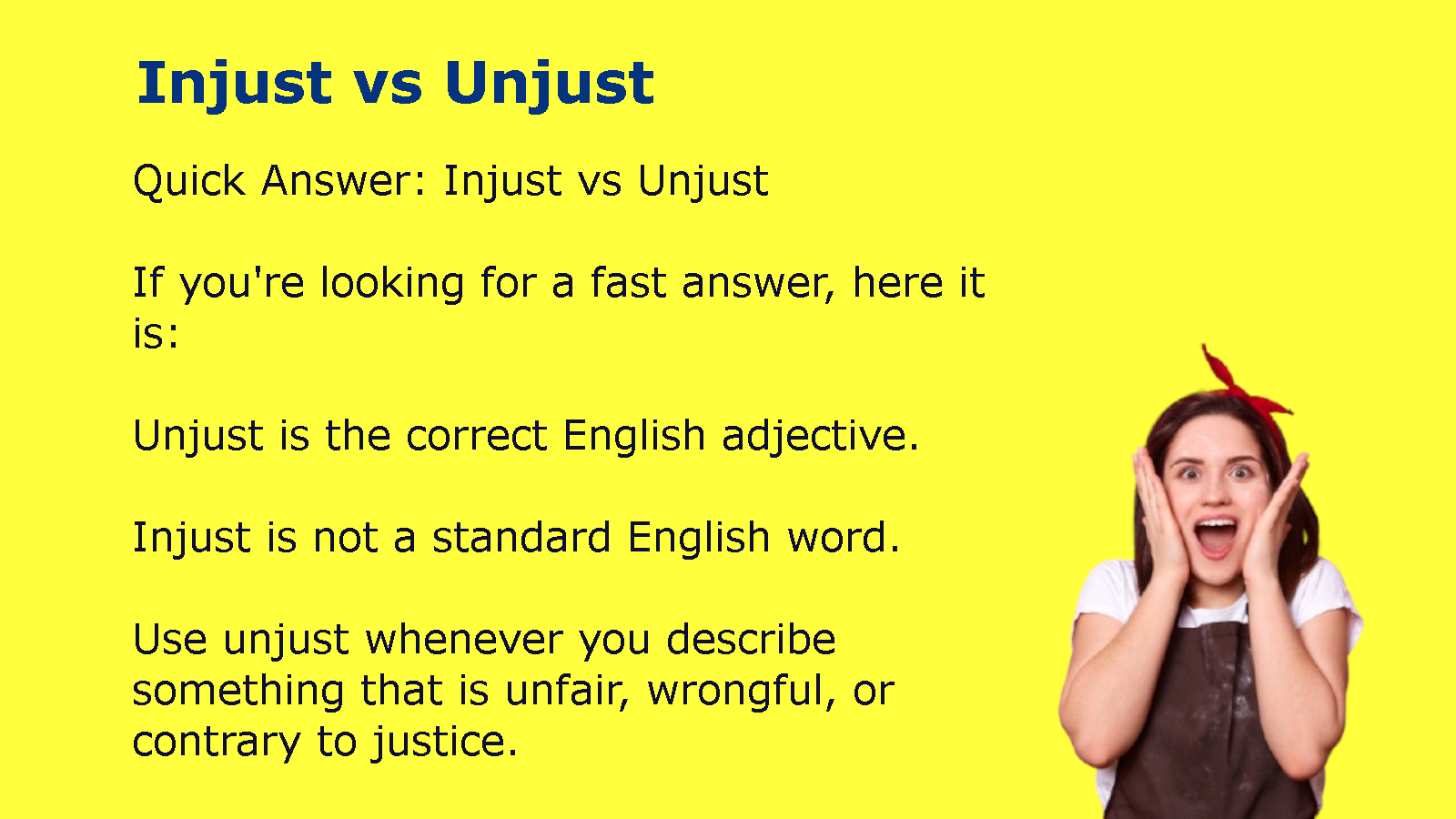
Quick Answer: Injust vs Unjust
If you’re looking for a fast answer, here it is:
- Unjust is the correct English adjective.
- Injust is not a standard English word.
- Use unjust whenever you describe something that is unfair, wrongful, or contrary to justice.
| Word | Correct in Modern English? | Meaning |
| Injust | ❌ No | Nonstandard spelling; avoid using it |
| Unjust | ✅ Yes | Unfair, not based on justice or fairness |
Example:
✅ The judge ruled that the punishment was unjust.
❌ The judge ruled that the punishment was injust.
A simple way to remember the difference is this:
Justice begins with “just,” and English forms its opposite with “un-“—not “in-“.
What Does “Unjust” Mean?
The word unjust describes something that is not fair, morally right, or consistent with justice. People commonly use it when talking about unfair treatment, unequal opportunities, biased decisions, or laws that fail to protect people’s rights.
Dictionary Meaning
Unjust (adjective)
Definition:
Not based on fairness, justice, or moral principles.
Pronunciation
un·just
/ʌnˈdʒʌst/
Part of Speech
- Adjective
Word Formation
- Prefix: un- (meaning not)
- Root: just
Together they form the meaning:
not just
Origin of the Word “Unjust”
The adjective unjust has existed in English for centuries. It comes from the Latin word justus, meaning lawful, upright, or fair. Over time, English adopted just and naturally created its opposite by adding the prefix un-.
Many everyday English adjectives follow this same pattern:
| Positive Word | Opposite |
| fair | unfair |
| kind | unkind |
| clear | unclear |
| happy | unhappy |
| just | unjust |
Because un- commonly forms opposites for native English adjectives, unjust became the accepted standard.
What Does “Unjust” Describe?
The word applies to many situations where fairness or justice is missing.
Laws
Some laws may treat certain groups unfairly.
Example
Many historians now consider those laws unjust because they denied equal rights.
Decisions
A decision becomes unjust when it favors one side without a fair reason.
Example
The committee made an unjust decision by ignoring important evidence.
Punishments
Punishment should match the offense. When it doesn’t, people often describe it as unjust.
Example
Many believed the sentence was unjust because the crime was minor.
Treatment
People often use unjust to describe unfair behavior.
Example
Employees protested what they considered unjust treatment in the workplace.
Social Systems
Entire institutions or systems can also be unjust.
Examples include:
- discriminatory policies
- unequal education
- unfair taxation
- biased hiring practices
Common Contexts Where “Unjust” Appears
Although unjust sounds formal, it appears in many types of writing.
Legal Writing
Lawyers and judges often discuss whether a decision or punishment is unjust.
Examples:
- unjust conviction
- unjust imprisonment
- unjust verdict
News Reports
Journalists frequently describe unfair situations.
Examples:
- unjust policy
- unjust discrimination
- unjust restrictions
Academic Writing
Researchers studying ethics, history, politics, or sociology often analyze unjust systems.
Example:
The paper examines how unjust institutions affect economic opportunity.
Everyday Conversation
People also use the word naturally in daily speech.
Examples:
“That wasn’t fair.”
“The teacher’s decision felt unjust.”
Examples of “Unjust” in Sentences
Here are several original examples showing how the word fits different contexts.
Everyday Examples
- The rule seemed unjust because only one student received a punishment.
- She felt the criticism was unjust.
- Everyone agreed the accusation was unjust.
Workplace Examples
- Workers challenged the company’s unjust policies.
- Management corrected an unjust pay difference.
Education
- Students protested an unjust grading system.
- Parents questioned what they believed was an unjust decision.
Government
- Citizens demanded reforms after years of unjust treatment.
- The organization opposed unjust laws affecting minority groups.
Is “Unjust” Always About the Law?
No.
Many people assume unjust belongs only in legal writing. In reality, the word covers any situation where fairness, morality, or justice is missing.
For example:
| Situation | Is “Unjust” Appropriate? |
| Court ruling | ✅ Yes |
| Teacher grading | ✅ Yes |
| Family argument | ✅ Yes |
| Workplace promotion | ✅ Yes |
| Government policy | ✅ Yes |
| Sports referee decision | ✅ Yes |
Whenever fairness becomes the issue, unjust is often the right adjective.
Is “Injust” a Real Word?
This question appears in search engines surprisingly often.
The short answer is:
No.
Injust is not recognized as a standard English word in modern dictionaries.
If you write:
The punishment was injust.
most readers will assume it’s a spelling mistake.
Instead, write:
The punishment was unjust.
Why Do People Think “Injust” Exists?
The confusion makes sense.
English contains many words beginning with in-, such as:
- incorrect
- incomplete
- inactive
- inaccurate
- incapable
After seeing these examples, many learners naturally expect:
just → injust
However, English doesn’t work that way.
Some adjectives take un- while others take in-. The choice depends largely on history rather than a simple grammar rule.
Does “Injust” Exist in Other Languages?
This is one reason the confusion continues.
Several Romance languages contain words that resemble injust.
For example:
| Language | Word |
| French | injuste |
| Romanian | injust |
| Catalan | injust |
| Occitan | injust |
Someone familiar with these languages may accidentally transfer that spelling into English.
Modern English, however, standardized the form unjust centuries ago.
Why Modern Dictionaries Reject “Injust”
Major English dictionaries list unjust as the accepted adjective.
They do not recognize injust as a standard English spelling.
If injust appears in writing today, it usually results from:
- typing errors
- autocorrect mistakes
- influence from another language
- misunderstanding English prefixes
- OCR scanning errors
- accidental misspellings
For professional, academic, or business writing, always choose unjust.
Injust vs. Unjust: Side-by-Side Comparison
The easiest way to understand the difference is to compare the two directly.
| Feature | Injust | Unjust |
| Standard English word | ❌ No | ✅ Yes |
| Accepted by modern dictionaries | ❌ No | ✅ Yes |
| Correct spelling | ❌ No | ✅ Yes |
| Safe for academic writing | ❌ No | ✅ Yes |
| Safe for business writing | ❌ No | ✅ Yes |
| Common in everyday English | ❌ No | ✅ Yes |
| Means unfair | Intended, but incorrect | Yes |
| Recommended to use | Never | Always |
The Bottom Line
Whenever you want to describe something that lacks fairness or justice, unjust is the only correct choice in modern English.
Why People Confuse “Injust” and “Unjust”
The mistake isn’t random. Several language patterns make it surprisingly easy to write injust by accident.
Understanding those patterns helps you avoid similar spelling errors in the future.
English Has Several Negative Prefixes
English doesn’t rely on just one negative prefix. Instead, it uses several, including:
- un-
- in-
- im-
- il-
- ir-
- non-
Because so many options exist, learners often try to apply one pattern everywhere.
Unfortunately, English developed over centuries by borrowing words from many languages. As a result, the prefixes don’t always follow a neat formula.
Similar Words Create False Patterns
Your brain naturally looks for familiar spelling patterns.
Consider these words:
| Word | Opposite |
| complete | incomplete |
| active | inactive |
| legal | illegal |
| responsible | irresponsible |
| possible | impossible |
After seeing these examples, injust looks reasonable—even though it isn’t correct.
Influence from Other Languages
Multilingual speakers often transfer spelling habits from one language to another.
For example:
French uses injuste.
Someone translating directly into English may accidentally write:
The law was injust.
Instead, English requires:
The law was unjust.
Typing Speed
Sometimes the explanation is much simpler.
Fast typing leads to:
- missing letters
- swapped prefixes
- autocorrect errors
- overlooked spelling mistakes
That’s one reason proofreading remains important, especially in professional writing.
Why English Uses “Un-” Instead of “In-“
English borrowed vocabulary from Germanic, Latin, and French sources. Because of that history, different prefixes developed for different groups of words.
Although there are exceptions, a helpful pattern exists.
| Prefix | Meaning | Example |
| un- | not | unfair |
| in- | not | incorrect |
| im- | not | impossible |
| il- | not | illegal |
| ir- | not | irresponsible |
The adjective just follows the un- pattern rather than the in- pattern.
Think of it this way:
- fair → unfair
- kind → unkind
- happy → unhappy
- certain → uncertain
- just → unjust
Trying to force in- onto just creates a word that standard English simply doesn’t use.
A Simple Memory Trick
If you’re unsure which spelling to choose, remember this phrase:
If something isn’t fair, it’s unjust—not injust.
It takes only a second to recall, yet it can prevent a spelling mistake that stands out immediately to readers.
When to Use Unjust
Knowing that unjust is the correct spelling is only the first step. The next challenge is understanding when it fits better than similar words like unfair, wrong, or illegal.
Use unjust when you want to emphasize that an action, decision, rule, or system violates principles of fairness, justice, or morality. The word often carries a stronger meaning than unfair because it suggests a deeper ethical concern.
In Legal Writing
Lawyers, judges, and legal scholars frequently use unjust when discussing outcomes that conflict with justice.
Examples
- The court overturned an unjust conviction.
- The attorney argued that the sentence was unjust.
- The organization campaigned against unjust laws.
In Academic Writing
Researchers often analyze history, politics, economics, and ethics through the lens of justice.
Examples
- The study examines unjust labor practices during the Industrial Revolution.
- Scholars continue debating whether the policy created an unjust distribution of resources.
In Journalism
News reports often describe policies, treatment, or events that many people consider unfair.
Examples
- Protesters called the regulation unjust.
- Community leaders criticized the unjust decision.
In Everyday Conversation
Although unjust sounds more formal than unfair, people still use it in daily speech when they want to stress the seriousness of a situation.
Examples
- That punishment feels unjust.
- It’s unjust to blame one person for everyone’s mistake.
- Many parents believed the decision was unjust.
Common Phrases with Unjust
Some combinations appear repeatedly in books, newspapers, and conversations. Learning these collocations makes your writing sound more natural.
| Phrase | Meaning | Example |
| unjust law | A law that lacks fairness | Many activists opposed the unjust law. |
| unjust treatment | Unfair treatment | She reported unjust treatment at work. |
| unjust punishment | Excessive or unfair punishment | The child received unjust punishment. |
| unjust decision | A biased or unfair decision | Employees appealed the unjust decision. |
| unjust accusation | A false or unfair claim | He defended himself against the unjust accusation. |
| unjust criticism | Criticism without good reason | The manager apologized for the unjust criticism. |
| unjust system | A system that treats people unfairly | Citizens demanded changes to the unjust system. |
| unjust imprisonment | Being imprisoned unfairly | The case became an example of unjust imprisonment. |
| unjust conviction | A wrongful criminal conviction | New evidence overturned the unjust conviction. |
| unjust discrimination | Unequal treatment without fairness | The organization challenged unjust discrimination. |
Synonyms of Unjust
No two words share exactly the same meaning. Choosing the right synonym depends on your context.
Formal Synonyms
| Word | Best Used When |
| Inequitable | Unequal distribution or treatment |
| Wrongful | Legal or moral wrongdoing |
| Oppressive | Abuse of authority or power |
| Biased | Favoring one side unfairly |
| Discriminatory | Unequal treatment based on personal characteristics |
| Partial | Showing favoritism |
Everyday Alternatives
| Word | Difference from Unjust |
| Unfair | Most common and conversational |
| Harsh | Focuses on severity |
| One-sided | Shows favoritism |
| Unreasonable | Lacks logic rather than justice |
| Cruel | Emphasizes suffering |
Which Synonym Should You Choose?
- Use unfair in casual conversation.
- Use unjust when discussing ethics, rights, or justice.
- Use wrongful in legal contexts.
- Use biased when favoritism is the main issue.
- Use oppressive for governments, institutions, or abuse of power.
Antonyms of Unjust
These words express fairness, equality, or moral correctness.
| Antonym | Meaning |
| Just | Fair and morally right |
| Fair | Treating everyone equally |
| Equitable | Based on equality |
| Impartial | Free from bias |
| Objective | Based on facts rather than opinions |
| Reasonable | Logical and sensible |
Examples
- The judge remained impartial throughout the trial.
- Everyone appreciated the fair decision.
- The company introduced a more equitable pay structure.
Real-Life Examples of Unjust
The word unjust appears in many situations beyond legal discussions.
Workplace
Imagine two employees perform equally well. One receives a promotion because of personal connections rather than performance.
Most employees would describe that outcome as unjust because it violates fairness.
Education
Suppose an entire class receives lower grades because one student cheated.
Students might say:
“The punishment was unjust because everyone suffered for one person’s mistake.”
Sports
A referee accidentally awards points to the wrong team.
Fans often call the result unjust, especially if the mistake changes the outcome of the game.
Family Life
Parents sometimes punish every child without finding out who actually caused the problem.
Children naturally see this as unjust because responsibility wasn’t assigned fairly.
Government
Throughout history, citizens have challenged policies they believed denied equal rights or opportunities.
Many social reform movements began because people wanted to replace unjust systems with fairer ones.
Grammar Tip: Can Unjust Describe People?
Yes.
Although unjust often describes decisions, laws, or actions, it can also describe people.
Correct Examples
- The ruler was unjust.
- She believed her supervisor was unjust.
- History remembers him as an unjust leader.
More commonly, however, the adjective modifies actions or decisions rather than individuals.
Compare these examples:
✅ The manager made an unjust decision.
✅ The manager was unjust.
Both are correct, but the first sounds more specific.
Unjust vs. Similar Words
Many writers confuse unjust with related words. While they overlap, each has its own meaning.
| Word | Main Meaning | Same as Unjust? |
| Unfair | Not treating people equally | Very close |
| Illegal | Against the law | Not always |
| Immoral | Against moral principles | Sometimes |
| Biased | Showing favoritism | Sometimes |
| Wrongful | Legally or morally wrong | Often |
Important Distinction
Something can be legal but still unjust.
For example, a law may technically follow legal procedures while treating certain people unfairly.
Likewise, something can be illegal without necessarily being unjust. A person may break a reasonable law, making the act illegal even though the law itself is fair.
Example Sentences Using Unjust
Here are original examples showing how naturally unjust fits different situations.
Everyday Examples
- The accusation was completely unjust.
- Everyone agreed the decision seemed unjust.
- She couldn’t stay silent after witnessing such unjust treatment.
- The new rule felt unjust to many students.
- Nobody deserves such unjust criticism.
Professional Examples
- Employees challenged the unjust promotion policy.
- The board reversed its unjust decision.
- Customers criticized the company’s unjust pricing strategy.
- The investigation exposed several unjust practices.
- Management corrected an unjust disciplinary action.
Academic Examples
- Researchers examined unjust social structures.
- The article argues that unequal access creates unjust outcomes.
- The philosopher questioned whether the law was unjust.
- The report analyzed unjust economic policies.
- Students debated the meaning of an unjust society.
Literary Examples
- The king ruled with an unjust hand.
- The villagers resisted an unjust ruler.
- Her heart rejected every unjust command.
- The novel portrays an unjust world where power outweighs truth.
- Even in darkness, people continued fighting against unjust oppression.
Common Mistakes to Avoid
Avoiding a few common errors will make your writing stronger and more accurate.
Writing Injust
❌ The punishment was injust.
✅ The punishment was unjust.
Using Unjust for Every Unfair Situation
Sometimes unfair sounds more natural in casual conversation.
For example:
“That’s unfair.”
This often sounds smoother than:
“That’s unjust.”
Choose the word that matches your audience and tone.
Assuming Illegal Means Unjust
These ideas often overlap, but they aren’t identical.
- Some legal actions may still feel unjust.
- Some illegal actions involve breaking perfectly fair laws.
Forgetting the Context
Reserve unjust for situations involving fairness, ethics, rights, or justice rather than simple inconvenience.
Practice Quiz
Test your understanding.
Choose the Correct Word
Question 1
The jury believed the punishment was _____.
A. injust
B. unjust
Answer: B
Question 2
Which spelling appears in standard English dictionaries?
A. injust
B. unjust
Answer: B
Fill in the Blank
The workers protested the ______ treatment.
Answer: unjust
True or False
Injust is accepted in modern English.
Answer: False
Which Sentence Is Correct?
A. The decision was injust.
B. The decision was unjust.
Answer: B
Frequently Asked Questions
Is injust a correct English word?
No. Modern standard English recognizes unjust as the correct adjective.
Why do people write injust?
Most cases result from spelling mistakes, influence from other languages, or confusion about English prefixes.
Is unjust formal?
Yes, but not excessively formal. It appears in newspapers, academic writing, legal documents, and everyday conversations.
Can unjust describe laws?
Absolutely. People often refer to unjust laws, especially when discussing history, ethics, or public policy.
Is unjust stronger than unfair?
Usually, yes.
Unfair describes unequal treatment in general, while unjust emphasizes a violation of justice or moral fairness.
What is the opposite of unjust?
Common opposites include:
- just
- fair
- equitable
- impartial
- reasonable
Can I use injust in academic writing?
No.
Always use unjust in essays, research papers, business communication, and professional documents.
Conclusion
The debate over injust vs unjust has a straightforward answer once you understand how English forms negative adjectives. While injust may look believable because of words like incorrect and incomplete, it isn’t part of standard modern English. The accepted form is unjust, and it has been the preferred spelling for centuries.
Beyond spelling, knowing when to use unjust helps you communicate more precisely. The word does more than describe something that seems unfair. It highlights situations where fairness, equality, or moral principles have been ignored. Whether you’re discussing a court ruling, workplace policy, historical event, classroom decision, or everyday disagreement, unjust conveys a stronger sense of ethical concern than many of its alternatives.