Have you ever come across the terms “Cacoon” vs. “Cocoon” and wondered if they mean the same thing—or if one of them is just a spelling mistake? This is a common confusion in English, especially because both words appear in very different contexts, from nature and biology to modern lifestyle products.
In biology, a cocoon is part of the insect life cycle, closely linked to Metamorphosis and the protective stage known as a Chrysalis, where caterpillars transform into butterflies or moths. This makes “cocoon” a scientifically recognized term used in entomology, nature studies, and biology-related content.
Many writers mistakenly use “descision” instead of “decision.” Learn the difference between decision and descision to avoid this common spelling error.
On the other hand, “Cacoon” is often used in modern branding, especially for hanging pod-style relaxation chairs like the popular Cacoon, which draws inspiration from the idea of comfort, enclosure, and relaxation—similar to how a cocoon protects an insect.
Because of these overlapping meanings, many users search for terms like:
- cacoon vs cocoon difference
- cocoon meaning in English
- is cacoon a correct spelling
- cocoon insect meaning
- hanging cocoon chair vs cacoon pod
- cocoon in biology explanation
In this guide, we’ll break down the real meaning, spelling difference, usage context, and common mistakes between cacoon and cocoon, so you can clearly understand when each term is correct and avoid confusion in writing, biology discussions, or product searches.
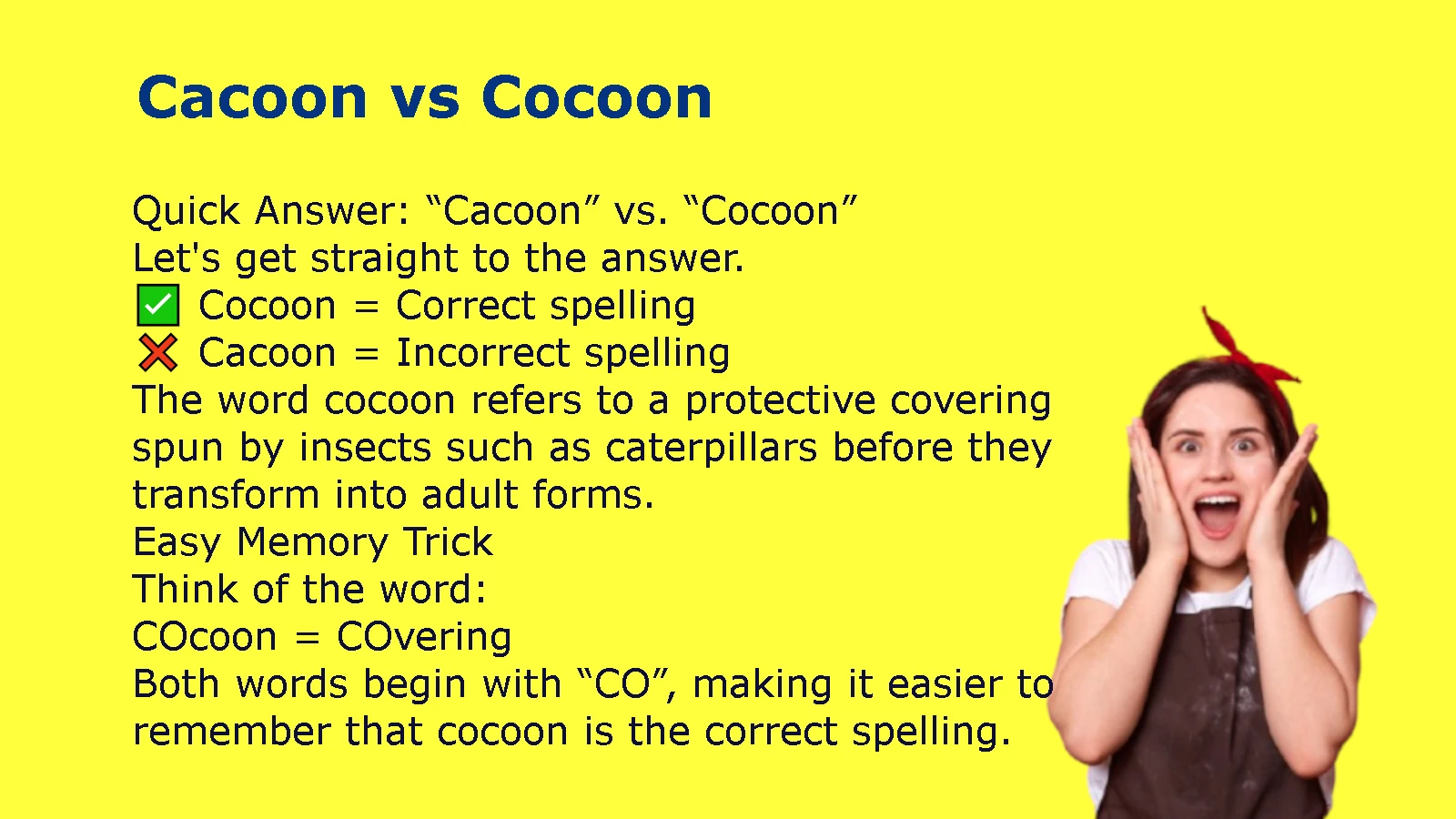
Quick Answer: “Cacoon” vs. “Cocoon”
Let’s get straight to the answer.
Confused between cleaning and emotions? Learn the difference between mopping and moping to avoid this common English mistake.
✅ Cocoon = Correct spelling
❌ Cacoon = Incorrect spelling
The word cocoon refers to a protective covering spun by insects such as caterpillars before they transform into adult forms.
Easy Memory Trick
Think of the word:
COcoon = COvering
Both words begin with “CO”, making it easier to remember that cocoon is the correct spelling.
What Does “Cocoon” Mean?
A cocoon is a silky protective case created by certain insects during their transformation process.
Example Sentences
- The caterpillar wrapped itself in a cocoon.
- Weeks later, a butterfly emerged from the cocoon.
- Scientists observed the insect inside its cocoon.
Figurative Meaning
The word can also describe a place of comfort, safety, or isolation.
Examples:
- She stayed inside her cocoon of blankets all weekend.
- The cabin became a cozy cocoon during the winter storm.
- He lived in a cocoon of privacy away from the public eye.
Why Do People Write “Cacoon”?
The misspelling usually happens because of pronunciation.
When spoken quickly, the first syllable of cocoon can sound similar to “ca.”
Common Reasons
- Phonetic spelling mistakes
- Hearing the word without seeing it written
- Typing errors
- Lack of familiarity with the correct spelling
Because English spelling doesn’t always match pronunciation perfectly, mistakes like cacoon are fairly common.
The Dictionary Verdict
If you search standard English dictionaries, you’ll find only one accepted spelling:
Cocoon
The spelling cacoon does not appear as a standard English word.
What Dictionaries Recognize
| Word | Correct? | Meaning |
| Cocoon | Yes | Protective covering of an insect |
| Cacoon | No | Misspelling of cocoon |
The Origin of “Cocoon”
Understanding a word’s history often makes it easier to remember.
The term cocoon entered English through French and ultimately comes from words associated with eggshells and protective coverings.
Over time, it became the standard term for the silk casing produced by certain insects.
Why This Matters
Since the word has always been spelled cocoon, there is no historical basis for the spelling cacoon.
“Cacoon” vs. “Cocoon” in Everyday Writing
Let’s compare how these spellings appear in real situations.
Incorrect
- The butterfly emerged from its cacoon.
- I stayed in my cacoon all day.
- The insect built a cacoon around itself.
Correct
- The butterfly emerged from its cocoon.
- I stayed in my cocoon all day.
- The insect built a cocoon around itself.
Notice that every correct example uses cocoon.
Common Expressions Using “Cocoon”
The word appears in many everyday phrases.
Popular Examples
- Cocoon of comfort
- Cocoon of safety
- Cocoon yourself indoors
- Silk cocoon
- Butterfly cocoon
These expressions all use the standard spelling cocoon.
Real-Life Examples of “Cocoon”
Here are some examples from different contexts.
Nature
- A moth spun a cocoon on the tree branch.
- The caterpillar remained inside the cocoon for several weeks.
Home and Comfort
- The soft blankets created a warm cocoon.
- She spent the rainy afternoon in a cocoon of comfort.
Personal Growth
- College helped him emerge from his cocoon and become more confident.
- The experience allowed her to break free from her emotional cocoon.
The Biggest Mistake People Make
Many people assume that if a word sounds right, the spelling must also be right.
What Happens
They hear:
“kuh-koon”
Then write:
“Cacoon”
Instead of:
“Cocoon”
The Solution
Always remember that English spelling often follows established word history rather than pronunciation alone.
Side-by-Side Comparison Table
| Feature | Cacoon | Cocoon |
| Correct English Word | No | Yes |
| Found in Dictionaries | No | Yes |
| Accepted in Formal Writing | No | Yes |
| Refers to Insect Covering | No | Yes |
| Recommended Usage | Never | Always |
How to Remember the Correct Spelling
Here are a few simple tricks.
Trick 1: CO Means Correct
COcoon = Correct
Trick 2: Think of Covering
Both words start with CO:
- COcoon
- COvering
Trick 3: Visual Memory
Imagine a caterpillar wrapped inside a giant letter O.
That extra O can remind you that cocoon is spelled with two O’s.
What to Use Instead of “Cacoon”
If you’re writing about insects, comfort, protection, or transformation, always use:
✅ Cocoon
Never use:
❌ Cacoon
This applies to:
- School assignments
- Business writing
- Blog posts
- Social media captions
- Professional communication
Quick Decision Guide
When choosing between the two spellings, follow this simple rule:
If you’re referring to an insect covering or a protective space:
→ Use cocoon
If you’ve written cacoon:
→ Correct it to cocoon
Simple. Reliable. Done.
FAQ: “Cacoon” vs. “Cocoon”
Is “cacoon” a real word?
No. It is generally considered a misspelling of cocoon.
Which spelling is correct?
Cocoon is the correct and accepted English spelling.
Why do people write “cacoon”?
Usually because they spell the word based on how it sounds rather than its standard spelling.
Can I use “cacoon” in formal writing?
No. Formal and informal writing should both use cocoon.
What does “cocoon” mean metaphorically?
It can describe a place or state of comfort, safety, protection, or isolation.
Key Facts You Should Remember
- Cocoon is the correct spelling.
- Cacoon is a misspelling.
- Dictionaries recognize only cocoon.
- The word can be used literally or figuratively.
- Using the correct spelling improves clarity and credibility.
Final Takeaway: Use “Cocoon,” Not “Cacoon”
The answer is simple: cocoon is the only correct spelling.
While cacoon is a common mistake, it isn’t recognized as a standard English word. Whether you’re talking about a caterpillar’s protective shell or using the term metaphorically to describe comfort and safety, cocoon is the spelling you should always choose.
When in doubt, remember this rule:
Cocoon = Correct
A small spelling difference can make a big impact on your writing. By choosing cocoon instead of cacoon, you’ll communicate more clearly and avoid a common English mistake every time.