Have you ever come across the words Currier vs. Courier and wondered whether they mean the same thing? You’re not alone. These two terms look remarkably similar, which often leads to confusion among writers, students, job seekers, and English learners. At first glance, it may seem like one is simply a misspelling of the other, but the truth is more interesting.
The confusion usually arises because Courier is a common English word associated with package delivery services, mail transportation, express shipping, logistics companies, and messenger services, while Currier is primarily a surname and a historical occupational name. Since both words share similar spelling and pronunciation patterns, many people accidentally use the wrong term in emails, business documents, resumes, and online searches.
Understanding the difference between Currier vs. Courier is important because using the incorrect word can affect your professional communication, business writing, vocabulary accuracy, and English grammar skills. Whether you’re discussing shipping services, parcel delivery, freight transportation, postal systems, same-day delivery, supply chain logistics, or courier companies, choosing the correct term ensures your message is clear and professional.
If you enjoy learning about commonly confused words, be sure to read our guide on Decision vs. Descision to avoid another frequent spelling mistake in English.
In this guide, you’ll learn the difference between Currier vs. Courier, when to use each word, common mistakes to avoid, and plenty of real-world examples. By the end, you’ll never confuse these terms again.
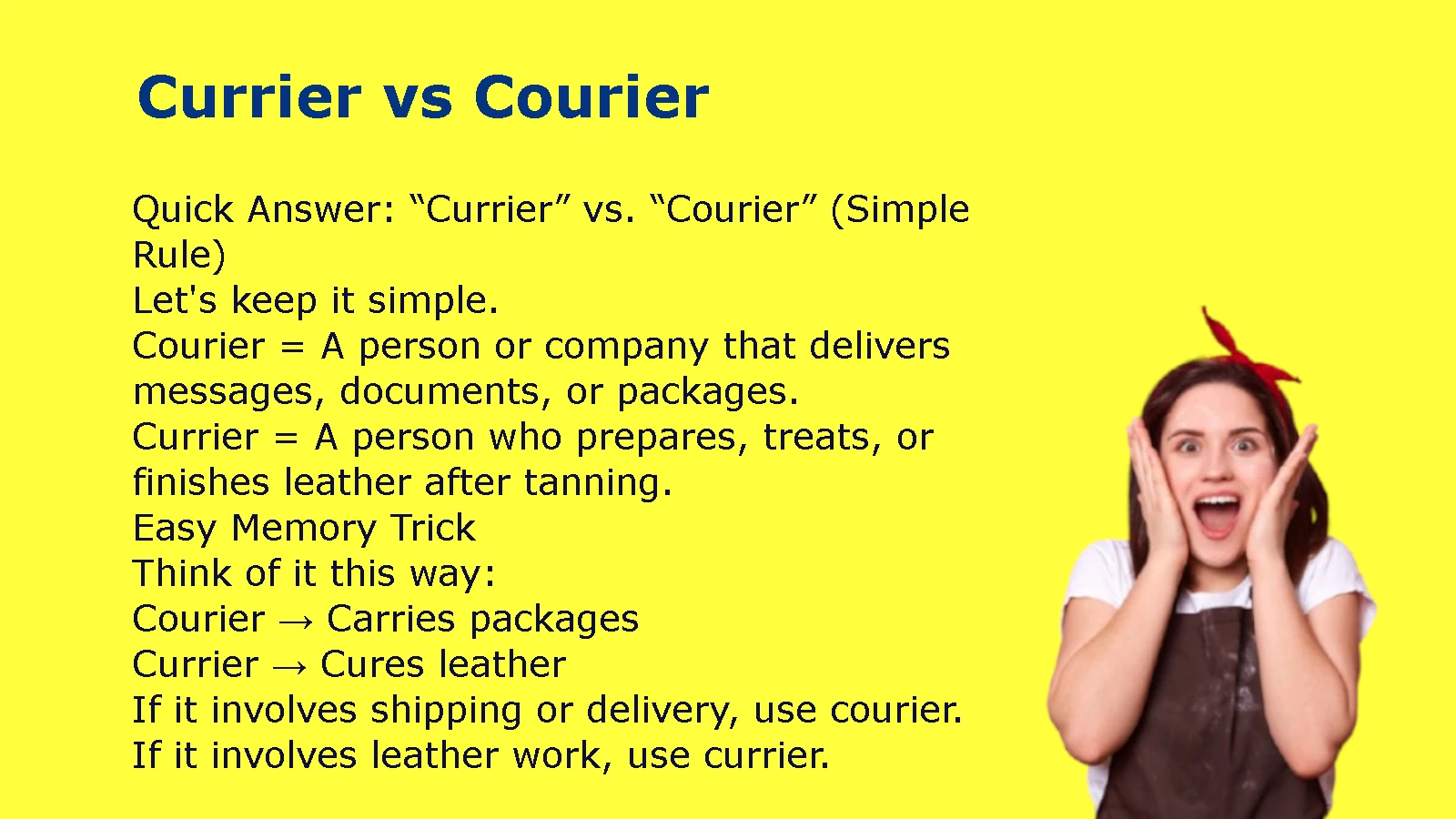
Quick Answer: “Currier” vs. “Courier” (Simple Rule)
Let’s keep it simple.
Courier = A person or company that delivers messages, documents, or packages.
Currier = A person who prepares, treats, or finishes leather after tanning.
Easy Memory Trick
Think of it this way:
Courier → Carries packages
Currier → Cures leather
If it involves shipping or delivery, use courier.
If it involves leather work, use currier.
What Does “Courier” Mean?
The word courier is commonly used in everyday English.
A courier is someone who transports items from one place to another, often quickly and securely.
Common Uses of Courier
- Package delivery services
- Document transportation
- Business shipments
- Express mail services
Examples
- The courier delivered the package before noon.
- We hired a courier to transport the legal documents.
- The company uses a reliable courier service for international shipping.
Key Insight
Whenever you’re talking about delivering something, courier is almost always the correct word.
What Does “Currier” Mean?
The word currier is much less common today.
Traditionally, a currier was a skilled worker who cleaned, softened, colored, and finished leather after it had been tanned.
Historical Role of a Currier
Before modern manufacturing, leather production involved several specialists:
- Tanner prepares the hide.
- Currier finishes and softens the leather.
- Leatherworker creates products from the leather.
Examples
- The currier spent hours preparing the leather.
- In medieval towns, a currier was an important tradesperson.
- The apprentice learned leather finishing from a master currier.
Key Insight
Unless you’re discussing leatherwork, history, or traditional trades, you’ll rarely need the word currier.
The Main Difference Between Currier and Courier
The confusion usually comes from their similar spelling.
| Word | Meaning | Common Today? | Industry |
| Currier | Person who finishes leather | Rare | Leatherworking |
| Courier | Person or service that delivers items | Very Common | Transportation & Logistics |
Quick Comparison
Courier
- Delivers packages
- Used frequently
- Modern business term
Currier
- Finishes leather
- Rarely used
- Historical trade term
Why People Confuse “Currier” and “Courier”
Several factors contribute to the confusion.
Similar Spelling
The words differ by only one letter.
Currier
Courier
A quick glance can easily lead to mistakes.
Courier Is More Common
Most people encounter the word courier regularly.
As a result, when they see currier, they often assume it’s a typo.
Pronunciation Similarities
Depending on accent and speaking speed, the two words may sound somewhat alike.
Real-Life Examples of “Courier”
Let’s look at situations where courier is the correct choice.
Business Communication
“The contract was sent by courier.”
Online Shopping
“A courier will deliver your order tomorrow.”
Medical Services
“The hospital uses a courier to transport lab samples.”
Government Documents
“Important documents were delivered through a secure courier service.”
Common Pattern
If an item is moving from one location to another, courier is likely the right word.
Real-Life Examples of “Currier”
Now compare that with currier.
Historical Writing
“The village currier was known for producing high-quality leather.”
Leather Manufacturing
“A skilled currier can improve the texture and durability of leather.”
Educational Context
“Students learned how a currier worked alongside tanners during the Middle Ages.”
Common Pattern
If leather preparation is involved, currier is the correct term.
The Biggest Mistake People Make
The most common mistake is using currier when discussing deliveries.
Incorrect
“The currier delivered my package.”
Correct
“The courier delivered my package.”
Why It’s Wrong
A currier works with leather.
A courier delivers packages.
The two professions have nothing in common.
Side-by-Side Comparison Table
| Feature | Currier | Courier |
| Part of Speech | Noun | Noun |
| Meaning | Leather finisher | Delivery person/service |
| Modern Usage | Rare | Very Common |
| Industry | Leatherworking | Shipping & Logistics |
| Commonly Confused? | Yes | Yes |
How to Remember the Difference
Here are some simple memory tricks.
Courier Carries
Both words start with “C”.
Courier carries packages.
Currier Cures Leather
Think of a currier helping to “cure” or finish leather.
Visual Shortcut
Package = Courier
Leather = Currier
This simple association prevents most mistakes.
Common Sentences and Corrections
Incorrect
- The currier delivered my online order.
- We hired a currier service for overnight shipping.
- The currier arrived with important documents.
Correct
- The courier delivered my online order.
- We hired a courier service for overnight shipping.
- The courier arrived with important documents.
Correct Use of Currier
- The currier treated the leather before it was sold.
- A currier traditionally worked after the tanning process.
Professional and Academic Usage
In Business
You will almost always use courier.
Examples include:
- Courier service
- Courier company
- Courier delivery
- Express courier
In History or Trade Studies
You may encounter currier when studying:
- Leather production
- Medieval occupations
- Traditional craftsmanship
- Historical trades
Quick Decision Guide (Use This Instantly)
Ask yourself one question:
Is someone delivering something?
Yes → Courier
No → Continue.
Is someone working with leather?
Yes → Currier
No → Courier is probably the word you need.
Simple. Reliable. Done.
FAQ: Currier vs. Courier
Is currier a misspelling of courier?
Not technically. Currier is a real word, but it has a completely different meaning related to leather processing.
Which word is more common?
Courier is far more common in modern English.
Can a currier deliver packages?
No. A currier traditionally works with leather, not deliveries.
What does courier mean in business?
A courier is a person or service that transports documents, parcels, or other items.
Why do people mix them up?
Because the words look very similar and differ by only one letter.
Case Study: A Simple Writing Mistake
A small online store updated its shipping page.
The website originally stated:
“We use trusted curriers for all deliveries.”
What Happened
Customers noticed the mistake.
Some questioned the professionalism of the company.
Others assumed the website had not been properly edited.
The Fix
The company changed the sentence to:
“We use trusted couriers for all deliveries.”
The confusion disappeared immediately.
Lesson
Using the correct word improves clarity and credibility.
Key Facts You Should Remember
- Courier delivers packages, documents, and shipments.
- Currier finishes and prepares leather.
- Courier is extremely common in modern English.
- Currier is mostly found in historical or leatherworking contexts.
- The words are not interchangeable.
- Most delivery-related situations require courier.
Final Takeaway: The One Rule That Never Fails
Here’s the easiest way to remember the difference between Currier vs. Courier:
Courier = Delivery
Currier = Leather
If someone is transporting a package, document, or shipment, use courier.
If someone is treating or finishing leather, use currier.
The words may look alike, but their meanings belong to entirely different worlds. Keep the package-versus-leather rule in mind, and you’ll choose the correct word every time.