Have you ever come across “Comparable vs. Comprable” and wondered whether they are interchangeable or if one of them is actually incorrect? You’re not alone. This is one of the most common spelling mistakes in English writing, especially because both words sound almost identical when spoken quickly.
The confusion usually happens because English pronunciation often drops or softens certain vowel sounds, so writers try to spell the word the way it sounds. As a result, many people accidentally write “comprable”, even though it is not a standard English word.
However, in modern English, only one spelling is correct.
In this guide, you will learn the difference between “comprable vs. comparable,” why this mistake happens, how to remember the correct spelling, and how to confidently use it in emails, essays, and professional writing.
By the end, you will never confuse these two spellings again.
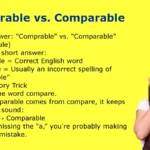
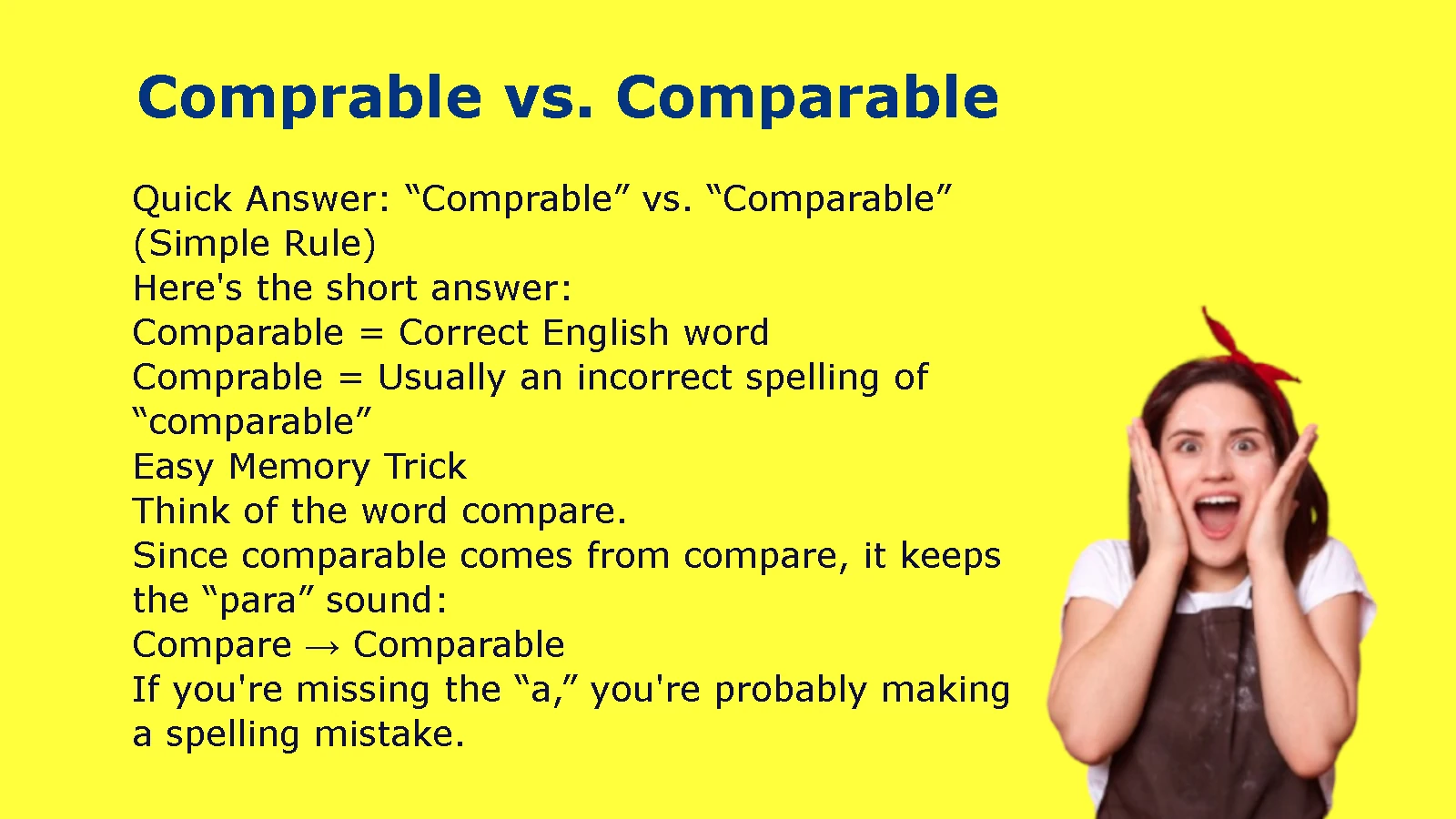
Quick Answer: Comparable vs. Comprable (Simple Rule)
Here is the simplest explanation:
- Comparable = Correct English word meaning similar in quality, value, or standard
- Comprable = Incorrect spelling (not used in modern English)
Easy Memory Trick
Think of it like this:
ComparaBLE = “ABLE to compare”
The ending “-able” is the key. If it describes something that can be compared, it must end in -able.
What Is the Difference Between Comprable and Comparable?
The main difference is very straightforward:
- Comparable is the correct and standard English word.
- Comprable is a spelling error caused by missing the “a” sound.
Why This Confusion Happens
This mistake happens because:
- The word is often spoken quickly in conversation
- The middle vowel sound (“a”) is not strongly pronounced
- Writers guess the spelling based on sound instead of structure
So “comprable” feels right, but it is not correct.
Is “Comprable” a Real Word?
In modern English:
- ❌ Comprable = Not a valid English word
- ❌ Not found in standard dictionaries as a correct form
- ❌ Always treated as a spelling mistake of “comparable”
Common Mistake Examples
Incorrect:
- ❌ This product is comprable to the other one
- ❌ Her skills are comprable to his
Correct:
- ✅ This product is comparable to the other one
- ✅ Her skills are comparable to his
What Does “Comparable” Mean? (Full Explanation)
The word comparable means something that is similar enough to be compared with another thing in terms of quality, value, or level.
As an Adjective
It describes similarity between two things.
Examples:
- His salary is comparable to mine.
- The two cars are comparable in performance.
- This experience is comparable to traveling abroad.
Common Uses of “Comparable” (High-Value Phrases)
These expressions always use comparable, never comprable:
- Comparable quality
- Comparable value
- Comparable experience
- Comparable results
- Not comparable
Examples:
- The two products are comparable in price.
- Her performance is not comparable to anyone else in the team.
Why People Write “Comprable” Instead of “Comparable”
This is a very common spelling issue in English.
1. Weak vowel pronunciation
In fast speech, “comparable” can sound like:
- “comp-ra-bul”
So the missing “a” disappears in writing.
2. Spelling by sound
People assume:
- “com-prable” instead of “com-par-able”
3. Lack of exposure
If you rarely see the correct spelling, your brain fills in missing letters incorrectly.
Comparable vs. Comprable in Real Usage
Correct Usage (Comparable)
- These two options are comparable in quality.
- The results are comparable across both groups.
- Her achievements are comparable to top performers.
Incorrect Usage (Comprable)
- ❌ This item is comprable in price
- ❌ Their results are comprable
- ❌ Nothing is comprable to this experience
Side-by-Side Comparison Table
| Word | Correct? | Meaning | Usage |
| Comparable | Yes | Similar in quality or value | Standard English |
| Comprable | No | Misspelling of “comparable” | Avoid completely |
When to Use “Comparable” (With Examples)
Everyday English
- The two phones are comparable.
- My experience is comparable to yours.
Workplace English
- The new system is comparable to the old one.
- Salaries are comparable across departments.
Academic Writing
- The findings are comparable with previous studies.
- The datasets are comparable in structure.
Why “Comparable” Is Spelled This Way
The correct spelling is comparable, not comprable, because it comes from:
- compare + able
So logically:
👉 compare → comparable
(not comprable)
The “-able” suffix is essential because it means “able to be compared.”
How to Avoid the Mistake Every Time
1. Break the word into parts
Think:
- compare + able = comparable
2. Focus on the “-able” ending
If it means “can be compared,” it must end in able.
3. Use writing tools
Spell check will always highlight “comprable” as incorrect.
4. Practice common phrases
- comparable quality
- comparable value
- comparable experience
Common Alternatives to “Comparable”
Depending on context, you can also use:
- Similar
- Equivalent
- Equal
- Matching
- Alike
Examples:
- The two products are similar.
- Their performance is equivalent.
Quick Decision Guide
Use this simple rule:
- Talking about similarity? → Use comparable
- Thinking of writing “comprable”? → Don’t
- Formal writing or exams? → Always comparable
FAQ: Comparable vs. Comprable
Is “comprable” ever correct?
No. It is always a spelling mistake in modern English.
Why is “comparable” hard to spell?
Because the middle vowel sound is often reduced in speech.
What is the correct spelling?
Comparable
Can I use “comparable” in formal writing?
Yes. It is the correct and standard form.
Final Takeaway
The difference between comprable vs. comparable is very simple:
👉 Only comparable is correct English
👉 “Comprable” is always a spelling error
Final Rule to Remember:
Compare + able = Comparable
So whenever you are unsure, just remember:
✔ Comparable = correct
❌ Comprable = wrong