Ever wondered why so many people get confused between Dought vs. Doubt, even in simple writing like emails or texts? You are not alone. Many English learners and even native speakers get confused by this spelling because English pronunciation often does not match how words are written.
The truth is simple but important: “dought” is not the correct spelling, while “doubt” is the standard and widely accepted word used in both American English and British English. However, because both words look similar in pronunciation patterns and English spelling rules, they often appear in searches related to commonly confused words, spelling mistakes, and English vocabulary errors.
If you’ve ever hesitated while writing an email, essay, or social media post, you’re not alone. Many learners confuse “dought vs doubt” due to silent letters, irregular spelling patterns, and limited exposure to correct usage in real-world contexts. This small mistake can affect clarity in professional writing, academic work, and SEO content if not corrected.
In this guide, you’ll learn the clear difference between dought and doubt, why this spelling error happens, the correct meaning of doubt, real usage examples, and simple memory tricks to avoid this mistake forever. You’ll also explore related grammar rules, spelling patterns, and vocabulary insights that help you write more confidently in English.
So, let’s break down this confusing pair and fix it once and for all.
Learn the difference between halt vs hault in English grammar with clear examples.
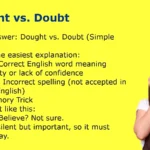
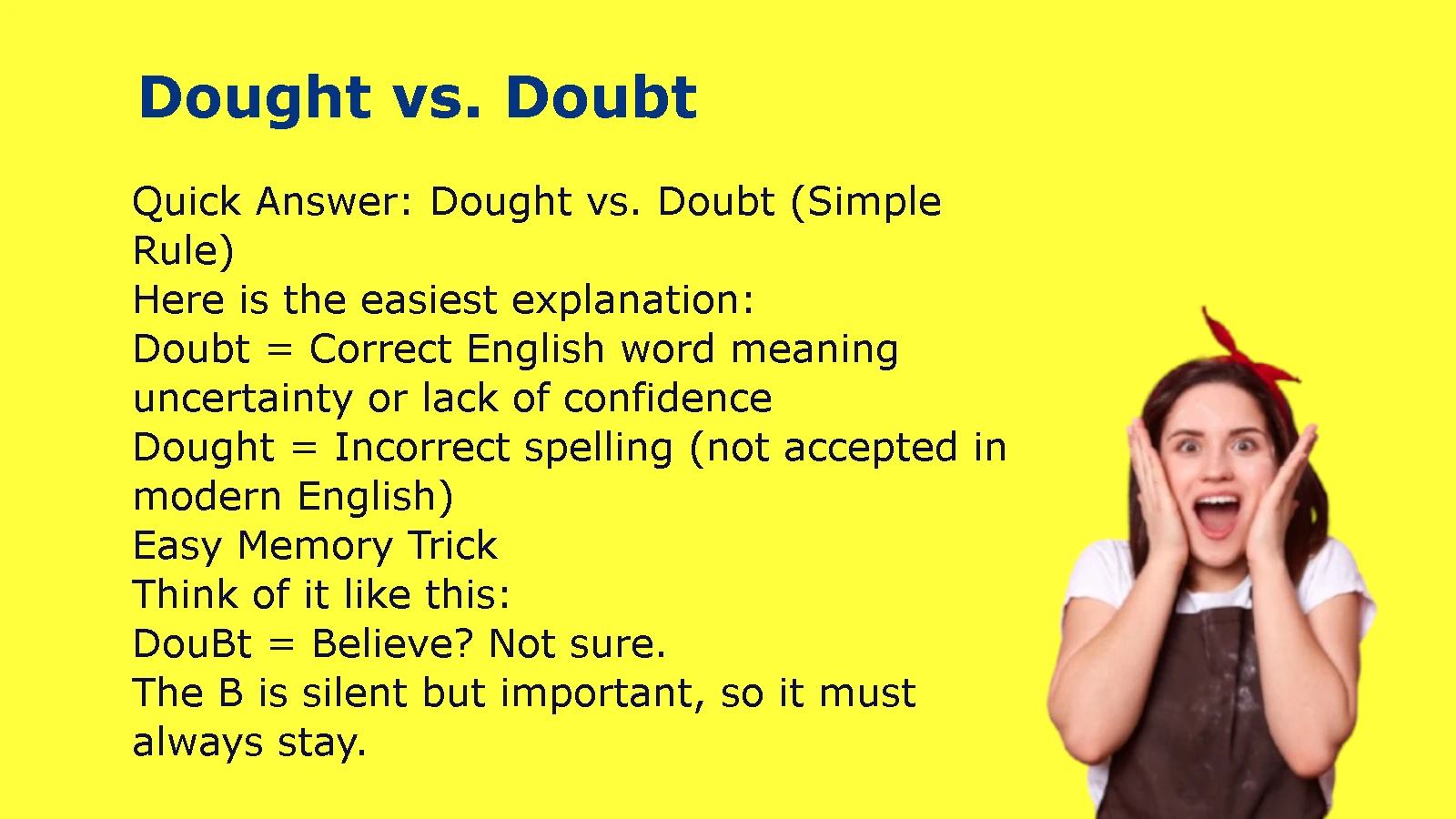
Quick Answer: Dought vs. Doubt (Simple Rule)
Here is the easiest explanation:
- Doubt = Correct English word meaning uncertainty or lack of confidence
- Dought = Incorrect spelling (not accepted in modern English)
Easy Memory Trick
Think of it like this:
DouBt = Believe? Not sure.
The B is silent but important, so it must always stay.
What Is the Difference Between Dought and Doubt?
The main difference is very simple:
- Doubt is the correct and standard English word.
- Dought is a spelling mistake caused by pronunciation confusion.
Why This Confusion Happens
This mistake happens because:
- The “b” in doubt is silent
- People write words based on how they sound
- English spelling is not always phonetic
So “dought” looks logical—but it is incorrect.
Is “Dought” a Real Word?
In modern English:
- ❌ Dought = Not a standard English word
- ❌ Not accepted in dictionaries (as meaning uncertainty)
- ❌ Considered a spelling error of “doubt”
Common Mistake Examples
Incorrect:
- ❌ I have dought about this.
- ❌ Without a dought
Correct:
- ✅ I have doubt about this.
- ✅ Without a doubt
What Does “Doubt” Mean? (Full Explanation)
The word doubt refers to uncertainty, hesitation, or lack of confidence.
As a Noun
It describes a feeling of uncertainty.
Examples:
- There is no doubt about her success.
- I have some doubt about this decision.
As a Verb
It means to question something.
Examples:
- I doubt he will come.
- She doubts the results.
Common “Doubt” Phrases (High-Usage Keywords)
These expressions always use doubt, never dought:
- Without a doubt
- No doubt
- Beyond doubt
- In doubt
- Cast doubt on
Examples:
- Without a doubt, this is correct.
- There is no doubt about his ability.
Why People Write “Dought” Instead of “Doubt”
This mistake is very common in English writing.
1. Silent Letter Problem
English words often contain silent letters:
- doubt
- debt
- subtle
- thumb
So learners drop the “b” when writing.
2. Sound-Based Spelling
People hear:
- “dout”
and assume:
- “dought”
3. Lack of Visual Exposure
If you don’t see the word often, the spelling feels unfamiliar.
Dought vs. Doubt in Real Usage
Correct Usage (Doubt)
- I doubt his explanation.
- There is no doubt she is right.
- They have doubts about the project.
Incorrect Usage (Dought)
- ❌ I dought his story.
- ❌ She has many doughts.
- ❌ Without a dought.
Side-by-Side Comparison Table
| Word | Correct? | Meaning | Usage |
| Doubt | Yes | Uncertainty / hesitation | Standard English |
| Dought | No | Misspelling of “doubt” | Avoid completely |
When to Use “Doubt” (With Examples)
Everyday English
- I doubt he is coming today.
- There is no doubt about it.
Workplace English
- Management expressed doubt about the plan.
- I doubt the deadline can be met.
Academic Writing
- Researchers doubt the validity of the claim.
- The study leaves no room for doubt.
Why “Doubt” Has a Silent B
The spelling comes from Latin origins (historically influenced by dubitare).
Even though pronunciation changed, the spelling remained.
Similar Words with Silent Letters
- Debt (silent b)
- Doubt (silent b)
- Subtle (silent b)
How to Avoid the Mistake (Easy Tips)
1. Remember the Silent B Rule
Always think:
👉 Doubt = Silent B stays
2. Use Common Phrases Often
- Without a doubt
- No doubt
- Beyond doubt
3. Use Spell Check Tools
Modern tools will always flag “dought” as incorrect.
Alternatives to “Doubt” (Useful Variations)
Sometimes you can replace “doubt” with:
- Uncertainty
- Concern
- Skepticism
- Hesitation
- Question
Examples:
- I have doubts → I have concerns
- I doubt it → I am skeptical
Quick Decision Guide
If you are confused, use this rule:
- Talking about uncertainty? → Use doubt
- Thinking of writing “dought”? → Stop
- Formal writing? → Always doubt
FAQ: Dought vs. Doubt
Is “dought” ever correct?
No. It is not accepted in modern standard English.
Why is the B silent in “doubt”?
It comes from historical spelling and Latin influence.
Which spelling should I use in exams or emails?
Always use doubt.
How do you spell “without a doubt”?
Correct: without a doubt
Incorrect: without a dought
Final Takeaway
The difference between dought and doubt is simple:
👉 Only “doubt” is correct English.
👉 “Dought” is a spelling mistake caused by pronunciation confusion.
The key rule is:
The silent B stays.
So whenever you are unsure, remember:
✔ Doubt = correct
❌ Dought = wrong