Have you ever stopped while writing and wondered whether Halt vs. Hault is a real word choice dilemma or simply a spelling mistake? You’re not alone. Many writers, students, and English learners encounter this confusing pair because the two words look similar, yet only one is commonly recognized in modern English vocabulary and grammar.
The confusion often appears in emails, essays, business communication, and everyday writing. Since English contains many homophones, misspelled words, and commonly confused words, it’s easy to assume that hault is an alternative spelling of halt. However, understanding the difference can help you avoid embarrassing spelling errors, improve your word choice, and communicate more clearly.
The good news is that the answer is surprisingly simple. In standard English language usage, halt is a legitimate word with several meanings, while hault is generally considered a misspelling or an extremely rare variant that most dictionaries do not recognize. Knowing when to use halt, understanding its role in English grammar, and recognizing common mistakes will instantly improve your writing accuracy.
In this guide, you’ll learn the meaning of Halt vs. Hault, explore their definitions, discover how native speakers use the word in everyday conversation, and understand why this spelling confusion happens in the first place. We’ll also cover practical examples, pronunciation tips, grammar rules, and frequently asked questions so you can use the correct term with confidence.
If you enjoy learning about commonly confused words, be sure to read our guide on Decision vs. Descision to avoid another frequent spelling mistake in English.
So, if you’ve ever searched for the difference between halt and hault, wondered whether hault is a word, or wanted to improve your English spelling, you’re in the right place. Let’s clear up the confusion once and for all.
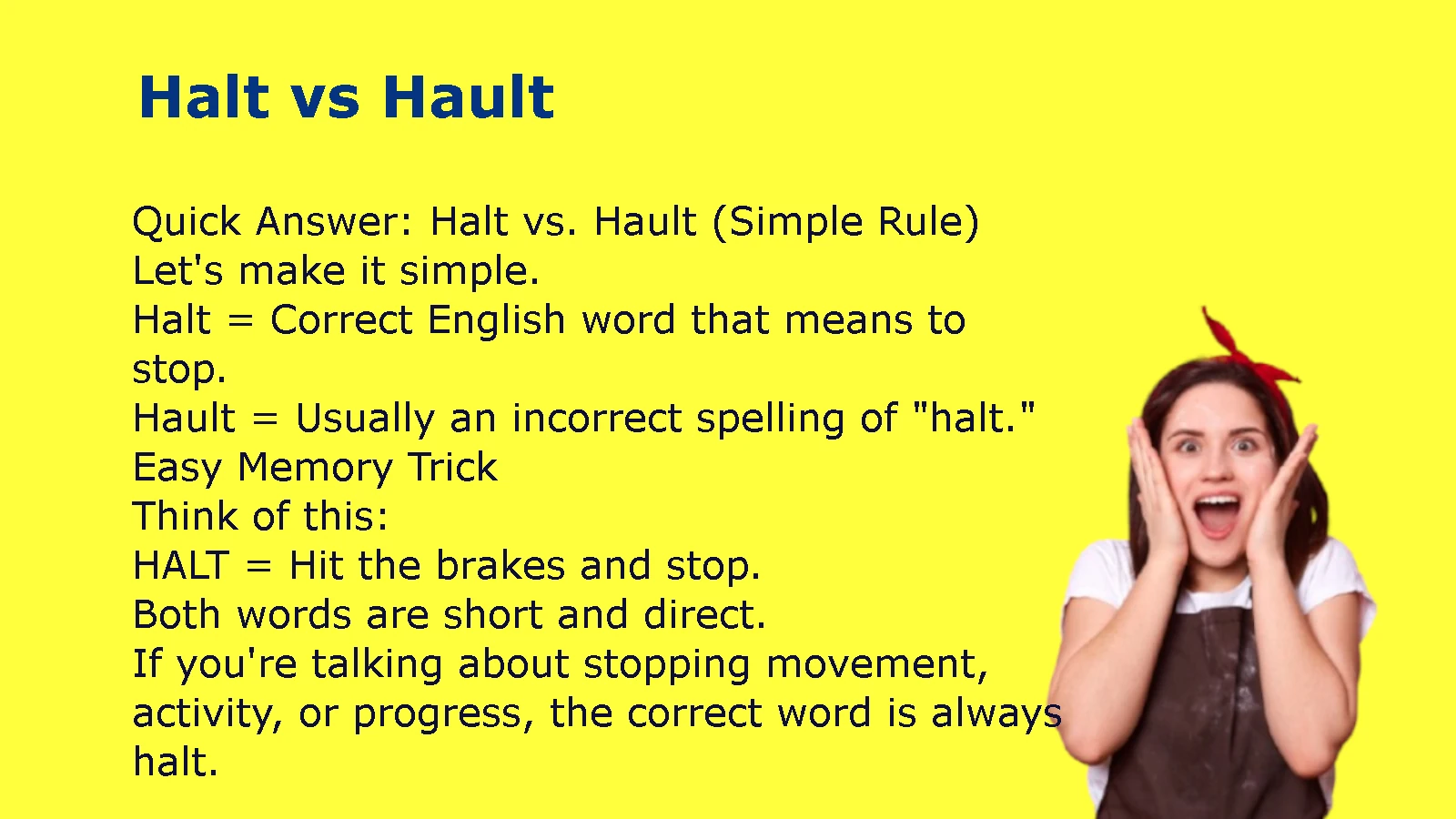
Quick Answer: Halt vs. Hault (Simple Rule)
Let’s make it simple.
Confusing similar-looking words is common in English. If you enjoy learning about commonly mixed-up terms, check out our guide on Mopping vs. Moping to understand another pair of words that are often mistaken for one another.
Halt = Correct English word that means to stop.
Hault = Usually an incorrect spelling of “halt.”
Easy Memory Trick
Think of this:
HALT = Hit the brakes and stop.
Both words are short and direct.
If you’re talking about stopping movement, activity, or progress, the correct word is always halt.
What Does “Halt” Mean?
The word halt means to stop moving, stop doing something, or bring something to an end.
Common Definitions
- To stop walking or moving
- To stop a process
- To interrupt progress
- To bring something to a standstill
Examples
- The soldiers were ordered to halt.
- Construction work came to a halt during the storm.
- Police told the driver to halt immediately.
- The project was halted due to budget issues.
Key Point
Halt can be used as both a verb and a noun.
Verb:
- Please halt the machine.
Noun:
- The negotiations came to a halt.
English contains many words that look or sound alike. Our article on Meating vs. Meeting explains the differences, meanings, and correct usage of these commonly mistaken terms.
What Does “Hault” Mean?
Here’s where the confusion begins.
In modern English, hault is generally not recognized as a standard spelling.
Why People Write “Hault”
People often spell it this way because:
- It looks similar to words like “vault” or “fault.”
- They assume the pronunciation requires “au.”
- They have seen the misspelling online.
The Reality
In most situations:
❌ Hault
✅ Halt
Example
Incorrect:
- The train came to a hault.
Correct:
- The train came to a halt.
The Main Difference Between Halt and Hault
The distinction is actually very straightforward.
| Word | Meaning | Correct Modern English? |
| Halt | Stop; cease movement or progress | Yes |
| Hault | Misspelling of halt in most contexts | No |
Key Insight
If you’re writing standard English, use halt.
In nearly every situation, hault is considered an error.
Why Do People Confuse Halt and Hault?
Several factors contribute to this common mistake.
Similar Sound
Many people pronounce words quickly, making spellings harder to remember.
Influence of Other Words
Words such as:
- Fault
- Vault
- Haul
make some writers believe “hault” should exist.
Typing Habits
Autocorrect doesn’t always catch uncommon spelling errors, especially in informal writing.
Key Takeaway
The confusion comes from spelling patterns, not meaning.
“Halt” in Everyday English
You’ll encounter halt in many situations.
Transportation
- The bus came to a halt.
- Traffic halted after the accident.
Work and Business
- Production was halted temporarily.
- The company halted the expansion plan.
Military Commands
- Halt! Identify yourself.
- The troops halted at the checkpoint.
Sports
- Rain halted the match.
- Play was halted due to injury.
Common Expressions Using “Halt”
English speakers frequently use the word in common phrases.
Bring to a Halt
- The roadblock brought traffic to a halt.
Grind to a Halt
- The economy ground to a halt during the crisis.
Come to a Halt
- The elevator came to a halt unexpectedly.
Halt Progress
- Funding cuts halted progress on the project.
The Biggest Mistake People Make
The most common error is assuming hault is an accepted alternative spelling.
What Goes Wrong
People write:
- haulted
- haulting
- hault
instead of:
- halted
- halting
- halt
Why It Matters
Incorrect spelling can:
- Reduce credibility
- Create confusion
- Appear unprofessional in academic or business writing
Lesson
If you mean “stop,” always choose halt.
Side-by-Side Comparison Table
Here’s a quick reference guide.
| Feature | Halt | Hault |
| Standard English word | Yes | No |
| Means stop | Yes | No |
| Used in dictionaries | Yes | Rarely as a modern word |
| Appropriate in professional writing | Yes | No |
| Common spelling mistake | No | Yes |
Real-Life Examples of “Halt”
Let’s look at practical examples.
Example 1
- The officer ordered everyone to halt.
2
- Heavy snowfall halted air travel.
3
- The discussion came to a halt after the announcement.
4
- Engineers halted the test for safety reasons.
What They Have in Common
Every example involves stopping movement, action, or progress.
Real-Life Examples of Incorrect “Hault”
These examples contain spelling mistakes.
Incorrect
- The car came to a hault.
- Operations were haulted.
- The workers were told to hault.
Correct
- The car came to a halt.
- Operations were halted.
- The workers were told to halt.
Quick Tip
Whenever you type “hault,” check whether you actually mean halt.
How to Remember the Correct Spelling
Need a simple trick?
Memory Trick #1
HALT = Hard Stop
Both words are short.
Memory Trick #2
Imagine a stop sign.
When you see it, think:
HALT
not
HAULT
Memory Trick #3
Remember that dictionaries, news articles, and professional writers consistently use halt.
What to Say Instead of “Halt”
Depending on the situation, you can use alternatives.
Synonyms
- Stop
- Pause
- Cease
- End
- Interrupt
- Suspend
- Freeze
Examples
- The company ceased operations.
- The driver stopped immediately.
- The project was suspended.
When to Use Them
Choose the word that best fits your tone and context.
Quick Decision Guide (Use This Instantly)
Ask yourself:
Are you talking about stopping something?
Yes → Use halt
Are you thinking of writing “hault”?
Stop and replace it with halt.
Simple. Reliable. Done.
FAQ: Halt vs. Hault
Is “hault” a real word?
In modern standard English, it is generally treated as a misspelling of halt.
Which spelling should I use?
Always use halt when you mean “stop.”
Why do people write “hault”?
Because it resembles words like “fault,” “vault,” and “haul.”
Is “haulted” correct?
No.
Use halted instead.
Can I use “halt” as a noun?
Yes.
Example:
- The negotiations came to a halt.
Case Study: A Professional Writing Mistake
A job applicant submitted a resume that included this sentence:
“The project was haulted due to budget constraints.”
What Happened
The hiring manager immediately noticed the spelling error.
Although the candidate was qualified, the mistake created a less professional impression.
The Fix
The sentence should have been:
“The project was halted due to budget constraints.”
Lesson
Small spelling errors can affect how others perceive your writing.
Key Facts You Should Remember
- Halt is the correct spelling.
- Halt means to stop.
- Halt can be a noun or a verb.
- Hault is usually a spelling mistake.
- Professional writing should always use halt.
- Remember: if something stops, it halts.
Final Takeaway: The One Rule That Never Fails
When comparing halt vs. hault, the answer is surprisingly simple.
Halt is the correct English word. It means to stop, pause, or bring something to an end.
Hault is almost always a misspelling that appears because people assume the word follows spelling patterns found in words like “fault” or “vault.”
So whenever you’re unsure, remember this simple rule:
If it means stop, write “halt.”
No extra letters. No confusion. Just the correct spelling every time.