Ever wondered why so many people get confused between Stopped or Stoped, even in simple writing like emails or texts? One small spelling difference can completely change how professional your writing looks—and here’s the kicker: only one of them is actually correct.
The real issue comes from English spelling rules, especially when dealing with past tense verbs and double consonant rules. Many learners accidentally drop letters, leading to common spelling mistakes in English that can hurt clarity and credibility.
You’re not alone if you’ve made this error. It’s one of the most frequent grammar confusion cases in everyday writing, especially when dealing with irregular verb forms, past tense spelling rules, and general English writing accuracy.
But don’t worry—this is easy to fix once you understand the pattern.
In this guide, you’ll learn the correct usage of Stopped or Stoped, why only one form is grammatically correct, and how English spelling rules for doubling consonants work in simple terms. You’ll also discover common mistakes learners make and how to avoid them in real writing situations.
And it gets better—you’ll never second-guess this word again once the rule clicks.
So let’s break it down clearly and end the confusion once and for all.
Learn the difference between halt vs hault in English grammar with clear examples.
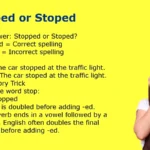
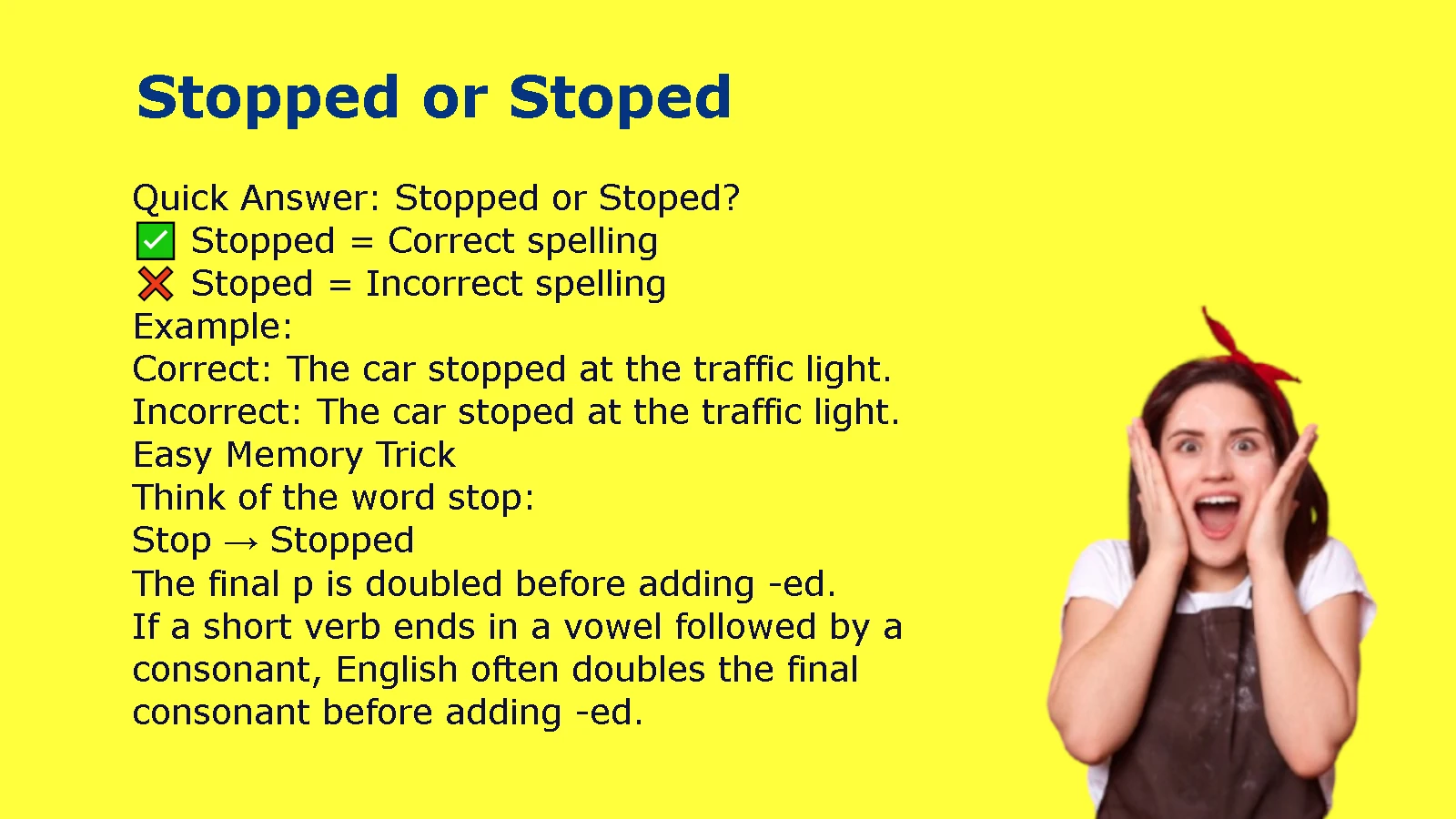
Quick Answer: Stopped or Stoped?
✅ Stopped = Correct spelling
❌ Stoped = Incorrect spelling
Example:
- Correct: The car stopped at the traffic light.
- Incorrect: The car stoped at the traffic light.
Easy Memory Trick
Think of the word stop:
Stop → Stopped
The final p is doubled before adding -ed.
If a short verb ends in a vowel followed by a consonant, English often doubles the final consonant before adding -ed.
Why “Stopped” Is Correct
The verb stop follows a common English spelling rule.
The Rule
When a one-syllable verb:
- Ends with a single vowel + single consonant
- Has the stress on that syllable
You double the final consonant before adding -ed.
Example
Stop
- One syllable
- Ends in vowel (o) + consonant (p)
Therefore:
Stop + ed = Stopped
Not:
Stop + ed = Stoped
Why “Stoped” Is Incorrect
Many people assume they can simply add -ed to a verb.
While that works for words like:
- Walk → Walked
- Jump → Jumped
- Call → Called
It does not work for stop because it follows the consonant-doubling rule.
What Happens If You Write “Stoped”?
Although readers may understand what you mean, the spelling is considered incorrect in:
- Academic writing
- Business communication
- Professional documents
- Formal English exams
That’s why you should always use stopped.
The Grammar Rule Behind “Stopped”
Let’s break the rule down step by step.
Step 1: Look at the Base Verb
Stop
Step 2: Check the Ending
The word ends with:
- Vowel: o
- Consonant: p
Step 3: Double the Final Consonant
P → PP
Step 4: Add “-ed”
Stopped
Formula
Base Verb + Double Consonant + ed
Stop → Stopped
Similar Words That Follow the Same Rule
The rule doesn’t apply only to stop.
Here are other common examples:
| Base Verb | Past Tense |
| Stop | Stopped |
| Hop | Hopped |
| Plan | Planned |
| Grab | Grabbed |
| Slip | Slipped |
| Drop | Dropped |
| Clap | Clapped |
| Shop | Shopped |
Notice how the final consonant is doubled before adding -ed.
Words That Do Not Double the Final Consonant
Not every verb doubles its last letter.
Examples
| Base Verb | Past Tense |
| Walk | Walked |
| Jump | Jumped |
| Call | Called |
| Need | Needed |
| Rain | Rained |
These words do not fit the consonant-doubling pattern.
Real-Life Examples of “Stopped”
Here are some everyday sentences using the correct spelling.
In Conversation
- The bus stopped right in front of us.
- She stopped talking when the teacher entered.
At Work
- The project stopped due to budget issues.
- Production stopped for maintenance.
While Traveling
- We stopped at a gas station.
- The train stopped unexpectedly.
In Stories
- The hero stopped and looked back.
- Time seemed to have stopped.
Common Mistakes People Make
Mistake #1: Writing “Stoped”
❌ The car stoped suddenly.
✅ The car stopped suddenly.
Mistake #2: Forgetting the Rule
Some writers know the rule but forget to apply it when typing quickly.
Mistake #3: Assuming Every Verb Works the Same Way
English spelling rules vary depending on the structure of the word.
Stopped in Different Tenses
Past Simple
- She stopped by the store yesterday.
Present Perfect
- They have stopped making that product.
Past Perfect
- The rain had stopped before sunset.
Passive Voice
- The machine was stopped for repairs.
In every case, the spelling remains stopped.
Side-by-Side Comparison
| Word | Correct? | Reason |
| Stopped | ✅ Yes | Follows the consonant-doubling rule |
| Stoped | ❌ No | Missing the doubled “p” |
Quick Check
If you’re using the past tense of stop, always choose stopped.
Why People Get Confused
The confusion comes from inconsistency in English spelling.
For example:
- Hope → Hoped
- Move → Moved
These verbs simply add -d.
But:
- Stop → Stopped
- Drop → Dropped
These verbs double the final consonant first.
Because both patterns exist, writers often second-guess themselves.
How to Remember the Correct Spelling
Memory Trick #1
Think:
Stop has one P.
Stopped has two Ps.
Memory Trick #2
Remember similar words:
- Dropped
- Hopped
- Planned
If those words double their final consonant, stopped should too.
Memory Trick #3
Say it aloud:
“Stop-ped”
The doubled sound helps reinforce the spelling.
When You Should Be Extra Careful
Using the wrong spelling may hurt credibility in:
- Job applications
- Business emails
- School essays
- Professional reports
- Online publications
Even small spelling mistakes can make writing appear less polished.
FAQ: Stopped or Stoped?
Is “stoped” ever correct?
No. In modern English, stoped is considered incorrect when referring to the past tense of stop.
Why does “stopped” have two Ps?
Because stop ends with a vowel followed by a consonant, so the final consonant is doubled before adding -ed.
Is “stopped” American or British English?
Both American and British English use stopped.
What is the past tense of stop?
The past tense and past participle are both stopped.
How do I avoid this mistake?
Learn the consonant-doubling rule and practice with similar verbs like hop, drop, and plan.
Key Facts to Remember
- Stopped is the correct spelling.
- Stoped is incorrect.
- The final p must be doubled.
- The rule applies to many short verbs ending in vowel + consonant.
- Both American and British English use stopped.
Final Takeaway: Always Use “Stopped”
The debate between “stopped” and “stoped” is actually very simple once you know the spelling rule. Because stop ends with a vowel followed by a consonant, English requires the final p to be doubled before adding -ed.
So whenever you need the past tense or past participle of stop, the correct form is always stopped.
Remember the rule:
Stop → Stopped
Not:
Stop → Stoped
Keep that simple pattern in mind, and you’ll avoid one of the most common English spelling mistakes every time you write.