Have you ever come across “oversite” vs. “oversight” and wondered whether they are interchangeable or if one of them is actually incorrect? This is a common question in the English language, especially among writers, students, and professionals who want to avoid grammar mistakes and improve their vocabulary usage.
At first glance, these two words look nearly identical, but they have very different meanings and levels of acceptance in standard English. In fact, oversight is a widely recognized word that can refer to supervision, monitoring, management, or an unintentional error, while oversite is much less common and is often considered a misspelling of oversight. Because of their similar spelling, many people search for terms like oversite meaning, oversight meaning, difference between oversite and oversight, and which word is correct: oversite or oversight.
This confusion frequently appears in business writing, professional communication, academic writing, and everyday correspondence, where choosing the wrong word can affect clarity and credibility. It is also a common topic in discussions about commonly confused words, English grammar rules, word choice, and spelling differences.
Related Spelling Mistakes
If you found Oversite vs Oversight confusing, here are more commonly misspelled English words you should also check:
In this guide, you’ll learn the exact difference between oversite and oversight, their meanings, correct usage, real-world examples, and common mistakes to avoid. You’ll also discover simple memory tricks and practical tips to help you use the right word confidently in both formal and informal writing.
Accross vs Across – Which One Is Correct?
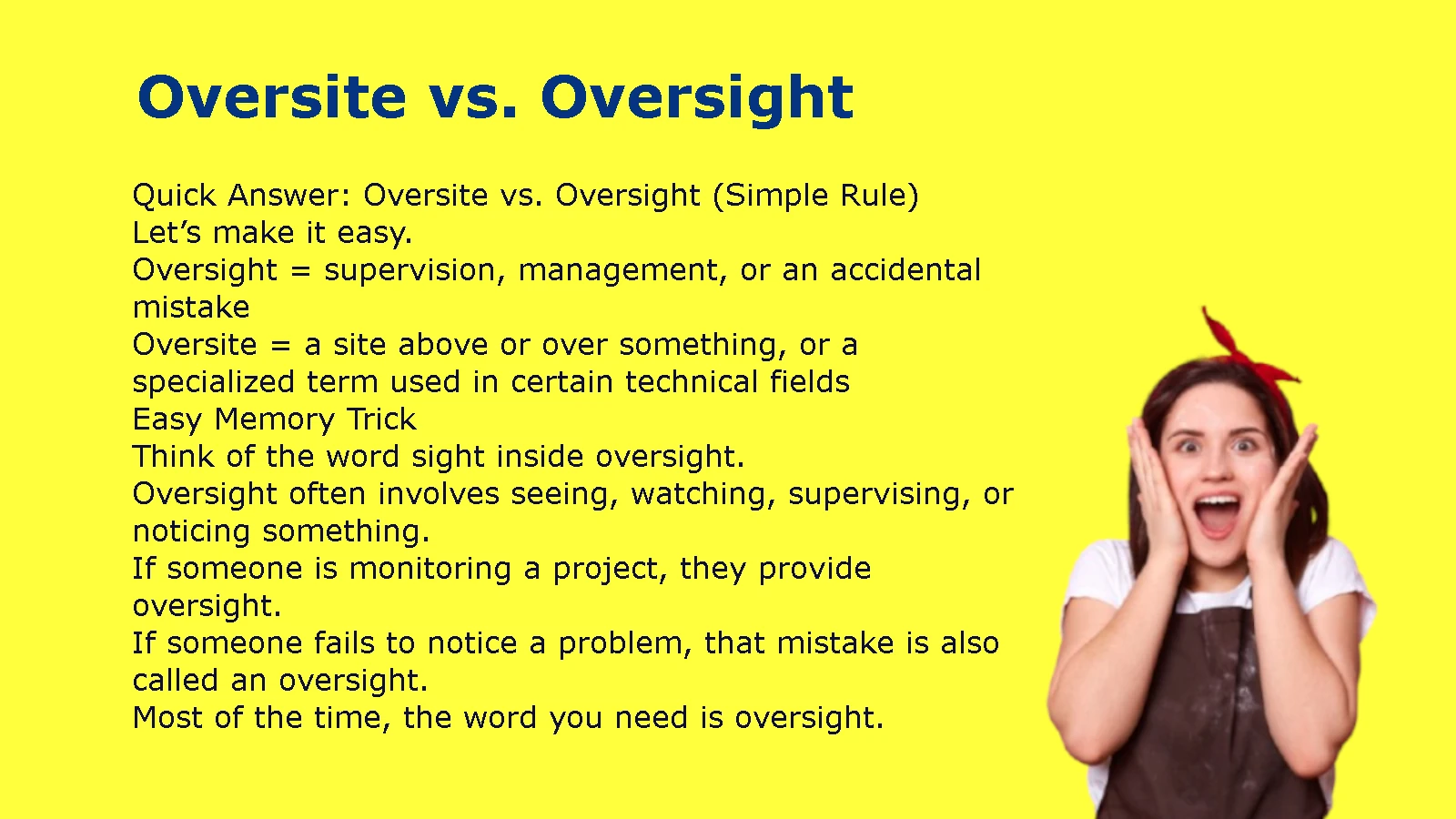
Quick Answer: Oversite vs. Oversight (Simple Rule)
Let’s make it easy.
Oversight = supervision, management, or an accidental mistake
Oversite = a site above or over something, or a specialized term used in certain technical fields
Easy Memory Trick
Think of the word sight inside oversight.
Oversight often involves seeing, watching, supervising, or noticing something.
If someone is monitoring a project, they provide oversight.
If someone fails to notice a problem, that mistake is also called an oversight.
Most of the time, the word you need is oversight.
How People Actually Use Oversite and Oversight
Here’s where confusion begins.
Many people encounter oversight regularly in business, government, education, and everyday conversation. Because oversite looks so similar, it is often mistaken for a misspelling or alternate version.
In Everyday Writing
People usually intend to write:
- Project oversight
- Government oversight
- An oversight on my part
But they accidentally type:
- Project oversite
- Government oversite
In Professional Settings
The mistake is common because spell-check may not always flag oversite, especially if it’s recognized as a legitimate but uncommon word.
Why This Happens
- The words differ by one letter
- Oversight is much more common
- People assume both words have the same meaning
- Fast typing increases the chance of errors
The Meaning of “Oversight” Explained Clearly
Let’s start with the word you’ll use most often.
Meaning 1: Supervision or Management
This is the most common definition.
Oversight means watching over, supervising, or managing something.
Examples
- The committee provides oversight of the budget.
- The manager has oversight of several departments.
- Government agencies require regulatory oversight.
Meaning 2: An Unintentional Mistake
Surprisingly, oversight can also mean the opposite of careful supervision.
It can refer to a mistake caused by failing to notice something.
Examples
- Leaving your name off the form was an oversight.
- The error occurred due to an oversight.
- It was simply an oversight, not intentional.
Key Insight
One word has two common meanings:
- Careful supervision
- Failure to notice something
Context determines which meaning is intended.
Stich vs Stitch – Spelling Difference Explained
The Meaning of “Oversite” Explained Clearly
Now let’s examine the less common word.
Standard Meaning
Oversite generally refers to a site located above or over another area.
In some technical, engineering, architectural, and geological contexts, the term may appear when describing a location or position.
Examples
- The oversite structure was built above the excavation area.
- Engineers evaluated the oversite platform before construction.
Why You Rarely See It
Most English speakers never use oversite in everyday communication.
Outside specialized industries, the word appears infrequently.
That’s why when people write oversite, they usually mean oversight.
Key Takeaway
If you’re writing about management, supervision, responsibility, or mistakes, you almost certainly need oversight, not oversite.
The Biggest Mistake People Make
The most common error is assuming that oversite is simply an alternate spelling of oversight.
It isn’t.
What Goes Wrong
Someone writes:
“The project requires careful oversite.”
Readers may notice the mistake immediately.
The Correct Version
“The project requires careful oversight.”
Why It Matters
Professional documents, reports, and emails can lose credibility when common word errors appear.
Side-by-Side Comparison Table
| Word | Meaning | Common Usage | Risk of Confusion |
| Oversight | Supervision or accidental mistake | Very common | Low |
| Oversite | A site above another area; specialized term | Rare | High |
Real-Life Examples of “Oversight”
Let’s see how the word appears in everyday situations.
Workplace Examples
- The director maintains oversight of company operations.
- Financial oversight helps prevent fraud.
- The delay resulted from an oversight in scheduling.
Academic Examples
- The research project was conducted under faculty oversight.
- Missing the citation was an oversight.
Government Examples
- Independent oversight ensures accountability.
- The agency operates under congressional oversight.
What They Mean
Depending on context:
- Supervision
- Monitoring
- Management
- An accidental error
Real-Life Examples of “Oversite”
Although less common, here are situations where the word may appear.
Construction and Engineering
- The team inspected the oversite structure.
- Workers reinforced the oversite platform.
Technical Documentation
- The oversite area was measured before installation.
- Engineers reviewed the oversite location.
What They Mean
In these cases, oversite refers to a physical location rather than supervision or management.
How to Know Which Word You Need
Ask yourself a simple question.
Are You Talking About Supervision?
Use oversight.
Example:
- Management oversight
- Regulatory oversight
- Executive oversight
Are You Talking About a Mistake?
Use oversight.
Example:
- It was an oversight.
- The omission was an oversight.
Are You Referring to a Physical Site Above Something?
Use oversite.
Example:
- Oversite platform
- Oversite structure
Quick Rule
In 99% of everyday writing, the correct word is oversight.
What to Say Instead (Clear Alternatives)
If you’re worried about confusion, consider using alternatives.
Alternatives to Oversight (Supervision)
- Supervision
- Monitoring
- Management
- Control
- Administration
Alternatives to Oversight (Mistake)
- Error
- Omission
- Neglect
- Slip
- Lapse
Alternatives to Oversite
- Elevated site
- Upper site
- Platform area
- Overhead location
Quick Decision Guide (Use This Instantly)
When you’re unsure, follow this process:
Talking about management or supervision? → Oversight
Talking about an accidental mistake? → Oversight
Talking about a specialized physical location? → Oversite
Still unsure? → You probably mean oversight.
FAQ: Oversite vs. Oversight
Is “oversite” a misspelling of “oversight”?
Not always. It can be a legitimate word in specialized fields, but most people who write it actually mean oversight.
Which word is more common?
Oversight is dramatically more common in everyday English.
Can oversight mean a mistake?
Yes. It often refers to something that was accidentally overlooked.
Can oversight mean supervision?
Yes. It commonly means management, monitoring, or supervision.
Should I use oversite in business writing?
Usually no. In business communication, oversight is almost always the correct choice.
Case Study: A Professional Email Mistake
A project coordinator sent an email to stakeholders stating:
“We appreciate your oversite throughout this project.”
What Happened
Several recipients noticed the word choice immediately.
The writer intended to thank the stakeholders for their supervision and guidance.
The Correct Version
“We appreciate your oversight throughout this project.”
Result
The corrected version clearly communicated the intended meaning and appeared more professional.
Lesson
When discussing leadership, supervision, management, or responsibility, use oversight.
Key Facts You Should Remember
- Oversight means supervision or an accidental mistake.
- Oversight is common in everyday English.
- Oversite is rare and mainly appears in specialized fields.
- Most people who write oversite actually mean oversight.
- Professional writing usually requires oversight.
Final Takeaway: The One Rule That Never Fails
The difference between oversite vs. oversight is simpler than it appears.
Oversight is the word used for supervision, management, monitoring, and even accidental mistakes. It’s the term you’ll encounter in business, government, education, and daily communication.
Oversite, on the other hand, is a much rarer word that typically refers to a physical site or location in specialized contexts.
When in doubt, ask yourself what you’re describing.
If it’s supervision or a mistake, choose oversight.
If it’s a technical reference to a physical location, choose oversite.
Remember this simple rule, and you’ll never confuse oversite vs. oversight again.