Have you ever wondered whether Stared vs. Starred is simply a spelling variation or if these two words have completely different meanings? You’re not alone. These commonly confused words often trip up English learners, writers, students, and even native speakers because they look almost identical but are used in very different contexts.
The confusion usually happens because both words are pronounced similarly in everyday speech, making it easy to choose the wrong spelling when writing emails, essays, social media posts, or professional documents. However, using the incorrect word can change the meaning of your sentence entirely and lead to grammar mistakes that affect clarity and credibility.
Many writers mistakenly use “descision” instead of “decision.” Learn the difference between decision and descision to avoid this common spelling error.
The good news is that understanding the difference between stared and starred is much easier once you know how each word functions in English grammar and vocabulary. While one relates to looking fixedly at someone or something, the other refers to featuring prominently in a movie, television show, play, or performance.
In this guide, you’ll learn the meaning of Stared vs. Starred, their definitions, pronunciation differences, correct usage, sentence examples, common writing errors, and simple memory tricks to help you choose the right word every time. We’ll also explore related concepts such as past tense verbs, homophones, commonly confused words, English language usage, spelling differences, movie roles, acting terminology, and visual attention verbs.
So, if you’ve ever paused while writing and wondered whether someone stared at a painting or starred in a film, this complete comparison will help you master the distinction with confidence.
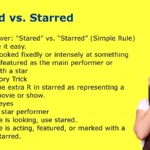
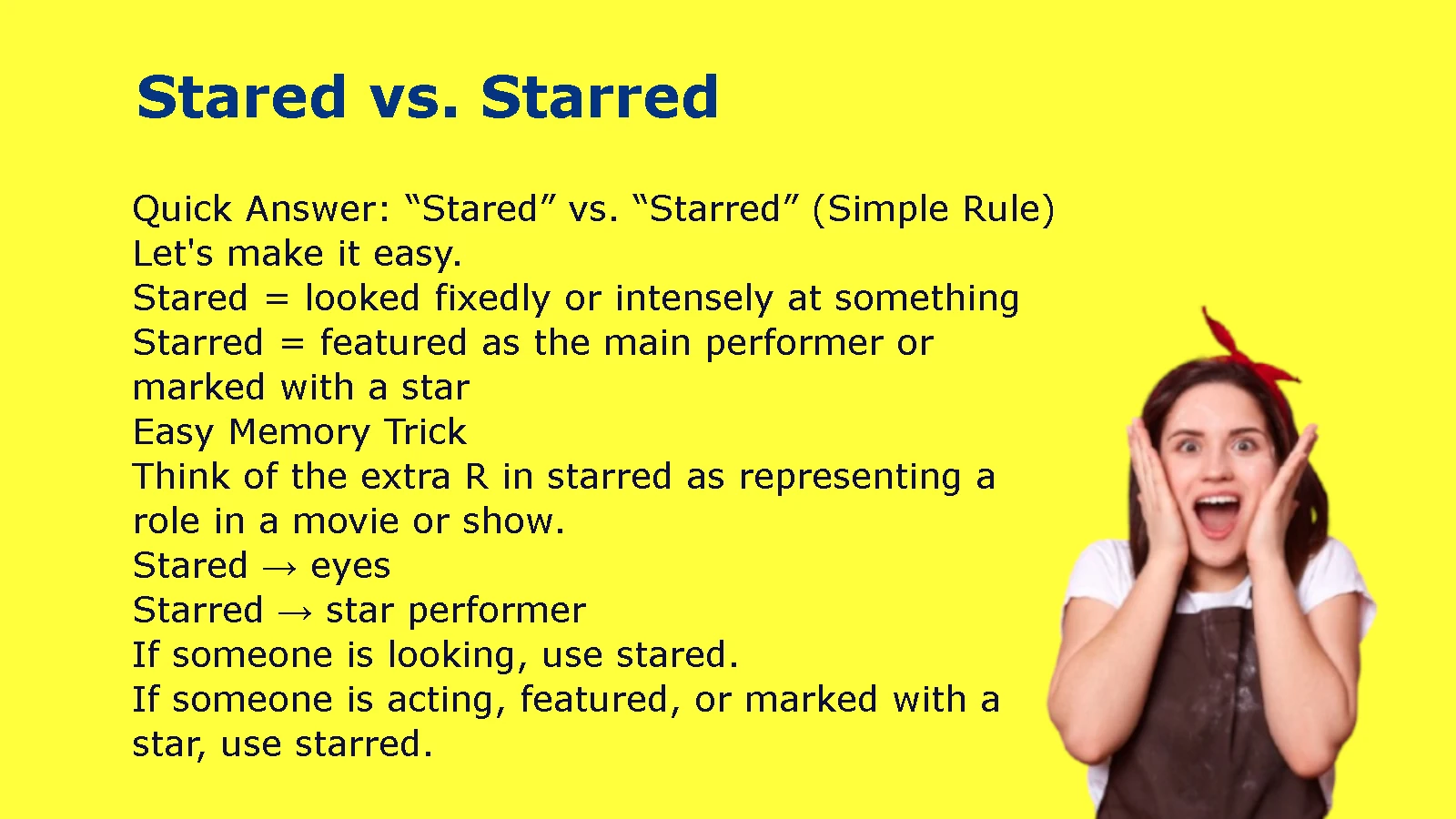
Quick Answer: “Stared” vs. “Starred” (Simple Rule)
Let’s make it easy.
Stared = looked fixedly or intensely at something
Starred = featured as the main performer or marked with a star
Easy Memory Trick
Think of the extra R in starred as representing a role in a movie or show.
- Stared → eyes
- Starred → star performer
If someone is looking, use stared.
If someone is acting, featured, or marked with a star, use starred.
What Does “Stared” Mean?
The word stared is the past tense of stare.
It means to look at someone or something for a long time, often with concentration, surprise, curiosity, or shock.
Common Uses of “Stared”
- Looking intensely
- Gazing without looking away
- Watching something closely
- Expressing surprise through eye contact
Examples
- She stared at the painting for several minutes.
- Everyone stared when the magician appeared.
- He stared out the window during class.
- The child stared at the giant elephant.
Key Insight
Whenever the sentence involves eyes, looking, watching, or gazing, the correct word is usually stared.
What Does “Starred” Mean?
The word starred is the past tense of star.
It typically means someone was featured as the main performer in a movie, show, play, or production.
It can also mean something was marked with a star symbol.
Common Uses of “Starred”
- Acting in a movie
- Being the main attraction
- Appearing prominently
- Marking something with a star
Examples
- She starred in a popular television series.
- The actor starred alongside several famous celebrities.
- I starred the email so I could find it later.
- The film starred an award-winning cast.
Key Insight
If the sentence involves entertainment, acting, performance, or marking an item with a star, use starred.
The Core Difference Between “Stared” and “Starred”
The distinction is actually simple once you focus on the action.
| Word | Meaning | Related To |
| Stared | Looked intensely | Eyes and vision |
| Starred | Featured or marked with a star | Movies, shows, symbols |
Quick Test
Ask yourself:
Is someone looking?
→ Use stared
Is someone acting or being featured?
→ Use starred
Why People Confuse “Stared” and “Starred”
Several factors make these words easy to mix up.
Similar Spelling
The words differ by only one letter.
- stared
- starred
At a quick glance, they look nearly identical.
Similar Pronunciation
In fast speech, the extra R in starred can be difficult to hear.
Autocorrect and Typing Errors
Many writing mistakes happen because people type quickly and don’t notice the extra letter.
Reading Too Fast
When proofreading, our brains often recognize word shapes instead of individual letters.
Side-by-Side Examples
Let’s compare them directly.
Correct Use of “Stared”
- He stared at the sky all night.
- The audience stared in amazement.
- She stared at the confusing instructions.
Correct Use of “Starred”
- He starred in a blockbuster movie.
- The actress starred in three hit films.
- I starred the important message.
Notice the Difference
❌ She starred at me angrily.
✅ She stared at me angrily.
❌ He stared in a new action film.
✅ He starred in a new action film.
Real-Life Examples of “Stared”
Here are examples you’ll encounter in everyday English.
At School
- The students stared at the science experiment.
At Work
- Everyone stared at the presentation screen.
In Public
- People stared at the unusual car.
In Literature
- The old man stared into the fire silently.
Real-Life Examples of “Starred”
Now let’s look at common situations involving starred.
Movies
- The actor starred in several award-winning films.
Television
- She starred in a popular drama series.
Email Apps
- I starred the message for future reference.
Streaming Platforms
- The documentary starred a famous explorer.
The Biggest Mistake People Make
The most common error is using starred when talking about looking at something.
Incorrect
“He starred at me during the meeting.”
Correct
“He stared at me during the meeting.”
Why?
Because the action involves looking, not acting.
Another Common Error
Incorrect:
“The actress stared in the movie.”
Correct:
“The actress starred in the movie.”
Because she performed in the film rather than looked at it.
Memory Tricks That Actually Work
Need a fast way to remember?
Trick #1: Eyes vs. Entertainment
Stared = eyes
Starred = entertainment
Trick #2: The Extra R Means Role
The extra R in starred can remind you of a role in a film or show.
Trick #3: Looking vs. Performing
If someone is watching:
→ stared
If someone is performing:
→ starred
Common Sentences and Their Correct Forms
Here are some examples people often get wrong.
| Incorrect | Correct |
| She starred at me. | She stared at me. |
| He stared in the movie. | He starred in the movie. |
| I stared the email. | I starred the email. |
| They starred out the window. | They stared out the window. |
| The actor stared in the show. | The actor starred in the show. |
How to Avoid Confusion Every Time
Follow these simple steps.
Step 1: Identify the Action
Ask:
What is happening?
Step 2: Look for Visual Clues
Words like:
- looked
- watched
- gazed
- observed
usually indicate stared.
Step 3: Look for Performance Clues
Words like:
- movie
- actor
- actress
- television
- role
usually indicate starred.
Step 4: Proofread Carefully
Pay special attention to the extra R.
One small letter completely changes the meaning.
Quick Decision Guide (Use This Instantly)
When you’re unsure, use this checklist.
Looking at something?
→ Stared
Acting in something?
→ Starred
Marking something with a star?
→ Starred
Watching someone intensely?
→ Stared
Simple. Reliable. Done.
FAQ: “Stared” vs. “Starred”
Is “starred at me” correct?
Usually no.
If you mean someone looked at you, the correct phrase is stared at me.
Can “starred” mean marked with a star?
Yes.
For example:
“I starred the document for later review.”
Which word is more common?
Stared appears more frequently in everyday conversation because people often describe looking at things.
Can an actor be described as “stared”?
No.
Actors starred in movies, shows, and plays.
Case Study: A Simple Writing Mistake
A student submitted an essay containing the sentence:
“The audience starred at the performer.”
The teacher marked it incorrect.
What Went Wrong?
The audience was looking at the performer.
They were not acting in a show.
Correct Version
“The audience stared at the performer.”
Lesson
Always determine whether the action involves looking or performing.
Key Facts You Should Remember
- Stared means looked intensely.
- Starred means acted in or was featured.
- Starred can also mean marked with a star.
- The extra R helps you remember role.
- Looking = stared.
- Performing = starred.
Final Takeaway: The One Rule That Never Fails
Here’s the simplest way to remember the difference between stared vs. starred.
If someone’s eyes are involved, use stared.
If someone is featured in a movie, show, production, or if something is marked with a star, use starred.
Think of it this way:
Stared = seeing.
Starred = starring.
One is about looking. The other is about being the star.
Remember that distinction, and you’ll never confuse these two words again.