Have you ever seen the words “Courtesy” vs. “Curtesy” and wondered whether they are just different spellings of the same idea—or completely different words? This is a common confusion in the English Language, especially because the two terms look almost identical but carry very different meanings and usage contexts.
In most modern writing, courtesy is the correct and widely used word in both American English and British English. It refers to politeness, respect, and considerate behavior in everyday communication. On the other hand, curtesy is not a spelling variation—it is actually an old legal term historically used in specific inheritance laws, making it rare and context-specific in modern usage.
This confusion often happens because learners assume both words belong to the same Grammar category, but in reality, they come from completely different linguistic and historical backgrounds.
In this guide, you’ll learn the clear difference between Courtesy vs. Curtesy, how each word is used, why the confusion exists, and when (if ever) you should use “curtesy.” We’ll also explore common spelling mistakes, real-world examples, and practical tips to help you choose the correct word confidently in both formal and informal writing.
By the end, you’ll never confuse these two terms again—and you’ll understand how small differences in Vocabulary can completely change meaning in English.
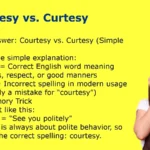
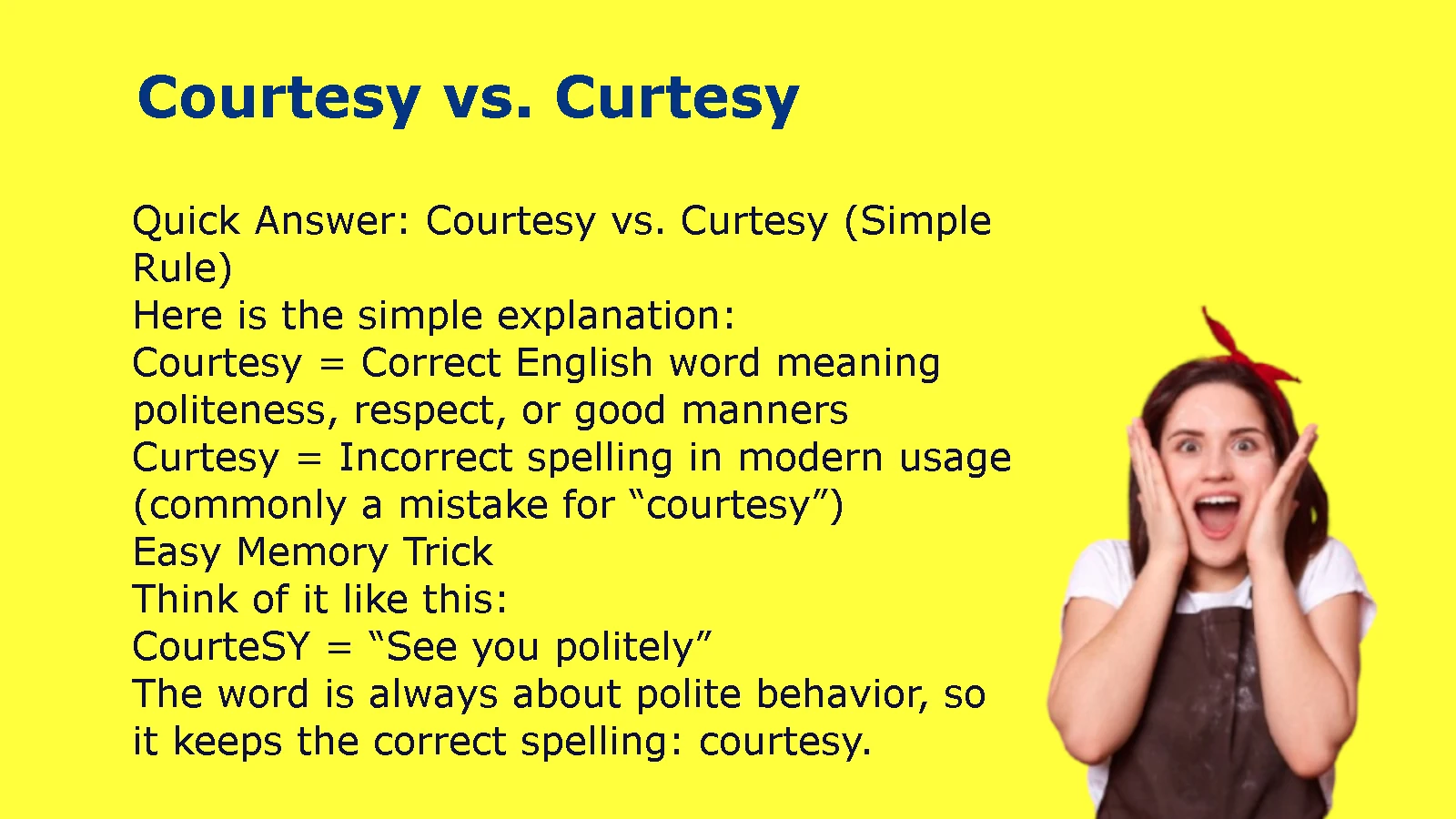
Quick Answer: Courtesy vs. Curtesy (Simple Rule)
Here is the simple explanation:
- Courtesy = Correct English word meaning politeness, respect, or good manners
- Curtesy = Incorrect spelling in modern usage (commonly a mistake for “courtesy”)
Easy Memory Trick
Think of it like this:
CourteSY = “See you politely”
The word is always about polite behavior, so it keeps the correct spelling: courtesy.
What Is the Difference Between Courtesy and Curtesy?
The difference is very simple:
- Courtesy is the correct word used for politeness and respectful behavior
- Curtesy is usually a misspelling of “courtesy” in modern English
The confusion happens because both spellings look natural, but only one is standard English.
Is “Curtesy” a Real Word?
Yes—but only in a very limited historical/legal sense.
- In modern everyday English: ❌ Curtesy = incorrect for politeness
- In legal history: ✔ Curtesy refers to an old law related to inheritance rights (rare usage)
Important takeaway:
If you are talking about manners, respect, or polite behavior, never use “curtesy.”
What Does “Courtesy” Mean?
The word courtesy refers to polite behavior and respect shown toward others.
As a Noun
It means politeness or respectful behavior.
Examples:
- He showed great courtesy to the guests.
- Please extend basic courtesy to others.
Common “Courtesy” Expressions
These phrases always use courtesy, never curtesy:
- Courtesy call
- Courtesy visit
- Courtesy reminder
- Courtesy of
- Professional courtesy
Examples:
- This ticket is a courtesy of the company.
- He gave me a courtesy call before arriving.
Why People Write “Curtesy” Instead of “Courtesy”
This mistake happens for a few reasons:
1. Sound-based spelling
The word is pronounced quickly, so “courtesy” may sound like “curtesy.”
2. Similar structure
Both words look grammatically possible, so learners assume both are valid.
3. Typing error
Many mistakes happen simply due to fast typing.
Courtesy vs. Curtesy in Real Usage
Correct Usage (Courtesy)
- She spoke with great courtesy.
- The staff treated us with courtesy.
- It was a courtesy visit.
Incorrect Usage (Curtesy)
- ❌ He showed great curtesy.
- ❌ Please extend curtesy to guests.
- ❌ A curtesy call was made.
Side-by-Side Comparison Table
| Word | Correct? | Meaning | Usage |
| Courtesy | Yes | Politeness, respect, manners | Standard English |
| Curtesy | No | Rare legal term / misspelling | Avoid in modern writing |
Where “Courtesy” Is Commonly Used
1. Professional Communication
- courtesy email
- courtesy reminder
- courtesy notice
2. Customer Service
- “We offer this as a courtesy to our customers.”
3. Everyday Conversation
- “He showed me courtesy at the store.”
Real-Life Examples of “Courtesy”
Workplace Examples
- The manager extended courtesy to all employees.
- We appreciate your courtesy during the meeting.
Formal Writing
- Please extend courtesy to all participants.
- The invitation was sent as a courtesy.
Common Mistake Examples (Curtesy → Courtesy)
❌ Curtesy reminder
✅ Courtesy reminder
❌ He showed curtesy
✅ He showed courtesy
❌ Curtesy of the company
✅ Courtesy of the company
How to Remember the Correct Spelling
1. Think of “COURT”
Courtesy comes from the idea of courtly behavior (politeness in royal courts).
So:
👉 COURT + E + SY = COURTESY
2. Link it to manners
Courtesy = courteous behavior
3. Repeat common phrases
- courtesy of
- professional courtesy
Quick Decision Guide
If you are unsure:
- Talking about politeness? → Use courtesy
- Thinking of writing “curtesy”? → Stop
- Writing emails or professional content? → Always courtesy
FAQ: Courtesy vs. Curtesy
Is “curtesy” correct in English?
Not in modern usage. It is mostly considered incorrect when referring to politeness.
What does “courtesy” mean?
It means politeness, respect, or good manners.
Why do people confuse courtesy and curtesy?
Because they sound similar when spoken.
Which spelling should I use in formal writing?
Always use courtesy.
Final Takeaway
The difference between courtesy vs curtesy is simple:
👉 Courtesy = correct word for politeness and respect
👉 Curtesy = incorrect in modern English (except rare legal usage)
Final rule:
Always remember:
✔ Courtesy = correct
❌ Curtesy = avoid
Using the correct spelling helps your writing look more professional, polished, and credible in all situations—from emails to academic writing.