Have you ever come across the words Engrained vs. Ingrained and wondered whether they mean the same thing or if one of them is actually incorrect? This is a common confusion in English language grammar, especially among writers, students, and content creators because both spellings appear in different contexts and can easily be mixed up.
In most modern usage, “ingrained” is the standard and widely accepted form, while “engrained” is often considered a less common variant or even a spelling error depending on the dictionary or style guide. The confusion usually comes from how English handles commonly confused words, spelling variations, and historical changes in vocabulary usage over time.
If you are working on improving your grammar skills, expanding your English vocabulary, or simply trying to avoid mistakes in writing, understanding the difference between these two terms is important. In formal writing, academic content, and professional communication, choosing the correct form can improve clarity and help your content sound more natural and authoritative.
In this guide, you’ll learn the meaning of Engrained vs. Ingrained, how each word is used, why the spelling difference exists, and when (if ever) “engrained” is acceptable. We’ll also explore real examples, common mistakes, and simple memory tips to help you use the correct form confidently in everyday writing.
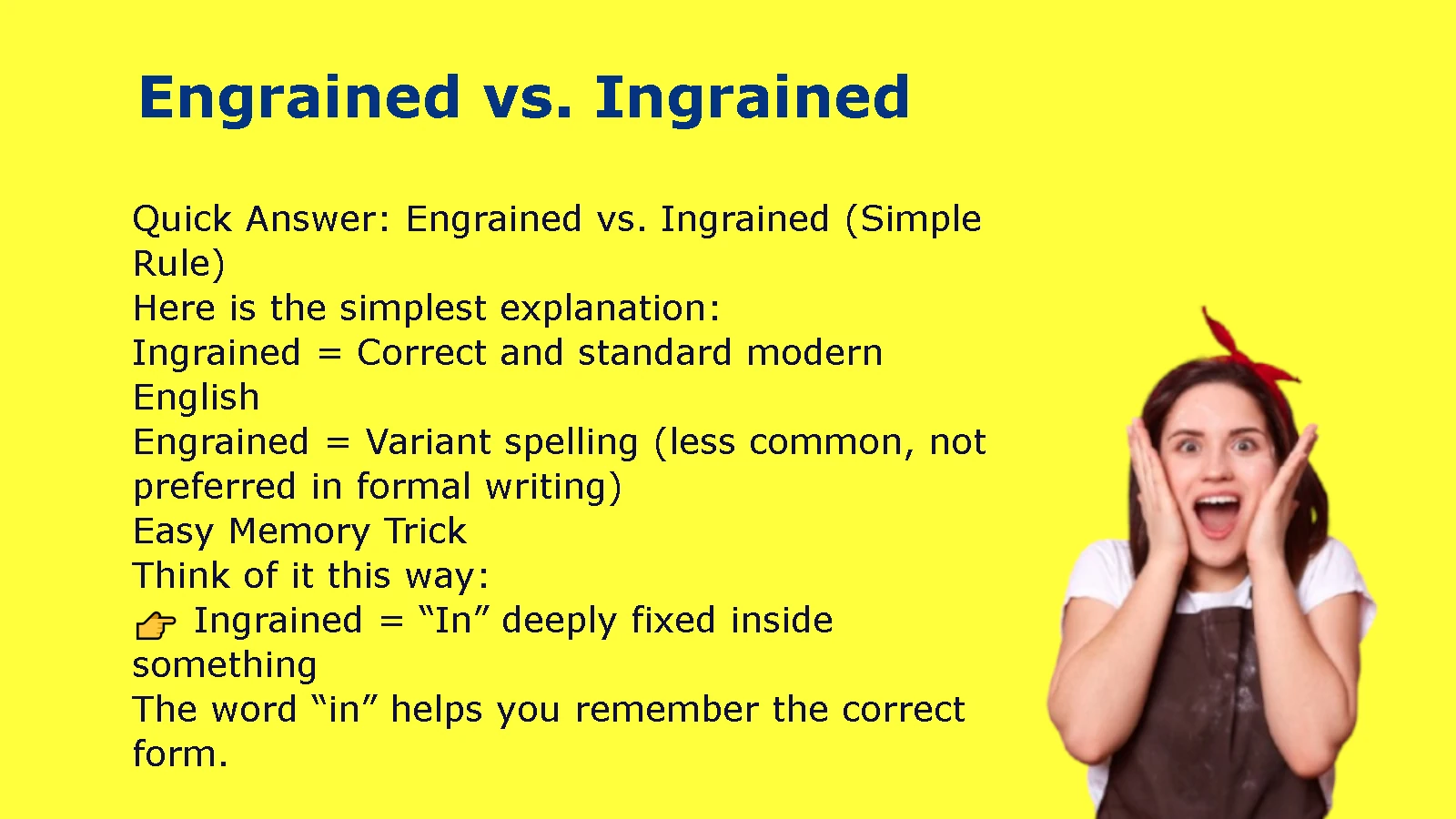
Quick Answer: Engrained vs. Ingrained (Simple Rule)
Here is the simplest explanation:
- Ingrained = Correct and standard modern English
- Engrained = Variant spelling (less common, not preferred in formal writing)
Easy Memory Trick
Think of it this way:
👉 Ingrained = “In” deeply fixed inside something
The word “in” helps you remember the correct form.
What Is the Difference Between Engrained and Ingrained?
The difference is mainly about standard usage vs. variation.
- Ingrained is the preferred spelling used in dictionaries and formal writing.
- Engrained is a less common alternative that appears in older or informal usage.
Key Idea
Both words refer to something deeply fixed or firmly established, but only one is widely accepted in modern English.
Is “Engrained” a Real Word?
Yes, but with limitations.
- ✔ It exists in English usage historically
- ✔ Sometimes appears in informal writing or older texts
- ❌ Not the preferred spelling in modern academic or professional English
Example
- Some habits are deeply engrained in culture. (less preferred)
- Some habits are deeply ingrained in culture. (correct and standard)
What Does “Ingrained” Mean? (Clear Explanation)
The word ingrained means something that is deeply fixed or strongly established, often in behavior, belief, or habit.
Common Meaning
- Deeply fixed in mind or behavior
- Difficult to change or remove
Examples of “Ingrained” in Use
Everyday English
- He has an ingrained habit of waking up early.
- Fear of failure is deeply ingrained in her mind.
Workplace English
- A culture of teamwork is ingrained in the company.
- These practices are ingrained in our organization.
Academic Context
- Bias can become ingrained over time.
- The behavior is culturally ingrained.
Why Do People Write “Engrained”?
This confusion happens for a few simple reasons:
1. Sound Similarity
Both words sound almost identical in speech.
2. Prefix Confusion
People assume “en-” and “in-” are interchangeable prefixes.
3. Exposure to Variants
Some older texts and informal usage still include “engrained.”
Engrained vs. Ingrained in Modern English
Preferred Usage (Ingrained)
- This habit is deeply ingrained.
- These values are ingrained in society.
- The behavior is ingrained over time.
Less Preferred Usage (Engrained)
- Some traditions are engrained in culture. ❌ (not recommended)
- The idea is engrained in his thinking. ❌ (avoid in formal writing)
Side-by-Side Comparison Table
| Word | Correct? | Usage Level | Meaning |
| Ingrained | Yes | Standard modern English | Deeply fixed or established |
| Engrained | Partially | Non-standard / informal | Same meaning, less preferred |
Why “Ingrained” Is the Preferred Form
The word “ingrained” aligns better with modern dictionary standards and consistent usage across:
- Academic writing
- Journalism
- Professional communication
- Exams and formal essays
That is why it is the safest choice.
How to Use “Ingrained” Correctly
As an Adjective
- The habit is deeply ingrained.
In Describing Behavior
- Discipline is ingrained in athletes.
In Cultural Context
- Respect is ingrained in their traditions.
Common Mistake People Make
The most common mistake is assuming both forms are equal.
Wrong Assumption
- “Engrained and ingrained are interchangeable.”
Correct Understanding
- Use ingrained for all formal writing
- Avoid engrained unless quoting older or informal usage
Simple Rule to Remember
If you are unsure, follow this rule:
👉 Always use “ingrained” in modern English
Think:
✔ In + grained = inside deeply fixed
❌ En + grained = avoid in formal writing
FAQ: Engrained vs. Ingrained
Is “engrained” correct English?
It exists, but it is not preferred in modern standard English.
Which spelling should I use in exams?
Always use ingrained.
Do they mean the same thing?
Yes, both refer to something deeply fixed, but usage differs.
Which is more common?
“Ingrained” is far more widely used today.
Final Takeaway
The difference between engrained vs. ingrained is simple:
👉 “Ingrained” is the correct and standard form
👉 “Engrained” is a less common variant that should be avoided in formal writing
Final Rule:
When in doubt, choose:
✔ Ingrained
It is always the safer and more professional choice in modern English writing.