Have you ever typed Shinny vs. Shiny and wondered whether both words are correct? You’re not alone. This common spelling confusion catches many English learners, writers, students, and even native speakers because the two words look nearly identical but have very different meanings and usage.
In English grammar and vocabulary, understanding the difference between Shinny vs. Shiny is important for clear communication. While shiny is a widely used adjective that describes something bright, glossy, polished, or reflective, shinny is a real word with a much more specific meaning related to a traditional sport similar to hockey. Because of their similar spelling, many people mistakenly use one in place of the other, leading to common writing mistakes and awkward sentences.
Whether you’re writing an essay, creating content, sending a professional email, or simply trying to improve your English language skills, knowing when to use shiny and when to use shinny can help you avoid embarrassing errors. This distinction is especially useful for anyone interested in word meanings, commonly confused words, correct spelling, and proper word choice.
In this guide, you’ll learn the meaning of Shinny vs. Shiny, how each word is used in everyday English, their pronunciation, grammatical roles, real-life examples, and simple memory tricks to remember the difference. We’ll also explore common mistakes, related vocabulary, and practical tips to help you choose the correct word with confidence every time.
So, if you’ve ever asked yourself, “Is it shinny or shiny?” you’re in the right place. Let’s clear up the confusion once and for all.
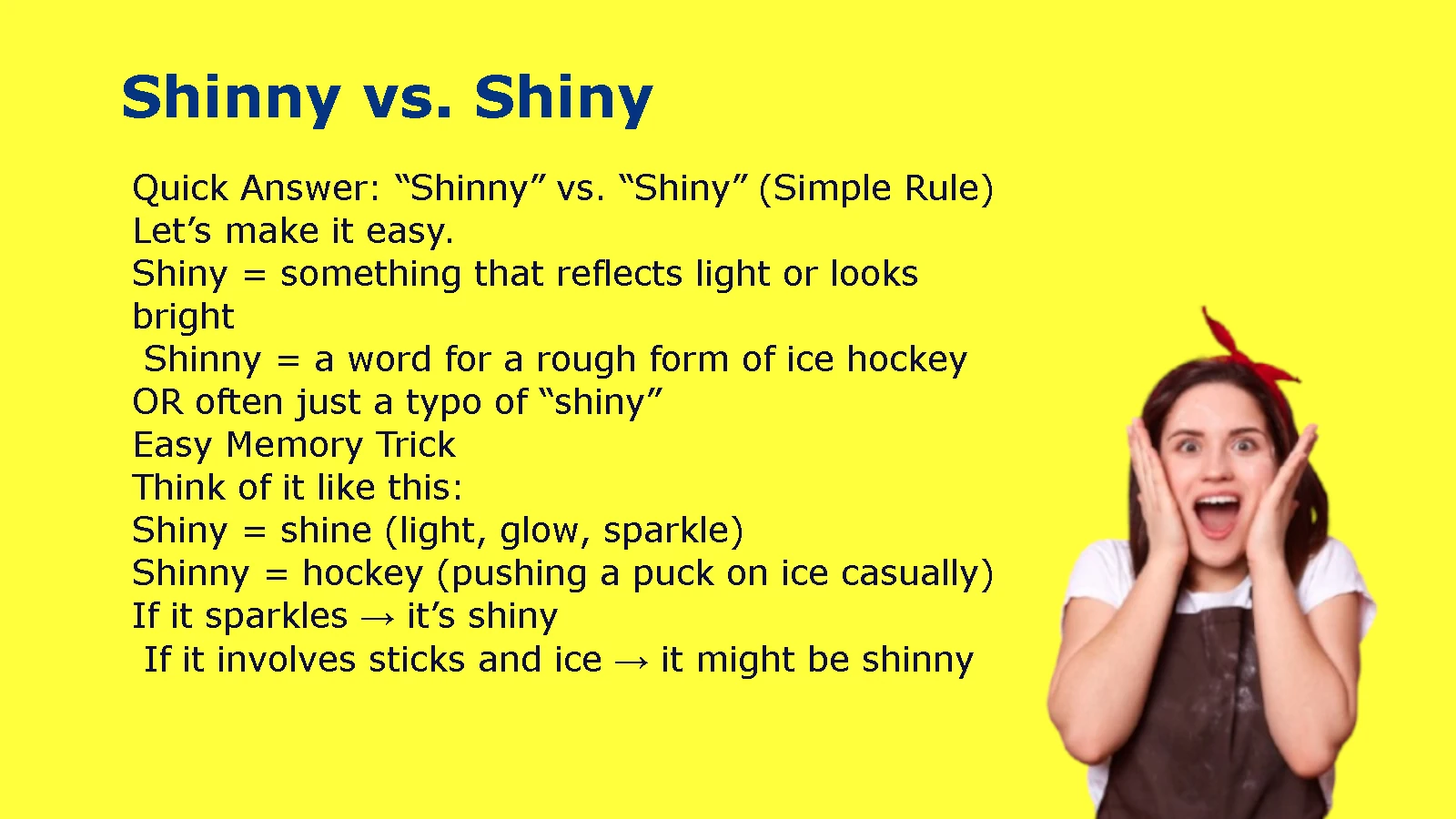
Quick Answer: “Shinny” vs. “Shiny” (Simple Rule)
Let’s make it easy.
Shiny = something that reflects light or looks bright
Shinny = a word for a rough form of ice hockey OR often just a typo of “shiny”
Easy Memory Trick
Think of it like this:
- Shiny = shine (light, glow, sparkle)
- Shinny = hockey (pushing a puck on ice casually)
If it sparkles → it’s shiny
If it involves sticks and ice → it might be shinny
How People Actually Use “Shinny” and “Shiny”
Here’s where most confusion starts.
In Everyday Writing
Most people accidentally type “shinny” when they mean “shiny.”
Autocorrect doesn’t always catch it, so it slips through.
In Sports Context
“Shinny” is actually used in a real context:
- A casual form of ice hockey played on outdoor rinks or frozen ponds
In Descriptive Language
“Shiny” is the one you want almost always:
- Shiny car
- Shiny shoes
- Shiny surface
The Meaning Behind “Shiny”
Let’s break it down clearly.
Standard Meaning
Shiny = reflecting light or having a bright polished surface
It describes something that looks clean, smooth, or glowing.
Real-Life Examples
- “The floor was so shiny it looked like glass.”
- “She wore a shiny silver dress.”
- “His new phone has a shiny screen.”
Why It Matters
“Shiny” is used in:
- Everyday English
- Academic writing
- Creative descriptions
- Marketing and branding
It’s the correct and widely accepted form.
The Meaning Behind “Shinny”
Now the tricky one.
Standard Meaning (Rare Use)
Shinny = a casual form of ice hockey played outdoors
Players:
- Don’t follow strict rules
- Often use improvised goals
- Play on frozen lakes or informal rinks
Example
- “We used to play shinny on the frozen pond every winter.”
Important Note
Outside of sports context, “shinny” is usually a spelling mistake for “shiny.”
The Biggest Mistake People Make
Here’s the real issue.
People assume “shinny” is just another spelling of “shiny.”
What Goes Wrong
- Writers use “shinny” in essays
- Bloggers miss it in editing
- Students lose marks in writing tasks
Real Scenario
A student writes:
“The sun reflected off the shinny surface of the lake.”
Problem:
- Teacher reads it as incorrect spelling
- Meaning becomes unclear
Correct version:
- “The sun reflected off the shiny surface of the lake.”
Side-by-Side Comparison Table
| Word | Meaning | Usage Frequency | Common Context |
| Shiny | Bright, reflective surface | Very High | Everyday English |
| Shinny | Casual ice hockey OR typo | Very Low | Sports / Errors |
Real-Life Examples of “Shiny”
Let’s make it practical.
Everyday Situations
- “The kitchen tiles were shiny after cleaning.”
- “He polished his shiny shoes.”
- “The metal surface looked shiny under the light.”
What It Always Means
Something that:
- Reflects light
- Looks polished
- Appears bright or clean
Real-Life Examples of “Shinny”
Now the rare one.
Sports Context
- “Kids went outside to play shinny on the frozen lake.”
- “We don’t have teams—just a game of shinny.”
What It Never Means
- It does NOT mean bright
- It does NOT mean polished
- It does NOT describe objects
Why This Confusion Happens
There are a few reasons.
1. Sound Similarity
Both words sound almost identical when spoken quickly.
2. Autocorrect Issues
Typing fast often leads to unnoticed mistakes.
3. Lack of Awareness
Many people don’t even know “shinny” is a real word.
4. Visual Assumption
People assume “shinny” looks like a variation of “shiny.”
The Simple Logic Behind It
Think in terms of meaning categories:
- Shiny → adjective (describes appearance)
- Shinny → noun/verb (sports activity or informal term)
If you’re describing something you can see → use shiny
How to Never Mix Them Up Again
Here’s a foolproof method.
Step 1: Ask What You Mean
- Is it about appearance? → shiny
- Is it about hockey? → shinny
Step 2: Replace Test
Try replacing the word:
- “sparkling” fits → shiny
- “ice hockey game” fits → shinny
Step 3: Default Rule
If you’re unsure → always use shiny
Because it is correct in 99% of situations.
What to Say Instead (Clear Alternatives)
To avoid mistakes completely:
Use “Shiny” When You Mean:
- Bright
- Reflective
- Polished
- Glossy
Better Alternatives
- “Glossy surface”
- “Polished finish”
- “Reflective metal”
Avoid Confusion In Writing
In formal content:
- Never use “shinny” unless talking about hockey
Quick Decision Guide
When you’re stuck, use this:
- Appearance → Shiny
- Ice hockey game → Shinny
- Still unsure → Shiny
Simple. Safe. Accurate.
FAQ: “Shinny” vs. “Shiny”
Is “shinny” just a typo?
Most of the time, yes. It’s usually a misspelling of “shiny.”
Is “shinny” a real word?
Yes, but only in the context of casual ice hockey.
Which one should I use in writing?
Always use shiny unless you are specifically referring to the sport.
Why do people confuse them?
Because they sound identical and differ by only one letter.
Key Facts You Should Remember
- “Shiny” = correct word for bright or reflective surfaces
- “Shinny” = informal hockey term or spelling error
- Context determines meaning
- “Shiny” is used 99% of the time in English writing
- “Shinny” should be avoided in formal content
Final Takeaway: The One Rule That Never Fails
Here’s the simplest truth:
If it sparkles, shines, or reflects light → it’s shiny.
“Shinny” only belongs on the ice rink—not in your everyday writing.
So next time you’re unsure, just remember:
Shiny is for light. Shinny is for hockey. Everything else is a mistake.