Have you ever come across Uncollectible vs. Uncollectable and wondered whether they’re different words or simply two spellings of the same term? You’re not alone. This common vocabulary and spelling question often confuses writers, students, and professionals, especially when dealing with financial, legal, or everyday English contexts.
The confusion gets even bigger when people search for uncollectible meaning, uncollectable meaning, uncollectible definition, or the difference between uncollectible and uncollectable. And here’s the kicker: while both words can refer to something that cannot be collected, their usage isn’t always identical in every context.
But don’t worry—there’s a clear explanation.
In this guide, you’ll learn the difference between Uncollectible vs. Uncollectable, discover the correct usage of each term, and understand whether one spelling is preferred in modern English. You’ll also find uncollectible examples, uncollectable examples, pronunciation guidance, and real-world situations where these words commonly appear.
By the end, you’ll know when to use uncollectible, when to use uncollectable, and how to choose the right word with confidence in both formal and everyday writing.
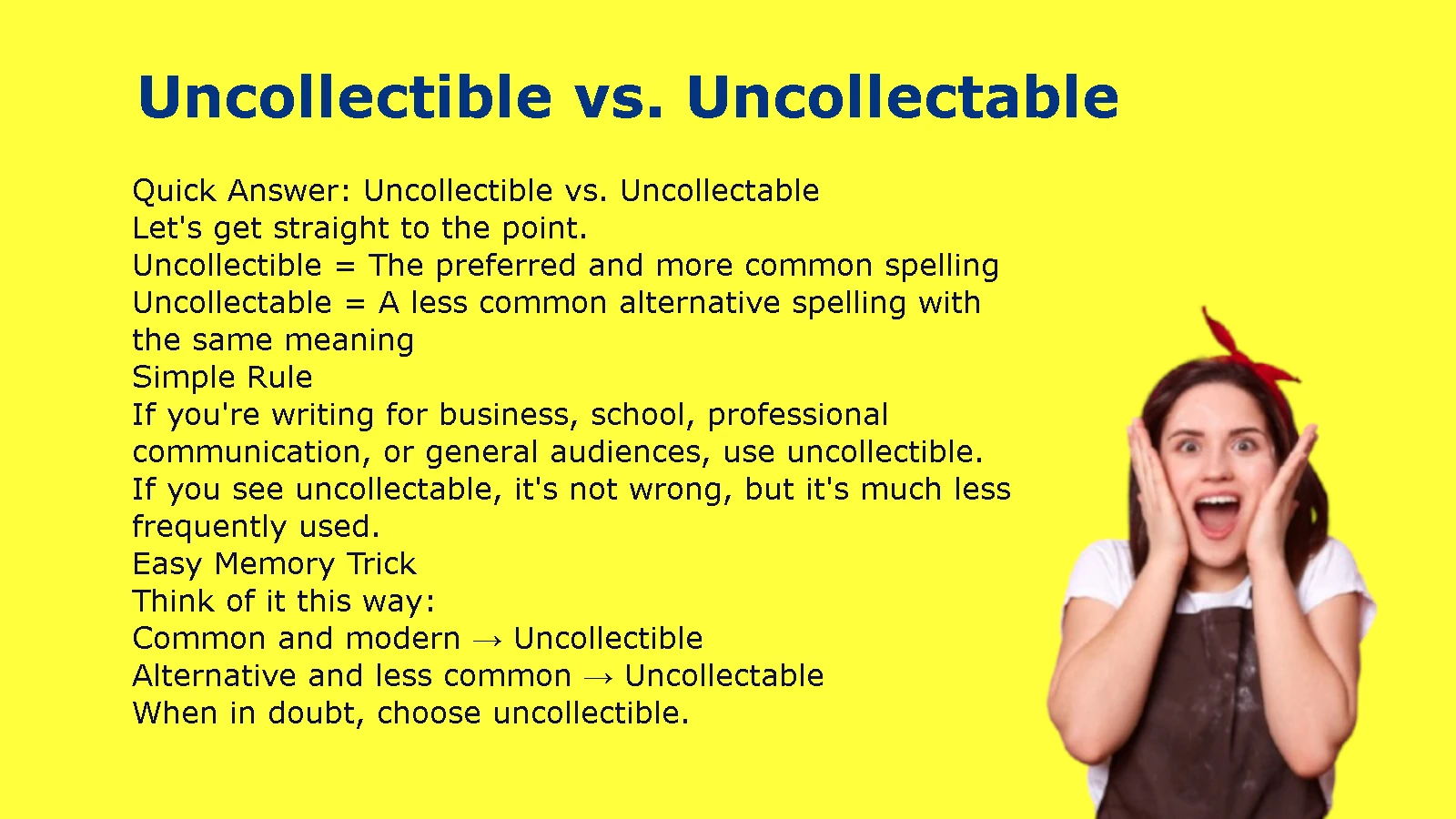
Quick Answer: Uncollectible vs. Uncollectable
Let’s get straight to the point.
Uncollectible = The preferred and more common spelling
Uncollectable = A less common alternative spelling with the same meaning
Simple Rule
If you’re writing for business, school, professional communication, or general audiences, use uncollectible.
If you see uncollectable, it’s not wrong, but it’s much less frequently used.
Easy Memory Trick
Think of it this way:
- Common and modern → Uncollectible
- Alternative and less common → Uncollectable
When in doubt, choose uncollectible.
What Does “Uncollectible” Mean?
The word uncollectible describes something that cannot be collected.
Most commonly, it refers to:
- Debts that cannot be recovered
- Payments that are unlikely to be received
- Accounts that businesses write off as losses
Examples
- The company marked the unpaid invoice as uncollectible.
- Several customer accounts became uncollectible after the bankruptcy.
- The bank reported millions of dollars in uncollectible loans.
In business and accounting, this is the spelling you’ll see most often.
What Does “Uncollectable” Mean?
Uncollectable has the same definition as uncollectible.
It also refers to something that cannot be collected or recovered.
Examples
- The debt was considered uncollectable after several years.
- Some legal fees became uncollectable.
- The agency classified the balance as uncollectable.
Key Point
There is no significant difference in meaning.
The distinction is mainly one of usage and preference rather than definition.
Why Are There Two Spellings?
English often allows multiple endings for adjectives.
Many words can end in:
- -able
- -ible
Examples include:
| -able | -ible |
|---|---|
| Comfortable | Sensible |
| Dependable | Flexible |
| Adaptable | Visible |
The word collect naturally forms collectable, but over time collectible became the dominant form in many contexts.
The same pattern eventually influenced the negative forms:
- Collectible → Uncollectible
- Collectable → Uncollectable
As a result, both spellings entered English usage.
Which Spelling Is More Common?
Today, uncollectible is significantly more common than uncollectable.
Where You’ll Usually See Uncollectible
- Accounting reports
- Financial statements
- Banking documents
- Business communication
- Academic writing
- News articles
Where You Might See Uncollectable
- Older documents
- Regional writing styles
- Informal usage
- Certain dictionaries that list both variants
Practical Advice
If you’re writing for a broad audience, choose uncollectible because it’s the spelling most readers expect.
The Accounting Connection
One reason uncollectible dominates modern English is its widespread use in accounting.
Businesses frequently discuss:
- Uncollectible accounts
- Uncollectible debts
- Uncollectible receivables
- Uncollectible invoices
Example
A company sells products on credit.
If customers fail to pay and recovery efforts fail, those balances become uncollectible accounts.
This terminology appears in accounting textbooks and financial reports worldwide.
Side-by-Side Comparison
| Feature | Uncollectible | Uncollectable |
|---|---|---|
| Meaning | Cannot be collected | Cannot be collected |
| Correct spelling | Yes | Yes |
| More common | Yes | No |
| Preferred in business writing | Yes | Rarely |
| Seen in accounting | Frequently | Occasionally |
| Recommended for most writers | Yes | No |
Real-Life Examples of Uncollectible
Here are some common situations where uncollectible appears.
Business
“The company wrote off several uncollectible invoices.”
Banking
“The loan was declared uncollectible.”
Insurance
“The claim became uncollectible due to missing documentation.”
Legal Context
“Certain court-awarded fees proved uncollectible.”
In each case, the spelling looks natural and professional.
Real-Life Examples of Uncollectable
Although less common, uncollectable still appears occasionally.
Business Example
“The debt was deemed uncollectable.”
Government Example
“The taxes were considered uncollectable.”
Personal Finance Example
“The lender eventually classified the amount as uncollectable.”
These sentences are correct, but many editors would still prefer uncollectible.
The Biggest Mistake People Make
The most common mistake is assuming one spelling is wrong.
What People Often Think
- Uncollectible = Correct
- Uncollectable = Incorrect
Reality
Both spellings are accepted.
The difference is simply frequency and preference.
Better Approach
Ask yourself:
“Which version will look most familiar to my audience?”
In most situations, the answer is uncollectible.
Professional Writing Recommendation
If you’re writing:
- Reports
- Academic papers
- Business emails
- Financial documents
- Legal communications
Use uncollectible.
Why?
Because it:
- Appears more often in professional publications
- Matches common accounting terminology
- Looks more familiar to readers
- Reduces the chance of being questioned by editors
Quick Decision Guide
Use this simple checklist.
Choose “Uncollectible” If:
You’re writing professionally
✔You’re discussing finance or accounting
You want the most widely accepted spelling
You’re unsure which version to use
Choose “Uncollectable” If:
✔ You’re following a specific style guide
You’re matching existing text that already uses it
Regional preferences favor that spelling
For most writers, uncollectible is the safest choice.
FAQ: Uncollectible vs. Uncollectable
Are both words correct?
Yes. Both uncollectible and uncollectable are recognized English words.
Do they mean different things?
No. Their meanings are essentially identical.
Which spelling is more common?
Uncollectible is considerably more common in modern usage.
Which spelling should I use in business writing?
Use uncollectible because it is the standard choice in finance and accounting.
Is uncollectable outdated?
Not necessarily. It’s still correct, but it appears less frequently than uncollectible.
Case Study: A Business Report Revision
A financial analyst prepared a report containing the sentence:
“The company recorded $50,000 in uncollectable accounts.”
The report was reviewed by senior accountants.
What Happened?
The editors changed:
uncollectable accounts
to
uncollectible accounts
Why?
Not because the original was wrong.
They simply preferred the spelling commonly used in accounting literature and financial reporting.
Lesson
Sometimes the best choice is the one readers expect to see.
Key Facts to Remember
- Uncollectible and uncollectable have the same meaning.
- Both spellings are considered correct.
- Uncollectible is much more common.
- Accounting and finance usually favor uncollectible.
- Most professional writers prefer uncollectible.
- Choosing the common spelling helps avoid confusion.
Final Takeaway: Which One Should You Use?
When comparing uncollectible vs. uncollectable, the difference is not about meaning—it’s about preference and usage.
Both words describe something that cannot be collected, especially debts, payments, or receivables. However, uncollectible has become the dominant spelling in modern English and is widely preferred in business, accounting, legal, and professional contexts.
If you want the simplest rule to remember, use this:
Uncollectible = preferred and most common
Uncollectable = correct but less common
In everyday writing, professional communication, and financial documents, choosing uncollectible is usually the safest and clearest option. That way, your writing looks natural, modern, and familiar to your readers.