Have you ever typed Seal vs. Seel and stopped to wonder which spelling is actually correct? This is a classic English word confusion where one option is valid, and the other is often a common misspelling that slips into writing by mistake.
The confusion usually comes from similar-sounding words and unclear spelling patterns, especially when people search for things like seal meaning, seal spelling, seal definition, and even how to spell seal correctly. And here’s the kicker: one extra letter can completely change whether your writing looks accurate or incorrect.
You’re not alone if you’ve mixed these up before. Many learners struggle with this because of tricky word usage rules and similar pronunciation.
In this guide, you’ll learn the difference between Seal vs. Seel, understand the correct seal spelling, and explore real seal examples in sentences. You’ll also discover why people search for is “seel” correct spelling, seal vs seel difference, and correct usage of seal when trying to avoid common spelling mistakes.
By the end, you’ll clearly know which word is correct, when to use seal, and why seel is often considered incorrect in modern English usage.
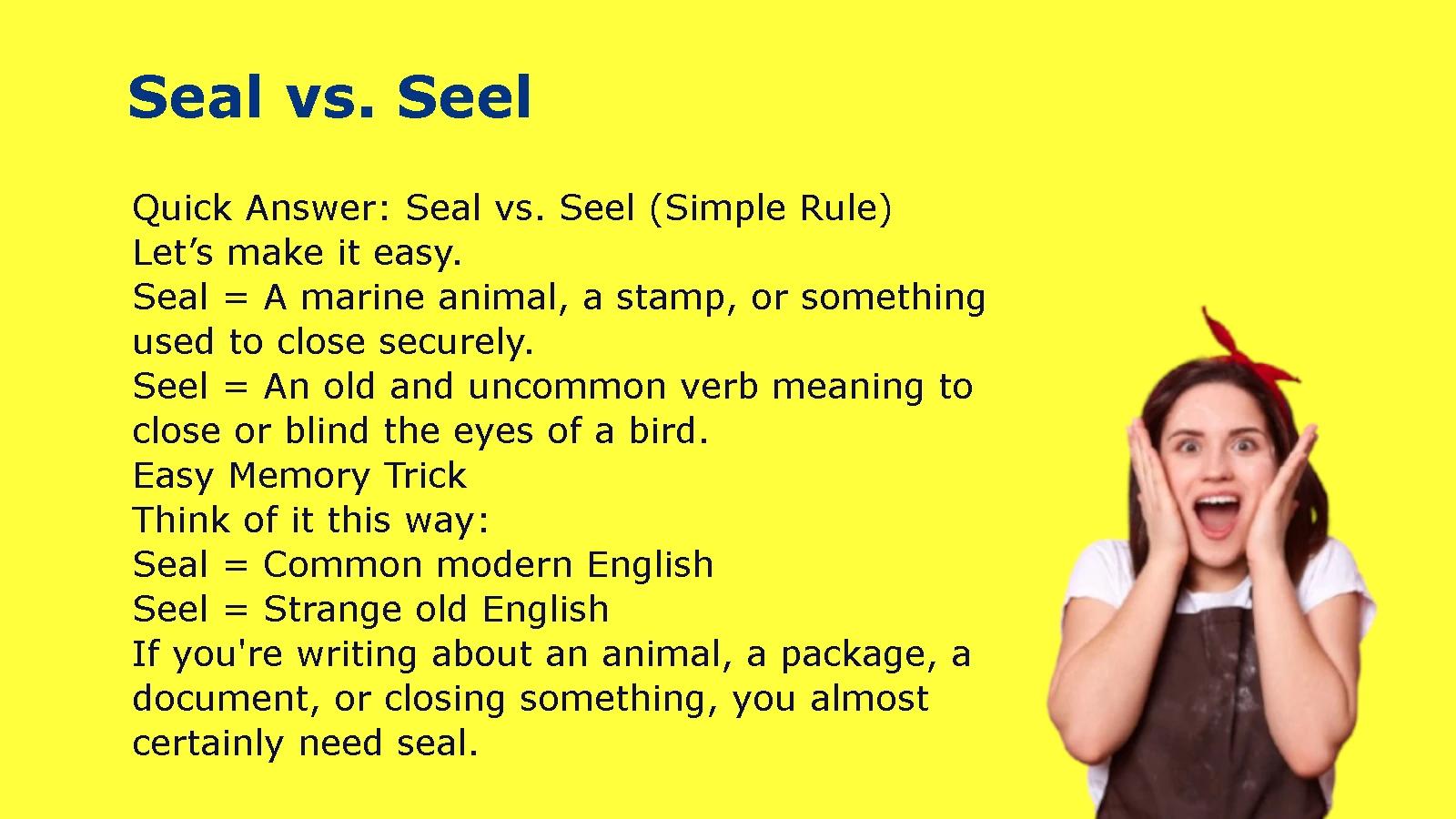
Quick Answer: Seal vs. Seel (Simple Rule)
Let’s make it easy.
Seal = A marine animal, a stamp, or something used to close securely.
Seel = An old and uncommon verb meaning to close or blind the eyes of a bird.
Easy Memory Trick
Think of it this way:
- Seal = Common modern English
- Seel = Strange old English
If you’re writing about an animal, a package, a document, or closing something, you almost certainly need seal.
What Does “Seal” Mean?
The word seal has several meanings and is widely used in modern English.
As an Animal
A seal is a marine mammal that lives in oceans and coastal areas.
Example:
- We watched a seal resting on the rocks.
As a Closure
Seal can mean to close something tightly.
Example:
- Please seal the envelope before mailing it.
As an Official Mark
A seal can also be an official stamp or symbol.
Example:
- The certificate carried the company’s official seal.
Why “Seal” Is Common
You’ll find this word in:
- Business documents
- Legal papers
- Shipping and packaging
- Wildlife discussions
- Everyday conversations
What Does “Seel” Mean?
Now let’s look at the much rarer word.
Traditional Meaning
Seel is an old verb meaning to close or stitch the eyelids of a bird, particularly a hunting bird.
Historically, falconers sometimes used this practice to calm birds.
Example:
- The falconer was instructed to seel the hawk before transport.
Modern Usage
Today, the word is rarely used.
Most native English speakers have never used it in conversation.
You may encounter it in:
- Historical literature
- Falconry texts
- Older dictionaries
- Academic discussions
Key Insight
If you’re writing modern English, you probably don’t need the word seel at all.
The Biggest Difference Between Seal and Seel
The distinction is straightforward.
| Word | Meaning | Modern Usage |
| Seal | Animal, stamp, or close securely | Very common |
| Seel | To close a bird’s eyes | Extremely rare |
Key Rule
If you’re unsure, seal is usually the correct choice.
Why People Confuse Seal and Seel
Several factors contribute to the confusion.
Similar Spelling
The words differ by only one letter.
- Seal
- Seel
A quick typing mistake can easily create confusion.
Similar Pronunciation
Depending on accent and pronunciation, the words may sound nearly identical.
Spell-Checking Issues
Some spell-checkers recognize both words because seel is technically a valid English word.
As a result, an error may not be flagged.
Real-Life Examples of “Seal”
Here are some common examples.
As a Verb
- Seal the package before shipping it.
- Workers sealed the cracks in the wall.
- Make sure you seal the container tightly.
As a Noun
- The seal swam gracefully through the water.
- The document bore the royal seal.
- We saw a baby seal at the aquarium.
What They Mean
In every example, seal refers to either:
- Closing something securely
- An official mark
- The marine animal
Real-Life Examples of “Seel”
Because the word is uncommon, examples are limited.
Historical Usage
- Falconers would sometimes seel birds during training.
- The ancient text described how to seel a hunting hawk.
- The practice of seeling birds is largely obsolete today.
What They Mean
In each sentence, seel refers specifically to temporarily closing a bird’s eyes.
Common Mistakes People Make
Here are the most frequent errors.
Mistake #1: Using Seel Instead of Seal
Incorrect:
- Please seel the envelope.
Correct:
- Please seal the envelope.
Mistake #2: Referring to the Animal as Seel
Incorrect:
- We saw a seel at the beach.
Correct:
- We saw a seal at the beach.
Mistake #3: Assuming Both Words Are Interchangeable
They are not.
The meanings are completely different.
Side-by-Side Comparison Table
| Feature | Seal | Seel |
| Part of Speech | Noun and Verb | Verb |
| Common Today | Yes | No |
| Refers to an Animal | Yes | No |
| Means to Close Securely | Yes | No |
| Historical Falconry Term | No | Yes |
| Used in Everyday Writing | Frequently | Rarely |
How to Remember the Difference
A simple trick can help.
Remember “Seal” Like an Envelope Seal
Think of:
- Sealed package
- Sealed letter
- Sealed container
These are common situations you encounter regularly.
Remember “Seel” as an Old Word
The double e can remind you that the word belongs to older English and specialized historical contexts.
When Should You Use Seal?
Use seal when talking about:
- Marine animals
- Official stamps
- Closing something securely
- Legal documents
- Packaging and shipping
Examples
- Seal the box.
- The seal surfaced from the water.
- The contract carries an official seal.
When Should You Use Seel?
Use seel only when discussing:
- Falconry
- Historical bird-training practices
- Older literary works
Examples
- The manuscript described how to seel a hawk.
- Historians documented methods used to seel hunting birds.
Quick Decision Guide
Use this simple checklist.
Are you talking about:
- A marine mammal? → Seal
- Closing an envelope? → Seal
- An official stamp? → Seal
- A historical bird-training practice? → Seel
For nearly all modern writing, the answer will be seal.
FAQ: Seal vs. Seel
Is “seel” a real word?
Yes. It is an old English word related to falconry and bird handling.
Which word is more common?
Seal is vastly more common and appears regularly in modern English.
Can “seel” mean to close something?
Not in the general sense. It specifically refers to closing a bird’s eyes.
Is “seel” used today?
Very rarely. Most people never use it outside historical or specialized discussions.
Can I use “seel” instead of “seal”?
No. The words have different meanings and are not interchangeable.
Key Facts You Should Remember
- Seal is a common modern English word.
- Seal can refer to an animal, a stamp, or closing something securely.
- Seel is a rare historical verb.
- Seel refers to closing a bird’s eyes, especially in falconry.
- The two words are not interchangeable.
- In everyday writing, seal is almost always the correct choice.
Final Takeaway: The One Rule That Never Fails
When comparing seal vs. seel, the easiest rule is this:
Use “seal” for modern English. Use “seel” only for historical falconry contexts.
If you’re talking about an envelope, package, contract, container, official stamp, or marine animal, the correct word is seal.
The word seel survives mainly in old texts and specialized discussions. Most writers will rarely, if ever, need it.
So whenever you’re in doubt, remember:
Seal = common and modern.
Seel = rare and historical.
That simple distinction will help you avoid mistakes and use the correct word every time.