Mentioned vs. Mentionned is a common spelling confusion that often appears in emails, academic writing, business communication, and everyday English. If you’ve ever wondered whether “mentioned” or “mentionned” is the correct spelling, you’re not alone. Many English learners and even native speakers occasionally add an extra “n” because the pronunciation can make both versions seem plausible. However, only one form is accepted in standard English grammar and spelling rules.
But here’s the thing: understanding the difference is easier than it seems. English verbs follow specific spelling patterns when forming the past tense and past participle, and the verb “mention” follows a regular rule. Knowing the correct spelling helps improve your writing accuracy, professional communication, and overall English language skills.
In this guide, you’ll learn the difference between mentioned vs. mentionned, discover which spelling is correct, explore common grammar mistakes, and see real-world examples that make the usage easy to remember. Whether you’re writing an email, preparing an essay, or improving your English vocabulary, this article will help you use the correct word with confidence.
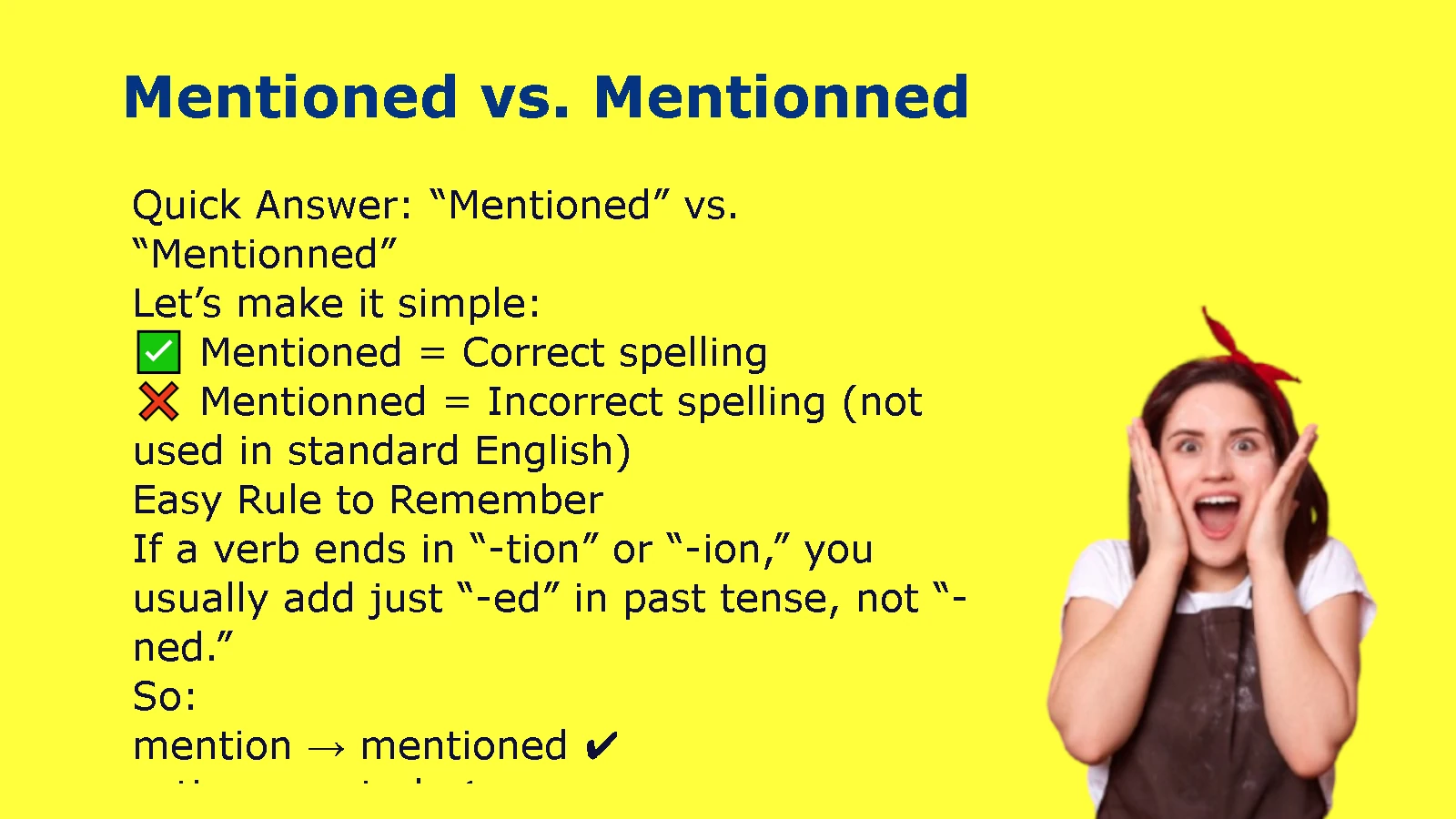
Quick Answer: “Mentioned” vs. “Mentionned”
Let’s make it simple:
- ✅ Mentioned = Correct spelling
- ❌ Mentionned = Incorrect spelling (not used in standard English)
Easy Rule to Remember
If a verb ends in “-tion” or “-ion,” you usually add just “-ed” in past tense, not “-ned.”
So:
- mention → mentioned ✔
- action → acted ✔
- caution → cautioned ✔
Why “Mentionned” Feels Correct (But Isn’t)
The mistake usually comes from pronunciation habits and visual assumptions.
Reason 1: Double consonant confusion
Words like:
- “planned”
- “stopped”
- “dropped”
all use double letters, so people assume “mentionned” should follow the same rule.
Reason 2: Sound influence
“Mention” ends with a soft “n” sound, so writers mistakenly add an extra “n” when forming the past tense.
Reason 3: Overgeneralizing grammar rules
English learners often think:
“If doubling works for some verbs, it should work for all.”
But English doesn’t always follow that logic.
Correct Form Explained: “Mentioned”
The correct past tense of mention is:
👉 mention → mentioned
Meaning
It simply means:
- to refer to something briefly
- to bring something up in conversation or writing
Examples
- She mentioned your name in the meeting.
- He mentioned that he would be late.
- I already mentioned the deadline yesterday.
Common Mistakes People Make
Here’s how the error usually appears in real writing:
❌ Incorrect:
- I have mentionned it before.
- She mentionned the issue in the report.
- They mentionned your suggestion.
✅ Correct:
- I have mentioned it before.
- She mentioned the issue in the report.
- They mentioned your suggestion.
Side-by-Side Comparison Table
| Word | Correct Spelling | Usage | Status |
| Mentioned | ✔ Yes | Past tense of “mention” | Correct |
| Mentionned | ❌ No | Not used in English | Incorrect |
Why English Does NOT Use “Mentionned”
English spelling rules depend on word structure:
- Words ending in “-tion” are already “complete” sound units
- You don’t double the final consonant when adding -ed
- The correct transformation is always:
- mention → mentioned
- function → functioned
- attention → attended (irregular variation)
So “mentionned” breaks standard spelling rules.
Real-Life Usage Examples of “Mentioned”
Everyday conversation
- You mentioned this yesterday.
Work / professional setting
- The client mentioned new requirements in the email.
Academic writing
- The study mentioned several limitations in the data.
Casual texting
- You already mentioned that 😄
The Biggest Reason People Get Confused
Here’s the real issue:
People rely on sound-based spelling, not rule-based spelling.
So when they hear:
“men-tioned”
they incorrectly assume:
“men-tionned”
But English spelling often separates:
- pronunciation
- spelling rules
- historical structure
That’s why mistakes like this are so common.
Quick Memory Trick
Use this simple rule:
👉 If the word ends in “-tion” → just add “-ed”
Think:
- mention → mentioned
- question → questioned
- action → actioned
No doubling needed.
How to Never Make This Mistake Again
If you want 100% accuracy, follow these strategies:
✔ Strategy 1: Break the word
ment + ion → mentioned
✔ Strategy 2: Remember the “TION rule”
No double letters after “-tion”
✔ Strategy 3: Use auto-check habit
If unsure, quickly compare with:
- actioned ✔
- mentioned ✔
- mentionned ❌ (will always look “off”)
FAQ: Mentioned vs. Mentionned
Is “mentionned” ever correct?
No. It is always incorrect in standard English.
Why do people still write “mentionned”?
Because of confusion with doubled consonant patterns in other English verbs.
What is the past tense of mention?
The correct form is mentioned.
Is this a spelling or grammar mistake?
It is a spelling mistake, not grammar.
Final Takeaway
The confusion between mentioned vs. mentionned is understandable—but the rule is actually very simple:
👉 There is only one correct form: mentioned
The double “n” version doesn’t exist in standard English, no matter how natural it may look at first.
So next time you write it, just remember:
“-tion + ed = mentioned (no double letters, no exceptions)”