Have you ever come across the words “title” vs. “tittle” and wondered if they are just spelling variations or completely different terms? This is a common confusion in English grammar and vocabulary, especially for learners who often mix up similar-sounding words in writing and editing.
The confusion becomes even more noticeable in American English and British English, where spelling, pronunciation, and usage rules can sometimes overlap or differ slightly. While “title” is widely used in everyday language to refer to the name of a book, article, job position, or heading, the word “tittle” has a much more specific and less commonly known meaning in linguistics and typography.
Understanding the difference between commonly confused English words like title and tittle is important for improving your grammar accuracy, writing clarity, and vocabulary skills. These terms also appear in discussions related to punctuation marks, typography, reading comprehension, and English language structure, making them valuable for students, writers, and editors.
In this guide, you’ll learn the exact meaning of title vs. tittle, how each word is used in real contexts, key differences in parts of speech, and practical examples that will help you avoid common English mistakes. We’ll also explore related concepts like word meaning, language structure, and punctuation usage to make the distinction crystal clear.
So if you’re ready to master this frequently confused pair and improve your command of English grammar, let’s get started.
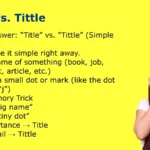
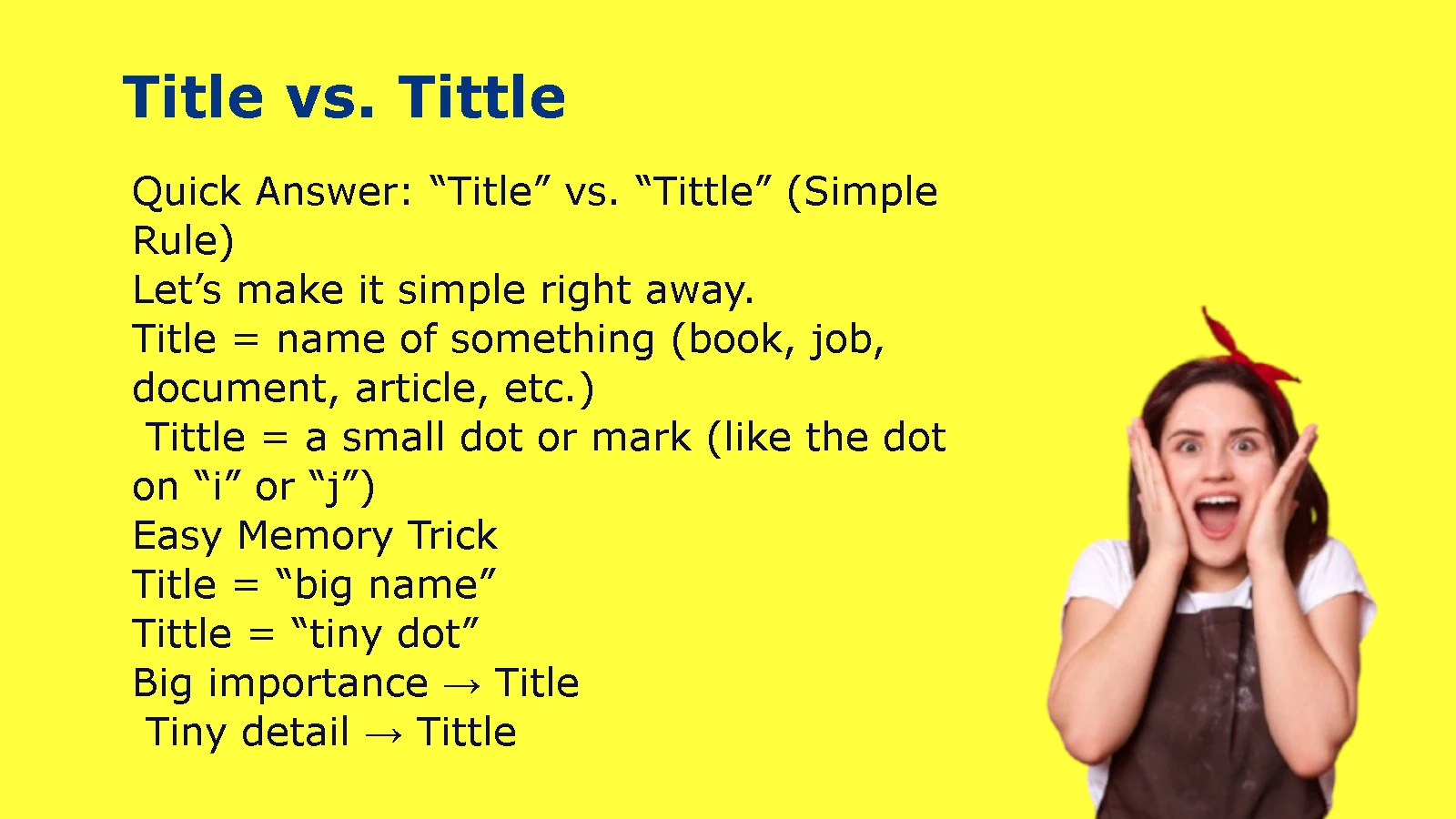
Quick Answer: “Title” vs. “Tittle” (Simple Rule)
Let’s make it simple right away.
Title = name of something (book, job, document, article, etc.)
Tittle = a small dot or mark (like the dot on “i” or “j”)
Easy Memory Trick
- Title = “big name”
- Tittle = “tiny dot”
Big importance → Title
Tiny detail → Tittle
Why People Confuse “Title” and “Tittle”
This confusion is more common than you think.
1. Similar spelling
They differ by just one letter.
2. Rare usage of “tittle”
Most people rarely see “tittle” in daily writing.
3. Context overlap
Both can appear in writing-related discussions, making them feel connected.
“Title” Explained Clearly (With Examples)
A title is the name or heading of something.
Common Uses of “Title”
- Book title
- Job title
- Article title
- Movie title
- Document title
Real Examples
- “What is the title of your book?”
- “Her job title is Marketing Manager.”
- “I forgot the title of that movie.”
Key Idea
A title identifies something important. It gives meaning, structure, and recognition.
“Tittle” Explained Clearly (With Examples)
A tittle is much more specific and technical.
It refers to a small distinguishing mark in writing, especially:
- The dot above “i”
- The dot above “j”
Real Examples
- “Don’t forget the tittle when writing the letter ‘i’.”
- “A missing tittle can change handwriting accuracy.”
Where You See It
- Typography
- Linguistics
- Religious texts (historically in biblical references)
Key Idea
A tittle is a tiny detail that completes a letter.
Side-by-Side Comparison Table
| Word | Meaning | Usage Level | Example |
| Title | Name or heading of something | Very common | Book title |
| Tittle | Small dot on “i” or “j” | Rare | Dot above letter |
Real-Life Examples of “Title”
- “The title of the essay is missing.”
- “What’s your official title at work?”
- “I love the title of this song.”
👉 In all cases, it refers to a name or label.
Real-Life Examples of “Tittle”
- “Make sure every ‘i’ has its tittle.”
- “The handwriting is neat, even the tittles are perfect.”
👉 In all cases, it refers to a tiny dot or mark.
The Biggest Mistake People Make
Here’s the real issue:
People assume “tittle” is just a spelling mistake of “title.”
What Goes Wrong
- They replace “title” with “tittle” accidentally
- Spellcheck doesn’t always catch it in context
- Meaning gets completely distorted
Example Mistake
❌ “What is the tittle of your book?”
✔ “What is the title of your book?”
Memory Trick to Never Confuse Them Again
Use this simple rule:
- Title = Think “important name” (T = Top importance)
- Tittle = Think “tiny dot” (T = Tiny detail)
Or even simpler:
👉 Title = big idea
👉 Tittle = tiny dot
When to Use Each Word
Use “Title” when:
- Naming books, movies, articles
- Talking about jobs or roles
- Referring to headings
Use “Tittle” when:
- Talking about writing/letters
- Discussing typography
- Rare technical contexts
Why “Tittle” Feels So Strange
Most people go their whole lives without using it because:
- It’s rarely needed in modern conversation
- It appears mostly in specialized writing
- “Dot on i” is usually described, not named
So if you’ve never used it before—you’re not alone.
Quick Decision Guide
Still confused? Use this:
- If it’s a name or heading → Title
- If it’s a tiny dot on letters → Tittle
- If unsure → You almost always mean Title
FAQ: “Title” vs. “Tittle”
Is “tittle” a typo of “title”?
No. It’s a real word with a very specific meaning.
Which word is more common?
“Title” is extremely common; “tittle” is rare.
Can I ignore “tittle” in daily writing?
Yes, unless you’re discussing writing or typography.
Final Takeaway
The difference between “Title” and “Tittle” is small in spelling but huge in meaning.
One represents names, headings, and identity.
The other represents a tiny dot that completes a letter.
So the simplest rule to remember is:
👉 Title = big name
👉 Tittle = tiny dot
Once you lock that in, you’ll never confuse them again.