Have you ever paused while writing and wondered whether you should use “Excited vs. Exited”? This is one of the most common confusion points in the English language, especially in modern writing where a single spelling mistake can completely change the meaning of a sentence.
Many learners of Grammar struggle with this pair because both words look almost identical, but they belong to completely different contexts. In American English and British English, this confusion often appears in emails, social media posts, and professional communication where tone and meaning matter.
Here’s the key difference: “excited” expresses emotion, enthusiasm, or happiness, while “exited” simply refers to leaving a place or situation. Despite their similar spelling, they are not interchangeable in any form of standard vocabulary usage.
This guide will help you clearly understand the difference between Excited vs. Exited, how each word is used in real-life sentences, common mistakes to avoid, and simple memory tricks to never confuse them again. You’ll also see practical examples, grammar rules, and usage patterns that make it easy to choose the correct word every time you write.
If you want to improve your writing accuracy and avoid one of the most common English spelling mistakes, let’s break it down step by step.
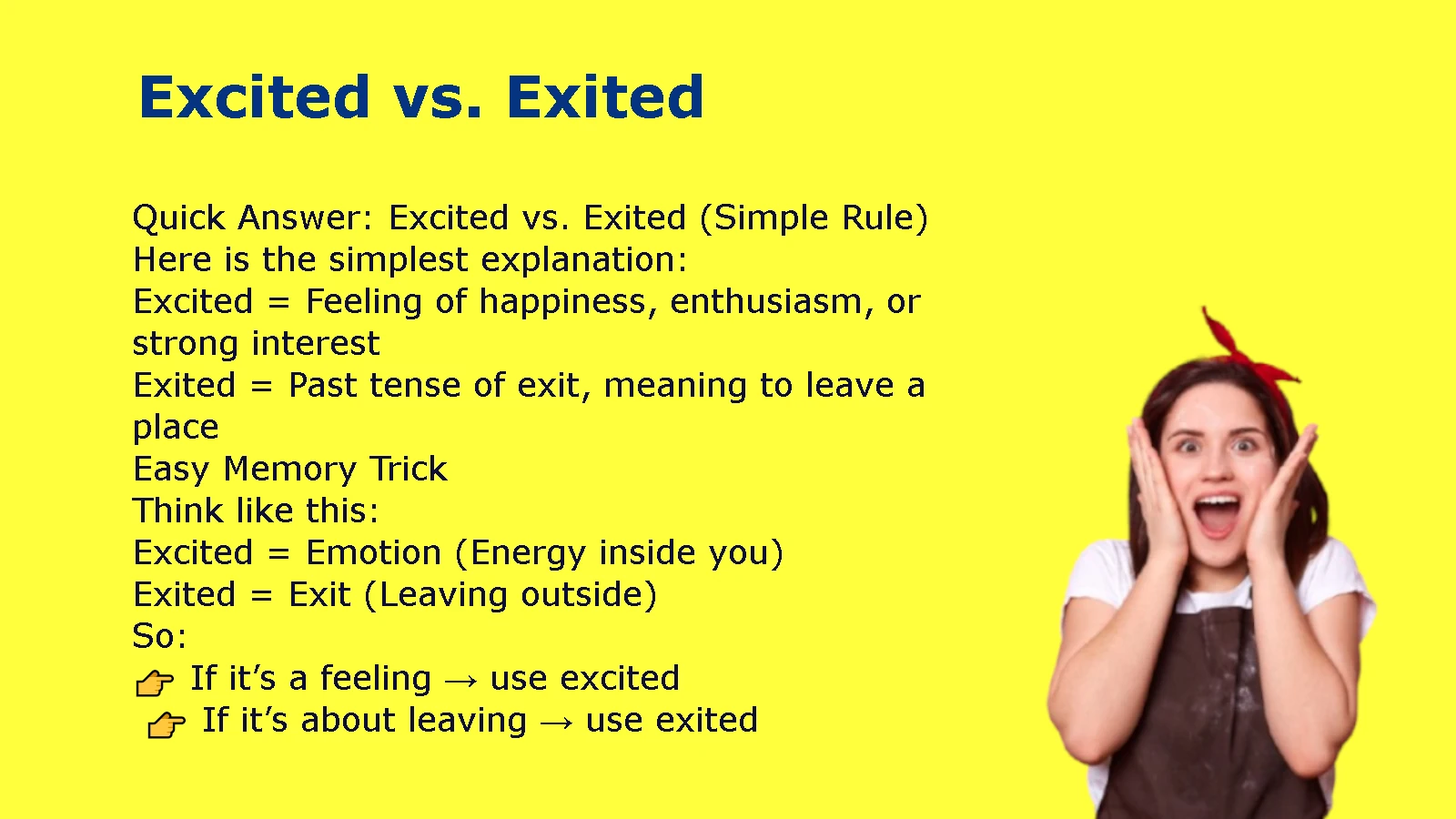
Quick Answer: Excited vs. Exited (Simple Rule)
Here is the simplest explanation:
- Excited = Feeling of happiness, enthusiasm, or strong interest
- Exited = Past tense of exit, meaning to leave a place
Easy Memory Trick
Think like this:
- Excited = Emotion (Energy inside you)
- Exited = Exit (Leaving outside)
So:
👉 If it’s a feeling → use excited
👉 If it’s about leaving → use exited
What Is the Difference Between Excited and Exited?
The main difference is very clear:
- Excited describes an emotion or feeling
- Exited describes an action of leaving
Why People Get Confused
This mistake usually happens because:
- The words sound almost identical when spoken
- Fast speech removes clarity between “c” and “x” sounds
- Both words look similar in spelling
So people often write:
- “I am exited” (incorrect when talking about emotions)
Is “Exited” the Same as “Excited”?
No, they are not the same.
Excited (Correct for emotions)
Used when someone feels happy, eager, or enthusiastic.
Examples:
- I am very excited about the trip.
- She is excited to start her new job.
- We are excited for the event.
Exited (Correct for movement)
Used when someone leaves or goes out of a place.
Examples:
- He exited the building quickly.
- They exited the stadium after the match.
- She exited the room quietly.
“Excited” Explained Clearly (With Examples)
The word excited is an adjective used to express strong positive emotions.
Everyday Use
- I am so excited for my birthday.
- They are excited to meet you.
Professional Use
- The team is excited about the new project.
- We are excited to announce the update.
Social Media Use
- I’m so excited for this moment!
- Super excited to share this news!
“Exited” Explained Clearly (With Examples)
The word exited is the past tense of the verb exit, meaning to leave.
Physical Movement
- He exited the room silently.
- The passengers exited the bus.
Formal Use
- The CEO exited the meeting early.
- Employees exited the building after the alarm.
Common Mistakes People Make
Here are the most common incorrect uses:
Incorrect Usage (Very Common)
- ❌ I am exited for the concert.
- ❌ She is exited about the news.
- ❌ We are exited to go on vacation.
Correct Usage
- ✅ I am excited for the concert.
- ✅ She is excited about the news.
- ✅ We are excited to go on vacation.
Side-by-Side Comparison Table
| Word | Correct? | Meaning | Usage |
| Excited | Yes | Feeling of happiness/enthusiasm | Emotion |
| Exited | Yes | Left a place (past of exit) | Action |
| Exited | No (for feelings) | Incorrect for emotions | Avoid in this case |
Why This Confusion Happens
1. Similar Pronunciation
Both words sound almost identical in fast speech.
2. Spelling Similarity
Only one letter changes (c vs x).
3. Lack of Grammar Awareness
Many learners focus on sound instead of meaning.
Real-Life Examples of “Excited”
Everyday English
- I am excited to see you.
- They are excited about the trip.
Workplace English
- The team is excited about the new launch.
- We are excited to collaborate.
Academic Context
- Students are excited about the results.
Real-Life Examples of “Exited”
- He exited the hall after the speech.
- She exited the app without saving.
- The players exited the field slowly.
Quick Rule to Remember
Use this simple test:
👉 Are you talking about feelings? → Excited
👉 Are you talking about leaving? → Exited
How to Avoid This Mistake
1. Focus on Meaning, Not Sound
Always ask: emotion or action?
2. Break the Word in Your Mind
- Excited = Excite + ed (emotion)
- Exited = Exit + ed (leave)
3. Use Spell Check
Writing tools often catch this mistake instantly.
FAQ: Excited vs. Exited
Is “I am exited” correct?
No, unless you mean physically leaving somewhere.
What is the correct spelling for happiness?
Always excited.
Can “exited” mean happy?
No, it only refers to leaving a place.
Why do people confuse excited and exited?
Because they sound similar in speech but have different meanings.
Final Takeaway
The difference between excited vs. exited is actually very simple:
👉 Excited = emotion (happy, eager, enthusiastic)
👉 Exited = action (to leave a place)
If you remember one rule:
Excited = Feelings inside
Exited = Leaving outside
So next time you write, always double-check:
✔ I am excited about something
❌ I am exited (unless you are leaving somewhere)