Have you ever come across Jynx vs. Jinx and wondered which spelling is actually correct? At first glance, these words look nearly identical, but they can have very different meanings depending on the context.
This confusion is more common than you might think. Whether you’re discussing a spelling difference, checking English vocabulary, talking about a superstition, or referring to the well-known Pokémon character Jynx, choosing the wrong term can easily lead to misunderstandings. And here’s the kicker: many people assume the two words are interchangeable when they’re not.
The good news? The distinction is simple once you know what to look for.
In this guide, you’ll learn the difference between Jynx vs. Jinx, how each word is used, and the contexts where one spelling is more appropriate than the other. You’ll also discover examples, word meanings, correct usage, and easy memory tricks to help you avoid common mistakes.
So, if you’ve ever been puzzled by these similar-looking words, keep reading—we’ll clear up the confusion once and for all.
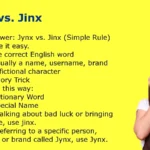
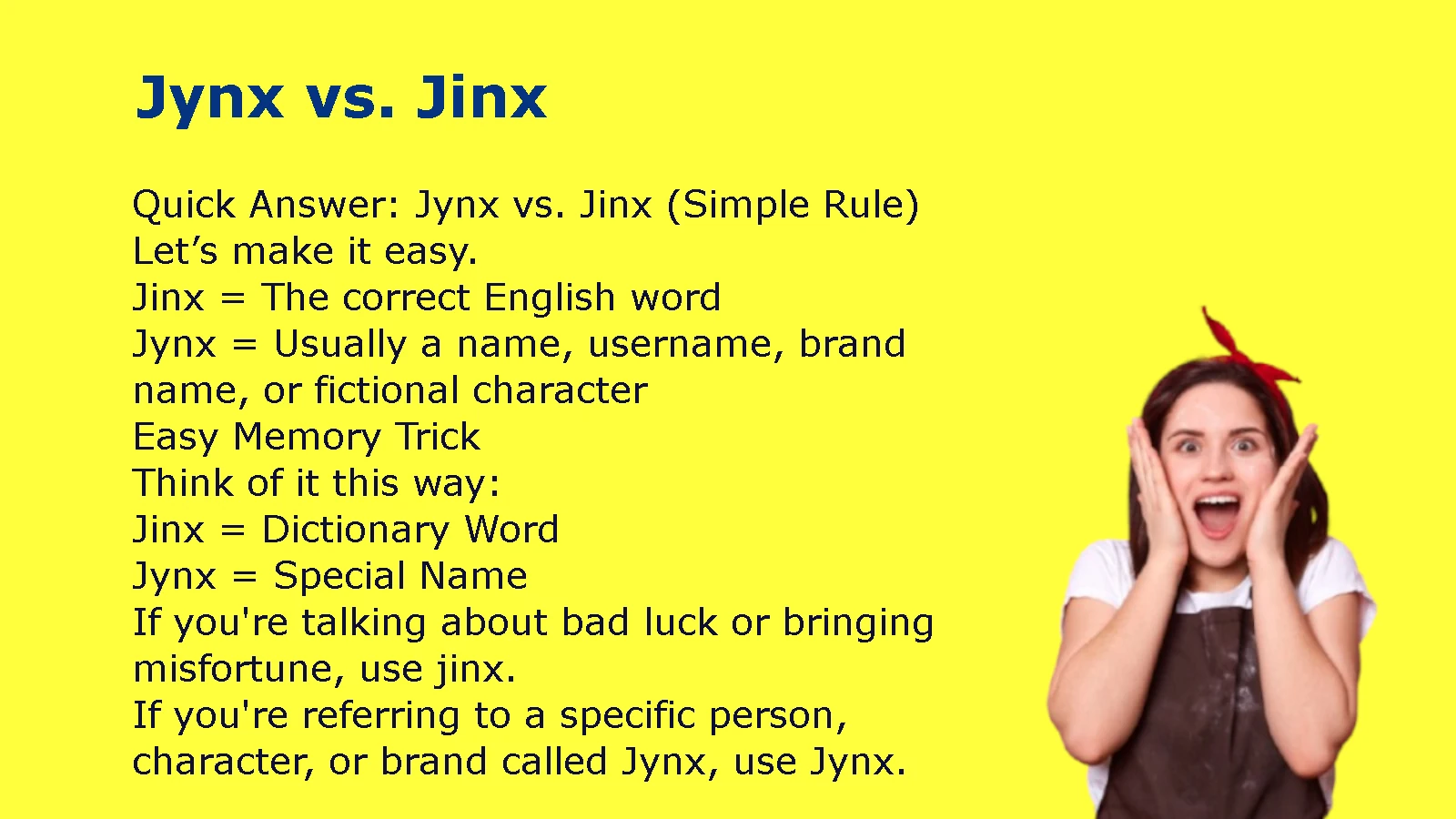
Quick Answer: Jynx vs. Jinx (Simple Rule)
Let’s make it easy.
Jinx = The correct English word
Jynx = Usually a name, username, brand name, or fictional character
Easy Memory Trick
Think of it this way:
Jinx = Dictionary Word
Jynx = Special Name
If you’re talking about bad luck or bringing misfortune, use jinx.
If you’re referring to a specific person, character, or brand called Jynx, use Jynx.
What Does “Jinx” Mean?
The word jinx has been part of English for many years.
Common Meaning
A jinx is something that brings bad luck.
Examples
- “Don’t say we’re going to win—you’ll jinx it.”
- “That old house is said to be a jinx.”
- “I think I jinxed my team by talking too soon.”
As a Verb
People often use jinx as a verb.
Examples:
- “You jinxed the game.”
- “Don’t jinx our vacation.”
- “He jinxed the project by predicting success too early.”
Key Point
Whenever you’re talking about bad luck, the correct spelling is jinx.
What Does “Jynx” Mean?
Unlike jinx, jynx is generally not a standard English word.
Common Uses
You might see Jynx used as:
- A character name
- A username
- A gaming alias
- A business name
- A fictional creature
Example Situations
- “My online username is Jynx.”
- “The character Jynx appeared in the game.”
- “Jynx is the name of the company.”
Key Point
Jynx is typically a proper noun rather than a common English word.
The Dictionary Difference
One of the easiest ways to understand Jynx vs. Jinx is by checking whether the word appears in a standard dictionary.
WordStandard English Word?Typical UseJinxYesBad luck, curse, misfortuneJynxNo (usually)Name, character, username
Quick Insight
If you’re writing an essay, email, article, or professional document, you’ll almost always need jinx, not jynx.
Why People Confuse Jynx and Jinx
The confusion is understandable.
They Sound Identical
Both words are pronounced the same way:
JINKS
Because English often allows different spellings for similar sounds, many people assume both versions are acceptable.
Internet Culture
Online communities frequently create alternative spellings.
Examples include:
- Nite → Night
- Xtreme → Extreme
- Jynx → Jinx
Result
People begin seeing the alternative spelling so often that they assume it’s standard English.
“Jinx” Explained Clearly (With Examples)
Let’s look closer at the standard word.
Meaning #1: Bad Luck
Example:
“The broken mirror is considered a jinx.”
Meaning #2: To Cause Bad Luck
Example:
“You jinxed the match by celebrating early.”
Meaning #3: A Playful Superstition
Example:
“We said the same thing at the same time—jinx!”
Key Takeaway
Whenever the meaning involves luck, superstition, or misfortune, use jinx.
“Jynx” Explained Clearly (With Examples)
Now let’s examine the alternative spelling.
Common Usage
Most often, Jynx serves as a unique name.
Examples:
- Gamer tags
- Character names
- Social media usernames
- Creative brand names
Example Sentences
- “Jynx won the tournament.”
- “The artist goes by Jynx online.”
- “Jynx released a new video.”
Key Takeaway
If it refers to a specific named person, character, or brand, Jynx may be correct.
The Biggest Mistake People Make
Here’s the most common error.
People replace jinx with jynx simply because they like the spelling.
Wrong
- “Don’t jynx the game.”
- “You jynxed our chances.”
Correct
- “Don’t jinx the game.”
- “You jinxed our chances.”
Why It Matters
In formal writing, using jynx instead of jinx can look like a spelling mistake.
Side-by-Side Comparison Table
Here’s a quick reference guide.
FeatureJinxJynxStandard English wordYesNoFound in dictionariesYesUsually NoMeans bad luckYesNoUsed as a nameSometimesOftenSuitable for formal writingYesOnly if it’s a proper name
Real-Life Examples of “Jinx”
Let’s see how people use it naturally.
Common Situations
- “Don’t jinx the weather.”
- “I hope I didn’t jinx our plans.”
- “The team thinks the trophy is jinxed.”
Mini Scenario
Before a big game, someone says:
“We’ve definitely won this.”
A teammate replies:
“Don’t jinx it!”
No one would normally write “Don’t jynx it.”
Real-Life Examples of “Jynx”
Now compare.
Common Situations
- “Jynx is streaming tonight.”
- “I follow Jynx on social media.”
- “The character Jynx became popular among fans.”
Mini Scenario
A gamer says:
“Jynx joined our squad today.”
Here, Jynx is clearly a name, not a reference to bad luck.
Pop Culture and Fictional Uses
Many alternative spellings become popular through entertainment.
Why Creators Choose “Jynx”
Creators often prefer unique spellings because they:
- Stand out
- Look distinctive
- Are easier to trademark
- Feel more memorable
Important Note
Even if a character is called Jynx, the regular English word remains jinx.
How to Avoid Confusion Every Time
Want a foolproof method?
Ask Yourself One Question
Are you talking about bad luck?
If yes:
Use jinx.
If you’re referring to a specific name:
Use Jynx.
Double-Check Context
Read your sentence again.
Example:
“You’ll _____ the project.”
Only jinx makes sense.
What to Say Instead
If you’re unsure, try these alternatives.
Alternatives to “Jinx”
- Curse
- Bad luck
- Hex
- Misfortune
- Bring bad luck
Example
Instead of:
“Don’t jinx the event.”
You could say:
“Don’t bring bad luck to the event.”
Quick Decision Guide (Use This Instantly)
Follow this simple checklist:
Talking about bad luck? → Jinx
Talking about a curse? → Jinx
Talking about a superstition? → Jinx
Talking about a character or username called Jynx? → Jynx
When in doubt? → Jinx is usually the correct choice.
FAQ: Jynx vs. Jinx
Is “jynx” a real word?
Not as a standard English dictionary word. It’s usually used as a name or creative spelling.
Is “jinx” the correct spelling?
Yes. If you’re referring to bad luck or superstition, jinx is the correct spelling.
Can I use “jynx” in professional writing?
Only if it’s part of a person’s name, brand, or title.
Why do people write “jynx”?
Often for stylistic reasons, branding, gaming names, or creative identity.
Which spelling should students use?
Students should almost always use jinx unless discussing a specific person or character named Jynx.
Case Study: A Simple Writing Mistake
A student submitted an essay that included the sentence:
“Many athletes believe they can jynx a game by celebrating too early.”
What Happened
The teacher marked jynx as incorrect.
Why
The sentence referred to bad luck, which requires the standard spelling:
jinx
Correct Version
“Many athletes believe they can jinx a game by celebrating too early.”
Lesson
Creative spellings don’t replace standard English words.
Key Facts You Should Remember
- Jinx is the correct English word.
- Jinx refers to bad luck or causing bad luck.
- Jynx is usually a name or creative spelling.
- The words sound the same but have different uses.
- Formal writing almost always requires jinx.
- Context determines whether Jynx is appropriate.
Final Takeaway: The One Rule That Never Fails
Here’s the simplest way to remember the difference between Jynx vs. Jinx.
If you’re talking about bad luck, superstition, or causing something unfortunate to happen, use “jinx.”
If you’re referring to a specific person, character, username, or brand named “Jynx,” use “Jynx.”
That’s it.
Think of jinx as the dictionary word and Jynx as the customized version. One belongs to everyday English, while the other usually belongs to names and creative identities.
When in doubt, choose jinx. In most situations, it’s the correct spelling and the one readers will expect to see.