Have you ever wondered whether Pant vs. Pants is just a spelling difference or whether the two words actually have different meanings? This common grammar and vocabulary question confuses many English learners, writers, and even native speakers because the correct choice often depends on regional English, usage rules, and the context of the sentence.
If you’ve ever hesitated while writing an email, essay, or social media post, you’re not alone. The confusion usually comes from differences between American English and British English, where the same item of clothing may be referred to differently. And here’s the kicker: using the wrong term can make your writing sound unnatural to your audience.
The good news? Understanding the difference is much simpler than it seems.
In this guide, you’ll learn the meaning of Pant vs. Pants, how each word is used in everyday conversation, the key distinctions in English grammar, and when to choose one over the other. You’ll also discover practical examples, common mistakes to avoid, and simple tips for improving your word choice in both formal and casual writing.
So, if you’re ready to master this frequently confused pair and communicate with greater confidence, let’s dive in.
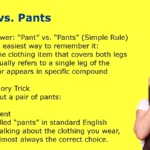
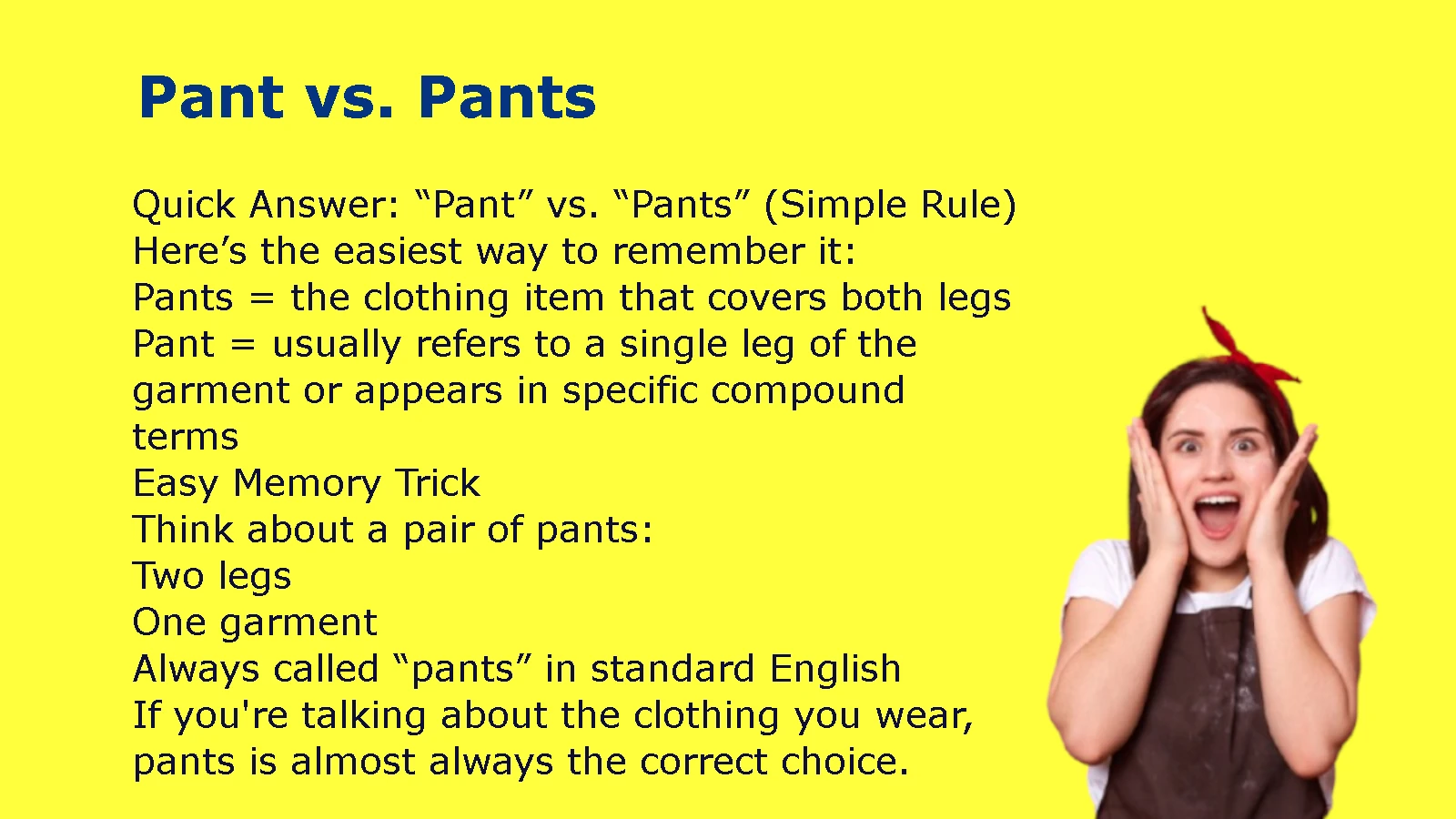
Quick Answer: “Pant” vs. “Pants” (Simple Rule)
Here’s the easiest way to remember it:
Pants = the clothing item that covers both legs
Pant = usually refers to a single leg of the garment or appears in specific compound terms
Easy Memory Trick
Think about a pair of pants:
- Two legs
- One garment
- Always called “pants” in standard English
If you’re talking about the clothing you wear, pants is almost always the correct choice.
How People Actually Use “Pant” and “Pants”
The confusion often comes from how the words appear in different situations.
In Everyday Conversation
Most native speakers say:
- “I need new pants.”
- “Those pants look great.”
Rarely:
- “I need a new pant.”
In Fashion and Manufacturing
You may hear:
- Pant leg
- Pant pocket
- Pant size
- Pant suit
In these cases, pant acts like a descriptive word.
Why This Happens
English treats some clothing items as plural nouns even when referring to one object.
Examples:
- Pants
- Shorts
- Jeans
- Scissors
That’s why “pants” feels natural while “pant” often sounds incomplete.
The Grammar Logic Behind “Pant” vs. “Pants”
Understanding the grammar makes everything easier.
Why “Pants” Is Plural
Historically, garments covering each leg were considered separate pieces.
Over time, they became one item, but the plural form remained.
Examples:
- These pants are comfortable.
- My pants are too long.
- Those pants were expensive.
Notice that pants takes a plural verb.
Why “Pant” Exists
“Pant” usually appears as part of another phrase.
Examples:
- Pant leg
- Pant cuff
- Pant pocket
Here, it describes a part of the garment rather than the whole item.
Key Insight
Pants = the entire garment
Pant = usually a component or modifier
“Pants” Explained Clearly (With Edge Cases)
In standard English, pants is the correct word for the clothing item.
Standard Meaning
Examples:
- I bought new pants.
- These pants fit perfectly.
- Her pants are blue.
Edge Case: One Pair
Even if you have only one pair:
Correct:
- I bought a pair of pants.
Incorrect:
- I bought a pant.
Edge Case: Different English Dialects
In American English:
- Pants = outerwear trousers
In British English:
- Pants often means underwear
This creates another layer of confusion.
Key Takeaway
When talking about the garment in American English, use pants.
“Pant” Explained Clearly (With Edge Cases)
Now let’s look at when pant is actually correct.
Standard Meaning
“Pant” commonly appears in compound nouns.
Examples:
- Pant leg
- Pant seam
- Pant pocket
- Pant hem
Edge Case: Fashion Industry
Retailers sometimes use:
- Pant collection
- Pant style
- Pant fit
This is industry-specific language.
Edge Case: As a Verb
Pant can also be a verb.
Examples:
- The dog began to pant.
- He was panting after the race.
This meaning has nothing to do with clothing.
Key Insight
If you’re referring to the actual garment someone wears, pants is usually the correct choice.
The Biggest Mistake People Make
The most common mistake is treating “pant” as the singular version of “pants.”
What Goes Wrong
People assume:
- One garment = one pant
But English doesn’t work that way.
Incorrect Examples
- I bought a new pant.
- That pant looks expensive.
Correct Examples
- I bought new pants.
- Those pants look expensive.
- I bought a pair of pants.
Lesson
Don’t force a singular form where English naturally uses a plural noun.
Side-by-Side Comparison Table
| Word | Standard Meaning | Common Usage | Risk of Mistakes |
| Pant | Part of the garment or a modifier | Pant leg, pant pocket | High |
| Pants | The full clothing item | Everyday speech | Low |
Real-Life Examples of “Pants”
Let’s see how native speakers use it.
Common Situations
- “My pants are too tight.”
- “I need black pants for work.”
- “These pants are comfortable.”
- “Where did you buy those pants?”
What They Mean
All examples refer to the complete garment.
Mini Scenario
At a clothing store:
Customer: “Do you have these pants in a larger size?”
This sounds perfectly natural.
Real-Life Examples of “Pant”
Now compare.
Common Situations
- “The pant leg is too long.”
- “There’s a tear in the pant pocket.”
- “The pant cuff needs repair.”
What They Mean
These examples describe parts of the garment.
Mini Scenario
At a tailor shop:
“The pant leg needs shortening.”
Correct usage.
Regional and Cultural Differences
Language changes depending on location.
In the United States
- Pants = trousers
- Underwear = underwear
Example:
“I bought new pants yesterday.”
In the United Kingdom
- Pants = underwear
- Trousers = outerwear
Example:
“I bought new trousers yesterday.”
In International Communication
Misunderstandings happen frequently.
Someone from the UK may hear “pants” and think of underwear.
Key Tip
Know your audience when communicating internationally.
How to Avoid Confusion Every Time
Want to use these words correctly every time?
Use “Pants” for the Garment
Say:
- New pants
- Blue pants
- Work pants
Use “Pant” for Specific Parts
Say:
- Pant leg
- Pant seam
- Pant pocket
Consider Your Audience
If speaking with British English users:
- Use “trousers” when referring to outerwear
Why This Works
Following standard usage eliminates confusion immediately.
What to Say Instead (Clear Alternatives)
Sometimes another word is even clearer.
Better Alternatives
- Trousers
- Slacks
- Dress pants
- Casual pants
- Jeans
- Chinos
When to Use Them
- Business communication
- International audiences
- Clothing descriptions
Quick Tip
If you’re unsure, “trousers” is often understood globally.
Quick Decision Guide (Use This Instantly)
Use this simple checklist:
Talking about the full garment?
→ Use pants
Talking about a part of the garment?
→ Use pant
Speaking to a British audience?
→ Consider using trousers
Still unsure?
→ “Pair of pants” is always safe.
FAQ: “Pant” vs. “Pants”
Is “pant” ever correct for clothing?
Yes. It is commonly used in phrases like “pant leg” or “pant pocket.”
Why do we say “pants” instead of “pant”?
English treats the garment as a plural noun, similar to “shorts” and “jeans.”
Is “a pant” grammatically correct?
Usually no when referring to clothing. “A pair of pants” is correct.
What do British people call pants?
They often use “trousers” for outerwear and “pants” for underwear.
Which word should English learners use?
Use pants when referring to the clothing item.
Case Study: A Funny Shopping Mix-Up
An English learner walked into a clothing store and said:
“I need a black pant.”
The salesperson looked confused and replied:
“One pant?”
The customer actually wanted a pair of black trousers.
What Happened
The learner translated directly from another language where clothing items have singular forms.
Result
Brief confusion during the conversation.
Fix
Simply say:
“I need black pants.”
or
“I need a pair of black pants.”
Problem solved instantly.
Key Facts You Should Remember
- Pants refers to the complete garment.
- Pant usually describes part of the garment.
- “A pant” sounds unnatural in standard English.
- “Pair of pants” is the correct singular expression.
- British and American English use the term differently.
- Context matters when communicating internationally.
Final Takeaway: The One Rule That Never Fails
Here’s the simplest rule to remember:
If you’re talking about the clothing item someone wears, use “pants.”
Use pant only when referring to a specific part of the garment or in specialized fashion terminology.
Think of it like jeans or shorts. Even though it’s one item, English naturally treats it as a plural noun.
So whenever you’re stuck between “Pant” vs. “Pants,” remember:
The garment = Pants
A part of the garment = Pant
Follow that rule, and you’ll never be confused again.