Ever typed Seing vs. Seeing and wondered which spelling is actually correct? You’re not alone. This common spelling mistake appears in emails, essays, text messages, and even professional documents, making many writers second-guess their English grammar and word usage.
The confusion is understandable. Since both words look similar, it’s easy to accidentally drop a letter when writing quickly. But here’s the kicker: only one of them is recognized as the correct English spelling, while the other is simply a misspelling.
The good news? The rule is surprisingly simple.
In this guide, you’ll learn the difference between Seing vs. Seeing, discover why the error happens so often, and see clear grammar examples that make the correct form easy to remember. You’ll also learn helpful writing tips and proofreading techniques to avoid making the same mistake in the future.
So whether you’re a student, professional, or anyone looking to improve their written communication, this article will help you use the correct spelling with confidence every time.
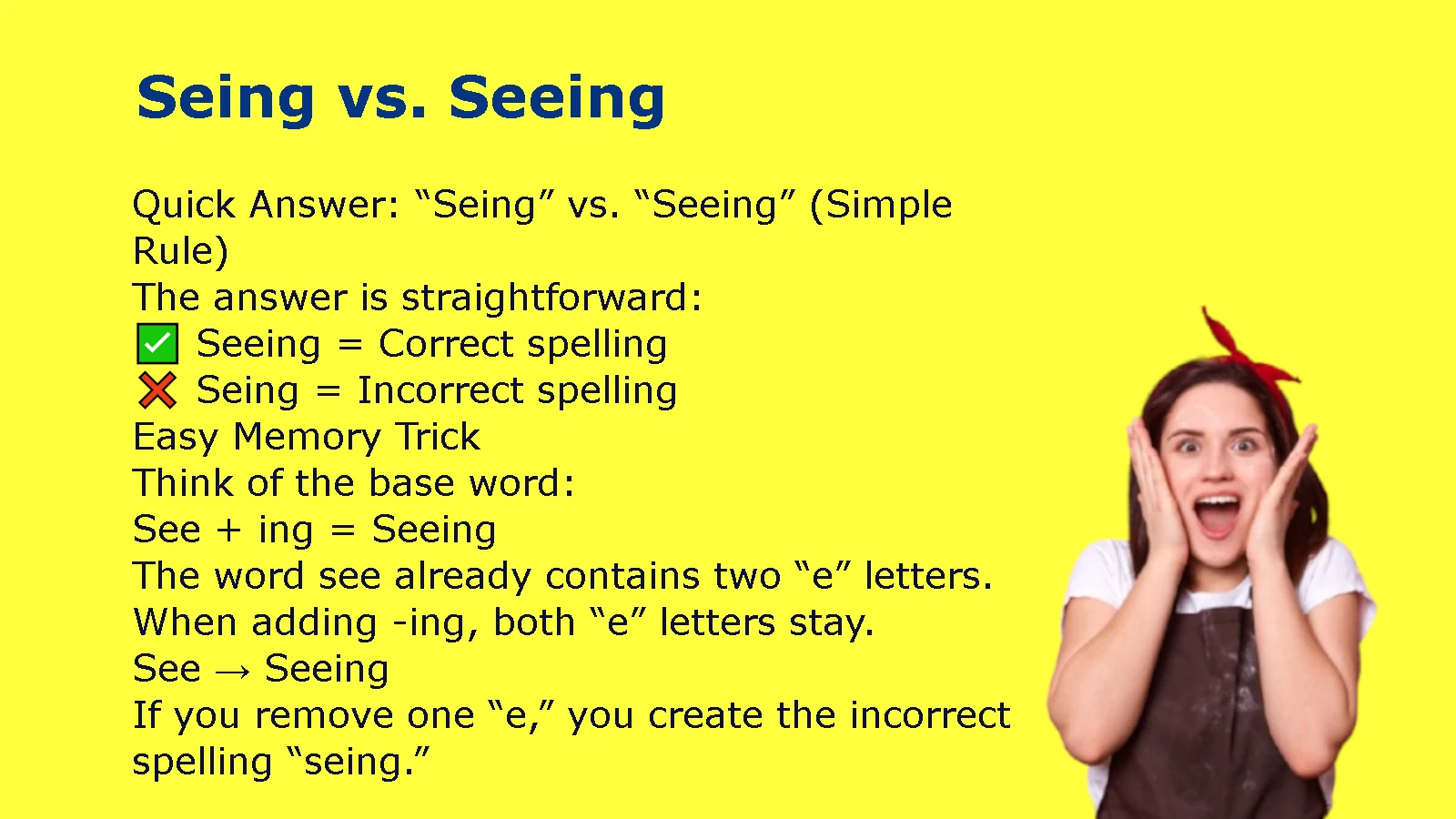
Quick Answer: “Seing” vs. “Seeing” (Simple Rule)
The answer is straightforward:
✅ Seeing = Correct spelling
❌ Seing = Incorrect spelling
Easy Memory Trick
Think of the base word:
See + ing = Seeing
The word see already contains two “e” letters. When adding -ing, both “e” letters stay.
See → Seeing
If you remove one “e,” you create the incorrect spelling “seing.”
What Does “Seeing” Mean?
Seeing is the present participle and gerund form of the verb see.
Common Meanings
- Looking at something with your eyes
- Meeting someone
- Understanding something
- Visiting a place or person
Examples
- I am seeing a beautiful sunset.
- She enjoys seeing new places.
- We are seeing our grandparents this weekend.
- After seeing the evidence, he changed his mind.
In all these examples, seeing is the correct spelling.
Why Do People Write “Seing”?
The mistake usually comes from confusion about English spelling rules.
The Missing “E” Problem
Many English words drop the final “e” before adding -ing.
Examples:
- Make → Making
- Take → Taking
- Write → Writing
Because of this pattern, people assume:
See → Seing
But that assumption is wrong.
Why “See” Is Different
The word see ends with two e’s.
When adding -ing, English keeps both letters:
See + ing = Seeing
This creates the correct spelling.
The Grammar Rule Behind “Seeing”
Let’s look at the actual rule.
Words Ending in Double “E”
When a verb ends with ee, you typically keep both letters before adding -ing.
Examples:
Base VerbCorrect FormSeeSeeingAgreeAgreeingFreeFreeingFleeFleeing
Notice that none of these words lose an “e.”
Key Insight
If a verb ends in ee, don’t drop either letter when adding -ing.
“Seeing” Explained With Examples
Since seeing is the only correct form, let’s explore how it’s used.
As a Verb
- I am seeing the doctor tomorrow.
- They are seeing a movie tonight.
- We were seeing signs of improvement.
a Gerund
- Seeing is believing.
- Seeing new cultures broadens your mind.
- She enjoys seeing wildlife.
Understanding
- I’m seeing your point now.
- After the explanation, she started seeing things differently.
Common Sentences Using “Seeing”
Here are examples you’ll encounter in everyday English.
Daily Conversation
- Nice seeing you again.
- I look forward to seeing you tomorrow.
- We’re seeing friends this weekend.
School and Work
- Thank you for seeing me today.
- After seeing the report, the manager approved it.
- We’re seeing strong growth this quarter.
Travel
- We spent the day seeing the sights.
- They love seeing historical landmarks.
The Biggest Mistake People Make
The most common mistake is assuming every word ending in “e” follows the same rule.
Incorrect Logic
People think:
Make → Making
Therefore:
See → Seing
Why It Fails
The rule changes because see ends with double e.
Correct formation:
See + ing = Seeing
Not:
See + ing = Seing
Lesson
Don’t apply the same spelling rule to every word ending in “e.”
Side-by-Side Comparison Table
Here’s a quick reference guide.
WordCorrect?MeaningSeeing✅ YesPresent participle of “see”Seing❌ NoMisspellingAgreeing✅ YesPresent participle of “agree”Agreeing (without e)❌ NoIncorrect spelling
Quick Rule
If the word ends with ee, keep both letters.
Real-Life Examples of “Seeing”
Let’s make the rule practical.
Example 1
Correct:
“I am seeing my dentist tomorrow.”
Incorrect:
“I am seing my dentist tomorrow.”
Example 2
Correct:
“Thank you for seeing me today.”
Incorrect:
“Thank you for seing me today.”
Example 3
Correct:
“We enjoyed seeing the mountains.”
Incorrect:
“We enjoyed seing the mountains.”
Words Similar to “Seeing”
Learning related words can help reinforce the rule.
Double-E Verbs
- Agree → Agreeing
- Flee → Fleeing
- Free → Freeing
- Oversee → Overseeing
Pattern Recognition
Notice that every one of these words keeps both “e” letters.
That same pattern applies to seeing.
How to Avoid This Spelling Mistake Every Time
Want to remember the correct spelling instantly?
Method 1: Remember the Base Word
Start with:
See
Then simply add:
-ing
Result:
Seeing
Method 2: Visual Check
Ask yourself:
“Can I still see both e’s from the original word?”
If yes, you’ve probably spelled it correctly.
Method 3: Read It Aloud
“Seeing” naturally sounds like:
See-ing
The spelling reflects both parts.
What to Say Instead If You’re Unsure
Sometimes spell-check isn’t available.
When in doubt:
- Think of the word see
- Keep both “e” letters
- Add -ing
This simple process always gives:
Seeing
Quick Decision Guide (Use This Instantly)
When writing the word:
Base verb = See
Adding = -ing
Result = Seeing
Never write:
❌ Seing
Always write:
✅ Seeing
FAQ: “Seing” vs. “Seeing”
Is “seing” ever correct?
No. Seing is not recognized as a correct English spelling.
Why does “seeing” have two e’s?
Because the original word see already contains two e’s, and both remain when adding -ing.
Is “seeing” a verb?
Yes. It is the present participle and gerund form of see.
Do other words follow this rule?
Yes. Words like agreeing, freeing, and fleeing follow the same pattern.
Why do people misspell it?
Many people mistakenly apply the rule used in words like making and taking, where the final “e” is dropped.
Case Study: A Common Student Error
A student writes:
“I am seing improvement in my grades.”
The teacher marks it incorrect.
What Went Wrong?
The student dropped one “e” from the original word see.
Correct Version
“I am seeing improvement in my grades.”
Lesson
Whenever a verb ends with ee, keep both letters when adding -ing.
Key Facts You Should Remember
- Seeing is the correct spelling.
- Seing is always incorrect.
- The word comes from see + ing.
- Both “e” letters remain.
- Other words like agreeing and fleeing follow the same pattern.
- Remembering the base word makes the spelling easy.
Final Takeaway: The One Rule That Never Fails
The debate between “seing” vs. “seeing” is actually very simple once you know the rule.
The verb is see, and when you add -ing, both “e” letters stay.
So:
✅ Seeing
❌ Seing
Whenever you’re unsure, look at the original word. If you can still see both “e” letters, you’ve spelled it correctly.
That’s the easiest way to remember it—and it works every single time.