Ever come across the terms Dysregulated vs. Disregulated and wondered if they mean the same thing—or if one of them is actually incorrect? This confusion is more common than you might think, especially in discussions around emotional regulation, psychology terminology, and mental health language.
That’s where the problem starts. You might hear people say “disregulated emotions” in casual conversation, while professionals often use emotional dysregulation or psychological regulation issues. And here’s the kicker: only one of these forms is widely accepted in standard English and clinical usage.
You’re not alone if this has tripped you up. Many learners, writers, and even content creators struggle to know which spelling is correct and when each term should be used. But don’t worry—this is easier to clear up than it seems.
In this guide, you’ll learn the difference between Dysregulated vs. Disregulated, how each term is used in psychology and behavioral science, and why emotional dysregulation is the preferred and more accurate form in academic and professional writing. You’ll also see simple explanations that make the distinction crystal clear.
So, let’s break it down and remove the confusion once and for all.
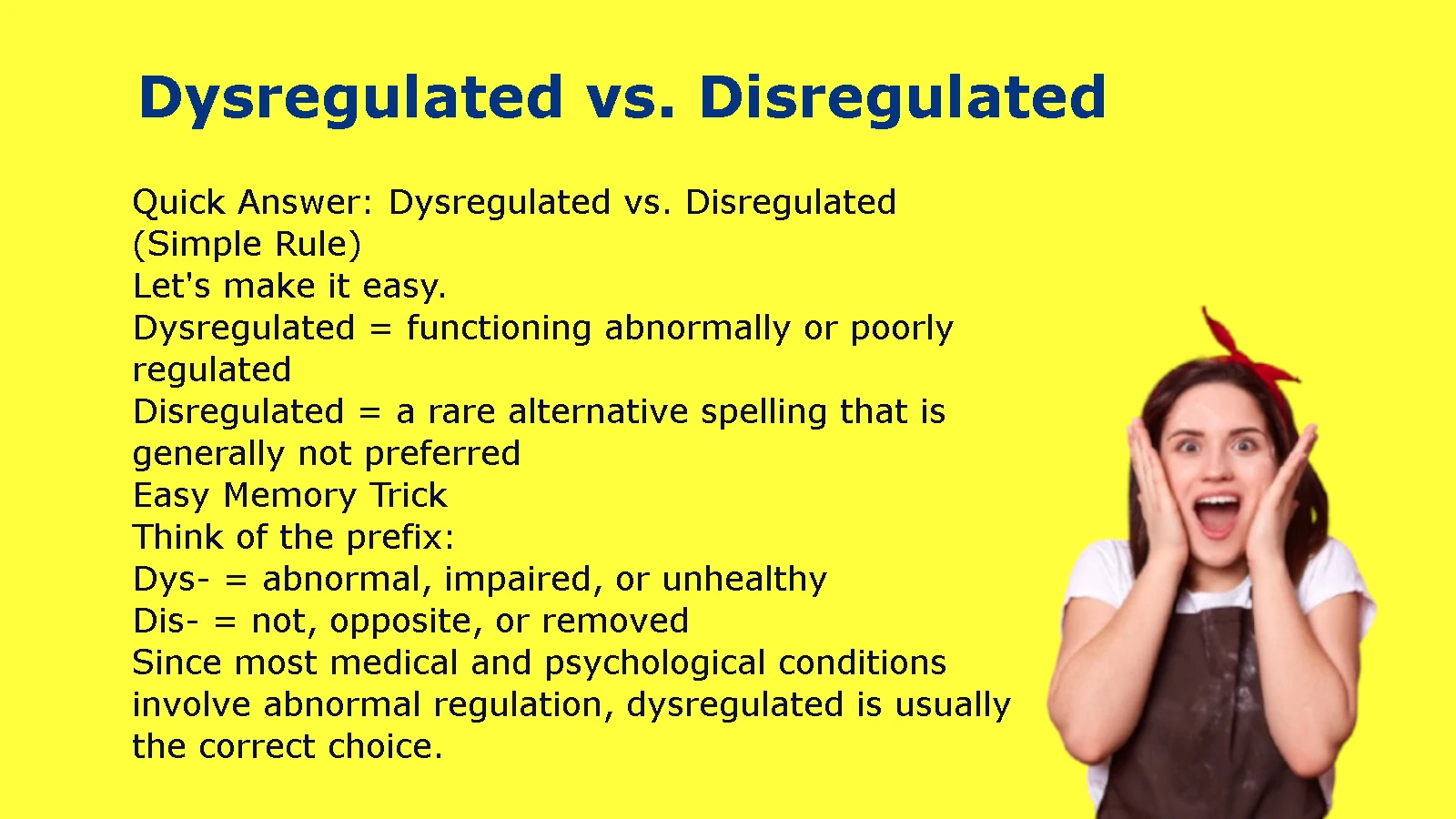
Quick Answer: Dysregulated vs. Disregulated (Simple Rule)
Let’s make it easy.
Dysregulated = functioning abnormally or poorly regulated
Disregulated = a rare alternative spelling that is generally not preferred
Easy Memory Trick
Think of the prefix:
- Dys- = abnormal, impaired, or unhealthy
- Dis- = not, opposite, or removed
Since most medical and psychological conditions involve abnormal regulation, dysregulated is usually the correct choice.
Quick Rule:
- Medical, emotional, biological, or psychological contexts → Dysregulated
- Rare or specialized contexts → Disregulated (uncommon)
How People Actually Use “Dysregulated” and “Disregulated”
Here’s where confusion begins.
Many people assume both words mean exactly the same thing because they sound similar.
In Everyday Writing
You’ll frequently encounter:
- Dysregulated emotions
- Dysregulated nervous system
- Dysregulated behavior
You will rarely see:
- Disregulated emotions
- Disregulated nervous system
In Academic and Medical Settings
Researchers overwhelmingly prefer dysregulated.
Why?
Because the prefix dys- specifically indicates abnormal functioning, which accurately describes many biological and psychological processes.
Why This Happens
- The words look similar
- Both involve regulation problems
- Many people are unfamiliar with the meaning of prefixes
As a result, writers sometimes use disregulated when they actually mean dysregulated.
The Meaning Behind “Dysregulated” vs. “Disregulated”
To understand the difference, you need to understand the prefixes.
What Does “Dys-” Mean?
The prefix dys- comes from Greek and means:
- Abnormal
- Impaired
- Difficult
- Faulty
Examples:
- Dysfunction
- Dyslexia
- Dysregulation
The idea is that something works, but not properly.
What Does “Dis-” Mean?
The prefix dis- generally means:
- Not
- Opposite of
- Removed from
Examples:
- Disagree
- Disconnect
- Disapprove
The focus is on separation or negation rather than abnormal functioning.
Key Insight
Dysregulated suggests a system is functioning incorrectly.
Disregulated suggests regulation has somehow been removed or undone, which is not usually what medical professionals mean.
“Dysregulated” Explained Clearly (With Examples)
At its core, dysregulated means that a system, process, or behavior is not being regulated normally.
Common Uses
- Dysregulated emotions
- Dysregulated immune system
- Dysregulated hormones
- Dysregulated sleep patterns
Example
A therapist might say:
“The patient experiences dysregulated emotional responses during stressful situations.”
This means emotional regulation exists but is not functioning properly.
In Psychology
The term is especially common when discussing:
- Trauma
- Anxiety
- ADHD
- Personality disorders
- Emotional regulation
Key Takeaway
When discussing abnormal functioning, dysregulated is almost always the correct word.
“Disregulated” Explained Clearly (With Examples)
Now let’s look at the less common option.
Standard Meaning
In theory, disregulated means regulation has been disrupted or removed.
However, this usage is rare.
Why It Sounds Strange
Most English speakers and professionals don’t use disregulated regularly.
As a result:
- It may sound awkward
- It may appear incorrect
- It can confuse readers
Example
You might occasionally encounter:
“The market became disregulated after policy changes.”
Even here, many writers would choose different wording.
Key Insight
While disregulated exists, it is rarely the preferred choice.
The Biggest Mistake People Make
The most common mistake is assuming the prefixes mean the same thing.
What Goes Wrong
Someone wants to describe abnormal emotional regulation.
They write:
“The child became disregulated.”
Many readers immediately notice the unusual spelling.
What They Should Write
“The child became dysregulated.”
This aligns with standard psychological and medical terminology.
Lesson
If you’re describing abnormal regulation, use dysregulated.
Side-by-Side Comparison Table
TermStandard MeaningFrequency of UseBest Use CaseDysregulatedFunctioning abnormallyVery commonPsychology, medicine, biologyDisregulatedRegulation disrupted or removedRareLimited or specialized contexts
Real-Life Examples of “Dysregulated”
Let’s see how professionals use the word.
Common Situations
- “Her nervous system became dysregulated after prolonged stress.”
- “The patient shows dysregulated emotional responses.”
- “Researchers found dysregulated hormone production.”
What They Mean
In every example, regulation still exists but is functioning improperly.
Mini Scenario
A counselor explains:
“After the traumatic event, his emotional system became dysregulated.”
This sounds natural and professional.
Real-Life Examples of “Disregulated”
Now compare the rarer alternative.
Possible Uses
- “The industry became disregulated after reforms.”
- “The process appeared disregulated by external factors.”
What They Mean
The regulation structure has been disturbed or removed.
Mini Scenario
An economist might discuss a market that no longer follows established controls.
Even then, other wording is often preferred.
Why “Dysregulated” Dominates Modern Usage
Language evolves according to practicality.
In Psychology
Mental health professionals regularly discuss:
- Emotional dysregulation
- Behavioral dysregulation
- Nervous system dysregulation
In Medicine
Doctors often refer to:
- Dysregulated immune responses
- Dysregulated metabolism
- Dysregulated hormone systems
In Research
Scientific literature overwhelmingly favors dysregulated because it precisely describes abnormal function.
Key Fact
If you search academic journals, you’ll find dysregulated far more often than disregulated.
How to Avoid Confusion Every Time
Want a foolproof method?
Ask Yourself One Question
Am I describing something functioning abnormally?
If yes:
Use dysregulated.
Check the Context
Medical topic? → Dysregulated
Psychology topic? → Dysregulated
Biology topic? → Dysregulated
Emotions topic? → Dysregulated
When in Doubt
Choose dysregulated.
It’s the accepted standard in most situations.
What to Say Instead (Clear Alternatives)
Sometimes neither term is necessary.
Better Alternatives
- Poorly regulated
- Out of balance
- Functioning abnormally
- Disrupted
- Uncontrolled
- Irregular
Example
Instead of:
“The system is dysregulated.”
You could say:
“The system is functioning abnormally.”
This may be clearer for general audiences.
Quick Decision Guide (Use This Instantly)
When you’re unsure, follow this:
Abnormal emotional regulation → Dysregulated
Abnormal biological regulation → Dysregulated
Medical discussion → Dysregulated
Psychological discussion → Dysregulated
Rare technical context involving removed regulation → Possibly disregulated
Still unsure? → Use dysregulated
Simple. Reliable. Done.
FAQ: Dysregulated vs. Disregulated
Is “dysregulated” a real word?
Yes. It is widely used in psychology, medicine, neuroscience, and biology.
Is “disregulated” a real word?
Yes, but it is much less common and rarely preferred.
Which term is correct in mental health discussions?
Dysregulated is the standard term.
Why do people confuse them?
Because both words look similar and involve regulation-related concepts.
Which word should I use in professional writing?
In most cases, choose dysregulated.
Case Study: A Common Writing Error
A graduate student was writing a psychology paper.
They wrote:
“Participants displayed disregulated emotional reactions.”
The professor corrected it to:
“Participants displayed dysregulated emotional reactions.”
What Happened?
The student confused the prefixes.
Result
The revised version matched accepted psychological terminology.
Lesson
Professional fields overwhelmingly prefer dysregulated.
Key Facts You Should Remember
- Dysregulated is the standard and widely accepted term.
- Disregulated is rare and often avoided.
- Psychology and medicine strongly favor dysregulated.
- The prefix dys- means abnormal or impaired.
- The prefix dis- usually means not or removed.
- Most situations call for dysregulated.
Final Takeaway: The One Rule That Never Fails
Here’s the truth.
Although dysregulated and disregulated look similar, they are not equally common. In modern English, especially in psychology, medicine, and scientific writing, dysregulated is the clear winner.
So remember:
- Abnormal functioning → Dysregulated
- Rare disruption/removal context → Disregulated (uncommon)
- Professional writing → Dysregulated
Think of it this way: if a system is still operating but doing so improperly, it’s dysregulated.
And since that’s what most people mean, choosing dysregulated will keep your writing accurate, professional, and easy to understand.