Ever wondered why stub vs stab confuses so many people, even in everyday writing? These two words look similar at a glance, but their meanings are completely different—one refers to a short blunt end or something cut off, while the other relates to a sharp force or piercing action.
That’s the real problem. You’re not alone if you’ve ever paused mid-sentence wondering which one is correct. And here’s the kicker: mixing them up can completely change the meaning of your message and make your writing look careless.
But don’t worry—this is easier to fix than it seems.
In this guide, you’ll clearly understand the difference between stub vs stab, explore common usage mistakes, and learn simple memory tricks to never confuse them again. You’ll also see real examples that make the distinction instantly clear in both writing and conversation.
So, let’s break it down and make sure you never get stuck between stub and stab again
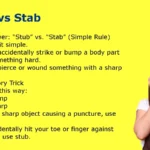
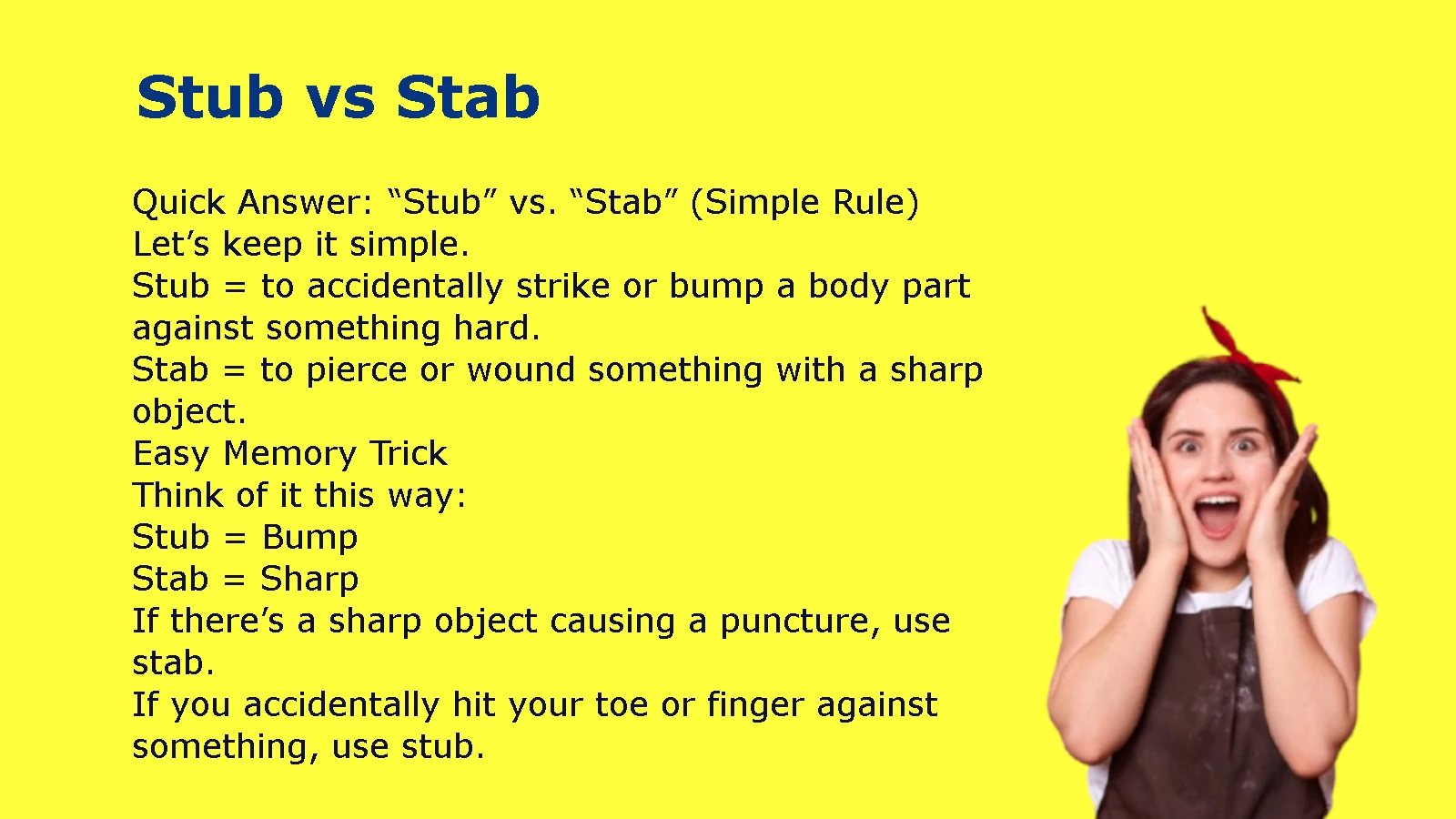
Quick Answer: “Stub” vs. “Stab” (Simple Rule)
Let’s keep it simple.
Stub = to accidentally strike or bump a body part against something hard.
Stab = to pierce or wound something with a sharp object.
Easy Memory Trick
Think of it this way:
- Stub = Bump
- Stab = Sharp
If there’s a sharp object causing a puncture, use stab.
If you accidentally hit your toe or finger against something, use stub.
How People Actually Use “Stub” and “Stab”
The confusion usually happens because both words involve pain.
In Everyday Conversations
People commonly say:
- “I stubbed my toe on the table.”
- “I accidentally stabbed myself with a needle.”
Both involve injury, but the type of injury is different.
Why the Confusion Happens
- Both words are short and sound similar.
- Both can describe painful experiences.
- English learners sometimes focus on the injury rather than the action.
Key Insight
The difference isn’t the pain.
It’s how the injury happened.
The Core Difference Between “Stub” and “Stab”
Understanding the action solves everything.
| Word | Meaning | Typical Cause |
| Stub | Hit against something | Blunt object |
| Stab | Pierce with something sharp | Knife, needle, pin |
Simple Examples
Stub
- I stubbed my toe on the couch.
Stab
- He stabbed the cardboard with a knife.
Notice how one involves impact while the other involves penetration.
“Stub” Explained Clearly
The word stub is most often used when someone accidentally hits a toe, finger, or another body part against a hard object.
Standard Meaning
To strike something accidentally and painfully.
Common Examples
- She stubbed her toe on the bed frame.
- I stubbed my finger against the wall.
- He stubbed his foot while running upstairs.
What Usually Gets Stubbed?
Most often:
- Toes
- Fingers
- Feet
Key Takeaway
A stub injury happens because of a collision, not because of a sharp object.
“Stab” Explained Clearly
The word stab means to pierce or thrust a sharp object into someone or something.
Standard Meaning
To puncture using a pointed object.
Common Examples
- The chef stabbed the potato with a fork.
- She accidentally stabbed her finger with a needle.
- The attacker stabbed the victim with a knife.
What Can Cause a Stab?
Common sharp objects include:
- Knives
- Needles
- Forks
- Pins
- Scissors
Key Takeaway
A stab involves something sharp entering a surface.
The Biggest Mistake People Make
Here’s the most common error:
Using stab when talking about hitting a toe.
Incorrect
❌ I stabbed my toe on the coffee table.
Correct
✅ I stubbed my toe on the coffee table.
Why?
The table isn’t piercing the toe. The toe is colliding with the table.
Another Example
❌ I stubbed myself with a needle.
✅ I stabbed myself with a needle.
Needles pierce, so stab is correct.
Side-by-Side Comparison Table
Here’s a quick reference guide:
| Feature | Stub | Stab |
| Action | Hit or bump | Pierce |
| Usually Accidental | Yes | Often, but not always |
| Requires Sharp Object | No | Yes |
| Common Body Part | Toe | Finger, hand, body |
| Typical Pain Type | Bruising | Puncture wound |
Real-Life Examples of “Stub”
Let’s see how native speakers use it.
Common Situations
- I stubbed my toe while walking in the dark.
- She stubbed her foot on the staircase.
- He stubbed his finger against the desk.
Mini Scenario
You wake up at night and walk to the kitchen.
Suddenly—
Bang!
Your toe hits the table leg.
You stubbed your toe.
Real-Life Examples of “Stab”
Now compare.
Common Situations
- I accidentally stabbed myself with a pencil.
- The gardener stabbed the soil with a tool.
- She stabbed the package with scissors to open it.
Mini Scenario
You’re sewing a shirt.
The needle slips and punctures your finger.
You stabbed your finger.
Can “Stab” Be Used Figuratively?
Yes.
Unlike stub, stab often appears in figurative expressions.
Examples
- A stab of guilt.
- A stab of pain.
- A stab at success.
- Take a stab at answering.
What It Means
In these cases, stab suggests a sudden or forceful feeling or attempt.
Example
“I took a stab at fixing the computer.”
Meaning:
“I tried to fix it.”
Can “Stub” Be Used Figuratively?
Sometimes, but much less often.
Common Uses
- Stub out a cigarette.
- A ticket stub.
- A paycheck stub.
These meanings are unrelated to injury.
Example
“Don’t forget to keep your ticket stub.”
Here, stub means a small remaining piece.
Pronunciation Differences
Although they look similar, pronunciation can help.
Stub
/stʌb/
Rhymes with:
- Club
- Tub
- Rub
Stab
/stæb/
Rhymes with:
- Cab
- Grab
- Lab
Quick Tip
Think:
- Stub = uh sound
- Stab = ah sound
How to Avoid Confusion Every Time
Follow these simple checks.
Ask Question #1
Did something sharp pierce something?
Yes → Stab
Ask Question #2
Did something hit or bump into something?
Yes → Stub
Visual Shortcut
Sharp → Stab
Bump → Stub
Simple.
What to Say Instead (Clear Alternatives)
Sometimes another word fits better.
Alternatives for “Stub”
- Bump
- Strike
- Knock
- Hit
Alternatives for “Stab”
- Pierce
- Puncture
- Jab
- Spear
Example
Instead of:
“I stabbed my finger with a thorn.”
You could say:
“I punctured my finger with a thorn.”
Quick Decision Guide (Use This Instantly)
When choosing between the two:
Hit a hard object?
→ Stub
Pierced by something sharp?
→ Stab
Still unsure?
Remember:
Stub = Bump
Stab = Sharp
FAQ: “Stub” vs. “Stab”
Is “I stabbed my toe” correct?
Usually no.
If you hit your toe against furniture, the correct phrase is:
“I stubbed my toe.”
Can you stab yourself accidentally?
Yes.
For example:
“I accidentally stabbed myself with a needle.”
Is stubbing always accidental?
Almost always.
People rarely stub body parts on purpose.
Which word is more common?
In daily conversation:
- Stub is common for toe injuries.
- Stab is common for sharp-object injuries.
Case Study: A Funny Miscommunication
An English learner once told coworkers:
“I stabbed my toe on the coffee table this morning.”
Everyone looked confused.
Why?
Coffee tables aren’t sharp enough to stab.
What the speaker meant was:
“I stubbed my toe on the coffee table.”
The injury was real, but the wrong word created confusion.
Lesson
Always think about the type of contact:
- Collision → Stub
- Piercing → Stab
Key Facts You Should Remember
- Stub means to bump into something.
- Stab means to pierce with something sharp.
- You usually stub a toe.
- You can stab with a knife or needle.
- Stub injuries involve impact.
- Stab injuries involve penetration.
- “Take a stab at it” means “give it a try.”
Final Takeaway: The One Rule That Never Fails
Here’s the simplest way to remember the difference between stub and stab.
If a body part accidentally hits something hard, use stub.
If a sharp object pierces something, use stab.
Think of it like this:
Stub = bumping into something.
Stab = piercing something.
That one rule will help you choose the correct word every time and eliminate confusion for good. When in doubt, ask yourself one question:
Was it a bump or a puncture?
The answer tells you whether you need stub or stab.