Have you ever stopped to wonder whether Seem vs. Seam are simply different spellings of the same word? Although they sound exactly alike, these two commonly confused English words have completely different meanings and are used in entirely different situations. Because they are homophones—words that share the same pronunciation but differ in spelling and meaning—many English learners and even native speakers occasionally mix them up in writing.
In simple terms, Seem is a verb that means to appear, look, or give the impression of being something. You might say someone seems happy, a task seems difficult, or the weather seems pleasant. Seam, on the other hand, is a noun that refers to the line where two pieces of fabric, leather, or other materials are stitched or joined together. It can also describe a natural line or layer in objects such as rocks or coal. Although only one letter separates these words, confusing them can completely change the meaning of a sentence.
Understanding the difference between Seem and Seam is essential for improving your grammar, spelling accuracy, vocabulary, and overall writing skills. These words frequently appear in everyday conversations, academic writing, professional communication, and English proficiency exams, making it important to know when each one is appropriate. Learning their meanings, grammatical roles, and common contexts will help you communicate with greater confidence and avoid one of the most common homophone mistakes in English.
In this guide, you’ll discover the clear difference between Seem and Seam, their definitions, pronunciation, grammar, real-life examples, common mistakes, and simple memory tricks that will help you choose the correct word every time you write or speak.
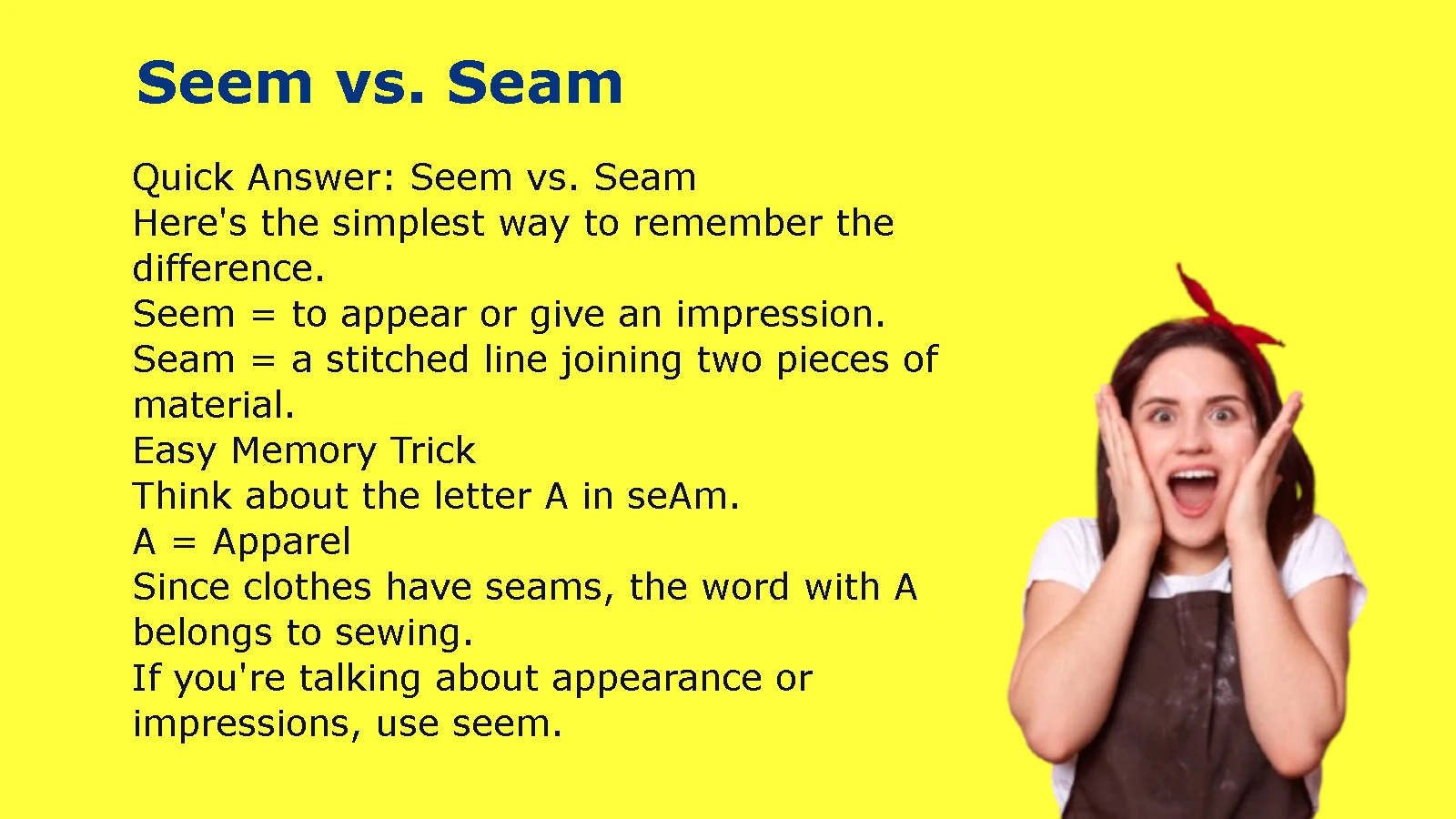
Quick Answer: Seem vs. Seam
Here’s the simplest way to remember the difference.
Seem = to appear or give an impression.
Seam = a stitched line joining two pieces of material.
Easy Memory Trick
Think about the letter A in seAm.
A = Apparel
Since clothes have seams, the word with A belongs to sewing.
If you’re talking about appearance or impressions, use seem.
The Difference Between Seem and Seam
Although they sound the same, these words belong to different parts of speech and serve completely different purposes.
| Word | Part of Speech | Meaning | Example |
| Seem | Verb | To appear or give an impression | You seem happy today. |
| Seam | Noun | A stitched line joining materials | The seam on my shirt came loose. |
The easiest way to choose the correct word is to ask yourself whether you’re describing an appearance or a piece of fabric.
What Does “Seem” Mean?
Seem is a verb that describes how something appears or feels from someone’s perspective. It doesn’t necessarily mean something is true—it only describes the impression it gives.
Common Uses of “Seem”
- expressing opinions
- describing appearances
- talking about impressions
- making observations
Examples
- You seem excited about the trip.
- It seems like it’s going to rain.
- She seemed nervous during the interview.
- This problem seems difficult at first.
- The movie seems interesting.
Key Idea
Seem describes perception, not certainty.
What Does “Seam” Mean?
A seam is the line where two pieces of fabric, leather, or another material are joined together.
It’s commonly used in sewing, clothing, construction, sports equipment, and manufacturing.
Common Uses of “Seam”
- clothing
- tailoring
- quilts
- shoes
- baseballs
- upholstery
Examples
- The seam on my jeans ripped.
- Check the seam before buying the jacket.
- The tailor reinforced every seam.
- The pillow has a hidden seam.
- The baseball’s seam helps pitchers create movement.
Key Idea
Whenever stitching or joining materials is involved, seam is the correct spelling.
Why People Confuse Seem and Seam
The confusion comes from one simple reason.
They are homophones, meaning they have the same pronunciation but different spellings and meanings.
Why Mistakes Happen
- They sound identical.
- Spell-check often won’t catch the error.
- Writers focus on pronunciation instead of meaning.
- Typing quickly increases mistakes.
The good news is that once you understand each word’s purpose, the confusion almost disappears.
Seem vs. Seam: Side-by-Side Comparison
| Feature | Seem | Seam |
| Meaning | To appear | A stitched line |
| Part of Speech | Verb | Noun |
| Related To | Appearance | Sewing and fabric |
| Common Context | Feelings, opinions, impressions | Clothing, tailoring, materials |
| Example | You seem tired. | The seam is torn. |
Real-Life Examples of “Seem”
Here are some situations where seem fits naturally.
At School
“This math problem seems easier than yesterday’s.”
At Work
“You seem ready for the presentation.”
At Home
“It seems everyone is asleep.”
With Friends
“You seem happier lately.”
While Traveling
“The roads seem quieter today.”
Notice that every example talks about appearance or impression, not certainty.
Real-Life Examples of “Seam”
Now compare those with seam.
Clothing
“The seam on my jacket needs repairing.”
Sewing
“Be careful not to tear the seam.”
Sports
“The pitcher grips the seam of the baseball.”
Furniture
“The sofa’s seam is beginning to split.”
Craft Projects
“The seam should be straight for a neat finish.”
Every example involves something that has been stitched or joined together.
Common Mistakes to Avoid
Many writers accidentally swap these words.
Incorrect
The shirt doesn’t seem very strong along the shoulder.
Correct
The shirt doesn’t seam very strong along the shoulder. ❌
Actually, this sentence should be:
The shirt’s seam isn’t very strong.
Incorrect
It seam like a good idea.
Correct
It seems like a good idea.
Incorrect
The dress seemed came apart.
Correct
The dress’s seam came apart.
Memory Tricks That Actually Work
Here are a few simple ways to remember the difference.
Trick 1
Seem = See
Both relate to appearance.
If something seems true, that’s how it looks.
Trick 2
Seam = Stitch
Both words relate to clothing and sewing.
Trick 3
Remember the letter A.
SeAm → Apparel
Clothes have seams.
When to Use Seem
Use seem whenever you’re talking about:
- appearance
- impressions
- opinions
- emotions
- possibilities
Examples:
- You seem confident.
- It seems unfair.
- They seem ready.
- This seems expensive.
When to Use Seam
Use seam whenever you’re talking about:
- fabric
- sewing
- stitching
- clothing
- materials joined together
Examples:
- The seam split.
- Sew the seam carefully.
- Every seam was reinforced.
Quick Decision Guide
Ask yourself one question.
Are you talking about appearance?
Yes → Seem
No.
Are you talking about stitching or fabric?
Yes → Seam
Still unsure?
Replace seem with appear.
If the sentence still makes sense, seem is correct.
Frequently Asked Questions
Is it “it seems” or “it seams”?
The correct phrase is “it seems.”
“It seams” is incorrect unless you’re talking about stitched material.
Can “seam” be used as a verb?
Yes, but it’s uncommon. In everyday English, seam is almost always used as a noun.
Why do seem and seam sound the same?
English contains many homophones—words that share pronunciation but have different meanings and spellings.
Which mistake is more common?
Using seam instead of seem is one of the most common spelling mistakes because spell-check usually accepts both words.
Case Study: A Small Spelling Mistake With a Big Impact
A clothing retailer emailed customers about a new collection.
The marketing team wrote:
“Our jackets seem is reinforced for extra durability.”
Customers quickly noticed the error because the sentence was discussing stitching, not appearance.
The corrected version became:
“Our jackets feature reinforced seams for extra durability.”
One small spelling change made the message professional and much clearer.
Key Facts to Remember
- Seem means to appear or give an impression.
- Seam is the stitched line joining two pieces of material.
- They sound identical but have different meanings.
- Seem is a verb.
- Seam is usually a noun.
- Think about whether you’re describing an impression or a piece of clothing before choosing the word.
Final Takeaway: Never Confuse Seem and Seam Again
The difference between Seem vs. Seam is simple once you focus on meaning instead of pronunciation. If you’re talking about how something appears or the impression it gives, choose seem. If you’re referring to stitching, fabric, or the line where materials are joined, use seam.
Whenever you’re unsure, pause and ask yourself one question: Am I describing an appearance or a stitch? That quick check will usually lead you to the correct spelling. And for important emails, school assignments, or professional writing, take an extra moment to proofread—homophones like these are easy to miss but just as easy to master once you know the rule.