Have you ever come across the word “ate” and wondered whether it simply refers to eating or has another meaning depending on the context? Although Ate is one of the most common words in the English language, many learners still have questions about its correct meaning, pronunciation, grammar, and usage. Understanding Ate Meaning is essential for improving your English vocabulary, grammar skills, and everyday communication.
In simple terms, ate is the past tense of the verb eat. It describes an action that happened in the past when someone consumed food or a meal. For example, “She ate breakfast before school” and “We ate dinner together last night” both show completed actions. While its primary meaning relates to eating, the word may also appear in idioms, informal expressions, and different writing contexts, making it useful to understand beyond its basic definition.
Many English learners search for topics such as Ate Meaning, what does ate mean, ate definition, past tense of eat, how to use ate in a sentence, and difference between eat and ate. These are common grammar questions because eat, eats, ate, and eaten each have different roles in English grammar. Learning when to use each form helps you write and speak with greater confidence and accuracy.
If you’ve ever paused while writing a sentence and wondered whether to use eat, ate, or eaten, you’re not alone. This is one of the most frequently confused verb forms for English learners because each word describes a different time or grammatical structure.
In this guide, you’ll learn the complete Ate Meaning, its definition, pronunciation, grammar rules, real-life examples, common phrases, and easy memory tips so you can use the word correctly in both writing and conversation.
What Does “Ate” Mean?
In modern slang, ate means someone performed exceptionally well, looked amazing, or succeeded with confidence and style. It’s a strong compliment that celebrates excellence.
Unlike the standard English verb, where ate is simply the past tense of eat, slang gives the word an entirely different meaning.
Quick Definition
| Term | Meaning |
| Ate | Did an outstanding job or impressed everyone. |
| You ate | You performed exceptionally well. |
| She ate | She looked amazing or delivered an impressive performance. |
| He ate | He excelled or dominated the moment. |
| They ate | They collectively did an excellent job. |
People often use the phrase after watching someone:
- Deliver an unforgettable speech
- Perform on stage
- Wear an eye-catching outfit
- Create beautiful artwork
- Finish a difficult challenge
- Post an impressive transformation
- Share a funny or clever video
What Does “You Ate” Mean?
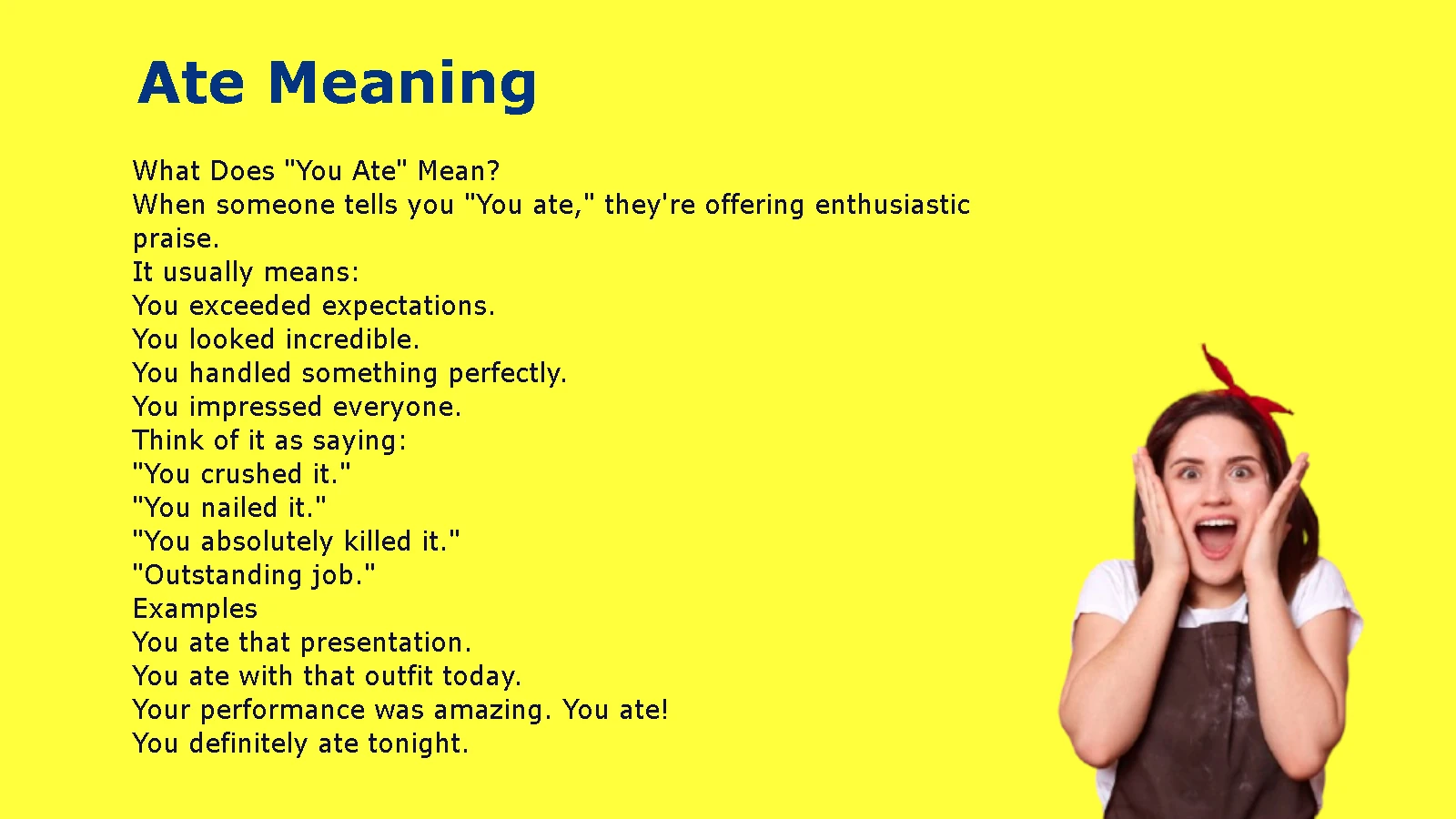
When someone tells you “You ate,” they’re offering enthusiastic praise.
It usually means:
- You exceeded expectations.
- You looked incredible.
- You handled something perfectly.
- You impressed everyone.
Think of it as saying:
- “You crushed it.”
- “You nailed it.”
- “You absolutely killed it.”
- “Outstanding job.”
Examples
- You ate that presentation.
- You ate with that outfit today.
- Your performance was amazing. You ate!
- You definitely ate tonight.
Although the wording is short, the compliment carries a lot of enthusiasm.
What Does “Ate” Mean on Social Media?
Social media helped turn ate into one of the internet’s favorite compliments. The word appears in millions of comments, captions, memes, and reaction videos because it’s quick, expressive, and easy to understand once you know the slang.
Different platforms use it in slightly different ways.
Ate Meaning on TikTok
TikTok has played a major role in making ate part of everyday internet language.
You’ll often find comments like:
- She ate.
- You ate that up.
- They ate and left no crumbs.
- Absolutely ate.
Common situations include:
- Dance routines
- Makeup transformations
- Fashion videos
- Comedy sketches
- Singing performances
- Cooking videos
- Acting clips
- Cosplay reveals
Example
A creator posts a dramatic makeup transformation.
Comments include:
“Girl, you ate!”
That means viewers think the final look is stunning.
Ate Meaning on Instagram
Instagram users often comment ate under visually impressive content.
Popular examples include:
- Outfit photos
- Vacation pictures
- Graduation posts
- Wedding photography
- Fitness transformations
- Professional portraits
Example
Someone uploads elegant graduation photos.
Comments might say:
“You seriously ate.”
Here, the compliment focuses on appearance and confidence.
Ate Meaning on X (Formerly Twitter)
On X, people frequently use ate while reacting to:
- Celebrity interviews
- Sports highlights
- Award shows
- Political debates
- Viral jokes
- Television moments
Because posts are short, users often keep the compliment brief.
Examples include:
- She ate.
- He absolutely ate.
- They all ate tonight.
The simplicity makes the expression highly shareable.
Ate Meaning on YouTube
YouTube viewers use the phrase while discussing:
- Music videos
- Dance performances
- Talent competitions
- Gaming content
- Tutorials
- Podcasts
Examples include:
- The choreography ate.
- She ate every verse.
- This performance absolutely ate.
In many comment sections, you’ll see hundreds of people repeating similar praise because it’s become part of internet culture.
Where Did “Ate” Come From?
Although many people associate ate with Gen Z slang, the expression has much deeper cultural roots.
Understanding its history helps explain why it’s important to use the term respectfully.
Origins in African American Vernacular English (AAVE)
The slang meaning of ate developed within African American Vernacular English (AAVE).
In this context, saying someone “ate” suggested they completely dominated a performance or executed something with exceptional confidence.
Rather than referring to food, the expression symbolized excellence and mastery.
Language within AAVE has influenced American English for generations, introducing expressions that later became mainstream.
Influence of Ballroom Culture
The phrase gained additional popularity through ballroom culture.
Ballroom communities celebrate creativity, dance, fashion, confidence, and self-expression through competitions known as balls.
Participants compete in different categories while judges evaluate their performances.
When someone gave an unforgettable performance, expressions similar to “they ate” communicated admiration and respect.
These communities helped shape much of today’s internet slang.
Connection to Drag Culture
Drag performers also embraced the phrase.
In drag shows, performers who impressed audiences with fashion, lip-syncing, comedy, or stage presence often received compliments using expressions like:
- She ate.
- She ate that up.
- She left no crumbs.
The phrase became closely associated with confidence, charisma, and unforgettable performances.
How Social Media Spread the Phrase
As platforms like TikTok, Instagram, and X grew, creators borrowed expressions already common within these communities.
Celebrity interviews, viral memes, dance challenges, and reaction videos accelerated its popularity.
Soon, millions of users began saying:
- You ate.
- He ate.
- She ate.
- They ate.
Today, many people use the expression without realizing its cultural origins.
Timeline of the Expression
| Period | Development |
| Early usage | Used within African American Vernacular English (AAVE). |
| Ballroom culture | Became associated with exceptional performances. |
| Drag community | Popularized through performances and entertainment. |
| Social media era | Spread across TikTok, Instagram, and X. |
| Present day | One of the internet’s most recognizable compliments. |
What Does “You Ate” Mean?
Among all variations, “you ate” is easily the most common.
It’s direct, encouraging, and easy to use in conversation.
When someone says:
“You ate.”
They usually mean:
- You impressed everyone.
- You looked amazing.
- You handled that perfectly.
- You performed confidently.
- You deserve recognition.
The compliment often highlights effort as much as the final result.
Situations Where People Say “You Ate”
People commonly use the phrase after someone:
Gives a Great Presentation
Example:
“You ate that presentation. Everyone was paying attention.”
Wins a Competition
Example:
“You completely ate that final round.”
Dresses Well
Example:
“You definitely ate with this outfit.”
Performs on Stage
Example:
“You ate every single song tonight.”
Creates Amazing Content
Example:
“This video is incredible. You ate.”
Why the Phrase Feels So Powerful
Part of the phrase’s popularity comes from its simplicity.
Instead of writing an entire sentence like:
“Your performance was incredibly polished, creative, and entertaining.”
People simply write:
“You ate.”
Those two words communicate excitement, admiration, and approval almost instantly.
What Does “Ate and Left No Crumbs” Mean?
One of the internet’s favorite expressions expands the original compliment even further.
When someone says:
“You ate and left no crumbs.”
They mean the performance or achievement was so complete that nothing could have been done better.
Imagine serving a perfect meal that everyone enjoyed until nothing remained on the plate. The metaphor suggests absolute excellence.
In slang, it means:
- Every detail was perfect.
- Nothing needed improvement.
- The performance exceeded expectations.
- Everyone else was impressed.
Examples
- You ate and left no crumbs with that speech.
- Her concert outfit ate and left no crumbs.
- That makeup look left no crumbs.
- Your graduation photos absolutely ate.
Why People Love This Phrase
Compared with simply saying “You ate,” this version adds emphasis.
It tells the reader that the accomplishment wasn’t merely good.
It was unforgettable.
Other Popular Variations of “Ate”
As the slang evolved, several creative variations appeared across social media. Each one shares the same core idea—doing something exceptionally well—but the wording adds different levels of enthusiasm or context.
Ate That
Meaning: You handled something perfectly or exceeded expectations.
Example:
- She ate that performance.
- You really ate that interview.
Ate That Up
This version adds even more excitement.
It suggests someone completely owned the moment from beginning to end.
Example:
- He ate that up on stage.
- You ate that speech up.
Ate Down
Ate down is another emphatic variation, especially common in online communities discussing music, fashion, and entertainment. It implies someone delivered at the highest level.
Example:
- The band ate down during the final song.
- She ate down with that red carpet look.
She Ate
This phrase praises a woman’s performance, style, or confidence.
Example:
- She ate with that graduation speech.
- She ate every scene in the movie.
He Ate
This version highlights a man’s impressive performance or achievement.
Example:
- He ate that guitar solo.
- He ate during the championship game.
They Ate
Used when praising a group or multiple people.
Example:
- The dance team ate tonight.
- They ate every performance.
Mother Ate
In internet slang, “mother” is often used to describe someone viewed as iconic, influential, or effortlessly stylish. Saying “Mother ate” expresses especially high praise.
Example:
- Mother ate and left no crumbs.
This variation is especially common in fashion, pop culture, and fan communities.
How to Use “Ate” Correctly
Learning the ate meaning is only the first step. Knowing when and how to use it naturally makes a bigger difference.
In most cases, ate works as a compliment. It fits casual conversations, social media comments, text messages, and friendly chats. However, it doesn’t belong in formal writing or professional communication.
Here are some of the most common situations where people use it.
Complimenting Someone
One of the easiest ways to use ate is to praise someone’s achievement.
Examples
- You ate that interview.
- She really ate during the debate.
- He ate that piano performance.
- You absolutely ate today.
Talking About Fashion
Fashion is one of the biggest categories where the slang appears.
People often compliment:
- Outfits
- Shoes
- Hairstyles
- Jewelry
- Makeup
- Accessories
Examples
- You ate with that outfit.
- She ate in that red dress.
- That jacket is amazing. You ate.
Music and Performances
Whether it’s a concert, school recital, or talent show, ate is a quick way to praise a standout performance.
Examples
- The band ate tonight.
- She ate every note.
- He ate that guitar solo.
Sports
Fans often use the phrase after an athlete dominates a game.
Examples
- The striker ate during the second half.
- She ate on defense today.
- That team completely ate.
Gaming
Gamers use ate when someone plays exceptionally well.
Examples
- You ate that final match.
- Our squad ate today.
- He ate every round.
School
Students also use the slang when classmates do well.
Examples
- You ate that presentation.
- She ate her science project.
- Your speech was incredible. You ate.
Everyday Conversations
The expression doesn’t always need a major accomplishment.
Friends might say it after someone:
- Tells a funny joke
- Solves a difficult problem
- Gives helpful advice
- Makes everyone laugh
Example
That comeback was perfect. You ate.
Examples of “Ate” in Sentences
Seeing the phrase in context makes it much easier to understand. Below are real-life examples grouped by category.
Fashion Examples
- You ate with that black suit.
- She ate every look during Fashion Week.
- Those boots are incredible. You ate.
- He ate with that vintage jacket.
Beauty Examples
- Your makeup ate today.
- She ate that hairstyle.
- You definitely ate with those nails.
Dance Examples
- The dance crew ate every routine.
- She ate the choreography.
- They ate from beginning to end.
Music Examples
- That singer ate every verse.
- The choir absolutely ate tonight.
- She ate the final chorus.
School Examples
- You ate your graduation speech.
- She ate that history presentation.
- Our team ate during the science fair.
Workplace Examples
- You ate that client presentation.
- She ate the meeting today.
- Your proposal was excellent. You ate.
Sports Examples
- The goalkeeper ate today.
- He ate during the championship game.
- The entire team ate in the second half.
Gaming Examples
- Our squad ate in every match.
- You ate that tournament.
- He ate the final boss fight.
Everyday Conversation Examples
- You ate with that joke.
- She ate that response.
- Your cooking ate tonight.
- You really ate with that birthday surprise.
Quick Reference Table: Common “Ate” Expressions
| Expression | Meaning | Example |
| You ate | You did an excellent job. | You ate that speech. |
| She ate | She performed exceptionally well. | She ate on stage. |
| He ate | He impressed everyone. | He ate during the game. |
| They ate | A group excelled together. | They ate that performance. |
| Ate that | Successfully completed something. | You ate that exam. |
| Ate that up | Completely dominated the moment. | She ate that up on the runway. |
| Ate and left no crumbs | Did something perfectly. | They left no crumbs. |
| Ate down | Performed at an extremely high level. | He ate down tonight. |
When You Shouldn’t Use “Ate”
Although the expression is popular, it isn’t suitable everywhere.
Because it’s informal slang, using it in professional settings can confuse readers or sound unprofessional.
Avoid Using It In:
- Business reports
- Academic essays
- Research papers
- Legal documents
- Formal emails
- Government correspondence
- Professional resumes
Instead, choose more formal alternatives.
| Informal | Formal Alternative |
| You ate. | You did an excellent job. |
| She ate. | She performed exceptionally well. |
| They ate. | They delivered outstanding results. |
| He ate that presentation. | He gave an excellent presentation. |
Is “Ate” Positive or Negative?
Almost always, ate has a positive meaning.
People use it to celebrate success, creativity, confidence, or talent.
Positive Examples
- She ate that performance.
- You ate with your graduation speech.
- He ate that interview.
Each sentence praises someone’s accomplishment.
Can “Ate” Be Sarcastic?
Yes.
Like many internet expressions, tone matters.
Someone might jokingly say:
“Yeah… you really ate.”
If the context suggests criticism, the compliment becomes sarcastic.
For example, imagine someone makes a mistake during a performance. A friend might use “You ate” ironically to tease them. The words stay the same, yet the meaning changes because of tone and context.
Sarcastic use is far less common than genuine praise.
Similar Slang Words to “Ate”
The internet constantly creates new expressions for success and confidence. Many overlap with ate, although each has its own subtle meaning.
| Slang | Meaning | Typical Use |
| Slayed | Performed exceptionally well | Fashion, music, beauty |
| Killed It | Did an outstanding job | Everyday conversations |
| Crushed It | Succeeded impressively | School, work, sports |
| Nailed It | Did something perfectly | General praise |
| Served | Delivered an amazing look or performance | Fashion and pop culture |
| Owned | Took complete control | Sports and debates |
| Cooked | Dominated or overwhelmed, depending on context | Gaming and sports |
| Went Hard | Put in maximum effort | Music and athletics |
While these expressions are similar, they aren’t always interchangeable.
“Ate” vs. “Slayed”
People often use ate and slayed together, but there are slight differences.
| Feature | Ate | Slayed |
| Main Meaning | Excelled or impressed | Dominated with confidence and style |
| Tone | Casual | Dramatic and energetic |
| Popular On | TikTok, Instagram, X | TikTok, Instagram, fashion communities |
| Common Context | General praise | Fashion, beauty, music, performances |
Example
Ate
She ate that speech.
This focuses on how well she performed.
Slayed
She slayed that runway look.
This emphasizes confidence, appearance, and style.
Both expressions communicate admiration, although slayed often feels slightly more theatrical.
“Ate” vs. “Cooked”
This comparison confuses many people because cooked has more than one slang meaning.
Ate
Usually means:
- Succeeded
- Impressed everyone
- Delivered an excellent performance
Example
You ate that debate.
Cooked
Depending on the situation, cooked can mean:
- Completely dominated someone.
- Completely exhausted.
- In serious trouble.
- Unable to recover.
Examples
Their team got cooked.
This means they lost badly.
I’m cooked after that workout.
This means the speaker feels exhausted.
Because cooked changes meaning depending on context, it’s more flexible than ate.
Comparison Table
| Expression | Positive | Negative | Context Dependent |
| Ate | ✔ | Rarely | Slightly |
| Cooked | ✔ | ✔ | Yes |
Why Has “Ate” Become So Popular?
Few slang expressions spread as quickly as ate.
Several factors explain its rise.
It’s Short and Memorable
Internet users love expressions that are quick to type.
Instead of writing:
That performance was absolutely incredible.
People simply comment:
She ate.
The meaning stays clear while saving time.
It Works Across Many Situations
Unlike some slang terms that fit only one topic, ate works almost anywhere.
People use it for:
- Fashion
- Sports
- Gaming
- Art
- Music
- Dance
- Acting
- Comedy
- School
- Work achievements
That versatility helped the expression spread across different online communities.
Social Media Encouraged It
Short comments attract more engagement.
Comments like:
- ATE
- YOU ATE
- LEFT NO CRUMBS
are easy to read, easy to post, and easy to repeat.
As more creators received these comments, more users adopted the expression.
Celebrity Influence
Celebrities, musicians, influencers, drag performers, and content creators regularly use the phrase.
Fans naturally imitate the language they hear from public figures, accelerating its popularity.
Meme Culture
Internet memes thrive on short, recognizable phrases.
Because ate is simple and adaptable, it became a staple reaction in meme culture.
One memorable outfit, performance, or speech can generate thousands of comments saying:
- She ate.
- Mother ate.
- No crumbs.
- Absolutely devoured.
Mini Case Study: How “Ate” Went Viral
Imagine a singer posts a live performance on TikTok.
Within a few hours:
- Thousands of viewers watch the video.
- Fans flood the comments with “She ate!”
- Other users repeat the phrase in reaction videos.
- Meme accounts repost the performance.
- New viewers begin using the same expression on unrelated content.
This cycle demonstrates how internet slang spreads. A short, memorable compliment catches attention, gains visibility through repeated use, and gradually becomes part of everyday online conversations.
“Internet slang evolves quickly, but the expressions that last are usually simple, adaptable, and easy to recognize.”
By combining brevity with strong emotional impact, ate has become one of the defining compliments of modern social media culture.
Frequently Asked Questions About the Ate Meaning
Does “ate” always mean something positive?
Most of the time, yes. In modern slang, ate is almost always a compliment. It tells someone they did an outstanding job, looked amazing, or impressed everyone.
However, tone matters. In rare cases, people use it sarcastically to poke fun at a mistake or awkward moment. The surrounding conversation usually makes the intended meaning obvious.
What does “she ate” mean?
“She ate” means a woman performed exceptionally well or looked fantastic.
People often use it after seeing someone:
- Wear a stylish outfit
- Deliver a speech
- Sing or dance
- Complete a difficult challenge
- Share an impressive social media post
Example
She ate with that graduation speech.
What does “he ate” mean?
“He ate” carries the same meaning. It praises a man’s performance, confidence, or achievement.
Example
He ate during the championship game.
What does “they ate” mean?
When talking about two or more people, “they ate” means the group did an excellent job together.
Example
The dance team ate tonight.
What does “you ate that” mean?
“You ate that” is a stronger version of “you ate.”
It highlights a specific achievement or moment.
Examples
- You ate that interview.
- You ate that performance.
- You ate that presentation.
What does “ate and left no crumbs” mean?
This phrase means someone performed so well that nothing could have been improved.
It’s one of the highest compliments in internet slang.
Examples
- She ate and left no crumbs.
- That outfit left no crumbs.
- The performance was flawless. They left no crumbs.
Is “ate” Gen Z slang?
It’s often associated with Gen Z, but the phrase existed before Gen Z popularized it online.
Social media helped introduce it to a wider audience. Today, people of different ages use it in casual conversations and online comments.
Is “ate” part of AAVE?
Yes.
The modern slang meaning of ate comes from African American Vernacular English (AAVE). It later gained wider recognition through ballroom culture, drag communities, entertainment, and social media.
Understanding its cultural origins helps people appreciate how many popular internet expressions enter mainstream language.
Can you use “ate” in real life?
Absolutely.
Although many people first encounter it online, ate also appears in everyday conversations among friends, classmates, teammates, and family members.
For example:
- You ate that exam.
- You really ate today.
- She ate during karaoke night.
Is “ate” appropriate at work?
It depends on the workplace.
If you’re chatting with coworkers in a relaxed environment, they may understand the slang.
In professional writing or formal meetings, it’s usually better to choose phrases such as:
- Excellent work
- Outstanding presentation
- Great job
- Well done
- Exceptional performance
These alternatives sound more professional while expressing the same appreciation.
What’s the opposite of “ate”?
There isn’t one universally accepted opposite.
Instead, people use different slang expressions depending on the situation.
Some examples include:
| Expression | Meaning |
| Fumbled | Made a mistake or missed an opportunity. |
| Dropped the ball | Failed to complete something successfully. |
| Folded | Lost confidence under pressure. |
| Choked | Performed poorly at an important moment. |
| Cooked | Can mean defeated, exhausted, or in trouble, depending on context. |
The opposite depends on what someone is describing, which is why no single expression directly replaces ate.
Common Mistakes People Make When Using “Ate”
Like many slang terms, ate is easy to misuse if you don’t understand the context. Avoiding these mistakes will help your conversations sound more natural.
Confusing the Slang With the Past Tense of “Eat”
The biggest misunderstanding comes from assuming every use of ate relates to food.
Compare these examples:
| Sentence | Meaning |
| I ate breakfast at 8 a.m. | Past tense of eat. |
| She ate that performance. | Slang meaning she performed exceptionally well. |
The surrounding words make the intended meaning clear.
Using It in Formal Writing
Although the expression is popular, it isn’t appropriate everywhere.
Avoid using ate in:
- Job applications
- Academic essays
- Business proposals
- Official reports
- Professional emails
Formal language is usually the better choice in these settings.
Overusing the Phrase
Because ate is trendy, some people use it to describe almost everything.
For example:
- The coffee ate.
- My backpack ate.
- The weather ate.
While playful exaggeration can be funny among friends, using the phrase too often may reduce its impact.
A compliment feels more meaningful when you save it for moments that truly stand out.
Related Expressions You Might Also See Online
If you’re exploring internet slang, you’ll probably encounter these phrases alongside ate.
| Expression | Meaning |
| It’s giving… | Describes the vibe or feeling something creates. |
| Main character energy | Someone appears confident and unforgettable. |
| No notes | Nothing needs improvement. |
| Iconic | Exceptionally memorable or influential. |
| Slayed | Performed with confidence and style. |
| Served | Delivered an impressive look or performance. |
| Understood the assignment | Did exactly what was expected—often even better. |
| Devoured | Another way of saying someone completely dominated a performance. |
Learning these expressions makes it easier to understand conversations across TikTok, Instagram, YouTube, and X.
Quick Cheat Sheet
If you need a fast refresher, this table summarizes the most important points.
| Phrase | Meaning | Positive or Negative? |
| Ate | Did an outstanding job. | Positive |
| You ate | You performed exceptionally well. | Positive |
| She ate | She impressed everyone. | Positive |
| He ate | He excelled. | Positive |
| They ate | The group performed brilliantly. | Positive |
| Ate that | Successfully completed something impressive. | Positive |
| Ate that up | Completely dominated the moment. | Positive |
| Ate and left no crumbs | Performed perfectly. | Very positive |
Key Takeaways
Before you start using the expression yourself, remember these points:
- Ate is modern slang that means someone performed exceptionally well or looked amazing.
- It has nothing to do with eating when used in internet slang.
- The expression originated in African American Vernacular English (AAVE) and later gained broader visibility through ballroom culture, drag culture, and social media.
- “You ate” is one of today’s most common online compliments.
- “Ate and left no crumbs” emphasizes that someone performed almost flawlessly.
- The phrase works best in casual conversations, social media comments, and text messages.
- It isn’t appropriate for formal writing, academic work, or professional documents.
- Context always matters. Although the phrase is overwhelmingly positive, sarcasm can occasionally change its meaning.
Conclusion
Understanding the ate meaning helps you make sense of one of today’s most recognizable internet expressions. What started as slang within AAVE and later flourished in ballroom and drag communities has grown into a mainstream compliment used across social media and everyday conversations.
Whether someone comments “You ate,” “She ate that,” or “They ate and left no crumbs,” the message is the same: the person delivered an exceptional performance, showed remarkable confidence, or created something worth celebrating.
Like all slang, ate works best when you pay attention to context. Use it in casual settings, save more formal language for professional situations, and appreciate the cultural history behind the expression. Once you understand those nuances, you’ll recognize why this simple four-letter word has become one of the internet’s favorite ways to celebrate excellence.