Doxxed vs Doxed: Doxxed is the correct and widely accepted spelling because the verb dox follows the standard English rule of doubling the final x before adding -ed. Doxed is a less common variant. Use doxxed when referring to someone’s private information being publicly revealed without their consent.
The confusion grows when you search for doxxed meaning, doxed meaning, or how to spell doxxed, as different websites and social media posts use different spellings. And here’s the kicker: choosing the wrong version can make your writing look inaccurate, especially when discussing online privacy, personal information, or cybersecurity topics.
In this guide, you’ll learn the difference between Doxxed vs Doxed, discover the correct spelling, understand why doxxed has two x’s, and see real doxxed examples in sentences. You’ll also learn how to use doxxed correctly, what the term means, and why one spelling is more widely accepted than the other.
By the end, you’ll know exactly when to use doxxed, why doxed is less common, and how to avoid this common spelling confusion in your writing.
What Does Doxed Mean?
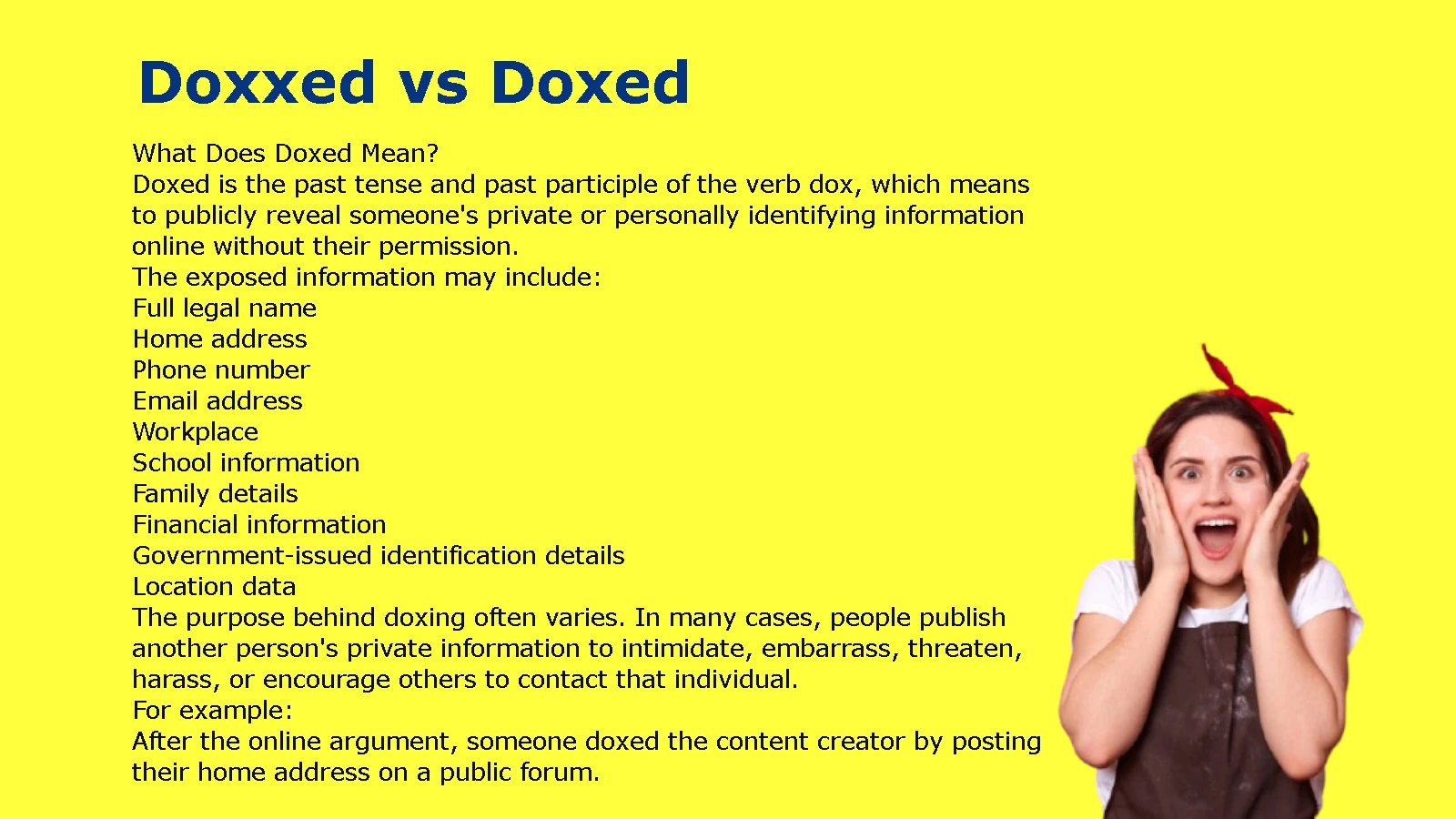
Doxed is the past tense and past participle of the verb dox, which means to publicly reveal someone’s private or personally identifying information online without their permission.
The exposed information may include:
- Full legal name
- Home address
- Phone number
- Email address
- Workplace
- School information
- Family details
- Financial information
- Government-issued identification details
- Location data
The purpose behind doxing often varies. In many cases, people publish another person’s private information to intimidate, embarrass, threaten, harass, or encourage others to contact that individual.
For example:
After the online argument, someone doxed the content creator by posting their home address on a public forum.
The word itself does not automatically imply hacking. Information used in a doxing incident may come from:
- Public records
- Social media profiles
- Old forum posts
- Data breaches
- Search engines
- Public databases
- Previously leaked information
Someone can be doxed even when every piece of information was technically public. The harm usually comes from collecting scattered details and publishing them together to identify or target a specific person.
Examples of “Doxed” in Sentences
Here are several examples showing natural usage.
- The journalist was doxed after publishing the investigation.
- Several users reported being doxed during the online dispute.
- She immediately contacted the platform after being doxed.
- The streamer feared being doxed during the live broadcast.
- Nobody deserves to be doxed for expressing an opinion.
Notice that every example uses doxed as the past tense of the verb dox.
What Counts as Doxing?
Not every disclosure of information qualifies as doxing. Context matters.
The following actions commonly fall under doxing:
| Situation | Usually Considered Doxing? |
| Publishing someone’s home address to encourage harassment | Yes |
| Posting a private phone number without permission | Yes |
| Revealing an anonymous user’s real identity | Usually |
| Sharing leaked personal emails | Yes |
| Publishing someone’s workplace to encourage complaints | Often |
| Linking together scattered public information to identify someone | Often |
| Quoting information someone voluntarily shared publicly | Usually No |
The key issue is intent and privacy, not simply whether the information exists somewhere online.
What Does Doxxed Mean?
Doxxed has exactly the same meaning as doxed.
It also serves as the:
- Past tense
- Past participle
of the verb dox.
For example:
The gamer was doxxed after winning a controversial tournament.
The double x doesn’t change pronunciation or meaning. It represents an alternative spelling that became popular within internet communities before dictionaries standardized the term.
Many people naturally assumed the verb should follow spelling patterns like:
- box → boxed
- fax → faxed
Others preferred doubling the consonant because the shortened base word looked unusual.
As a result, doxxed became widespread across:
- Gaming forums
- Hacker communities
- Reddit discussions
- Social media
- Online message boards
- Internet culture
Today, both spellings continue to appear in everyday writing.
Examples of “Doxxed” in Sentences
- The moderator was doxxed after banning several users.
- Several activists claimed they had been doxxed online.
- He worried that his family might be doxxed.
- The company condemned users who doxxed its employees.
- Nobody should be doxxed because of a disagreement.
Each sentence would mean exactly the same if doxxed were replaced with doxed.
Doxxed vs. Doxed: The Key Difference
The biggest surprise is that there isn’t a difference in meaning at all.
Both spellings:
- Mean the same thing.
- Sound identical.
- Function the same grammatically.
- Refer to exposing someone’s personal information without consent.
The only distinction is spelling preference.
| Feature | Doxed | Doxxed |
| Meaning | Same | Same |
| Pronunciation | Same | Same |
| Part of speech | Past tense / past participle | Past tense / past participle |
| Dictionary acceptance | Yes | Yes |
| Common in journalism | Very common | Common |
| Common in internet culture | Common | Very common |
| Preferred by many style guides | Often | Sometimes |
| Difference in meaning | None | None |
Quick Comparison
| Question | Answer |
| Different meaning? | No |
| Different pronunciation? | No |
| Different grammar? | No |
| Different spelling? | Yes |
| Can both be correct? | Yes |
Which Spelling Is Correct?
The answer depends on editorial preference, not grammar.
Modern English accepts both doxed and doxxed.
However, you’ll notice subtle differences depending on where you read.
Doxed often appears in:
- Newspapers
- Technology publications
- Cybersecurity reports
- Academic writing
- Professional blogs
- News websites
Doxxed often appears in:
- Reddit discussions
- Gaming communities
- Discord servers
- Internet forums
- Social media conversations
- Online communities
Neither spelling is incorrect.
The most important rule is consistency.
If you begin an article using doxed, continue using doxed throughout the entire piece.
If you choose doxxed, stick with that spelling instead of switching back and forth.
Editorial Preference Matters More Than Grammar
Professional editors generally care less about which spelling you choose and more about whether you remain consistent.
Imagine reading this paragraph:
The creator was doxed yesterday. Several viewers later claimed he had been doxxed before.
Although technically correct, the mixed spellings distract readers.
Instead, write:
The creator was doxed yesterday. Several viewers later claimed he had been doxed before.
Or:
The creator was doxxed yesterday. Several viewers later claimed he had been doxxed before.
Consistency improves readability.
Why Are There Two Spellings?
The existence of doxed and doxxed reflects how internet language develops.
Unlike centuries-old English verbs, dox originated in online communities during the digital age. Because no formal spelling rules existed at first, users naturally created different versions.
Several factors influenced the competing spellings.
The Word Is a Shortened Form
The verb comes from docs, itself a shortened version of documents.
As internet users turned the noun into a verb, writers experimented with different past-tense endings.
English Doesn’t Always Follow One Pattern
English contains many irregular spelling habits.
Consider these examples:
| Base Verb | Past Tense |
| text | texted |
| emailed | |
| bookmark | bookmarked |
| googled | |
| dox | doxed / doxxed |
New technology words often evolve before dictionaries establish a preferred style.
Internet Communities Spread Alternative Spellings
Online forums don’t follow formal editorial rules.
One community might favor doxxed, while another consistently writes doxed.
Over time, both spellings became widely recognized.
The Origin of the Word “Dox”
Understanding the word’s history explains why spelling variation exists.
The term traces back to early internet culture during the 1990s.
Hackers and online users referred to collections of personal information as docs, short for documents.
Someone who revealed another person’s documents was said to drop docs.
Eventually, the phrase became shorter.
Drop docs evolved into:
dox
As online communities grew, the verb expanded beyond hacker circles.
Today, dox refers broadly to exposing someone’s personal information online, regardless of whether the information came from hacking, public records, or social media.
How the Meaning Expanded
Originally, the term mostly described exposing rival hackers.
Today, the word applies to many situations involving:
- Political disputes
- Online harassment
- Social media conflicts
- Gaming communities
- Journalism
- Content creators
- Activists
- Businesses
- Private individuals
The broader meaning reflects how internet communication has changed over the past two decades.
Is “Dox” or “Doxx” the Base Verb?
This question causes much of the confusion.
The standard base verb is:
dox
Not:
doxx
That’s why you’ll typically see these forms:
| Verb Form | Preferred Form |
| Base verb | dox |
| Present tense | doxes |
| Present participle | doxing |
| Past tense | doxed / doxxed |
| Past participle | doxed / doxxed |
The base form almost never appears as doxx in modern dictionaries or professional writing.
Instead, doxxed survives mainly as an alternative spelling of the past tense.
Grammar: How to Use “Dox” Correctly
Using the verb correctly is straightforward once you know its forms.
Base Form
dox
Examples:
- Never dox someone during an argument.
- People should not dox others online.
Third-Person Singular
doxes
Examples:
- He doxes people who criticize him.
- Anyone who doxes others may face platform penalties.
Present Participle
doxing
Examples:
- Doxing has become a growing concern across social media platforms.
- Many communities prohibit doxing in their rules.
Past Tense
Both forms are accepted:
- doxed
- doxxed
Examples:
- Someone doxed the developer yesterday.
- Someone doxxed the developer yesterday.
Past Participle
Again, both spellings are correct.
Examples:
- The journalist has been doxed.
- The journalist has been doxxed.
Both sentences communicate exactly the same idea and follow standard English grammar.
Pronunciation of Doxed and Doxxed
One reason the doxxed vs. doxed debate continues is that you can’t hear the spelling difference. Both words are pronounced exactly the same.
IPA pronunciation:
/dɒkst/ (British English)
/dɑkst/ (American English)
The pronunciation breaks down like this:
| Part | Sound |
| dox | rhymes with “box” |
| -ed | pronounced as a t sound |
So, doxed sounds like “dokst.” The same applies to doxxed.
Why Doesn’t the Double “X” Change the Pronunciation?
English spelling doesn’t always match pronunciation perfectly. A double consonant often affects spelling rules rather than how a word sounds.
Consider these examples:
| Word | Pronunciation Changes? |
| traveled / travelled | No |
| canceled / cancelled | No |
| modeled / modelled | No |
| doxed / doxxed | No |
Whether you choose one x or two, readers will pronounce the word the same way.
Doxed vs. Doxxed in American and British English
Unlike many spelling differences between American and British English, there isn’t a strict regional rule for doxed and doxxed.
For example:
| American English | British English |
| color | colour |
| traveled | travelled |
| center | centre |
Those differences follow established spelling conventions. However, doxed and doxxed developed online rather than through traditional publishing, so usage depends more on editorial preference than geography.
American English
Many U.S. newspapers, cybersecurity firms, and technology websites favor doxed because it aligns with the base verb dox.
Examples include:
- Technology blogs
- Cybersecurity companies
- Digital news outlets
- Educational websites
British English
British publications also use doxed frequently, although doxxed appears in online communities and gaming spaces.
The important takeaway is simple:
Neither spelling belongs exclusively to American or British English.
Real Examples of Doxed and Doxxed in Sentences
Looking at real-world examples makes the distinction easier to understand.
Examples Using “Doxed”
These examples reflect common usage in professional writing.
- The researcher was doxed after publishing controversial findings.
- Several volunteers reported being doxed on social media.
- The platform removed posts that doxed private citizens.
- She feared someone had doxed her personal address.
- The company condemned users who doxed its employees.
Notice how the tone suits news articles and formal writing.
Examples Using “Doxxed”
These examples resemble language commonly found in gaming communities and online forums.
- The streamer got doxxed during a live broadcast.
- Nobody deserves to get doxxed over a video game.
- Users warned newcomers about being doxxed online.
- Several moderators were reportedly doxxed after enforcing the rules.
- Creators often worry about being doxxed as their audiences grow.
Again, the meaning never changes.
Examples in Different Contexts
| Context | Example |
| News | The witness was doxed shortly after the trial concluded. |
| Gaming | The player claimed someone doxxed him after the tournament. |
| Workplace | An employee was doxed following an online disagreement. |
| Politics | Several campaign volunteers reported being doxed. |
| Education | The university investigated reports that students had been doxed. |
Common Mistakes to Avoid
Although the spelling itself is flexible, writers still make several common mistakes.
Assuming One Spelling Is Wrong
The biggest misconception is believing only one version is correct.
In reality:
- doxed ✔
- doxxed ✔
Both appear in respected publications.
Switching Spellings Mid-Article
Choose one spelling and stick with it.
Instead of writing:
He was doxed yesterday. Others were doxxed earlier.
Write:
He was doxed yesterday. Others were doxed earlier.
Consistency always looks more professional.
Confusing Doxing with Hacking
Many people assume doxing requires hacking.
It doesn’t.
Someone may gather publicly available information from:
- Social media
- Public records
- Old forum posts
- Search engines
- Archived websites
No unauthorized access is necessary.
Thinking Every Privacy Violation Is Doxing
Doxing specifically involves exposing identifying information.
Other online misconduct includes:
- Identity theft
- Account hacking
- Data breaches
- Cyberstalking
- Online impersonation
These activities may overlap, but they aren’t identical.
Using the Term Too Broadly
Calling every disagreement “doxing” weakens the meaning.
For example:
Someone criticized my post.
That’s criticism.
Compare it with:
Someone published my home address to encourage harassment.
That is much closer to the accepted definition of doxing.
Doxing vs. Related Terms
Many internet safety terms sound similar, yet each describes a different behavior.
| Term | Meaning | How It Differs from Doxing |
| Doxing | Publishing someone’s identifying information without permission | Primary term |
| Cyberstalking | Repeated online harassment or monitoring | Broader pattern of behavior |
| Swatting | Making a false emergency report to trigger an armed police response | Criminal act that may follow doxing |
| Identity Theft | Using another person’s identity for fraud | Financial crime |
| Online Harassment | Abusive online behavior | Umbrella category |
| Privacy Violation | Unauthorized disclosure of private information | Broader legal and ethical concept |
| Data Breach | Exposure of stored data through security failures or unauthorized access | Usually targets organizations or systems |
Understanding these differences helps you use each term accurately.
Is Doxing Illegal?
Many people ask whether doxing automatically breaks the law.
The answer is more nuanced than a simple yes or no.
Doxing isn’t universally illegal as a standalone offense in every jurisdiction. Instead, its legality depends on several factors, including local laws, how the information was obtained, what information was shared, and whether additional crimes occurred.
For example, a person who posts another individual’s home address alongside threats may face legal consequences under laws related to harassment, intimidation, stalking, or incitement. If someone acquires personal information through unauthorized access to computer systems, data theft, or fraud, those actions may violate separate criminal laws regardless of whether the information is later published.
Civil liability may also arise. Victims sometimes pursue legal claims involving invasion of privacy, intentional infliction of emotional distress, defamation, or misuse of personal data, depending on the facts and the applicable legal framework.
Because laws differ from one country or state to another, there is no single legal rule that applies everywhere.
Platform Rules Often Go Further Than the Law
Even when a particular act of doxing doesn’t violate a specific statute, many online platforms prohibit it under their community guidelines.
Common consequences include:
- Content removal
- Temporary account suspension
- Permanent account bans
- Restrictions on posting or messaging
- Removal from online communities
Private platforms can enforce their own policies independently of government laws.
Case Study: How Doxing Can Escalate
Scenario
A software developer uses a pseudonym on a coding forum. After a heated disagreement, another user pieces together information from old blog posts, public domain registration records, and social media accounts. They publish the developer’s full name, employer, email address, and home city in a public thread.
Within hours:
- The developer receives hundreds of abusive messages.
- Strangers contact the employer.
- Family members receive unwanted calls.
- Personal social media accounts become targets of harassment.
Although none of the individual facts were necessarily secret, combining and distributing them for harassment significantly increased the risk to the individual’s privacy and safety.
Key lesson: Doxing often causes harm through the aggregation and exposure of personal information rather than through the creation of new information.
How to Protect Yourself from Doxing
Completely eliminating your digital footprint is nearly impossible, but you can reduce your exposure with thoughtful privacy habits.
Review Your Social Media Profiles
Many people unknowingly share more personal information than they realize.
Consider limiting access to:
- Birthdays
- Home locations
- Family relationships
- Phone numbers
- Workplace details
- Travel plans
The less unnecessary personal information you publish, the smaller your public footprint becomes.
Use Strong Account Security
Protect every important account with:
- Unique passwords
- Long passphrases
- Multi-factor authentication (MFA)
- Password managers
- Updated recovery information
Strong account security reduces the likelihood that someone can gain access to private data.
Think Before Posting Personal Information
Ask yourself:
- Would I share this information with a stranger?
- Could someone combine this detail with other public information?
- Does this reveal my daily routine or location?
Small details often become valuable when combined.
Search for Yourself Periodically
Occasionally search your own name, usernames, and public profiles to understand what information is easily available online.
You may discover:
- Old accounts
- Public photos
- Cached pages
- Forum posts
- Contact information
- Outdated profiles
Cleaning up unused accounts helps reduce your digital footprint over time.
Adjust Privacy Settings Regularly
Social media platforms frequently update their privacy controls.
Review settings for:
- Friend visibility
- Profile indexing
- Search engine visibility
- Tagged photos
- Contact permissions
- Public profile information
Regular reviews help ensure your settings still match your preferences.
Be Careful with Third-Party Apps
Many apps request access to:
- Contacts
- Photos
- Email addresses
- Location history
- Social media accounts
Only grant permissions that the app genuinely needs, and periodically remove access for apps you no longer use.
Know How to Respond if You’re Doxed
If your personal information is exposed without your consent:
- Document the content by saving screenshots and relevant links.
- Report the material to the platform where it appears.
- Notify affected organizations if workplace, school, or financial information is involved.
- Strengthen your account security, including changing passwords and enabling multi-factor authentication if you haven’t already.
- Monitor important accounts for suspicious activity.
- Seek legal guidance if the situation involves threats, stalking, extortion, or other potentially unlawful conduct under your local laws.
Taking prompt, organized action can help reduce further harm while preserving evidence if additional steps become necessary.
Frequently Asked Questions About Doxxed vs. Doxed
Is “doxed” or “doxxed” more common?
Both spellings appear frequently online, but doxed has become the more common choice in professional writing. You’ll often see it in:
- News articles
- Cybersecurity blogs
- Technology publications
- Academic resources
- Editorial content
Meanwhile, doxxed remains especially popular in internet communities, including gaming forums, social media, and discussion boards.
If you’re writing for a broad audience, doxed is usually the safer choice because it aligns with the base verb dox and appears in many modern dictionaries and style guides.
Are both spellings correct?
Yes.
Both doxed and doxxed are accepted spellings of the past tense and past participle of dox. Neither changes the meaning of the word.
The important thing is to stay consistent throughout your writing. Switching between spellings in the same article can distract readers and make the content look less polished.
Which spelling do dictionaries prefer?
Many dictionaries list dox as the base verb and recognize doxed as the standard past tense. Some also acknowledge doxxed as an accepted variant because of its widespread use online.
Language evolves constantly, especially when new words emerge from technology and internet culture. As usage becomes more standardized, dictionaries update their entries to reflect how people actually write and speak.
Is “doxing” spelled with one “x” or two?
The accepted present participle is:
doxing
Not:
- doxxing (less common alternative)
- doxxing (used informally by some online communities)
Most professional publications prefer doxing, which follows naturally from the base verb dox.
Can I use both spellings in the same article?
Technically, yes.
Practically, you shouldn’t.
Readers expect consistency. Choosing one spelling and using it throughout the article creates a smoother reading experience and reflects careful editing.
For example:
✔ Consistent
The creator was doxed after the interview. Others who had been doxed shared similar experiences.
✘ Inconsistent
The creator was doxed after the interview. Others had been doxxed previously.
Both sentences are grammatically correct, but the first reads more naturally.
Is doxing the same as hacking?
No.
This is one of the most common misunderstandings.
Hacking involves gaining unauthorized access to systems, accounts, or data.
Doxing involves revealing someone’s personal information without permission.
Sometimes hacking leads to doxing, but not always.
For example:
| Situation | Hacking? | Doxing? |
| Someone guesses your password and publishes your private files | ✔ | ✔ |
| Someone collects public information and posts your address online | ✘ | ✔ |
| Someone steals financial records but never publishes them | ✔ | ✘ |
| Someone copies your public profile information without revealing new personal details | ✘ | Usually ✘ |
The two behaviors can overlap, yet they describe different actions.
Is doxing always illegal?
Not necessarily.
Whether doxing violates the law depends on factors such as:
- Local legislation
- How the information was obtained
- The intent behind publishing it
- Whether threats or harassment accompanied the disclosure
- Whether other offenses occurred alongside the disclosure
Even when a specific act of doxing isn’t prohibited by law, it may still violate a platform’s rules or expose the person responsible to civil liability.
What Should You Do if You’ve Been Doxed?
If someone exposes your personal information online without your consent, acting quickly can help limit the impact.
A practical response includes:
- Document everything by saving screenshots and URLs before content changes or disappears.
- Report the posts to the website, forum, or platform where they appear.
- Strengthen your account security by changing passwords and enabling multi-factor authentication.
- Notify relevant organizations if your employer, school, or financial accounts could be affected.
- Monitor your accounts for unusual activity or unauthorized access.
- Consider legal advice if the incident involves threats, stalking, extortion, or other unlawful conduct under your local laws.
Responding promptly can reduce further exposure and preserve important evidence.
Common Myths About Doxing
Because the term has become part of everyday internet vocabulary, several myths continue to circulate.
| Myth | Reality |
| Only celebrities get doxed. | Anyone can become a target. |
| Doxing always involves hacking. | Publicly available information can also be used. |
| Only home addresses count as doxing. | Many types of identifying information may be involved. |
| Using a fake username guarantees privacy. | Public clues can sometimes reveal real identities. |
| Only one spelling is correct. | Both doxed and doxxed are accepted. |
Understanding these misconceptions helps people discuss online privacy more accurately.
Quick Reference: Doxxed vs. Doxed
If you only remember one section from this guide, make it this one.
| Question | Answer |
| Do doxed and doxxed mean different things? | No |
| Are both spellings correct? | Yes |
| Which spelling is more common in professional writing? | Doxed |
| Which spelling appears more often in internet communities? | Doxxed |
| Do they sound different? | No |
| Is one American and the other British? | No |
| Should you mix both spellings? | No |
Best Practices for Writers
Whether you’re writing a blog post, news article, cybersecurity guide, or academic paper, following a few simple practices will improve clarity.
Choose One Spelling
Decide whether you’ll use doxed or doxxed before you start writing.
Consistency strengthens credibility.
Know Your Audience
Different audiences often expect different styles.
| Audience | Recommended Choice |
| News readers | Doxed |
| Academic writing | Doxed |
| Business communication | Doxed |
| Cybersecurity articles | Doxed |
| Gaming communities | Either |
| Online forums | Either |
Professional publications generally lean toward doxed, while informal online communities accept both forms without concern.
Use the Term Accurately
Avoid calling every online disagreement “doxing.”
The word has a specific meaning related to exposing identifying personal information. Using it precisely helps maintain clear communication and prevents unnecessary confusion.
Quote to Remember
“The difference between ‘doxed’ and ‘doxxed’ is one of spelling, not meaning. Choose one, stay consistent, and focus on using the term accurately.”
Final Verdict: Doxxed vs. Doxed
When comparing doxxed vs. doxed, the conclusion is straightforward: both spellings are correct, both mean the same thing, and both are widely understood. The difference lies in usage preferences rather than grammar or definition.
If you’re writing for a professional audience, doxed is generally the better choice. It aligns with the base verb dox, appears frequently in dictionaries, and is commonly used by journalists, technology writers, cybersecurity experts, and editors. It also creates a cleaner, more standardized appearance in formal writing.
On the other hand, doxxed remains a valid alternative. You’ll encounter it regularly in gaming communities, social media discussions, online forums, and other spaces where internet slang continues to shape everyday language. Readers in those communities recognize the spelling immediately, and it carries the same meaning as doxed.
Ultimately, the most important rule isn’t choosing one spelling over the other. It’s using the term accurately and consistently. Once you decide which version fits your audience and editorial style, keep that spelling throughout your article. Doing so improves readability, strengthens credibility, and prevents unnecessary distractions.
As internet language continues to evolve, both doxed and doxxed are likely to remain part of modern English. Understanding their shared meaning, historical background, grammatical forms, and common usage ensures you can write about online privacy, cybersecurity, and digital culture with confidence and precision.