Siring meaning: Siring is the present participle of sire and means fathering or producing offspring, especially in animals such as horses, dogs, and livestock. It can also be used figuratively to describe creating or giving rise to something.
The confusion often comes from the fact that siring has different uses depending on the context. People commonly search for what does siring mean, siring definition, siring pronunciation, siring examples, and how to use siring in a sentence to make sure they understand the word correctly. But here’s the kicker: using the wrong interpretation can completely change the meaning of a sentence.
In this guide, you’ll discover the complete Siring Meaning, learn the definition of siring, explore its origin, pronunciation, and real-life examples, and understand when the word is appropriate in both formal and everyday English. You’ll also find common contexts where siring is used and related terms that help you grasp its meaning with confidence.
By the end, you’ll know exactly what siring means, how to use it correctly, and why understanding this word can improve your English vocabulary and comprehension.
What Does Siring Mean?
The siring meaning is straightforward:
Siring is the present participle of the verb sire, which means to father or produce offspring through biological reproduction.
The word describes the act of becoming the biological father of a child or an animal’s offspring. Unlike many everyday terms, siring focuses specifically on biological parenthood rather than raising or caring for a child.
For example:
- A champion stallion is siring award-winning racehorses.
- Historical records mention a king siring many heirs.
- Scientists studied a wolf siring multiple litters over several breeding seasons.
Each sentence emphasizes biological reproduction rather than parenting responsibilities.
Simple Definition of Siring
| Term | Meaning |
| Sire | A male parent, especially of an animal |
| Siring | Fathering or producing offspring |
| Sired | Fathered or produced offspring |
| Sires | Fathers or produces offspring |
The word appears most often in:
- Animal breeding
- Biology
- Genetics
- Family history
- Historical writing
- Legal documents involving paternity
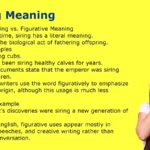
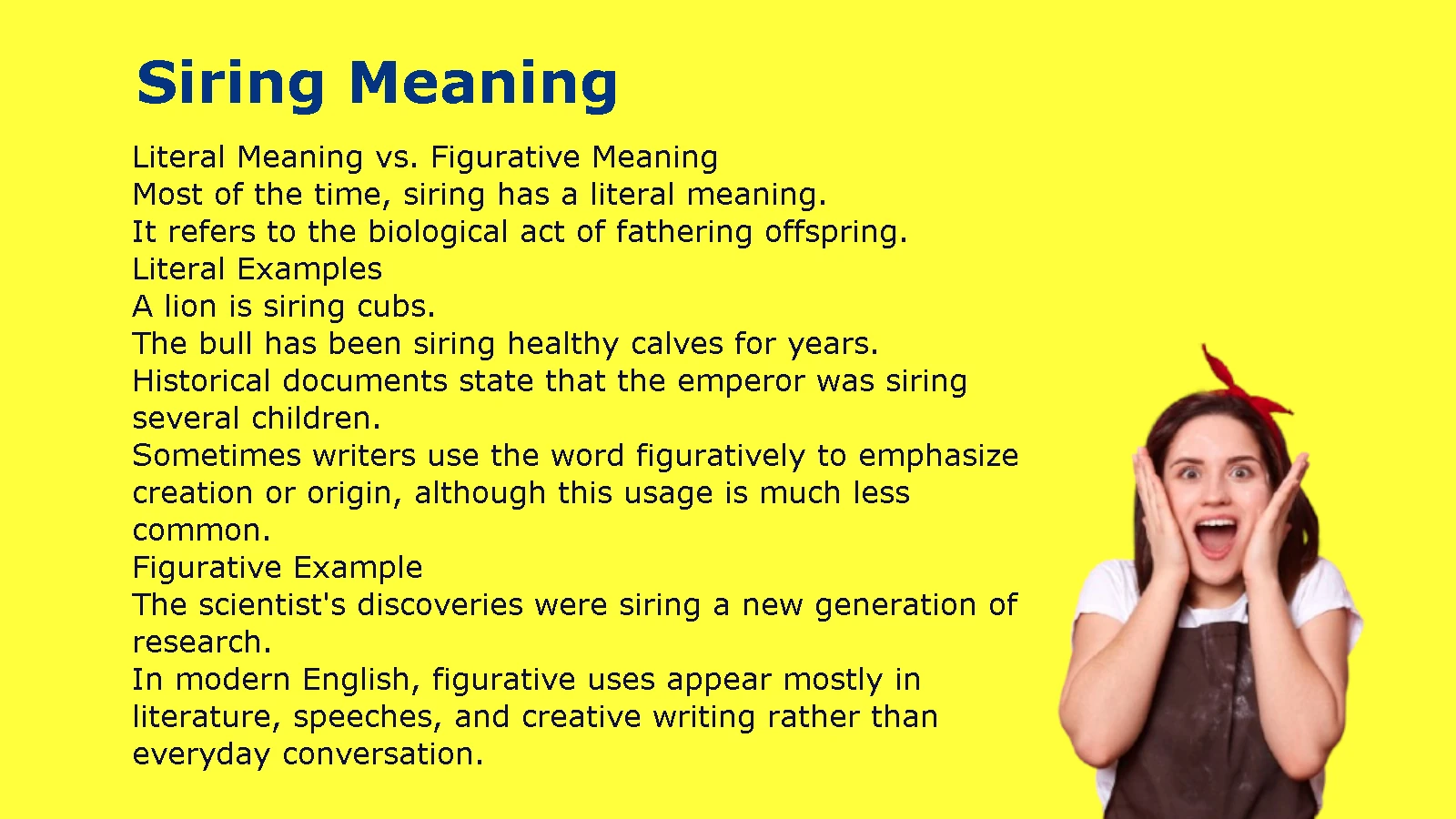
Literal Meaning vs. Figurative Meaning
Most of the time, siring has a literal meaning.
It refers to the biological act of fathering offspring.
Literal Examples
- A lion is siring cubs.
- The bull has been siring healthy calves for years.
- Historical documents state that the emperor was siring several children.
Sometimes writers use the word figuratively to emphasize creation or origin, although this usage is much less common.
Figurative Example
- The scientist’s discoveries were siring a new generation of research.
In modern English, figurative uses appear mostly in literature, speeches, and creative writing rather than everyday conversation.
How to Pronounce Siring
The word is pronounced:
SYE-ring
Phonetic spelling: /ˈsaɪərɪŋ/
It rhymes with words like:
- Hiring
- Firing
- Wiring (depending on accent)
What Does Siring Mean in Biology and Animal Breeding?
The word siring is especially important in biology because it identifies the male parent responsible for producing offspring.
Scientists, veterinarians, and breeders use the word to describe biological reproduction while keeping records of inherited traits, bloodlines, and genetics.
For example, instead of saying:
“The stallion became the father of twelve foals.”
Professional breeding records usually state:
“The stallion sired twelve foals.”
This wording is shorter, more precise, and widely accepted within breeding industries.
Why Animal Breeding Uses the Word Siring
Selective breeding depends on identifying which male produced specific offspring.
Knowing the sire helps breeders:
- Predict inherited traits
- Improve bloodlines
- Reduce genetic disorders
- Preserve desirable characteristics
- Track pedigrees
- Increase breeding value
Without accurate records of siring, maintaining healthy breeding programs would become much more difficult.
Examples Across Different Animals
| Animal | Example of Siring |
| Horse | A stallion siring champion racehorses |
| Dog | A male dog siring several litters |
| Cow | A bull siring healthy calves |
| Sheep | A ram siring lambs |
| Goat | A buck siring kids |
| Lion | A dominant male lion siring cubs |
| Wolf | An alpha male siring pups |
| Deer | A stag siring fawns |
Each example highlights biological fatherhood rather than parental care.
The Role of Genetics
Every offspring inherits DNA from two biological parents.
Generally speaking:
- Approximately 50% of genetic material comes from the sire.
- The remaining 50% comes from the dam (the female parent).
Because of this genetic contribution, breeders carefully evaluate sires for characteristics such as:
- Strength
- Health
- Fertility
- Disease resistance
- Athletic ability
- Temperament
- Longevity
- Physical appearance
One exceptional sire can influence hundreds—or even thousands—of descendants over time through natural breeding or modern reproductive technologies.
Case Study: Why Champion Stallions Matter
In the horse racing industry, a successful stallion often becomes one of the most valuable breeding animals in the world after retiring from competition.
A stallion that consistently sires fast, healthy foals gains a reputation for passing along desirable traits. As demand grows, breeders may pay significant breeding fees to include that stallion in their bloodlines. Over time, a single sire can shape entire generations of racehorses and influence the future of the sport.
This example shows why the word siring appears so often in breeding records. It identifies more than biological fatherhood. It also documents the genetic legacy that affects future generations.
What Does Siring Mean for Humans?
Although many people associate siring with animals, the word can also refer to humans.
In human contexts, siring means fathering biological children.
However, it is much more formal than simply saying having children or becoming a father.
For instance:
- The king was said to be siring numerous heirs.
- Historical accounts describe wealthy nobles siring children with multiple wives.
- Genealogists traced one ancestor siring descendants across several generations.
Notice that each example emphasizes biological lineage rather than emotional relationships.
Why Native Speakers Rarely Say “Siring”
While the word is correct, it sounds formal and somewhat old-fashioned in everyday speech.
Most English speakers naturally choose expressions like:
- Becoming a father
- Having children
- Fathering children
- Starting a family
Instead of saying:
“He’s siring children.”
Most people would simply say:
“He’s having children.”
The meaning stays the same, but the second version sounds much more natural in casual conversation.
Historical Context
History books frequently use the word siring because royal families depended on producing heirs.
For centuries, kings, emperors, and noblemen measured political success partly by the number of legitimate heirs they produced.
Historical examples often describe rulers as:
- Siring princes
- Siring royal heirs
- Siring successors
- Siring descendants who established new dynasties
In these cases, siring highlights biological succession rather than parenting style.
Genealogy and Family History
Genealogists also rely on the word when documenting family trees.
Instead of writing:
John became the father of William.
Historical records may state:
John sired William.
This wording is concise and emphasizes direct biological ancestry.
Family historians often use sired by to identify paternal relationships within pedigrees and ancestral charts.
Legal Usage
The word occasionally appears in legal writing involving:
- Paternity disputes
- Estate claims
- Inheritance rights
- Family law
- Historical property records
For example:
DNA evidence confirmed that the defendant had sired the child.
Legal professionals choose precise wording because biological parentage can affect inheritance, custody, citizenship, and financial responsibilities.
Modern Usage Compared with Everyday English
The table below shows how different contexts influence word choice.
| Context | Preferred Expression |
| Daily conversation | Having children |
| Family discussion | Becoming a father |
| Medical writing | Fathering offspring |
| Biology | Siring offspring |
| Animal breeding | Siring |
| Historical writing | Siring heirs |
| Genealogy | Sired by |
| Legal documents | Sired |
The pattern is clear.
The more formal or technical the context becomes, the more likely you’ll encounter the word siring instead of everyday alternatives.
When Is It Appropriate to Use “Siring”?
Using siring makes sense when you want to emphasize:
- Biological fatherhood
- Genetic lineage
- Reproductive history
- Breeding records
- Historical ancestry
- Scientific precision
If you’re speaking casually with friends or family, simpler alternatives usually sound more natural. In academic, historical, legal, or biological writing, however, siring remains an accurate and respected term.
Siring vs. Fathering: What’s the Difference?
Many people assume that siring and fathering mean exactly the same thing. They certainly overlap, yet they aren’t interchangeable in every situation. The biggest difference lies in context and emphasis.
Siring focuses on biological reproduction. Fathering can describe both biological parenthood and the broader role of raising, guiding, and caring for a child.
For example:
- The stallion sired twelve foals.
- He fathered three children.
- He fathered a movement through his leadership. (Figurative use.)
Notice that fathered carries broader meanings while sired remains closely tied to biological lineage.
Siring vs. Fathering Comparison Table
| Feature | Siring | Fathering |
| Primary meaning | Producing biological offspring | Becoming or acting as a father |
| Common in animal breeding | Yes | Rarely |
| Common in everyday speech | No | Yes |
| Used in biology | Frequently | Sometimes |
| Used in genealogy | Frequently | Sometimes |
| Formal tone | Yes | Moderate |
| Focus on genetics | Strong | Moderate |
| Can describe parenting responsibilities | No | Yes |
When to Use Each Word
Choose siring when discussing:
- Animal breeding
- Genetics
- Biological ancestry
- Historical lineage
- Scientific research
- Pedigrees
Choose fathering when discussing:
- Parenting
- Family life
- Raising children
- Emotional responsibility
- Everyday conversations
Example Comparison
| Sentence | Natural? |
| The bull is siring healthy calves. | ✔ Yes |
| The father is siring his children every day. | ✘ No |
| He fathered four children. | ✔ Yes |
| The king sired several heirs. | ✔ Yes |
| He enjoys fathering his children. | ✔ Yes |
The comparison makes an important point. Siring describes the act of biological reproduction. It doesn’t describe the ongoing relationship between a parent and a child.
Sire vs. Sir vs. Father
These three words look similar, which explains why many learners confuse them. Their meanings, however, are completely different.
| Word | Meaning | Example |
| Sir | A respectful title for a man | Yes, sir. |
| Sire | A male parent, especially of an animal | The sire produced champion offspring. |
| Father | A male parent or caregiver | My father taught me to fish. |
Although sir and sire differ by only one letter, they developed different meanings over time.
What Is a Sire?
A sire is the biological male parent of an offspring.
The word commonly appears in:
- Horse pedigrees
- Dog registrations
- Livestock records
- Scientific publications
- Family history documents
Example:
The puppy’s sire won several national competitions.
What Does “Sir” Mean?
Sir is an honorific title.
People use it to:
- Address someone politely
- Refer to a knight
- Show professional respect
Example:
Excuse me, sir. You dropped your wallet.
Despite their similar spelling, sir has nothing to do with reproduction.
Parts of Speech and Grammar of Siring
Understanding grammar helps you recognize how siring functions in different sentences.
The base word is sire, which acts as both a noun and a verb.
As a Noun
Sire refers to the biological father.
Example:
The sire has an excellent genetic record.
As a Verb
The verb means to father or produce offspring.
Example:
The stallion sired dozens of foals.
Verb Forms
| Verb Form | Example |
| Base verb | sire |
| Third-person singular | sires |
| Past tense | sired |
| Past participle | sired |
| Present participle | siring |
Examples
- The stallion sires healthy foals every season.
- Last year he sired ten offspring.
- He has sired several champions.
- He is siring another generation of winners.
Sentence Patterns
Pattern One
Subject + sire + object
Example:
The bull sired several calves.
Pattern Two
Subject + is/was + siring + object
Example:
The stallion is siring high-quality offspring.
Pattern Three
Subject + has/had + sired + object
Example:
The wolf has sired multiple litters.
How to Use “Siring” in a Sentence
Learning from examples makes vocabulary easier to remember.
Animal Breeding Examples
- The champion stallion is siring elite racehorses.
- The prized bull has been siring healthy calves for years.
- The ram continues siring strong lambs each season.
- Wildlife researchers observed the dominant wolf siring several litters.
Human Examples
- Historical records describe the king siring numerous heirs.
- The nobleman spent decades siring children across several royal marriages.
- DNA testing confirmed the athlete had sired the child.
Scientific Examples
- Researchers studied males capable of siring larger numbers of offspring.
- Genetic diversity improved because multiple males were siring young within the population.
- The study examined environmental factors affecting reproductive success and siring rates.
Historical Examples
- Medieval chronicles mention rulers siring heirs to secure the throne.
- Ancient dynasties depended on monarchs siring legitimate successors.
- Royal genealogies carefully recorded each prince sired by the king.
Everyday Alternatives
Instead of saying:
He’s siring children.
Native speakers usually say:
- He’s becoming a father.
- He’s having children.
- He started a family.
- He’s the biological father.
These alternatives sound more natural in casual conversation.
Common Synonyms of Siring
No synonym matches siring perfectly in every context. Each word carries its own shade of meaning.
| Word | Best Context |
| Fathering | General use |
| Begetting | Formal or biblical writing |
| Procreating | Biological discussion |
| Reproducing | Scientific writing |
| Generating | Figurative creation |
| Producing offspring | Scientific description |
Fathering
This is the closest everyday synonym.
Example:
He fathered two daughters.
Begetting
Begetting sounds old-fashioned and often appears in religious or historical texts.
Example:
Abraham begat Isaac.
Modern English rarely uses this wording outside quotations or discussions of older texts.
Procreating
This word emphasizes reproduction rather than parenthood.
Example:
Animals instinctively procreate to continue the species.
Reproducing
Scientists frequently use reproducing when discussing populations instead of individual family relationships.
Example:
The birds reproduce during spring.
Words Related to Siring
Learning related vocabulary helps you understand breeding, genealogy, and genetics more easily.
| Word | Meaning |
| Sire | Male biological parent |
| Dam | Female biological parent |
| Offspring | Children or young |
| Progeny | Descendants or offspring |
| Descendant | Later family member |
| Ancestor | Earlier family member |
| Lineage | Family line |
| Pedigree | Recorded ancestry |
| Bloodline | Genetic family line |
| Genetics | Study of heredity |
| Inheritance | Passing traits to offspring |
| Reproduction | Producing offspring |
Understanding Lineage
Lineage describes direct family descent.
Example:
Historians traced the royal lineage back ten generations.
When discussing animals, lineage determines breeding quality and genetic diversity.
Understanding Pedigree
A pedigree records an individual’s ancestry.
Professional breeders rely on pedigrees to:
- Verify parentage
- Predict inherited traits
- Avoid inbreeding
- Improve breeding programs
- Maintain breed standards
Without pedigree records, evaluating long-term genetic quality becomes much more difficult.
Etymology and Word History of Siring
The history of siring stretches back hundreds of years.
The noun sire entered English through Old French, where sire served as a respectful title meaning lord or master. Its roots trace even further to the Latin word senior, meaning elder.
Over time, English speakers expanded the meaning. Because respected family leaders were often fathers or patriarchs, sire gradually developed a second definition that referred to a male parent.
As animal breeding became more organized, the term took on a specialized role. Breeders used sire to identify the male parent in pedigree records, a practice that continues today.
Eventually, the verb to sire emerged. From that verb came sired, sires, and siring, the forms still used in modern English.
Timeline of the Word
| Period | Development |
| Latin era | Senior meant elder or older person |
| Old French | Sire became a title of respect |
| Middle English | Sire referred to fathers and rulers |
| Early Modern English | Sire developed into a verb meaning to father offspring |
| Modern English | Siring became common in biology, breeding, genealogy, and formal writing |
How Usage Has Changed
Centuries ago, writers used sire more broadly when referring to kings, noblemen, and fathers.
Today, the word has become much more specialized. Most modern readers encounter it in:
- Veterinary medicine
- Agricultural publications
- Horse racing
- Dog breeding
- Wildlife biology
- Genetics
- Historical research
- Genealogical records
Common Mistakes When Using “Siring”
Even native English speakers occasionally misuse the word siring. Most mistakes happen because people confuse it with similar words or apply it in situations where a more natural expression would work better.
Understanding these common errors will help you use the word confidently and accurately.
Confusing “Sire” with “Sir”
This is one of the most frequent mistakes.
Although the words look similar, they have entirely different meanings.
| Word | Meaning | Example |
| Sir | A respectful title for a man | Thank you, sir. |
| Sire | A biological father, especially of an animal | The sire produced healthy offspring. |
Adding or removing the letter e completely changes the meaning.
Using “Siring” in Everyday Conversation
The word is correct, but it often sounds overly formal in casual speech.
For example:
❌ Less Natural
He’s siring another child.
✅ More Natural
He’s expecting another child.
or
He’s becoming a father again.
In scientific, historical, or legal contexts, however, siring remains perfectly appropriate.
Using “Siring” for Parenting
Another common misunderstanding is assuming that siring refers to raising children.
It doesn’t.
The word only describes biological fatherhood.
Consider the difference:
- A man may sire a child.
- A father raises, supports, guides, and cares for a child.
Those responsibilities go beyond the meaning of siring.
Using It for Female Parents
The verb sire refers specifically to the male biological parent.
The corresponding term for a female parent in animal breeding is dam.
Example:
- Sire: Male parent
- Dam: Female parent
Using siring for a mother would be grammatically incorrect.
Overusing the Word
Because siring is specialized vocabulary, repeating it too often can make your writing sound unnatural.
Instead, vary your wording where appropriate.
Examples include:
- Fathered
- Produced offspring
- Became the biological father
- Had children
- Passed on genetic traits
Good writing balances precision with readability.
Frequently Asked Questions About Siring Meaning
Is “Siring” a Real English Word?
Yes. Siring is a standard English word and the present participle of the verb sire.
It appears in major dictionaries and is widely used in:
- Biology
- Genetics
- Veterinary medicine
- Animal breeding
- Genealogy
- Historical writing
- Legal documents
Is “Siring” Used Only for Animals?
No.
Although it appears most often in discussions of animal breeding, siring can also describe humans when emphasizing biological fatherhood.
For example:
- A king siring heirs.
- A man siring biological children.
- Historical figures siring descendants.
Modern everyday English, however, usually prefers fathering or having children.
Can “Siring” Refer to Humans?
Yes.
The word is grammatically correct when referring to human fathers.
You’ll most often encounter it in:
- Historical biographies
- Family history records
- Academic writing
- Medical research
- Legal documents
It sounds formal, which is why casual conversations rarely use it.
What Is the Difference Between “Sire” and “Siring”?
The difference is grammatical.
| Word | Function |
| Sire | Base verb or noun |
| Siring | Present participle of the verb |
Examples:
- The stallion will sire many foals.
- The stallion is siring many foals.
Is “Siring” Formal or Informal?
It is generally considered formal.
Professionals commonly use it in technical writing, while everyday conversations favor simpler alternatives.
Formal Contexts
- Scientific papers
- Veterinary reports
- Historical books
- Legal records
- Genealogical documents
Informal Alternatives
- Becoming a father
- Having children
- Fathering children
What Is the Opposite of Siring?
There is no direct one-word opposite.
However, depending on the context, related opposites may include:
- Childless
- Infertile
- Sterile
- Not reproducing
- Without offspring
If discussing parentage, the opposite idea is simply not fathering biological children.
Can a Woman Be Described as “Siring” a Child?
No.
The verb sire refers exclusively to the male biological parent.
For females, English uses terms such as:
- Mother
- Bear
- Give birth
- Produce offspring
In animal breeding, the correct technical term is dam.
What Is the Noun Form of “Siring”?
The related noun is sire.
Examples:
- The sire won multiple breeding awards.
- Breeders carefully selected the sire.
Although siring can occasionally function as a gerund, sire remains the primary noun.
Case Study: Why the Word “Siring” Matters in Horse Breeding
Imagine two racehorses with nearly identical records.
One retires and becomes a breeding stallion.
Within a decade, that stallion has sired dozens of winners, many of which go on to earn championship titles. Breeders begin studying his pedigree because they want to understand which inherited traits contribute to consistent success.
His offspring demonstrate:
- Excellent speed
- Strong bone structure
- Competitive temperament
- High endurance
- Sound health
As a result, demand for breeding rights increases dramatically.
This scenario highlights why the word siring remains indispensable in professional breeding. It communicates biological parentage while connecting that parentage to measurable genetic outcomes.
Without accurate records showing which stallion sired which foal, breeders would struggle to improve bloodlines or preserve valuable traits over time.
Quick Reference Guide
Siring at a Glance
| Question | Answer |
| What does siring mean? | Fathering biological offspring |
| Is it a verb? | Yes |
| Can it refer to humans? | Yes |
| Is it common in conversation? | No |
| Is it common in biology? | Yes |
| Is it common in animal breeding? | Yes |
| Does it mean raising children? | No |
| Is it formal? | Yes |
Examples of “Siring” in Different Contexts
| Context | Example Sentence |
| Biology | Scientists observed the dominant male siring most offspring in the population. |
| Horse breeding | The stallion continues siring champion racehorses. |
| Dog breeding | The registered sire has been siring healthy litters for several years. |
| History | The monarch focused on siring legitimate heirs to secure the succession. |
| Genealogy | Family records identify the ancestor as siring several generations of descendants. |
| Law | DNA evidence confirmed that he had sired the child. |
Key Facts About the Word “Siring”
- Siring is the present participle of sire.
- It means to father biological offspring.
- The word is common in biology, genetics, genealogy, veterinary medicine, and animal breeding.
- It can describe both animals and humans, although it sounds more formal when referring to people.
- It emphasizes biological parentage, not parenting responsibilities.
- In breeding records, the sire is the male parent, while the dam is the female parent.
- Native English speakers usually choose fathering or having children in everyday conversation.
Siring Meaning: Key Takeaways
Understanding the siring meaning becomes much easier once you recognize the contexts in which the word naturally appears. At its core, siring simply means fathering biological offspring. Yet its usage carries a level of precision that makes it especially valuable in scientific research, animal breeding, genealogy, legal writing, and historical records.
Unlike everyday expressions such as having children or becoming a father, siring places the emphasis on biological lineage and genetic inheritance. That’s why breeders track sires in pedigrees, historians document rulers who sired heirs, and researchers use the term when discussing reproductive success.
For most casual conversations, simpler alternatives sound more natural. However, when accuracy matters—especially in technical or formal settings—siring remains the preferred term. Knowing the distinction between sire, siring, fathering, and parenting helps you choose the right word for the right situation and avoid common misunderstandings.
Whether you encounter the term in a pedigree chart, a scientific journal, a legal document, or a history book, you’ll now understand that siring is more than an old-fashioned synonym for fatherhood. It is a precise word that highlights the biological connection between a male parent and his offspring while reflecting centuries of use in English.