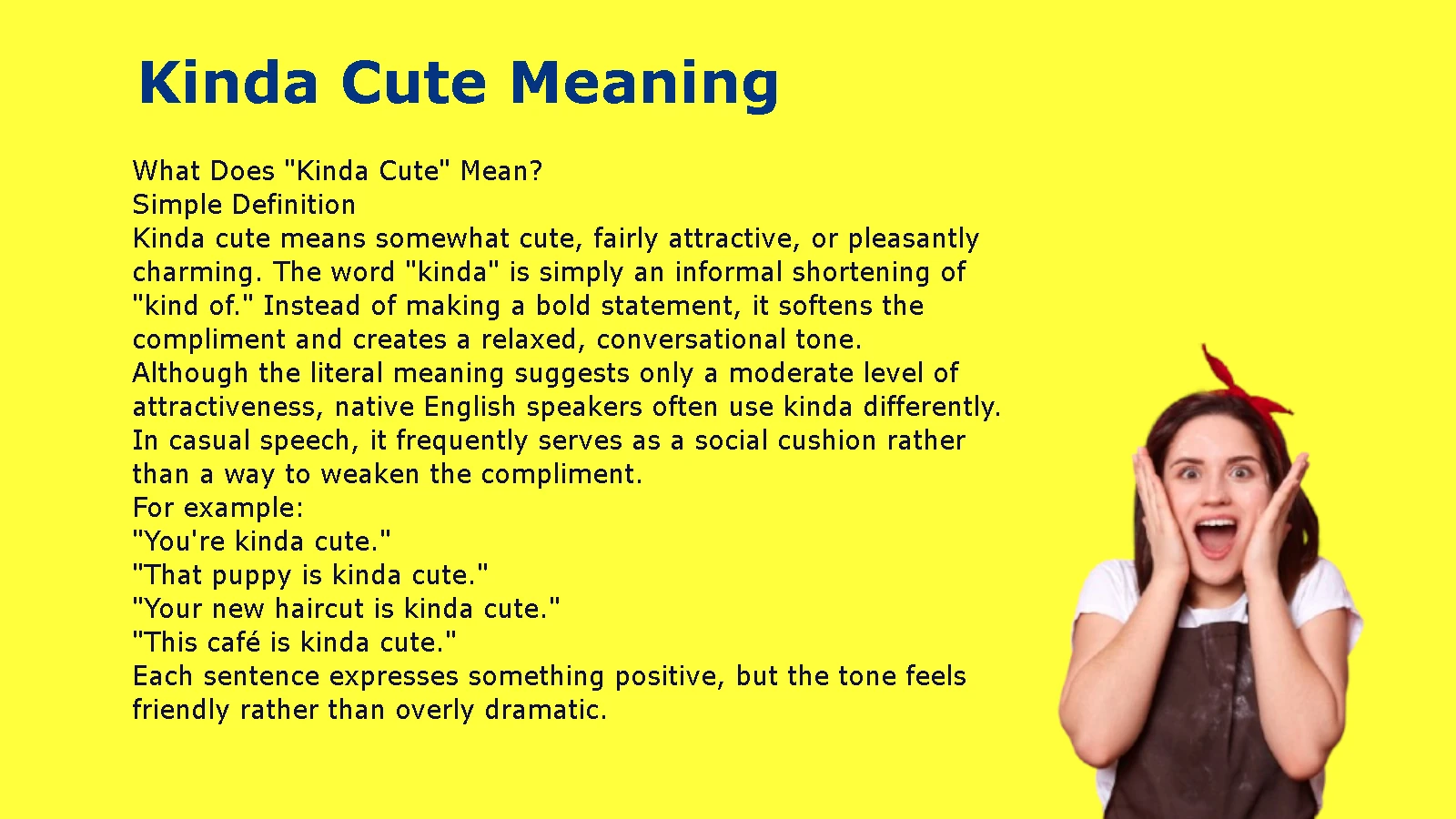
Kinda Cute Meaning: Kinda cute means somewhat attractive, fairly adorable, or mildly appealing. It is a casual expression commonly used in texting, social media, and everyday conversations to describe a person, pet, outfit, or object that is attractive without being overwhelmingly impressive. The tone can be sincere, playful, or slightly teasing, depending on the context.
Many people search for phrases like kinda cute meaning, what does kinda cute mean, is kinda cute a compliment, kinda cute vs cute, how to respond to kinda cute, and when someone calls you kinda cute because they want to understand the hidden meaning behind this popular expression. Learning how native speakers use this phrase can help improve your English vocabulary, communication skills, dating conversations, and overall understanding of everyday slang and informal English.
In this guide, you’ll learn the complete kinda cute meaning, where the phrase comes from, how to use it correctly, real-life examples, common misunderstandings, and simple tips to help you understand and use it naturally in everyday conversations.
What Does “Kinda Cute” Mean?
Simple Definition
Kinda cute means somewhat cute, fairly attractive, or pleasantly charming. The word “kinda” is simply an informal shortening of “kind of.” Instead of making a bold statement, it softens the compliment and creates a relaxed, conversational tone.
Although the literal meaning suggests only a moderate level of attractiveness, native English speakers often use kinda differently. In casual speech, it frequently serves as a social cushion rather than a way to weaken the compliment.
For example:
- “You’re kinda cute.”
- “That puppy is kinda cute.”
- “Your new haircut is kinda cute.”
- “This café is kinda cute.”
Each sentence expresses something positive, but the tone feels friendly rather than overly dramatic.
The Literal Meaning
Breaking the phrase into individual words makes it easier to understand.
| Word | Meaning | Example |
| Kinda | Informal form of kind of, meaning somewhat or to a certain degree | “I’m kinda tired.” |
| Cute | Attractive, charming, sweet, or appealing | “That’s a cute dog.” |
Together, the phrase literally means:
Somewhat cute or fairly attractive.
However, spoken English doesn’t always follow dictionary definitions perfectly.
Native speakers regularly soften statements using words like:
- Kind of
- Sort of
- Pretty
- Fairly
- A little
- Rather
These words don’t always reduce enthusiasm. Instead, they make conversations sound more natural.
Consider these examples:
- “That’s kinda amazing.”
- “She’s kinda brilliant.”
- “He’s kinda funny.”
No one assumes the speaker only thinks the person is slightly funny or slightly brilliant. The wording simply sounds relaxed.
“Sometimes people soften compliments not because they mean less but because they want the conversation to feel comfortable.”
That idea explains much of the kinda cute meaning in modern English.
What Does “Kinda Cute” Really Mean in Different Contexts?
One phrase can communicate several different ideas. Context changes everything.
The relationship between the speakers, their tone of voice, and the surrounding conversation all influence how the compliment should be understood.
As a Genuine Compliment
Most of the time, kinda cute is exactly what it sounds like—a sincere compliment.
The speaker notices something appealing about another person and decides to mention it without sounding overly intense.
They may be referring to:
- Appearance
- Smile
- Laugh
- Personality
- Style
- Voice
- Sense of humor
- Confidence
- Habits
Examples:
- “Your smile is kinda cute.”
- “You’re kinda cute when you laugh.”
- “That outfit is kinda cute.”
- “Your handwriting is kinda cute.”
Notice that these compliments often focus on charm rather than perfection.
People frequently describe attractive qualities as cute because the word feels warm, approachable, and genuine.
Common situations
- First dates
- Meeting someone new
- Friendly conversations
- Casual texting
- Complimenting someone’s personality
- Commenting on style or fashion
As a Casual Observation
Sometimes kinda cute has absolutely nothing to do with romance.
Instead, it’s simply a descriptive phrase.
People regularly use it when talking about:
- Coffee shops
- Restaurants
- Small houses
- Decorations
- Stationery
- Pets
- Plants
- Cars
- Artwork
- Children’s toys
Examples:
- “This bookstore is kinda cute.”
- “That little apartment is kinda cute.”
- “Your dog is kinda cute.”
In these situations, no hidden message exists.
The phrase simply expresses mild appreciation.
As Flirting
One of the biggest reasons people search for kinda cute meaning is because they receive the compliment from someone they like.
In dating, kinda cute often functions as subtle flirting.
Instead of saying:
“I think you’re really attractive.”
Someone says:
“You’re kinda cute.”
Why?
Because softer language feels safer.
Flirting usually begins with small signals rather than dramatic declarations.
Why people flirt this way
- They don’t want to appear too eager.
- They’re unsure whether the attraction is mutual.
- They fear rejection.
- They prefer playful conversations.
- They want to test your reaction first.
Imagine this conversation:
Emma: “I tripped walking into the coffee shop.”
Liam: “That’s actually kinda cute.”
Liam probably isn’t complimenting the fall itself.
He’s saying Emma’s awkwardness seems charming.
That subtle difference matters.
As Uncertainty
Occasionally, kinda reflects genuine uncertainty.
Perhaps the speaker hasn’t fully formed an opinion.
Examples include:
- “I think he’s kinda cute.”
- “She’s kinda interesting.”
- “That movie was kinda good.”
The speaker isn’t expressing strong enthusiasm.
Instead, they’re acknowledging a developing impression.
Human opinions often exist somewhere between certainty and doubt.
Language naturally reflects that middle ground.
As Polite Language
English speakers frequently soften opinions to sound more approachable.
Linguists call this practice hedging.
Instead of making absolute statements, speakers use modifiers that reduce social pressure.
Examples include:
- Kind of
- Sort of
- Pretty
- Fairly
- A little
- Rather
Compare these examples:
Direct
- “You’re beautiful.”
Softened
- “You’re kinda cute.”
Both comments are compliments.
The second simply feels more casual.
Common hedging expressions
| Expression | Example |
| Kind of | Kind of funny |
| Sort of | Sort of difficult |
| Pretty | Pretty smart |
| Fairly | Fairly interesting |
| Rather | Rather unusual |
| A little | A little expensive |
These expressions appear constantly in everyday American English.
Is “Kinda Cute” a Compliment?
In the overwhelming majority of situations, the answer is yes.
However, understanding how someone says it is just as important as understanding the words themselves.
When It Is
Several signs indicate that kinda cute is intended as a genuine compliment.
Common signs
- They smile while saying it.
- They continue the conversation afterward.
- They make additional compliments.
- They initiate conversations regularly.
- They seem relaxed around you.
- They maintain eye contact.
- They use positive emojis in text.
Example:
“You’re kinda cute when you’re excited.”
This compliments personality rather than appearance alone.
Another example:
“I like talking to you. You’re kinda cute.”
That message combines emotional interest with physical attraction.
Why people avoid stronger compliments
Not everyone enjoys using dramatic language.
Some people rarely say:
- Gorgeous
- Stunning
- Beautiful
- Handsome
Instead, their vocabulary naturally includes:
- Cute
- Pretty cute
- Kinda cute
- Really cute
Their communication style may simply be more understated.
When It Isn’t
Although uncommon, kinda cute isn’t always positive.
Tone can completely change the meaning.
Consider these examples.
“Well…you’re kinda cute.”
The hesitation weakens the compliment.
Or:
“That presentation was…kinda cute.”
Depending on delivery, this could sound dismissive or sarcastic.
Situations where it may not be positive
| Situation | Possible Meaning |
| Sarcasm | Mocking someone |
| Passive-aggressive remark | Downplaying effort |
| Friendly teasing | Lighthearted joke |
| Awkward conversation | Uncertain compliment |
Fortunately, these interpretations occur far less often than sincere compliments.
How Tone Changes the Meaning
Words tell only part of the story.
Tone often communicates the rest.
In face-to-face conversations
People naturally rely on:
- Facial expressions
- Eye contact
- Smiles
- Voice pitch
- Body language
- Timing
Imagine someone saying:
“You’re kinda cute.”
With a warm smile, the sentence feels affectionate.
With crossed arms and an eye roll, it feels sarcastic.
The words haven’t changed.
Only the delivery has.
In text messages
Text removes vocal cues.
Instead, people rely on punctuation and emojis.
Compare these examples.
You’re kinda cute 😊
Friendly compliment.
You’re kinda cute ❤️
Likely romantic interest.
You’re kinda cute 😉
Playful flirting.
You’re kinda cute 😂
Light teasing.
You’re kinda cute…
Possibly awkward or uncertain.
No emoji automatically determines meaning, but together with the conversation, these details provide valuable clues.
Quick Interpretation Guide
| Version | Most Likely Meaning |
| You’re kinda cute 😊 | Friendly compliment |
| You’re kinda cute ❤️ | Romantic attraction |
| You’re kinda cute 😉 | Flirting |
| You’re kinda cute 😂 | Playful teasing |
| You’re kinda cute… | Hesitation or uncertainty |
What Does “Kinda Cute” Mean in Text Messages?
Text messaging has changed the way people compliment one another. Because messages are short and informal, phrases like kinda cute fit naturally into digital conversations.
Most people use kinda cute in texts because it sounds relaxed. It communicates interest without creating pressure.
Someone might text:
“I didn’t notice before, but you’re kinda cute.”
That usually signals attraction.
Another example:
“You’re kinda cute when you talk about your hobbies.”
Here, the compliment focuses on personality instead of appearance.
Common texting meanings
- Light flirting
- Friendly admiration
- Romantic interest
- Playful teasing
- Testing someone’s reaction
- Starting a deeper conversation
Sample conversation
Chris: I spent four hours building that LEGO set.
Taylor: That’s honestly kinda cute.
Taylor isn’t mocking Chris.
Instead, they’re saying his enthusiasm is charming.
Small compliments like this often help relationships develop naturally because they feel authentic rather than exaggerated.
What Does “Kinda Cute” Mean on Social Media?
Social media has made casual compliments more common than ever. Whether someone comments on a selfie, reacts to a TikTok, or replies to an Instagram Story, kinda cute appears across nearly every platform.
Unlike formal conversations, social media encourages quick reactions. People rarely write long compliments. Instead, they use short phrases that sound genuine and conversational.
Instagram is one of the most common places to see the phrase kinda cute.
People comment on:
- Selfies
- Outfit posts
- Vacation photos
- Pets
- Home décor
- Food pictures
- Couple photos
Examples:
- “This outfit is kinda cute.”
- “Your smile is kinda cute.”
- “This whole vibe is kinda cute.”
The compliment often refers to the overall aesthetic rather than only physical appearance.
TikTok
TikTok trends have made understated compliments increasingly popular.
Common comments include:
- “This is actually kinda cute.”
- “Your laugh is kinda cute.”
- “This relationship is kinda cute.”
- “That ending was kinda cute.”
The phrase frequently describes wholesome moments rather than beauty alone.
Creators often appreciate these comments because they feel sincere instead of exaggerated.
Snapchat
Snapchat conversations usually happen between friends or people getting to know each other.
Messages often include:
- “You look kinda cute today.”
- “That filter is kinda cute.”
- “You’re kinda cute without trying.”
Because Snapchat is more personal, these compliments often carry greater emotional significance.
X (Formerly Twitter)
On X, users frequently react to memes, jokes, and photos.
Examples include:
- “This puppy is kinda cute.”
- “That comeback was kinda cute.”
- “You’re kinda cute for posting this.”
Depending on context, the tone may be sincere, humorous, or slightly sarcastic.
How Social Media Changes the Meaning
| Platform | Typical Meaning | Most Common Tone |
| Compliment | Friendly | |
| TikTok | Reaction | Playful |
| Snapchat | Personal compliment | Flirty |
| X | Casual reaction | Humorous or conversational |
What Does It Mean When a Girl Says “You’re Kinda Cute”?
Hearing a girl say “you’re kinda cute” can leave you wondering whether she’s flirting, being polite, or simply making conversation. There’s no universal answer because people communicate differently. However, in everyday American English, the phrase is generally positive and often signals that she sees something attractive or appealing about you.
The key is to look beyond the words themselves. Her tone, body language, texting habits, and overall behavior provide far more information than a single compliment ever could.
Possible Interpretations
She Finds You Attractive
This is the most straightforward explanation.
She likes your appearance, smile, style, or overall vibe and chooses a compliment that sounds casual instead of overly intense.
Rather than saying:
“You’re really handsome.”
She might naturally say:
“You’re kinda cute.”
Many people prefer softer compliments because they feel more authentic and less dramatic.
She’s Flirting
Flirting often starts with subtle signals.
A phrase like “you’re kinda cute” allows someone to express attraction without making themselves feel too vulnerable.
You may notice additional signs, such as:
- She texts first.
- She laughs at your jokes.
- She asks personal questions.
- She keeps conversations going.
- She remembers small details about your life.
- She compliments you more than once.
When these behaviors accompany the compliment, romantic interest becomes much more likely.
She’s Testing Your Reaction
Sometimes people compliment someone because they want to see how the other person responds.
Think of it as emotional testing.
If you react positively, she may become more open about her feelings.
If you seem uncomfortable, she can easily brush the comment off as friendly conversation.
This low-risk communication style is common during the early stages of dating.
She’s Being Friendly
Not every compliment carries romantic meaning.
Some people naturally compliment friends.
For example:
- “Your haircut is kinda cute.”
- “That’s a kinda cute jacket.”
- “You’re kinda cute when you get excited.”
In these situations, the compliment simply reflects warmth and kindness.
She Likes Your Personality More Than Your Looks
Interestingly, cute often refers to behavior rather than appearance.
She may appreciate:
- Your sense of humor
- Your confidence
- Your kindness
- Your intelligence
- Your enthusiasm
- Your awkward moments
Many people describe personality traits as cute because they’re emotionally appealing.
How to Read the Context
One compliment never tells the whole story.
Instead, ask yourself these questions.
Does she initiate conversations?
Someone who consistently starts conversations usually enjoys talking with you.
Does she make eye contact?
Comfortable eye contact often indicates genuine interest.
Does she compliment you often?
Multiple compliments usually matter more than one isolated comment.
Does she spend time with you?
People naturally invest time in relationships they value.
Does she seem engaged?
Notice whether she asks follow-up questions, remembers previous conversations, and actively participates.
Those behaviors reveal much more than a single phrase ever could.
Case Study: Reading the Bigger Picture
Situation
Noah meets Ava through mutual friends.
After several conversations, she texts:
“You’re kinda cute lol.”
Instead of assuming she likes him immediately, Noah notices additional behaviors.
Over the following weeks:
- She texts first.
- She asks about his hobbies.
- She laughs at small jokes.
- She invites him to join group outings.
- She remembers details from earlier conversations.
Together, those actions suggest genuine interest.
The compliment alone wasn’t enough.
The overall pattern made the meaning clear.
What Does It Mean When a Guy Says “You’re Kinda Cute”?
Men also use the phrase kinda cute, although communication styles vary from person to person.
Some men speak directly.
Others prefer understated compliments.
Understanding the surrounding context remains the most reliable way to interpret the message.
Possible Meanings
He’s Genuinely Attracted to You
This is the simplest explanation.
He finds you attractive and expresses it naturally.
Rather than sounding overly serious, kinda cute keeps the conversation relaxed.
He’s Flirting
Flirting often begins with small compliments.
Examples include:
- “You’re kinda cute.”
- “I like your smile.”
- “You’re funny.”
- “You’re easy to talk to.”
Small compliments help build comfort before stronger emotions develop.
He’s Interested but Taking It Slow
Some people avoid strong romantic statements early in a relationship.
Instead of saying:
“I really like you.”
They choose:
“You’re kinda cute.”
This approach lowers emotional pressure for both people.
He’s Giving a Friendly Compliment
Sometimes there isn’t any romantic intention.
Perhaps he simply likes your style or personality.
Examples include:
- “That outfit is kinda cute.”
- “Your dog is kinda cute.”
- “Your new glasses are kinda cute.”
The compliment may refer to something specific rather than your overall appearance.
Context Matters
Ask yourself several questions.
How well do you know each other?
Compliments between close friends often mean something different than compliments between strangers.
Does he continue the conversation?
Someone who genuinely enjoys talking with you usually keeps the interaction going.
Does he compliment only your appearance?
Or does he also notice your personality, intelligence, humor, and interests?
People interested in long-term relationships often compliment multiple qualities.
Does he look for opportunities to spend time together?
Actions consistently communicate more than isolated words.
Quick Comparison
| Situation | Most Likely Meaning |
| During a date | Romantic interest |
| Between friends | Friendly compliment |
| In playful texting | Flirting |
| While discussing your outfit | Style compliment |
| After an awkward moment | Finding your behavior charming |
Does “Kinda Cute” Mean Someone Likes You?
This is one of the most searched questions online.
The honest answer is:
Sometimes.
A compliment alone doesn’t prove romantic interest.
However, repeated positive behavior often paints a much clearer picture.
Signs It May Indicate Romantic Interest
If someone calls you kinda cute and also displays several of the following behaviors, attraction becomes more likely.
They start conversations
People naturally reach out to those they enjoy talking with.
They ask personal questions
Questions about your hobbies, goals, family, or interests usually indicate curiosity beyond surface-level conversation.
They remember details
Remembering your favorite movie, birthday, or recent story shows attention and care.
They compliment you repeatedly
Consistent compliments demonstrate ongoing appreciation.
They make future plans
Examples include:
- “We should watch that movie.”
- “Let’s grab coffee sometime.”
- “You should come with us next weekend.”
Future-oriented language often reflects growing interest.
They tease you playfully
Gentle teasing commonly appears during flirting because it creates comfort and laughter.
When It Doesn’t Mean Romantic Interest
Not everyone uses compliments romantically.
Some people simply have warm personalities.
Examples include:
- Teachers encouraging students.
- Friends complimenting each other.
- Coworkers praising someone’s outfit.
- Family members expressing affection.
In these situations, kinda cute remains positive without implying attraction.
Behavior Matters More Than Words
Relationship experts consistently emphasize one idea:
Patterns outweigh isolated moments.
One compliment proves very little.
Several weeks of thoughtful communication reveal much more.
Attraction Checklist
| Behavior | Possible Sign of Interest |
| Initiates conversations | ✅ |
| Compliments you often | ✅ |
| Remembers small details | ✅ |
| Wants to spend time together | ✅ |
| Responds quickly | Often |
| Makes eye contact | Frequently |
| Introduces you to friends | Sometimes |
The more boxes you can honestly check, the stronger the evidence becomes.
Why People Say “Kinda Cute” Instead of “Cute”
This small word—kinda—changes the entire emotional tone of a sentence.
Interestingly, people often choose it for psychological rather than grammatical reasons.
To Sound Less Intense
Strong compliments can feel overwhelming.
Compare these two statements.
“You’re beautiful.”
Versus:
“You’re kinda cute.”
The second feels easier to say.
It also feels easier to receive.
Many people intentionally soften compliments to make conversations more comfortable.
To Reduce Social Risk
Complimenting someone creates vulnerability.
What if they don’t feel the same way?
Using kinda provides emotional protection.
If the compliment isn’t well received, the speaker can easily continue the conversation without embarrassment.
To Test Romantic Interest
Flirting rarely begins with dramatic confessions.
Instead, people often exchange small signals.
Examples include:
- “You’re funny.”
- “I like talking to you.”
- “You’re kinda cute.”
Each compliment invites a response without demanding one.
To Match Everyday Speech
Native English speakers constantly soften language.
Consider these examples.
- “I’m kinda hungry.”
- “That’s kinda interesting.”
- “It’s kinda cold today.”
- “That movie was kinda good.”
Using kinda simply sounds conversational.
Many speakers don’t consciously think about it.
It’s part of their everyday vocabulary.
To Avoid Sounding Overconfident
Some people worry that strong compliments may sound exaggerated.
A softer phrase feels more believable.
Compare:
“You’re the most beautiful person I’ve ever seen.”
Versus:
“You’re kinda cute.”
The second sounds more natural during casual conversation.
To Create Playful Chemistry
Flirting often succeeds because it leaves room for mystery.
Instead of revealing every emotion immediately, people gradually increase emotional openness.
That’s one reason kinda cute has become such a popular dating phrase.
It creates curiosity while keeping the conversation light.
Why the Phrase Has Become So Popular
Several cultural changes have contributed to the popularity of kinda cute.
- Text messaging encourages shorter, softer language.
- Dating apps reward casual conversation.
- Social media favors authentic communication.
- Younger generations often avoid overly formal compliments.
- Modern conversations generally value subtlety over exaggeration.
As a result, kinda cute has become one of the most recognizable casual compliments in contemporary American English.
“The meaning of a compliment isn’t determined by the dictionary alone. It’s shaped by context, tone, timing, and the relationship between the people involved.”
How to Respond to “Kinda Cute”
Receiving the compliment “You’re kinda cute” can catch you off guard, especially if you’re unsure what the other person means. The best response depends on your relationship with the speaker and how you feel about them.
There’s no perfect reply. Instead, choose one that matches your personality and the tone of the conversation.
If You’re Interested
If you like the person, keep the conversation light and engaging. A little confidence goes a long way.
Flirty responses
- “Only kinda?” 😄
- “I’ll take that as a compliment.”
- “Thanks. I think you’re pretty cute too.”
- “Glad you finally noticed.”
- “You’re making me blush.”
- “Does that mean I get a second date?”
- “I was hoping you’d say that.”
These replies acknowledge the compliment without making the interaction feel awkward.
If You Want to Stay Friendly
Sometimes you appreciate the compliment but don’t want to encourage romantic interest.
Simple responses work best.
Examples include:
- “Thank you! That’s nice of you to say.”
- “I appreciate that.”
- “You’re very kind.”
- “Haha, thanks!”
- “That’s sweet.”
These replies remain warm while keeping the conversation casual.
If You’re Unsure What They Mean
If the compliment surprises you, there’s no need to analyze it immediately.
Instead, continue the conversation naturally.
You could reply:
- “Thanks! What made you say that?”
- “I’ll definitely take that compliment.”
- “Haha, I’ll count that as a win.”
Their next response often reveals far more than the original compliment.
Replies to Avoid
Some responses can unintentionally create awkwardness.
Try not to:
- Demand an explanation immediately.
- Assume they’re deeply in love with you.
- Dismiss the compliment.
- Respond sarcastically if you’re interested.
- Overanalyze every word.
Remember, casual compliments are often just that—casual.
Quick Response Guide
| Situation | Best Response |
| You like them | “I think you’re pretty cute too.” |
| You’re unsure | “Thanks! I’ll take that.” |
| Friends | “Haha, thanks!” |
| You aren’t interested | “That’s kind of you to say.” |
| Flirty conversation | “Only kinda?” |
Examples of “Kinda Cute” in Sentences
Understanding real-world examples helps you recognize how native English speakers use the phrase naturally.
Romantic Examples
- “You’re kinda cute when you smile.”
- “I wasn’t expecting you to be this kinda cute.”
- “Your laugh is honestly kinda cute.”
- “You’re getting kinda cute the more I know you.”
Notice that these examples often focus on charm instead of perfect physical appearance.
Friendly Examples
- “That sweater is kinda cute.”
- “Your dog is kinda cute.”
- “Your apartment is kinda cute.”
- “That idea is actually kinda cute.”
Here, kinda cute simply expresses appreciation.
Workplace Examples
Although possible, the phrase should be used carefully at work.
Appropriate examples include:
- “That’s a kinda cute design.”
- “The new office decorations are kinda cute.”
- “This presentation theme is kinda cute.”
Avoid commenting on coworkers’ appearance in professional settings unless you’re certain it’s appropriate and welcome.
Social Media Examples
Common comments include:
- “This reel is kinda cute.”
- “Your vacation photos are kinda cute.”
- “That puppy is kinda cute.”
- “This couple is kinda cute.”
These uses are extremely common across Instagram, TikTok, Facebook, and Snapchat.
Funny Examples
People also use the phrase humorously.
Examples:
- “Your terrible dance moves are kinda cute.”
- “You’re kinda cute for someone who still gets lost using GPS.”
- “That face you make when you’re confused is kinda cute.”
Humor often makes compliments feel more memorable.
Synonyms and Similar Expressions
Several expressions communicate a similar idea while varying in intensity.
| Expression | Meaning | Strength |
| Cute | Direct compliment | Strong |
| Pretty cute | More enthusiastic | Strong |
| Kinda cute | Casual compliment | Moderate |
| Sort of cute | Similar to kinda cute | Moderate |
| Low-key cute | Quiet admiration | Moderate |
| Adorable | Sweet and affectionate | Very Strong |
| Charming | Attractive personality | Strong |
| Endearing | Emotionally appealing | Strong |
| Lovely | Warm compliment | Strong |
| Attractive | Physical appeal | Strong |
| Good-looking | Appearance-focused | Strong |
| Nice-looking | Neutral compliment | Moderate |
Each phrase creates a slightly different emotional tone.
Expressions With a Similar Tone
Native speakers frequently substitute kinda cute with comparable expressions.
Examples include:
- Pretty cute
- Kind of adorable
- Sort of cute
- Actually cute
- Surprisingly cute
- Low-key cute
- Secretly cute
- A little cute
- Weirdly cute
- Quietly charming
- More adorable than expected
These phrases all soften compliments in slightly different ways.
Common Misunderstandings About “Kinda Cute”
Many people misinterpret the phrase because they focus only on the dictionary definition instead of everyday usage.
Let’s clear up the most common misconceptions.
It Doesn’t Always Mean “Only Slightly Attractive”
This is probably the biggest misunderstanding.
Although kinda technically means somewhat, native English speakers often use it simply because it sounds conversational.
Someone who says:
“You’re kinda cute.”
may actually think you’re very attractive.
They’re simply expressing it casually.
It Isn’t Automatically Friend-Zoning
Some people assume cute equals friendship.
That’s not true.
Many romantic relationships begin with compliments like:
- “You’re cute.”
- “You’re kinda cute.”
- “You’re adorable.”
The compliment alone doesn’t determine someone’s intentions.
It Doesn’t Always Signal Romantic Interest
The opposite misunderstanding also happens.
Not every compliment indicates attraction.
Someone may describe:
- Your sweater
- Your dog
- Your smile
- Your handwriting
- Your coffee mug
as kinda cute without having romantic feelings.
Tone Matters More Than the Words
Imagine these examples.
Smiling
“You’re kinda cute.”
Sounds affectionate.
Laughing sarcastically
“You’re kinda cute.”
Sounds teasing.
The words remain identical.
The delivery changes everything.
Context Always Comes First
Whenever you’re unsure, ask yourself:
- Where did the conversation happen?
- What were you discussing?
- How well do you know each other?
- Have they complimented you before?
- What happened afterward?
Those answers usually reveal the intended meaning.
Case Study: Two Identical Sentences, Two Different Meanings
Scenario One
Emma tells Jake:
“You’re kinda cute.”
She smiles, keeps talking, and asks if he’d like to grab coffee later.
The compliment clearly supports romantic interest.
Scenario Two
A coworker says:
“That’s a kinda cute notebook.”
The conversation immediately shifts back to work.
No romantic meaning exists.
The words are almost identical.
The context completely changes their interpretation.
When You Should Use the Phrase “Kinda Cute”
Like many informal expressions, kinda cute works best in relaxed settings.
Knowing when to use it helps your conversations sound natural and appropriate.
Appropriate Situations
The phrase fits well in:
- Casual conversations
- Text messages
- Dating apps
- Social media comments
- Friendly compliments
- Family conversations
- Informal group chats
- Conversations with friends
Examples:
- “Your new haircut is kinda cute.”
- “That café is kinda cute.”
- “You’re kinda cute when you’re excited.”
These situations encourage relaxed, conversational language.
Situations to Avoid
Avoid using kinda cute in:
- Business emails
- Job interviews
- Academic papers
- Professional presentations
- Legal documents
- Formal speeches
Instead, choose more appropriate alternatives such as:
- Attractive
- Appealing
- Well-designed
- Professional
- Impressive
- Elegant
Matching your language to the setting demonstrates strong communication skills.
Frequently Asked Questions
Is “kinda cute” positive or negative?
Almost always positive. Most people use it as a friendly or flirtatious compliment rather than an insult.
Is “kinda cute” flirting?
It can be. If the compliment is paired with other signs of interest—such as frequent conversations, playful teasing, and spending time together—it often functions as flirting.
Is “kinda cute” less than “cute”?
Not necessarily.
While kinda literally means somewhat, everyday American English often uses it simply to soften statements. Many native speakers say kinda cute even when they find someone very attractive.
Can “kinda cute” be sarcastic?
Yes, but context usually makes sarcasm obvious through tone, facial expressions, or the surrounding conversation.
Does “kinda cute” mean someone likes you?
Sometimes.
The phrase alone isn’t enough to prove romantic interest. Look for consistent patterns of behavior rather than relying on one compliment.
Is “kinda cute” a Gen Z phrase?
No.
People of all ages use kind of and kinda. However, younger generations often use the phrase more frequently in text messages, dating apps, and social media.
Can you call objects “kinda cute”?
Absolutely.
People commonly describe:
- Houses
- Pets
- Restaurants
- Decorations
- Clothing
- Books
- Coffee shops
- Cars
- Artwork
as kinda cute.
Is “kinda cute” rude?
No.
In most situations, it’s considered a friendly and polite compliment. Only sarcasm or an inappropriate setting might make it seem rude.
What’s the difference between “kind of cute” and “kinda cute”?
The meaning is the same.
The only difference is formality.
| Expression | Formality | Common Usage |
| Kind of cute | Slightly more formal | Writing and careful speech |
| Kinda cute | Informal | Everyday conversations, texting, social media |
How should you respond when someone calls you “kinda cute”?
A simple “Thank you!” is always appropriate.
If you’re interested in the person, you can keep the conversation going with a playful response like “Only kinda?” or “I think you’re pretty cute too.”
Final Thoughts
The kinda cute meaning is much more flexible than many people expect. While the phrase literally means somewhat cute, native English speakers rarely use it to measure someone’s attractiveness with mathematical precision. Instead, they use it to create a relaxed, natural, and approachable tone.
Whether the phrase appears in a text message, a social media comment, a first date, or an everyday conversation, its true meaning depends on context, tone, relationship, and behavior. Most of the time, it’s a genuine compliment. Sometimes it’s playful flirting. Other times, it’s simply an observation about something charming or appealing.
Instead of focusing on the single word “kinda,” pay attention to the bigger picture. Look at how the person communicates, whether they continue the conversation, and how they behave over time. Those clues reveal far more than one phrase ever could.
Once you understand how native speakers actually use the expression, you’ll recognize that “you’re kinda cute” is usually meant to make someone smile—and in many cases, it’s the beginning of a much more interesting conversation.