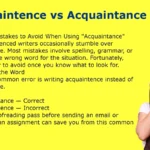
Acquaintence vs. Acquaintance: Acquaintance is the correct spelling, while acquaintence is a common misspelling. Use acquaintance to refer to a person you know but are not closely friends with, or the state of being familiar with someone or something.
The confusion is understandable. English spelling can be tricky, and it’s easy to assume acquaintence spelling is acceptable when it closely resembles the correct word. But here’s the kicker: only one spelling is recognized by dictionaries, while the other is a common mistake that can affect the credibility of your writing.
In this guide, you’ll learn the difference between Acquaintance vs Acquaintence, discover the acquaintance meaning, the acquaintance definition, the correct spelling of acquaintance, and why acquaintence is considered incorrect. You’ll also see acquaintance examples, learn how to use acquaintance in a sentence, and pick up an easy memory trick so you never confuse these spellings again.
By the end, you’ll know exactly which spelling to use and feel confident whenever the word acquaintance appears in your writing.
Acquaintance or Acquaintence: What’s the Correct Spelling?
The Short Answer
The correct spelling is acquaintance.
❌ Acquaintence — Incorrect
✅ Acquaintance — Correct
The word always ends with -ance, never -ence.
Here’s a quick comparison:
| Spelling | Correct? | Notes |
| Acquaintance | ✅ Yes | Standard English spelling |
| Acquaintence | ❌ No | Common misspelling |
If you’re unsure which version to use, remember this simple rule:
When referring to a person you know casually or to the state of knowing someone, always write “acquaintance.”
Why Is “Acquaintence” Incorrect?
Many English words end in -ence, including:
- confidence
- independence
- intelligence
- patience
- competence
Because these endings are so common, many writers assume acquaintance follows the same pattern. It doesn’t.
Instead, it belongs to another group of nouns ending in -ance, such as:
- acceptance
- assistance
- attendance
- importance
- resistance
The spelling comes from the history of the word rather than modern pronunciation.
A Quick Memory Tip
A helpful trick is to focus on the middle and ending:
Acquaint + ance = acquaintance
Never replace ance with ence.
Think of it this way:
An acquaintance deserves an “A.”
It may sound playful, but memory devices like this often work because they create a mental association that sticks.
What Does “Acquaintance” Mean?
Dictionary Definition
An acquaintance is a person you know but who isn’t a close friend. You recognize each other, may exchange greetings, or occasionally spend time together, yet your relationship lacks the closeness associated with friendship.
The word can also refer to knowledge or familiarity with a person, subject, place, or experience.
For example:
- “She’s an old acquaintance from college.”
- “He has little acquaintance with modern art.”
Both meanings remain common in formal and everyday English.
The Origin of the Word
The word has an interesting history.
It developed from the Old French verb acointer, meaning to make known or become familiar with. Eventually, it entered Middle English before evolving into the modern spelling acquaintance.
The related verb acquaint means:
- to introduce
- to make familiar
- to inform
- to become knowledgeable about something
Understanding this history helps explain why the spelling doesn’t perfectly match today’s pronunciation.
Modern Meaning in Everyday English
Today, people most often use acquaintance to describe relationships that fall somewhere between strangers and friends.
Imagine a ladder of familiarity:
| Relationship | Level of Familiarity |
| Stranger | No relationship |
| Acquaintance | Casual relationship |
| Friend | Close relationship |
| Best friend | Deep personal connection |
| Family | Lifelong relationship |
An acquaintance might be:
- a coworker you occasionally chat with
- a neighbor you greet every morning
- someone from your gym
- another parent at your child’s school
- a former classmate
- someone you met at a conference
You know their name. They know yours. However, you probably don’t share personal secrets or spend weekends together.
Knowing Someone Doesn’t Always Mean Friendship
One of the biggest misunderstandings involves assuming that everyone you know is a friend.
That’s rarely true.
For example:
You may recognize the receptionist at your dentist’s office after several visits. You exchange smiles and brief conversations. That person is an acquaintance, not necessarily a friend.
Likewise, someone you’ve connected with on LinkedIn may be a professional acquaintance without becoming part of your personal life.
This distinction matters because English uses different words to describe different levels of relationships.
How to Pronounce “Acquaintance”
Correct pronunciation helps reinforce correct spelling.
Standard American pronunciation
/əˈkweɪn.təns/
It sounds approximately like:
uh-KWAYN-tuhns
Break it into syllables:
ac • quaint • ance
Pronunciation Breakdown
| Part | Sound |
| ac | uh |
| quaint | kwaynt |
| ance | uhns |
Notice something important.
The ending doesn’t clearly sound like ance.
Instead, it often sounds closer to uhns, which explains why many people mistakenly write ence instead.
Common Pronunciation Mistakes
Some learners incorrectly pronounce it as:
- acquaint-ence
- acquaint-ants
- acquaint-an-see
These versions aren’t standard English.
The final syllable is soft and unstressed.
Tips for Natural Pronunciation
Try these steps:
- Say acquaint first.
- Add uhns naturally.
- Keep the last syllable light.
- Don’t overemphasize the ending.
Practice with these sentences:
- “My acquaintance works downtown.”
- “We became acquainted years ago.”
- “She’s merely an acquaintance.”
Reading these aloud several times helps build confidence.
Why People Misspell “Acquaintance” as “Acquaintence”
English spelling isn’t always logical.
That’s one reason this word causes confusion.
The Pronunciation Doesn’t Reveal the Spelling
Many English words are spelled exactly as they sound.
Unfortunately, acquaintance isn’t one of them.
When spoken naturally, both endings—
- -ance
- -ence
—sound remarkably similar.
As a result, writers often guess.
Sometimes they guess wrong.
The Influence of Similar Words
Your brain naturally searches for familiar spelling patterns.
Consider these examples:
| Word | Ending |
| confidence | ence |
| competence | ence |
| difference | ence |
| excellence | ence |
| intelligence | ence |
Since these words are common, your mind expects acquaintance to follow the same rule.
It doesn’t.
Silent Letters Increase Confusion
The word already contains several unusual letter combinations:
- ac
- qu
- ai
- nt
- ance
Because there are multiple vowels and consonants grouped together, people often focus more on pronunciation than spelling.
That creates mistakes.
Typing Quickly Encourages Errors
Many spelling mistakes happen because people type faster than they think.
For example:
You know the word.
You hear it correctly.
Yet your fingers automatically type:
acquaintence
Modern spell-checkers usually catch the error, but handwritten notes, exams, and printed materials may not.
Autocorrect Isn’t Always Enough
Most word processors correct acquaintence automatically.
However, relying entirely on technology has drawbacks.
If you’re writing:
- an exam
- a job application
- a scholarship essay
- handwritten correspondence
there’s no automatic correction available.
Learning the correct spelling remains valuable.
Memory Tricks to Spell “Acquaintance” Correctly
Some spelling tricks actually work because they create lasting mental images.
Here are the most effective ones.
Break the Word Into Smaller Pieces
Instead of memorizing one long word, divide it.
Ac + quaint + ance
Now it becomes much easier to remember.
Remember the Root Word
The base word is:
acquaint
Now simply add:
ance
Not ence.
Think:
Acquaint + ance = acquaintance
Visual Memory Technique
Picture the word written like this:
ACQUAINTANCE
Focus your eyes on the ending.
Notice the large letter A before NCE.
Repeat it several times.
Visual repetition strengthens memory much faster than simply reading definitions.
Use Word Association
Associate the ending with another familiar word.
For example:
- assistance
- acceptance
- attendance
- importance
Each ends with -ance.
Now group acquaintance with them instead of words ending in -ence.
Your brain remembers patterns remarkably well.
Create a Mnemonic
A memorable sentence can make spelling surprisingly easy.
Try this one:
An Acquaintance Always Accepts An Invitation.
Notice how each important word begins with A.
That reminds you the ending is -ance.
Write It in Context
Instead of writing the word repeatedly by itself, use complete sentences.
For example:
- “My acquaintance lives across the street.”
- “We became acquaintances after the seminar.”
- “She’s more than an acquaintance now.”
Writing naturally strengthens long-term recall because your brain remembers meaning along with spelling.
A Real-Life Example
Imagine attending a business conference.
You exchange business cards with several professionals. Months later, you recognize their names and occasionally message them on LinkedIn. They’re people you know, but you haven’t built close personal relationships.
Calling them friends would feel inaccurate.
Calling them acquaintances fits perfectly.
This simple scenario reinforces both the meaning and the correct spelling of the word, making it much easier to remember the next time you write it.
Acquaintance Meaning in Different Contexts
The word acquaintance doesn’t always describe the same type of relationship. Its meaning shifts slightly depending on the situation. Whether you’re talking about personal life, work, education, or social networking, the core idea remains the same: you know someone, but the relationship isn’t especially close.
Let’s look at how the word fits into different settings.
Personal Relationships
In everyday life, an acquaintance is someone you recognize and occasionally interact with. You might know their name, occupation, or a few personal details, but your conversations rarely go beyond casual topics.
Examples include:
- A neighbor you greet each morning
- Someone from your local gym
- A parent from your child’s soccer team
- A former classmate you occasionally meet around town
These relationships are friendly without being deeply personal.
Example:
“Sarah is an acquaintance from my photography club. We enjoy talking at meetings, but we don’t spend time together outside the club.”
Professional Relationships
The workplace introduces many acquaintances.
You may work alongside dozens of people without developing close friendships. Professional acquaintances often share information, collaborate on projects, or network at industry events.
Examples include:
- Coworkers from another department
- Clients you’ve met several times
- Vendors and suppliers
- Conference attendees
- Business contacts on LinkedIn
Professional acquaintances can become valuable members of your network even if your relationship remains formal.
School and College
Students naturally build a wide circle of acquaintances.
You might recognize classmates from lectures, study groups, or campus organizations without knowing much about their personal lives.
For example:
- Students who sit nearby in class
- Members of the same student organization
- Lab partners
- People you regularly see in the library
College campuses often create hundreds of acquaintances because students interact frequently in shared spaces.
Business Networking
Networking thrives on acquaintances.
Many successful careers grow through introductions made by casual professional contacts. An acquaintance may recommend you for a position, introduce you to a future client, or share valuable industry knowledge.
That doesn’t mean every acquaintance becomes a close colleague. However, maintaining respectful relationships often opens unexpected opportunities.
Case Study: Networking That Led to a Career Opportunity
A marketing graduate attended several local networking events over six months. Rather than focusing only on making close friends, she stayed in touch with dozens of professional acquaintances through occasional emails and LinkedIn messages.
Months later, one acquaintance remembered her when a marketing coordinator position became available. A simple recommendation led to an interview and eventually a full-time job.
The relationship wasn’t personal. Still, it proved valuable.
Social Media and Online Communities
Modern technology has changed the meaning of acquaintance without replacing it.
Today, you may know someone entirely online through:
- Professional forums
- Facebook groups
- Discord communities
- Reddit discussions
- Gaming platforms
- Industry webinars
Although you’ve never met in person, you recognize each other’s names and communicate regularly.
These online connections often qualify as acquaintances.
How Relationships Typically Progress
Not every acquaintance becomes a friend, but many friendships begin this way.
Stranger
│
▼
Acquaintance
│
Regular Conversations
│
Shared Interests
│
Growing Trust
│
Friend
│
Close Friend
The transition depends on shared experiences, communication, and trust rather than simply spending time together.
Acquaintance vs Friend
People often confuse these two words because both involve knowing another person. The difference lies in the depth of the relationship.
An acquaintance is someone you know.
A friend is someone you trust and share a stronger emotional connection with.
Key Differences
| Feature | Acquaintance | Friend |
| Emotional connection | Limited | Strong |
| Trust level | Moderate | High |
| Personal conversations | Occasional | Frequent |
| Shared experiences | Few | Many |
| Time spent together | Infrequent | Regular |
| Offers emotional support | Sometimes | Usually |
| Knows personal details | Few | Many |
| Long-term commitment | Not expected | Often expected |
An Everyday Example
Imagine working in an office.
You chat with Alex in the break room several times each week. You know Alex enjoys hiking and owns a Labrador.
Alex is your acquaintance.
Meanwhile, Jamie knows your family, celebrates birthdays with you, and supports you during difficult times.
Jamie is your friend.
The distinction feels natural because friendship includes emotional closeness.
Can an Acquaintance Become a Friend?
Absolutely.
Many lasting friendships begin with simple introductions.
People often meet through:
- School
- Work
- Sports
- Volunteer organizations
- Neighborhood activities
- Conferences
- Mutual friends
Over time, repeated interactions build familiarity. Shared experiences create trust. Eventually, the relationship may develop into genuine friendship.
Acquaintance vs Colleague
Although these words sometimes overlap, they aren’t identical.
A colleague is someone you work with.
An acquaintance is anyone you know casually.
Sometimes a colleague is also an acquaintance.
Sometimes a colleague becomes a close friend.
Comparison Table
| Feature | Acquaintance | Colleague |
| Casual relationship | Yes | Sometimes |
| Works together | Not necessarily | Yes |
| Personal friendship required | No | No |
| Professional connection | Sometimes | Always |
| Outside interaction | Limited | Varies |
Example
You attend a national conference and exchange business cards with someone from another company.
They’re your professional acquaintance.
Your teammate who works beside you every day is your colleague.
The two relationships serve different purposes.
Acquaintance vs Stranger
The difference between these words is straightforward.
A stranger is someone you’ve never met.
An acquaintance is someone you’ve already met and recognize.
Quick Comparison
| Stranger | Acquaintance |
| Unknown person | Known person |
| No interaction | Some interaction |
| Doesn’t recognize you | Usually recognizes you |
| No relationship | Casual relationship |
Real-Life Scenario
Imagine entering a coffee shop.
You see someone you’ve never encountered before.
They’re a stranger.
The barista greets you by name because you’ve visited many times.
The barista is your acquaintance.
Neither situation implies friendship, yet the level of familiarity differs.
Examples of “Acquaintance” in Sentences
Seeing words used naturally helps reinforce their meaning.
Everyday Conversations
- “An acquaintance introduced us at the party.”
- “She’s only an acquaintance, so I don’t know much about her.”
- “We remained acquaintances after graduation.”
- “I ran into an old acquaintance at the airport.”
Workplace Examples
- “One business acquaintance recommended the software.”
- “Several acquaintances attended the industry conference.”
- “My acquaintance works in the finance department.”
- “A mutual acquaintance arranged the meeting.”
Academic Examples
- “The researcher had little acquaintance with the historical records before beginning the study.”
- “Students developed acquaintances across different departments.”
Formal Writing
- “The witness identified the suspect as a casual acquaintance.”
- “The organization expanded its network of professional acquaintances.”
Informal Writing
- “He’s more of an acquaintance than a close buddy.”
- “I know her through a mutual acquaintance.”
Common Phrases Using “Acquaintance”
English includes several expressions built around this word.
Understanding them improves both vocabulary and comprehension.
Make Someone’s Acquaintance
Meaning:
To meet someone for the first time.
Example:
“I was delighted to make your acquaintance.”
This phrase appears more often in formal speech and literature.
Casual Acquaintance
Someone you know only slightly.
Example:
“He’s a casual acquaintance from my neighborhood.”
Mutual Acquaintance
A person known by two or more people.
Example:
“We met through a mutual acquaintance.”
Business Acquaintance
A professional contact rather than a friend.
Example:
“One business acquaintance introduced me to the client.”
Passing Acquaintance
Someone you’ve met briefly.
Example:
“She was only a passing acquaintance.”
Old Acquaintance
Someone you knew years ago.
Example:
“I unexpectedly met an old acquaintance while traveling.”
Close Acquaintance
This phrase describes someone who isn’t quite a friend but is more familiar than an ordinary acquaintance.
Mere Acquaintance
Used to emphasize the lack of closeness.
Example:
“We’re merely acquaintances.”
Synonyms of Acquaintance
No synonym matches acquaintance perfectly in every situation. Each carries its own nuance.
| Word | Meaning | Best Used When |
| Contact | Professional connection | Networking |
| Associate | Business relationship | Workplace |
| Colleague | Coworker | Employment |
| Neighbor | Person living nearby | Residential context |
| Classmate | Student in the same class | Education |
| Peer | Equal in status | Academic or professional settings |
| Connection | General relationship | Networking |
| Familiar | Someone recognized | Informal conversation |
Choosing the Right Word
For instance:
- Use contact when discussing networking.
- Choose associate in business settings.
- Pick classmate when referring to school.
- Use neighbor when location matters.
While these words overlap, none completely replace acquaintance because they often describe a specific type of relationship rather than the degree of familiarity.
Antonyms of Acquaintance
Opposites depend on the meaning you’re expressing.
When Referring to a Person
Common antonyms include:
- Stranger
- Unknown person
- Outsider
- Unfamiliar individual
When Referring to Knowledge
If acquaintance means familiarity, its opposites include:
- Ignorance
- Unfamiliarity
- Inexperience
- Lack of knowledge
Context determines which opposite fits best.
Grammar Guide
Using acquaintance correctly means understanding its grammatical role.
Is “Acquaintance” a Noun?
Yes.
It functions as a countable noun.
Examples:
- an acquaintance
- several acquaintances
- many acquaintances
Singular and Plural Forms
| Form | Example |
| Singular | acquaintance |
| Plural | acquaintances |
Notice that only -s is added.
Possessive Forms
| Form | Example |
| Singular possessive | acquaintance’s advice |
| Plural possessive | acquaintances’ opinions |
Is It Countable?
Yes.
You can count acquaintances.
For example:
- one acquaintance
- five acquaintances
- dozens of acquaintances
Unlike words such as information or equipment, acquaintance always works as a countable noun when referring to people.
Can It Be Used as an Adjective?
No.
You wouldn’t say:
❌ acquaintance person
Instead, English uses related adjectives.
Examples include:
- acquainted
- familiar
- known
Correct usage:
- “We’re acquainted.”
- “He’s a familiar face.”
Word Forms Related to “Acquaintance”
Learning the entire word family makes English easier to master.
| Word | Part of Speech | Meaning |
| Acquaint | Verb | To introduce or inform |
| Acquainted | Adjective | Familiar with |
| Acquainting | Verb (present participle) | Becoming familiar |
| Reacquaint | Verb | To become familiar again |
| Reacquainted | Adjective/Verb | Familiar again after time apart |
| Acquaintances | Noun | More than one acquaintance |
| Acquaintanceship* | Noun (rare) | The state of being acquaintances |
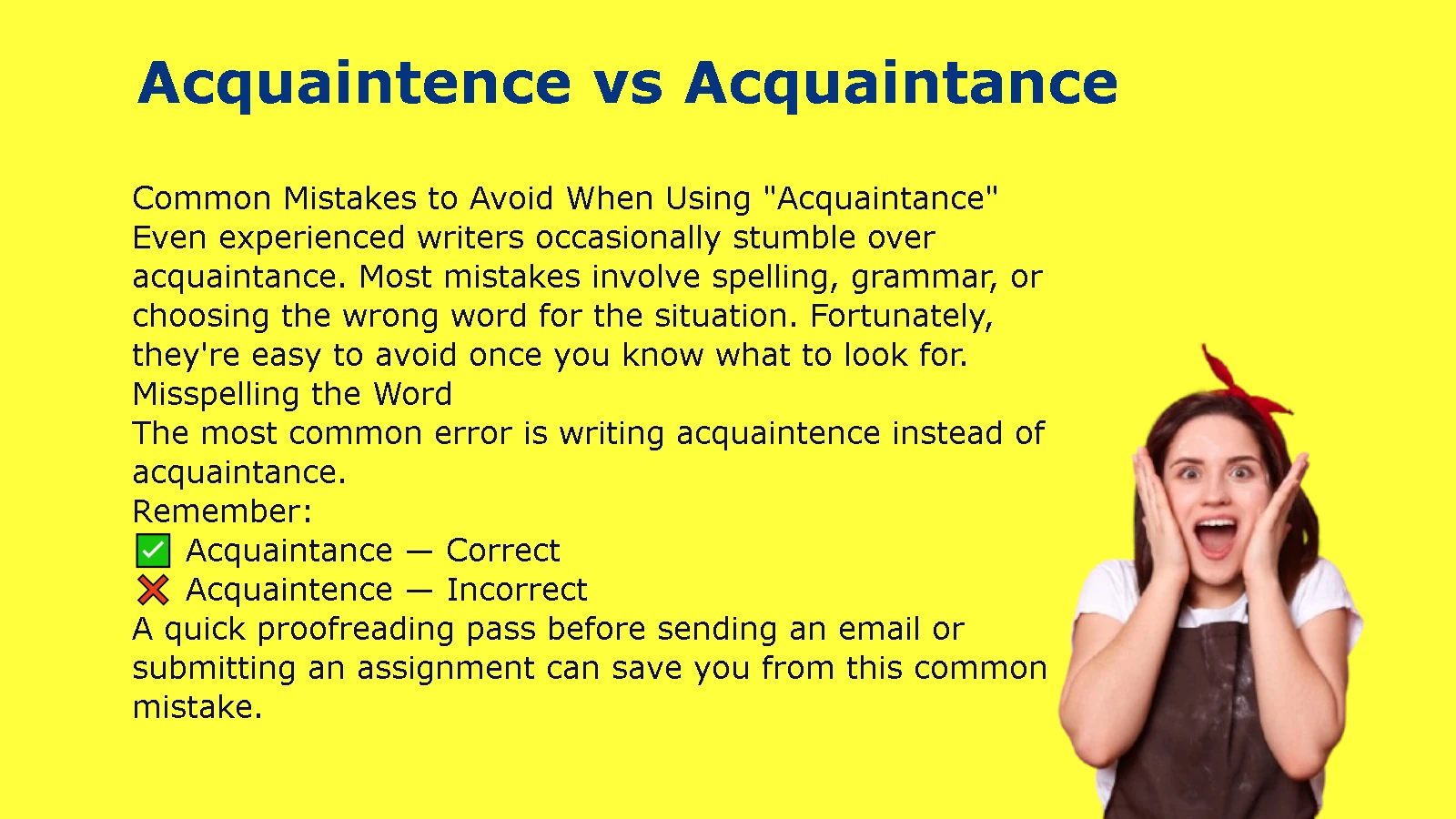
Common Mistakes to Avoid When Using “Acquaintance”
Even experienced writers occasionally stumble over acquaintance. Most mistakes involve spelling, grammar, or choosing the wrong word for the situation. Fortunately, they’re easy to avoid once you know what to look for.
Misspelling the Word
The most common error is writing acquaintence instead of acquaintance.
Remember:
- ✅ Acquaintance — Correct
- ❌ Acquaintence — Incorrect
A quick proofreading pass before sending an email or submitting an assignment can save you from this common mistake.
Confusing an Acquaintance with a Friend
These words aren’t interchangeable.
A friend typically shares a stronger emotional bond, while an acquaintance is someone you know casually.
Incorrect:
“Everyone I follow on social media is my friend.”
More accurate:
“Many people I follow online are acquaintances.”
Choosing the right word makes your writing more precise.
Using “Acquaintance” Instead of “Acquainted”
This mistake appears surprisingly often.
Incorrect
“I am acquaintance with her.”
Correct
“I am acquainted with her.”
Remember:
- Acquaintance = noun
- Acquainted = adjective
Using the Wrong Plural Form
The plural simply adds -s.
| Incorrect | Correct |
| acquaintanceses | acquaintances |
| acquaintence | acquaintance |
| acquaintence’s | acquaintance’s |
Capitalizing It Unnecessarily
The word isn’t a proper noun.
Write:
- my acquaintance
- our mutual acquaintance
Don’t capitalize it unless it begins a sentence.
Overusing the Word
Repeating the same noun throughout an article or conversation can make your writing sound repetitive.
Instead, vary your wording when appropriate.
For example:
- contact
- colleague
- connection
- classmate
- neighbor
- business associate
Use these alternatives only when they match the context.
Quick Checklist Before You Use the Word
Ask yourself these questions:
- Is the spelling acquaintance?
- Am I referring to a noun rather than an adjective?
- Would friend or colleague be more accurate?
- Does the sentence sound natural?
- Have I avoided unnecessary repetition?
If you answer “yes” to all five, you’re probably using the word correctly.
Real-World Case Studies
Seeing how the word appears in realistic situations makes it much easier to understand.
Case Study: A Networking Event
Emma attended a technology conference and met twenty professionals.
She exchanged business cards, connected with them on LinkedIn, and occasionally commented on their posts.
Several months later, one of those contacts referred her to a new employer.
Although they weren’t close friends, they were professional acquaintances.
Key takeaway: Professional acquaintances can become valuable career connections.
Case Study: Moving Into a New Neighborhood
After moving into a new community, David greeted the same neighbors each morning.
They talked about the weather, exchanged gardening tips, and occasionally accepted deliveries for one another.
Over time, one family invited David to a barbecue.
Eventually, those acquaintances became close friends.
Key takeaway: Many friendships begin as simple acquaintances.
Case Study: College Life
Sophia recognized hundreds of students across campus.
She worked on group projects with several classmates and often chatted before lectures.
Despite seeing them regularly, she considered only a handful of people close friends.
Everyone else remained acquaintances.
Key takeaway: Frequency of interaction doesn’t automatically create friendship.
Interesting Facts About the Word “Acquaintance”
Here are a few facts you may not know.
- Acquaintance has existed in English for several centuries.
- The word originated from Old French before entering Middle English.
- It functions primarily as a countable noun.
- The incorrect spelling acquaintence appears frequently in online searches despite not being recognized by standard dictionaries.
- The phrase “make your acquaintance” remains common in literature, historical writing, and formal introductions.
- Psychologists and sociologists often distinguish acquaintances from friends when studying human relationships and social networks.
Quote About Relationships
“A journey of a thousand friendships often begins with a single acquaintance.”
While this modern saying doesn’t come from a historical source, it captures an important truth: meaningful relationships rarely happen overnight. Nearly every close friendship starts with a simple introduction.
Frequently Asked Questions About Acquaintance or Acquaintence
Is Acquaintence vs Acquaintance correct?
Acquaintance is the correct spelling.
Acquaintence is a misspelling and shouldn’t appear in formal or informal writing.
Why Is “Acquaintance” So Difficult to Spell?
Several factors contribute to the confusion:
- The pronunciation doesn’t clearly reveal the ending.
- English contains many words ending in -ence.
- Multiple vowels appear close together.
- The word comes from historical spellings rather than modern pronunciation.
These factors make it one of the more commonly misspelled English words.
Is “Acquaintence” a Real Word?
No.
Although millions of people search for acquaintence, dictionaries recognize only acquaintance.
Spell-check software also flags acquaintence as incorrect.
What Is the Plural of Acquaintance?
The plural is:
acquaintances
Example:
“She introduced me to several acquaintances at the conference.”
Can an Acquaintance Be a Friend?
Not exactly.
An acquaintance is someone you know casually.
A friend shares a deeper personal relationship.
However, acquaintances often become friends over time.
How Do You Use “Acquaintance” in a Sentence?
Here are a few examples:
- “My acquaintance recommended a great restaurant.”
- “We met through a mutual acquaintance.”
- “He’s an old acquaintance from graduate school.”
- “Several acquaintances attended the charity event.”
Is “Acquaintance” Formal or Informal?
It’s suitable for both.
You’ll see it in:
- Everyday conversations
- Academic writing
- Business communication
- News articles
- Legal documents
- Books and novels
Its versatility makes it useful across many forms of writing.
What Part of Speech Is “Acquaintance”?
Acquaintance is a noun.
Related forms include:
- acquaint (verb)
- acquainted (adjective)
- reacquaint (verb)
Do American and British English Spell It Differently?
No.
Both American English and British English use exactly the same spelling:
acquaintance
Unlike words such as color/colour or center/centre, there are no regional spelling variations.
What’s the Easiest Way to Remember the Correct Spelling?
Use this formula:
Acquaint + ance = acquaintance
Or remember this phrase:
An acquaintance always ends with “A-N-C-E.”
Simple memory devices often work better than memorizing a spelling list.
Quick Recap: Acquaintence vs Acquaintance
Here’s a summary of the key points covered in this guide.
| Topic | Answer |
| Correct spelling | Acquaintance |
| Incorrect spelling | Acquaintence |
| Part of speech | Noun |
| Plural form | Acquaintances |
| Meaning | A person you know casually or familiarity with someone or something |
| Opposite | Stranger, unfamiliarity |
| Related verb | Acquaint |
| Related adjective | Acquainted |
| American spelling | Acquaintance |
| British spelling | Acquaintance |
Key Takeaways
If you remember only a few things from this guide, make them these:
- Acquaintance is the only correct spelling.
- Acquaintence isn’t recognized in standard English.
- An acquaintance is someone you know but don’t know well.
- The word always ends in -ance, never -ence.
- It works as a countable noun with the plural acquaintances.
- Both American and British English use the same spelling.
- Many close friendships begin as simple acquaintances.
Mastering this single word can improve your writing, strengthen your vocabulary, and help you communicate with greater confidence. The next time you hesitate between Acquaintence vs Acquaintance, you’ll know exactly which spelling belongs on the page.