Pennywise Meaning refers to being careful or wise with money and spending. The word often describes someone who avoids unnecessary expenses, although it is also commonly used in the phrase penny wise, pound foolish, which means saving small amounts while making costly financial mistakes.
You might hear someone mention Pennywise, see it online, or come across the phrase “penny wise, pound foolish” without knowing the context. And here’s the kicker: understanding the wrong meaning can completely change how you interpret a conversation, book, movie, or social media post.
In this guide, you’ll learn the Pennywise Meaning, discover the Pennywise definition, understand what does Pennywise mean in different situations, and see Pennywise examples in real sentences. You’ll also explore the origin of Pennywise, the meaning behind the Pennywise character, and how the term is used in everyday English.
By the end, you’ll know exactly what Pennywise means, when to use each meaning correctly, and why the term continues to appear in both popular culture and everyday language.
What Does Pennywise Mean?
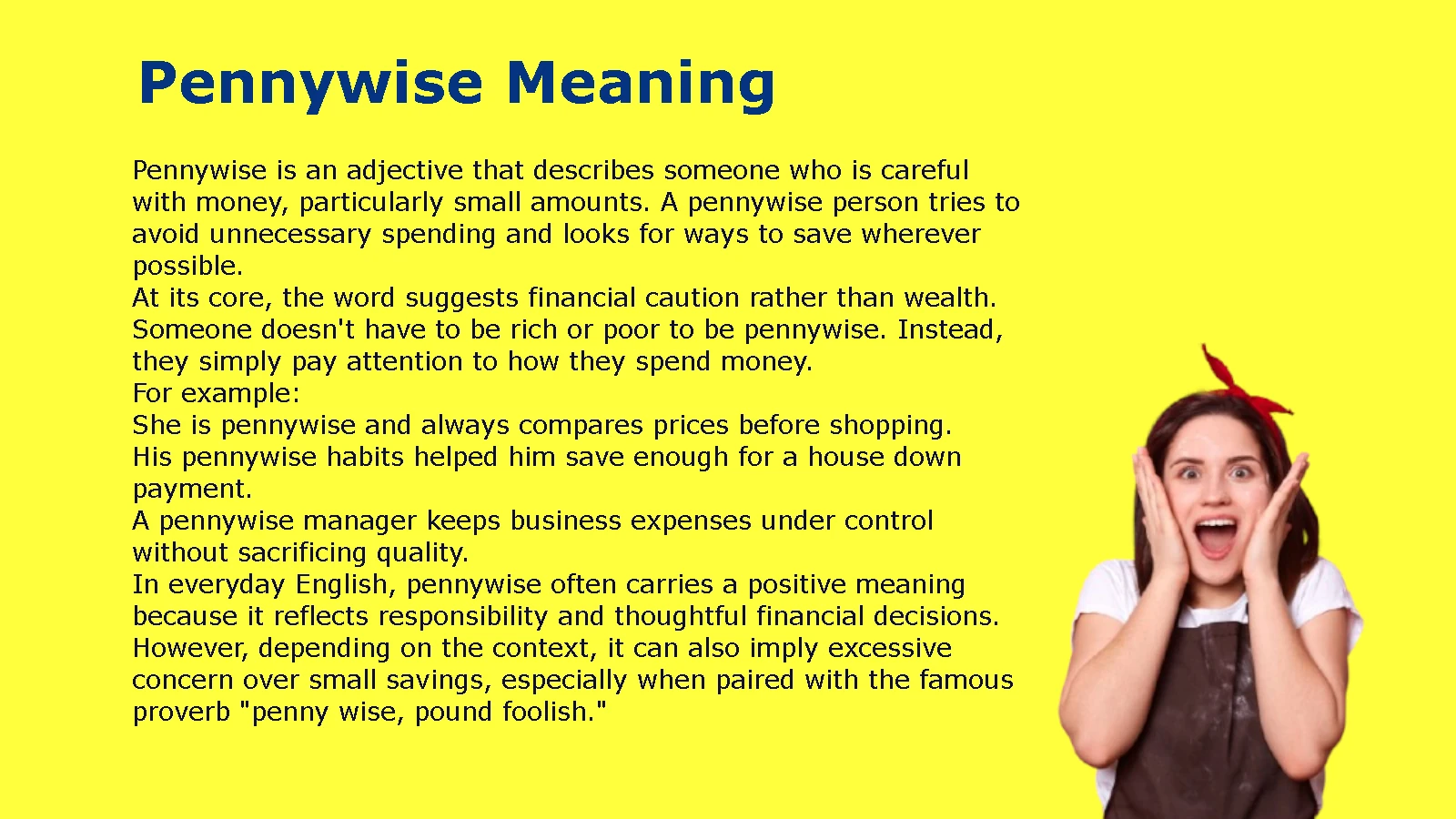
Pennywise is an adjective that describes someone who is careful with money, particularly small amounts. A pennywise person tries to avoid unnecessary spending and looks for ways to save wherever possible.
At its core, the word suggests financial caution rather than wealth. Someone doesn’t have to be rich or poor to be pennywise. Instead, they simply pay attention to how they spend money.
For example:
- She is pennywise and always compares prices before shopping.
- His pennywise habits helped him save enough for a house down payment.
- A pennywise manager keeps business expenses under control without sacrificing quality.
In everyday English, pennywise often carries a positive meaning because it reflects responsibility and thoughtful financial decisions. However, depending on the context, it can also imply excessive concern over small savings, especially when paired with the famous proverb “penny wise, pound foolish.”
Pennywise Definition at a Glance
| Feature | Details |
| Word | Pennywise |
| Pronunciation | PEN-ee-wize |
| Part of Speech | Adjective |
| Primary Meaning | Careful with small amounts of money |
| Tone | Usually positive, sometimes neutral or mildly negative |
| Common Contexts | Budgeting, personal finance, business, everyday conversation |
| Opposite Ideas | Wasteful, extravagant, spendthrift |
Pennywise Etymology and Word Origin
The word pennywise combines two simple English words:
- Penny — a small coin representing a small amount of money.
- Wise — showing good judgment or practical thinking.
Together, they literally mean wise with pennies, or careful when spending small amounts of money.
The term appeared in English several centuries ago and became closely associated with thrift. During periods when every coin mattered, especially for working families, being pennywise meant making thoughtful purchasing decisions instead of spending carelessly.
Over time, the meaning stayed remarkably consistent. While many English words have shifted dramatically, pennywise still describes someone who manages money carefully.
The word also inspired one of the most famous English proverbs:
“Penny wise, pound foolish.”
This saying reminds people that saving tiny amounts while ignoring much larger costs often leads to poor financial decisions.
What Does Pennywise Mean in Everyday English?
In everyday conversation, pennywise usually refers to practical spending habits rather than extreme frugality.
Someone who is pennywise might:
- Wait for sales before making purchases.
- Compare prices between stores.
- Avoid impulse buying.
- Plan monthly expenses.
- Stick to a shopping list.
- Save for future goals instead of making unnecessary purchases.
These habits reflect thoughtful financial management rather than deprivation.
For example, imagine two friends buying a laptop.
Alex spends a few extra minutes comparing prices online and saves $150.
Jordan buys the first laptop he sees without checking alternatives.
Most people would describe Alex as pennywise, not because he avoided spending altogether, but because he spent wisely.
Everyday Situations Where Pennywise Fits
| Situation | Is Pennywise Appropriate? | Why |
| Comparing grocery prices | ✔ Yes | Saves money without reducing quality |
| Using coupons | ✔ Yes | Smart shopping habit |
| Creating a monthly budget | ✔ Yes | Encourages financial planning |
| Repairing instead of replacing | ✔ Yes | Extends product life and reduces costs |
| Refusing every expense regardless of need | ✘ Not always | May become excessive or impractical |
The key difference lies in balance. Pennywise people spend intentionally instead of simply spending less.
Pennywise Meaning in Business and Finance
The concept of being pennywise extends far beyond personal budgets. Businesses also strive to control costs while maintaining quality, productivity, and customer satisfaction.
Successful companies rarely cut expenses randomly. Instead, they evaluate which costs produce value and which don’t.
For example, a company might:
- Negotiate better supplier contracts.
- Reduce unnecessary subscriptions.
- Improve energy efficiency.
- Automate repetitive administrative tasks.
- Purchase equipment that lowers long-term operating costs.
These decisions reflect pennywise thinking because they reduce waste without harming performance.
However, businesses must also avoid focusing solely on immediate savings.
Mini Case Study: Smart Savings vs. Poor Savings
A small manufacturing company wanted to reduce expenses.
Instead of replacing aging machinery, management postponed maintenance to save money. Initially, they saved several thousand dollars.
Within a year, the outdated equipment failed unexpectedly.
The company faced:
- Expensive emergency repairs
- Production delays
- Missed customer deadlines
- Lost revenue
- Reduced customer trust
The short-term savings disappeared almost immediately.
A different company invested in preventive maintenance. Although maintenance required regular spending, it reduced breakdowns, increased productivity, and lowered long-term costs.
This example illustrates why being pennywise requires long-term thinking, not simply cutting today’s expenses.
Benefits of Being Pennywise
- Better financial stability
- Improved budgeting habits
- Lower unnecessary spending
- Increased savings
- Stronger emergency funds
- More intentional purchasing decisions
- Reduced financial stress
When Pennywise Thinking Can Become a Problem
Being careful with money is generally beneficial, but excessive caution sometimes creates new problems.
For example:
- Buying the cheapest product repeatedly instead of purchasing one durable item.
- Delaying necessary home repairs.
- Ignoring preventive healthcare because of small costs.
- Choosing poor-quality tools that require frequent replacement.
These situations often cost much more over time.
As financial experts frequently note:
“The cheapest option isn’t always the least expensive in the long run.”
That idea perfectly captures the balance behind true pennywise decision-making.
Pennywise and the Expression “Penny Wise, Pound Foolish”
Few English expressions remain as relevant today as “penny wise, pound foolish.”
The proverb warns against focusing so heavily on saving small amounts that you overlook much larger financial consequences.
What Does the Expression Mean?
Someone who is penny wise, pound foolish pays close attention to minor expenses while making poor decisions involving much larger sums.
Instead of thinking strategically, they become obsessed with tiny savings.
Simple Example
Imagine someone buys a $20 pair of shoes because they’re cheaper than a well-made $80 pair.
The inexpensive shoes wear out every six months.
The higher-quality shoes would have lasted five years.
Over five years:
- Cheap shoes: approximately $200
- Quality shoes: approximately $80
The attempt to save money actually resulted in spending far more.
That is the essence of being penny wise, pound foolish.
Common Real-Life Examples
| Situation | Small Saving | Bigger Loss |
| Skipping routine car maintenance | Saves on service costs | Expensive engine repairs |
| Buying poor-quality appliances | Lower purchase price | Frequent replacements |
| Ignoring cybersecurity updates | Saves IT expenses | Costly data breaches |
| Delaying roof repairs | Avoids repair bill | Major structural damage |
| Hiring unqualified workers | Lower wages | Reduced productivity and rework |
Why the Saying Still Matters
Modern life presents countless opportunities to make quick financial decisions.
People compare prices online within seconds. Businesses negotiate contracts daily. Governments manage massive budgets.
Despite advances in technology, the underlying lesson hasn’t changed:
Good financial decisions consider both immediate costs and long-term value.
Pennywise vs. Penny-Pinching
Many people mistakenly use pennywise and penny-pinching interchangeably.
Although they’re related, they carry different meanings.
A pennywise person spends carefully while recognizing value.
A penny-pincher often avoids spending regardless of whether the expense is worthwhile.
The distinction comes down to judgment.
| Pennywise | Penny-Pinching |
| Smart spending | Excessive cost-cutting |
| Focuses on value | Focuses only on price |
| Usually positive | Often negative |
| Encourages planning | May discourage necessary spending |
| Long-term thinking | Short-term savings |
Example Comparison
Pennywise
“She purchased the higher-quality refrigerator because it uses less electricity and lasts longer.”
Penny-Pinching
“He bought the cheapest refrigerator available, even though it required costly repairs within a year.”
The first decision prioritizes long-term value.
The second prioritizes immediate savings at the expense of future costs.
Pennywise vs. Frugal vs. Cheap
Although these words all relate to money, they aren’t synonyms.
Each describes a different attitude toward spending.
| Term | Meaning | Typical Connotation | Example |
| Pennywise | Careful with smaller expenses while considering value | Mostly positive | Comparing prices before making a purchase |
| Frugal | Living efficiently and avoiding unnecessary spending | Positive | Cooking meals at home instead of eating out regularly |
| Cheap | Reluctant to spend money, even when appropriate | Often negative | Refusing to replace worn-out safety equipment |
| Economical | Using resources efficiently | Positive | Buying energy-efficient appliances |
| Cost-conscious | Paying close attention to expenses | Neutral to positive | Choosing software that delivers the best value |
How These Terms Differ
A frugal person focuses on overall financial efficiency.
A pennywise person pays attention to everyday spending decisions.
A cheap person may refuse necessary purchases simply to avoid spending money.
For example, bringing lunch from home instead of eating at expensive restaurants is frugal. Comparing grocery prices before shopping is pennywise. Refusing to replace unsafe tires to save money is simply cheap.
Understanding these differences helps you choose the right word for the situation and avoid common misunderstandings.
Pennywise Meaning in Popular Culture
For many people today, the first thing that comes to mind when they hear Pennywise isn’t budgeting or careful spending. Instead, they think of the frightening clown from Stephen King’s 1986 novel It.
The popularity of the novel and its film adaptations has made the name Pennywise instantly recognizable around the world. Even so, the fictional character and the dictionary word have completely different meanings. Knowing the distinction prevents confusion when reading books, watching movies, or discussing personal finance.
Pennywise the Dancing Clown
In Stephen King’s novel It, Pennywise the Dancing Clown is the form most often taken by an ancient supernatural creature that feeds on fear, particularly the fear of children.
Unlike the dictionary definition, this version of Pennywise has nothing to do with being economical or careful with money. The name functions purely as a character name rather than a description of personality.
Over the years, the character has become one of horror fiction’s most recognizable villains because of:
- Its unsettling clown appearance
- Its ability to shape-shift
- Its psychological manipulation
- Its memorable dialogue
- Its lasting influence on horror films and popular culture
Although millions of people now associate the word with horror, that popularity hasn’t changed the original English meaning of pennywise.
Why Is the Clown Named Pennywise?
Stephen King has never presented the name as a direct reference to the adjective pennywise. Instead, readers generally view it as a memorable fictional name chosen to fit the mysterious and unsettling nature of the character.
Because the clown often lures children with playful behavior before revealing its true form, the name has become iconic rather than descriptive.
Today, context determines which meaning people intend.
For example:
- “He’s pennywise with his paycheck.” → careful with money.
- “Pennywise is one of horror’s most famous villains.” → the fictional clown.
Pennywise in Movies and Television
The character reached an even larger audience through screen adaptations.
Major appearances include:
| Release | Format | Actor |
| 1990 | Television miniseries | Tim Curry |
| 2017 | Feature film (It) | Bill Skarsgård |
| 2019 | Feature film (It Chapter Two) | Bill Skarsgård |
Tim Curry’s portrayal introduced the character to an entire generation of viewers, while Bill Skarsgård’s performance helped redefine modern horror for a new audience.
Despite the fame of these adaptations, dictionaries continue to define pennywise according to its long-established financial meaning.
Pennywise in Internet Culture
Social media has expanded the use of the name even further.
Online, people often use Pennywise in:
- Memes
- GIFs
- Halloween discussions
- Horror movie rankings
- Fan art
- Cosplay
- Gaming references
- Pop culture trivia
Because of these trends, younger audiences may recognize the clown before learning the original definition of the word.
Is Pennywise a Positive or Negative Word?
One interesting aspect of pennywise meaning is that the word can sound positive, neutral, or slightly negative depending on the situation.
The dictionary definition itself isn’t negative. Instead, the surrounding context shapes the meaning.
Positive Usage
Most often, pennywise praises someone for making smart financial decisions.
Examples include:
- Planning a monthly budget.
- Comparing prices before purchasing.
- Avoiding unnecessary debt.
- Saving consistently for retirement.
- Building an emergency fund.
Example:
“She’s pennywise and always plans her purchases carefully.”
Here, the speaker compliments responsible money management.
Neutral Usage
Sometimes the word simply describes someone’s spending habits without expressing approval or criticism.
Example:
“He’s generally pennywise, so he tracks every household expense.”
This sentence simply states a fact.
Negative Usage
Occasionally, pennywise suggests excessive concern over saving small amounts.
This usually happens when someone ignores bigger financial consequences.
Example:
“The company became so pennywise that it stopped replacing worn equipment.”
In this case, the speaker implies that excessive cost-cutting caused larger problems.
How Context Changes the Meaning
| Context | Meaning | Tone |
| Family budgeting | Financially responsible | Positive |
| Personal savings | Careful spending | Positive |
| Business planning | Cost-conscious | Neutral |
| Ignoring major repairs | Excessive saving | Negative |
| Used as the clown’s name | Fictional character | Neutral |
The surrounding words almost always make the intended meaning clear.
How to Use Pennywise in a Sentence
Learning Pennywise meaning becomes much easier when you see the word in realistic situations.
Below are examples covering different contexts.
Everyday Examples
- She’s pennywise and never shops without comparing prices.
- My grandfather was pennywise, so he rarely wasted money.
- Being pennywise helped us save enough for our vacation.
- He became more pennywise after creating a household budget.
- They are pennywise without sacrificing quality.
Business Examples
- The company’s pennywise purchasing strategy reduced unnecessary expenses.
- Good managers remain pennywise while investing in long-term growth.
- A pennywise procurement team evaluates both price and quality.
- Smart organizations are pennywise, not penny-pinching.
- Investors appreciate pennywise financial planning.
Financial Examples
- Becoming pennywise starts with tracking your expenses.
- Small savings can grow significantly when you’re consistently pennywise.
- Pennywise habits often lead to stronger financial security.
- Saving automatically each month is a pennywise strategy.
- Careful spending creates room for future investments.
Academic Examples
- The article described pennywise behavior among budget-conscious households.
- Researchers examined pennywise purchasing decisions during economic downturns.
- Students learned how pennywise choices affect long-term financial health.
Conversation Examples
Friend A: “Why do you always compare prices?”
Friend B: “I’m just trying to be pennywise.”
Parent: “Let’s wait for next week’s sale.”
Child: “That’s pretty pennywise.”
Quick Practice
Choose the correct sentence.
✅ She is pennywise because she plans her monthly expenses.
❌ She is pennywise because she wastes money every weekend.
Only the first sentence uses the word correctly.
Common Synonyms of Pennywise
No synonym matches pennywise perfectly. However, several words share similar ideas about careful spending and financial responsibility.
| Synonym | Meaning | Typical Use |
| Frugal | Avoiding unnecessary spending | Personal finance |
| Economical | Efficient use of money or resources | Business and home |
| Thrifty | Skilled at saving money | Everyday conversation |
| Cost-conscious | Focused on controlling expenses | Business |
| Prudent | Showing good judgment | Finance and planning |
| Budget-minded | Thinking carefully about spending | Household budgeting |
| Money-saving | Reducing expenses | Shopping |
| Careful | Avoiding unnecessary risks or waste | General use |
| Efficient | Making the best use of resources | Business and productivity |
When to Use Each Synonym
- Use frugal when discussing an overall lifestyle.
- Choose economical when referring to products or systems.
- Use thrifty for everyday conversations about saving money.
- Select cost-conscious in professional or corporate settings.
- Use pennywise when emphasizing thoughtful spending on smaller expenses.
Although these words overlap, each highlights a slightly different aspect of financial behavior.
Antonyms of Pennywise
Antonyms describe people who spend carelessly or fail to manage money responsibly.
| Antonym | Meaning |
| Wasteful | Uses money or resources unnecessarily |
| Extravagant | Spends excessively on luxury |
| Spendthrift | Habitually spends without restraint |
| Lavish | Very generous or excessive with spending |
| Prodigal | Recklessly wasteful with money |
| Reckless | Acts without considering consequences |
| Imprudent | Lacking good judgment |
| Free-spending | Readily spends money without much concern |
Example Comparisons
- A pennywise shopper compares prices.
- A wasteful shopper buys items that never get used.
- A pennywise company invests carefully.
- An extravagant company spends beyond its means.
- A pennywise homeowner schedules preventive maintenance.
- A spendthrift homeowner ignores the budget entirely.
Understanding these opposites makes the meaning of pennywise even clearer.
Related Words and Expressions
Several English words and expressions share themes with Pennywise meaning. Some focus on saving money, while others describe broader financial habits.
Common Related Terms
- Penny wise, pound foolish
- Penny-pinching
- Penny-pincher
- Frugal living
- Cost-conscious
- Budget-friendly
- Economical
- Money management
- Financial discipline
- Financial prudence
- Smart spending
- Expense tracking
- Saving habits
- Household budgeting
- Living within your means
- Value for money
- Cost-effective
- Long-term planning
- Financial responsibility
- Personal finance
How These Terms Connect
Although each expression has its own meaning, they all relate to making thoughtful financial decisions.
For example:
- Frugal living focuses on reducing unnecessary expenses across your lifestyle.
- Budget-friendly describes products or services that cost less without sacrificing value.
- Cost-effective emphasizes getting the best results for the money spent.
- Financial prudence highlights careful planning before making financial commitments.
- Living within your means encourages spending less than you earn to maintain financial stability.
Together, these expressions reinforce the central idea behind pennywise: making informed decisions that balance present needs with future financial well-being.
Quote: “Beware of little expenses; a small leak will sink a great ship.” — Benjamin Franklin
Common Mistakes About the Meaning of Pennywise
Although Pennywise meaning seems straightforward, many people misunderstand how to use the word. Some confuse it with stinginess, while others think it only refers to the famous horror character. Understanding these common mistakes will help you use the word accurately in conversations and writing.
Assuming Pennywise Always Means “Cheap”
One of the biggest misconceptions is that pennywise and cheap mean the same thing.
They don’t.
A pennywise person looks for value and avoids unnecessary expenses. A cheap person often refuses to spend money even when doing so would clearly be beneficial.
For example, replacing worn-out tires with high-quality ones may cost more today, but it improves safety and reduces the risk of expensive repairs later. A pennywise buyer recognizes that value. A cheap buyer focuses only on the lowest price.
Comparison
| Pennywise | Cheap |
| Considers long-term value | Focuses only on the lowest cost |
| Makes informed purchases | Avoids spending whenever possible |
| Usually viewed positively | Often viewed negatively |
| Prioritizes quality and cost | Prioritizes price alone |
Confusing Pennywise With Stinginess
Another mistake is assuming that anyone who saves money is stingy.
In reality, stinginess usually describes someone who is unwilling to spend money, even in situations where generosity or fairness is expected.
A pennywise person might:
- Tip appropriately.
- Donate to meaningful causes.
- Invest in quality products.
- Spend money when necessary.
The difference lies in intention.
Being pennywise means spending wisely, not refusing to spend.
Believing Pennywise Applies Only to Small Purchases
Although the word contains penny, its meaning isn’t limited to inexpensive items.
Someone can be pennywise when:
- Buying a home
- Choosing insurance coverage
- Planning retirement
- Managing a business budget
- Investing in education
The underlying principle remains the same: make thoughtful financial decisions.
Mixing Up the Word With the Horror Character
Because Pennywise the Dancing Clown is so well known, many younger readers assume the dictionary meaning originated from the novel or movies.
That’s incorrect.
The adjective pennywise existed centuries before Stephen King wrote It. The fictional character borrowed the name, but the traditional definition has remained unchanged.
Context makes the intended meaning clear.
For example:
- “She’s pennywise with every paycheck.” → Financial behavior.
- “Pennywise appears in It.” → Fictional character.
Misusing “Penny Wise, Pound Foolish”
Many people quote the proverb without understanding its lesson.
It doesn’t criticize saving money.
Instead, it warns against concentrating so much on tiny savings that you ignore much larger costs.
Incorrect Thinking
“I saved $10 by skipping maintenance.”
What Happened Later
The equipment failed and required a $2,000 repair.
That is exactly what “penny wise, pound foolish” describes.
Frequently Asked Questions About Pennywise Meaning
Does pennywise always mean frugal?
Not exactly.
Both words describe careful spending, but frugal usually refers to an overall lifestyle, while pennywise focuses on making thoughtful financial decisions, especially with everyday expenses.
Is pennywise a compliment or an insult?
Most of the time, it’s a compliment.
Calling someone pennywise usually means they manage money responsibly. However, the tone can become negative if it suggests excessive focus on saving small amounts while ignoring larger financial consequences.
Is pennywise a real English word?
Yes.
Pennywise is a standard English adjective recognized by major dictionaries. It has been part of the language for centuries and commonly appears in discussions about budgeting, finance, and responsible spending.
Why is the clown called Pennywise?
Pennywise the Dancing Clown is the primary form taken by the supernatural entity in Stephen King’s novel It.
The character’s name is fictional and separate from the dictionary definition of pennywise. Although the shared name often causes confusion, the two meanings are unrelated.
What is the difference between pennywise and penny-pinching?
A pennywise person seeks the best value.
A penny-pinching person often avoids spending money regardless of quality or long-term consequences.
The first reflects smart financial planning.
The second can suggest unnecessary or excessive cost-cutting.
Can businesses be pennywise?
Absolutely.
Businesses become pennywise by:
- Negotiating better supplier agreements.
- Reducing waste.
- Improving operational efficiency.
- Investing in equipment that lowers long-term costs.
- Monitoring expenses without sacrificing quality.
Successful companies focus on value rather than simply spending less.
Is pennywise still commonly used today?
Yes.
Although it isn’t as common in everyday speech as words like frugal or budget-conscious, pennywise still appears in:
- Financial articles
- Business publications
- Personal finance books
- Newspapers
- Educational resources
- Everyday conversations about saving money
Its popularity has also increased because of the cultural recognition of Pennywise from It.
What does “penny wise, pound foolish” really mean?
The proverb teaches an important financial lesson:
Don’t sacrifice major value just to save a small amount of money.
In other words, evaluate the total cost of a decision instead of focusing only on the initial price.
Can someone be pennywise without being wealthy?
Yes.
Being pennywise has nothing to do with income level.
Anyone can develop habits such as:
- Tracking expenses.
- Planning purchases.
- Avoiding impulse buying.
- Saving regularly.
- Comparing prices.
- Living within a budget.
These habits reflect financial discipline rather than financial status.
Real-World Case Study: Pennywise Thinking in Action
Consider two homeowners replacing an aging water heater.
Homeowner A
- Chooses the least expensive model available.
- Pays a lower upfront cost.
- Faces frequent repairs after a few years.
- Replaces the unit sooner than expected.
Homeowner B
- Researches energy-efficient models.
- Pays more initially.
- Benefits from lower utility bills.
- Experiences fewer maintenance issues.
- Keeps the unit in service for many years.
Although Homeowner B spent more at the beginning, the long-term cost of ownership turned out to be lower.
This example illustrates the difference between smart spending and simply choosing the lowest price.
Quick Summary Table
| Question | Answer |
| What does pennywise mean? | Careful and sensible with money, especially small expenses. |
| Part of speech | Adjective |
| Positive or negative? | Usually positive, but context matters. |
| Related proverb | “Penny wise, pound foolish.” |
| Common synonym | Frugal, thrifty, economical, cost-conscious. |
| Common antonym | Wasteful, extravagant, spendthrift. |
| Pop culture meaning | The fictional clown from Stephen King’s It. |
| Business meaning | Making thoughtful, value-driven financial decisions. |
Key Takeaways About Pennywise Meaning
Understanding Pennywise meaning is easier once you separate its two distinct uses.
The traditional English adjective describes someone who spends money carefully and makes thoughtful financial choices. It encourages smart budgeting, comparing prices, avoiding unnecessary expenses, and considering long-term value instead of short-term savings.
At the same time, the name Pennywise has become famous worldwide because of Stephen King’s horror novel It. While the fictional clown dominates popular culture, the character’s name has no connection to the dictionary definition of the adjective.
The well-known proverb “penny wise, pound foolish” adds another important layer. It reminds us that focusing only on small savings can lead to much larger losses if we ignore the bigger financial picture.
Whether you’re managing a household budget, running a business, or simply making everyday purchasing decisions, the principle remains the same: the smartest financial choices balance cost, quality, and long-term value.
“A wise person isn’t the one who spends the least. It’s the one who gets the greatest value from every dollar spent.”
That idea captures the true meaning of pennywise. It’s not about avoiding every expense. It’s about making informed decisions that support lasting financial well-being.