Have you ever paused while writing an email, submitting a booking request, or drafting a formal document and wondered whether Cancellation or Cancelation is the correct spelling? You’re not alone. This is one of the most frequently searched spelling questions in English because both words appear online, yet only one is widely accepted in modern writing. Understanding the difference between Cancellation vs Cancelation can help you write with greater confidence and avoid common spelling mistakes in academic, professional, and everyday communication.
In simple terms, Cancellation is the standard and preferred spelling in both British English and American English. It refers to the act of calling something off, ending an agreement, or making an event, reservation, subscription, or appointment no longer valid. Cancelation, on the other hand, is a much less common variant. While it has appeared in some historical texts and dictionaries, it is rarely used today and is generally considered a nonstandard or uncommon spelling in modern English.
The confusion exists because the verb cancel ends with a single l, leading many writers to assume that the noun should naturally become cancelation. However, English spelling rules don’t always follow a predictable pattern, and cancellation developed as the accepted standard through long-established usage. As a result, most style guides, publishers, educational institutions, and spell-checking tools recognize cancellation as the preferred form.
Whether you’re writing a business email, preparing a legal document, creating website content, or simply improving your English vocabulary, knowing when to use cancellation instead of cancelation is essential. In this guide, you’ll learn the exact difference between Cancellation and Cancelation, why one spelling is far more common than the other, how each is used in real-life sentences, and simple memory tricks to ensure you never confuse them again.
Quick Answer
If you are in a hurry:
👉 The correct spelling is cancellation (with double “L”)
- ✔ Correct in US English
- ✔ Correct in UK English
- ✔ Used in formal writing
- ✔ Accepted by all major dictionaries
👉 Cancelation (single “L”) is:
- Rare
- Uncommon
- Often treated as an error
Why “Cancellation” Has Two Ls
The spelling follows a simple English rule.
When a verb ending in -l is turned into a noun using -ation, the final consonant is often doubled.
Examples:
- cancel → cancellation
- travel → travelling
- control → controlling
This doubling helps preserve correct pronunciation and word structure.
Cancellation vs Cancelation: Key Difference
The key difference between cancellation vs cancelation lies mainly in standard usage and acceptance, not in meaning or pronunciation. Both words come from the same verb cancel, and both refer to the act of stopping, ending, or calling off something such as an event, booking, or service.
However, only one form is widely accepted in modern English.
Cancellation
- Standard and correct spelling
- Used in both US and UK English
- Preferred in academic, business, and professional writing
- Recognized as the primary form in all major dictionaries
- Examples: flight cancellation, order cancellation, subscription cancellation
Cancelation
- Rare variant spelling
- Occasionally seen in older or informal American writing
- Not preferred in formal communication
- Often flagged as incorrect by grammar tools
- May appear unusual to most readers
Main Takeaway
👉 Both words mean the same thing, but cancellation is the standard global form, while cancelation is an uncommon variant that should generally be avoided in professional writing.
Is “Cancelation” Correct?
Technically, cancelation is not completely wrong, but it is rarely used.
- Some American dictionaries list it as a variant
- It is uncommon in real-world writing
- It often appears like a spelling mistake
👉 In modern usage, cancellation is strongly preferred in all contexts
What Dictionaries Say
Leading dictionaries consistently support the same conclusion:
- Oxford Dictionary → cancellation (standard form)
- Cambridge Dictionary → cancellation
- Merriam-Webster → cancellation preferred, cancelation variant
👉 All major sources agree: cancellation is the correct spelling
Examples of “Cancellation” in Sentences
Here are real-world examples of correct usage:
- The flight cancellation was announced due to bad weather.
- I received a cancellation email for my order.
- The event faced a sudden cancellation.
👉 These examples show how naturally the word is used in everyday English.
American vs British English: The Real Difference
The difference between American and British English mainly comes from historical spelling reforms and regional language evolution. While both forms share the same roots, they sometimes differ in spelling, pronunciation, and usage patterns. However, when it comes to cancellation vs cancelation, the gap is smaller than many expect, because both dialects strongly prefer cancellation in modern usage.
Webster’s Spelling Reforms
In the 1800s, American lexicographer Noah Webster introduced spelling reforms to simplify English in the United States. His goal was to create a more consistent and independent form of American English.
Some key changes influenced by Webster include:
- colour → color
- centre → center
- travelled → traveled
These reforms removed unnecessary letters and helped shape modern American spelling. However, not every word followed this simplification. Words like cancellation retained their traditional structure.
US Spelling Trends
American English generally favors shorter and simplified spellings, especially in verb forms:
- canceled
- labeling
- traveling
- modeling
But interestingly, when forming nouns like cancellation, the double “L” remains intact. This is because the spelling rule for noun formation overrides simplification trends.
As a result, even in the US, cancellation is far more common than cancelation.
Global Publishing Standards
In global communication—especially in publishing, education, and corporate writing—consistency is important. That’s why international style guides tend to follow standardized English.
Most global organizations, academic journals, and media outlets use: 👉 cancellation
This ensures clarity and avoids confusion across different English-speaking regions.
What Major Dictionaries Say
Leading dictionaries strongly support a single standard:
- Oxford Dictionary → cancellation (main form)
- Cambridge Dictionary → cancellation
- Merriam-Webster → cancellation preferred, cancelation variant
👉 Conclusion: All major references agree that cancellation is the primary and correct spelling.
Why Is “Cancellation” Spelled with Two Ls?
The spelling comes from a basic English grammar rule.
When the verb cancel is turned into a noun using the suffix -ation, the final consonant is doubled:
- cancel → cancellation
This happens to preserve pronunciation and maintain consistency in word formation.
The double “L” is not random—it follows a predictable spelling pattern seen in many English words.
Which Countries Prefer “Cancellation” Over “Cancelation”?
The spelling cancellation is widely accepted across almost all English-speaking countries. In fact, it is considered the global standard spelling, used in both formal and informal writing.
Countries where cancellation is preferred include:
- United Kingdom 🇬🇧
- United States 🇺🇸
- Canada 🇨🇦
- Australia 🇦🇺
- India 🇮🇳
- New Zealand 🇳🇿
While minor regional spelling variations exist in English, cancelation is not the standard in any major English-speaking country. This makes cancellation the safest and most globally accepted form.
The Impact of Spelling Differences on Professional Writing
Spelling differences can significantly affect how professional your writing appears.
Using the correct form:
- Builds credibility
- Improves readability
- Strengthens SEO performance
- Avoids confusion in global communication
Using non-standard spelling like cancelation in formal content may:
- Look like a typo
- Reduce trust in your writing
- Create inconsistency in branding or documents
👉 That’s why most professionals consistently use cancellation.
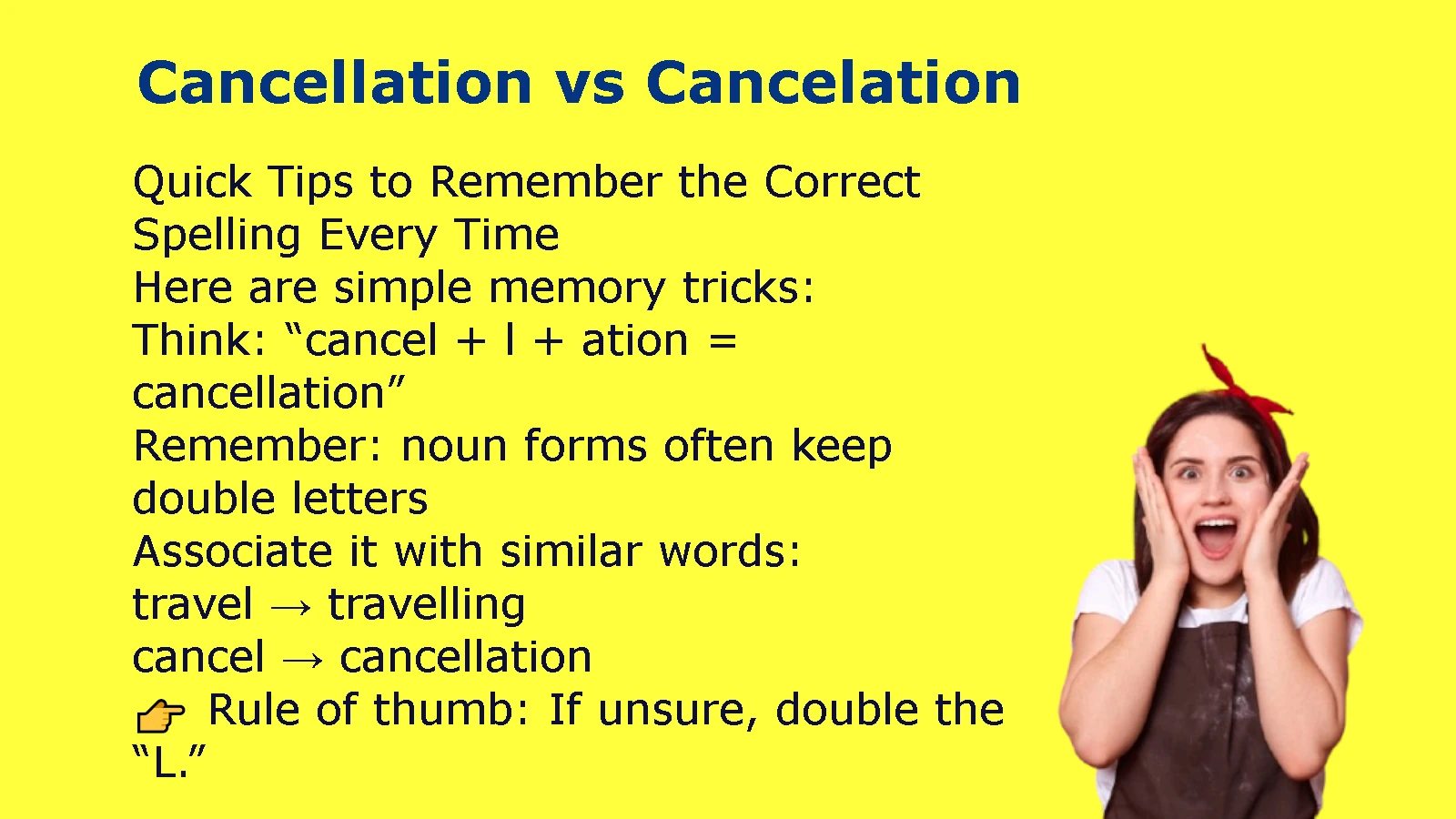
Quick Tips to Remember the Correct Spelling Every Time
Here are simple memory tricks:
- Think: “cancel + l + ation = cancellation”
- Remember: noun forms often keep double letters
- Associate it with similar words:
- travel → travelling
- cancel → cancellation
👉 Rule of thumb: If unsure, double the “L.”
How Spell Checkers Handle “Cancellation” vs “Cancelation”
Modern spell checkers and grammar tools (like Grammarly, Microsoft Word, and Google Docs) consistently:
- ✔ Accept cancellation as correct
- ⚠ Flag cancelation as incorrect or rare
Even when cancelation is recognized, it is usually marked as:
- “Less common”
- “Variant spelling”
- Or suggested to replace with cancellation
👉 This reinforces cancellation as the preferred modern standard.
Pronunciation Guide: Does Spelling Affect How You Say It?
cancellation
The pronunciation of cancellation does not change based on spelling.
Both cancellation and the rare cancelation are pronounced the same way:
- /kan-suh-LAY-shun/
👉 Key point: Spelling differences do not affect pronunciation.
So whether someone writes it correctly or incorrectly, the spoken word remains identical.
Is “Cancelation” Ever Considered Correct? Grammar Experts Weigh In
Most grammar experts agree:
- Cancellation = correct and standard
- Cancelation = rare variant
Linguists and style guides emphasize that:
- cancelation is historically recorded
- but not preferred in modern usage
👉 In expert opinion, cancelation is acceptable only in technical rarity, not recommended in practice.
How to Use “Cancellation” and “Cancelation” in Business Communication
In business writing, clarity and professionalism matter.
Recommended usage:
- flight cancellation
- order cancellation
- subscription cancellation
- service cancellation
Avoid:
- cancelation request
- cancelation policy
👉 Businesses should always use cancellation to maintain credibility and consistency.
The Evolution of the Word: From Latin Roots to Modern Usage
The word cancel originates from the Latin word cancellare, meaning “to cross out or make void.”
Over time:
- Latin → Middle English → Modern English
- “cancel” became the base verb
- “-ation” was added to form the noun
👉 This linguistic evolution is why cancellation became the standardized noun form.
How Media Style Guides Treat “Cancellation” vs “Cancelation”
Major media organizations follow strict style rules:
- Associated Press (AP Stylebook) → cancellation
- BBC Style Guide → cancellation
- Reuters Style Guide → cancellation
👉 Across journalism and publishing, cancelation is not used as a standard form.
This ensures consistency in global news reporting.
“Cancel Culture” vs “Cancellation”: Are They Related?
These two terms are often confused but are not directly related.
- Cancellation → refers to stopping or ending something (event, service, booking)
- Cancel culture → social phenomenon involving public criticism or withdrawal of support
👉 Key difference:
- One is a formal noun (cancellation)
- The other is a modern social concept
They share the root word “cancel,” but their meanings are completely different.
Is “Cancelation” Ever Correct?
Yes, but only in a very limited sense.
- It appears as a rare variant spelling
- It is mostly found in older or informal American writing
- It is not preferred in modern academic or professional English
👉 In short: it is technically recognized, but not standard.
Is “Cancelation” Ever Acceptable?
Rare Acceptance Cases
You may occasionally see cancelation in:
- informal writing
- older American publications
- rare dictionary listings as a variant
However, even in these cases, it is considered secondary and uncommon.
Why It Looks Wrong to Most Readers
Most readers are trained to recognize: 👉 cancellation as the correct spelling
Because of this familiarity, cancelation often:
- appears like a typo
- looks unprofessional
- triggers spellcheck warnings
In modern writing, readability and expectation matter more than technical correctness of rare variants.
Common Grammar Pattern: Traveling vs Travelling & Other Double-L Words
The confusion is part of a larger spelling pattern in English.
Compare:
American EnglishBritish Englishtravelingtravellinglabelinglabellingmodelingmodellingcanceledcancelled
However, nouns often behave differently. For example:
- cancel → cancellation (double “L” kept in all forms)
This shows that spelling rules are not always perfectly consistent.
Why This Pattern Matters
Understanding this pattern helps you avoid common writing mistakes, especially in:
- academic writing
- SEO content
- business communication
It also improves spelling accuracy when forming noun versions of verbs.
Common Mistakes & How to Avoid Them
Writers often make errors such as:
❌ Using “cancelation policy” on websites ❌ Mixing canceled / cancelled inconsistently ❌ Assuming all American English removes double letters
How to Avoid Mistakes
To write correctly every time:
- Always use cancellation for noun form
- Follow one English style (US or UK) consistently
- Use grammar tools for proofreading
- Learn common suffix rules like “-ation” doubling
Quick Comparison Table
FeatureCancellationCancelationCorrectnessStandardRare variantUsage in USCommonVery rareUsage in UKStandardNot usedFormal WritingRecommendedAvoidGlobal UseUniversalLimited
Final Verdict: Which One Should You Use in 2026?
Cancellation
In modern English writing, cancellation is the only safe and professional choice.
It is:
- globally accepted
- grammatically standard
- preferred in academic and business writing
- supported by all major dictionaries
👉 Cancelation may exist, but it is not suitable for professional use.
Cancellation vs Cancelation – Which Should You Use?
If you are still unsure, the answer is simple:
👉 Always use cancellation
It ensures clarity, correctness, and consistency across all types of writing, whether formal or informal.
US vs UK English Perspective
English spelling varies between regions, but not in this case.
Typical differences include:
- colour → color
- travelled → traveled
- centre → center
However, cancellation remains the same in both US and UK English, making it a globally accepted word.
Common Mistakes to Avoid
Many writers make small errors such as:
❌ Writing “cancelation policy” ❌ Mixing canceled / cancelled inconsistently ❌ Assuming American English always removes double letters
How to avoid these mistakes:
- Always use cancellation as a noun
- Stay consistent with your chosen English style
- Use proofreading tools when unsure
FAQs
Is cancelation wrong?
Not entirely, but it is rare and not recommended in formal writing.
Which is correct: cancellation or cancelation?
Cancellation is the correct and standard spelling.
Why is cancellation spelled with two Ls?
Because of the English rule where consonants are doubled before adding the suffix “-ation.”
Is cancelation used in American English?
Occasionally, but it is not the preferred or standard form.
Is cancelation wrong?
Not completely, but it is rare and not recommended in modern writing.
Why is cancellation spelled with two Ls?
Because of English spelling rules when forming nouns using the suffix “-ation.”
Which spelling is more common?
Cancellation is far more common in both US and UK English.
Is cancelation used in American English?
Yes, but only rarely and usually in informal or variant usage.
Conclusion
The confusion between cancellation vs cancelation is common, but the answer is actually very clear. Across all major English-speaking countries, dictionaries, style guides, and professional writing standards, cancellation is the correct and preferred spelling.
While cancelation does appear occasionally as a rare variant, it is not widely accepted in modern academic, business, or global communication. Using it can make your writing look inconsistent or unprofessional, even if it is technically recognized in limited contexts.
What makes this distinction important is not just grammar, but clarity and credibility. In professional writing, consistency matters, and using the standard form ensures your message is understood without distraction.
So, whether you are writing emails, articles, business documents, or SEO content, the safest and most accurate choice is simple: