Have you ever seen “Challange” vs. “Challenge” and wondered which spelling is actually correct? You’re not alone. This is one of the most common spelling mistakes in English, appearing in everything from emails and social media posts to academic writing and professional documents.
The confusion is understandable. Since the two words look very similar, many people accidentally type “challange” when they mean “challenge.” But here’s the kicker: only one of them is recognized as the correct English spelling, while the other is simply a misspelling.
The good news? The difference is easy to remember once you know the rule.
In this guide, you’ll learn the correct usage of “Challange” vs. “Challenge,” discover why this common grammar and spelling error happens, and see examples that will help you avoid it in your writing, communication, and everyday conversations. And it gets better—you’ll also learn simple memory tricks to ensure you never make this mistake again.
Let’s clear up the confusion once and for all.
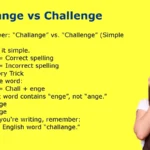
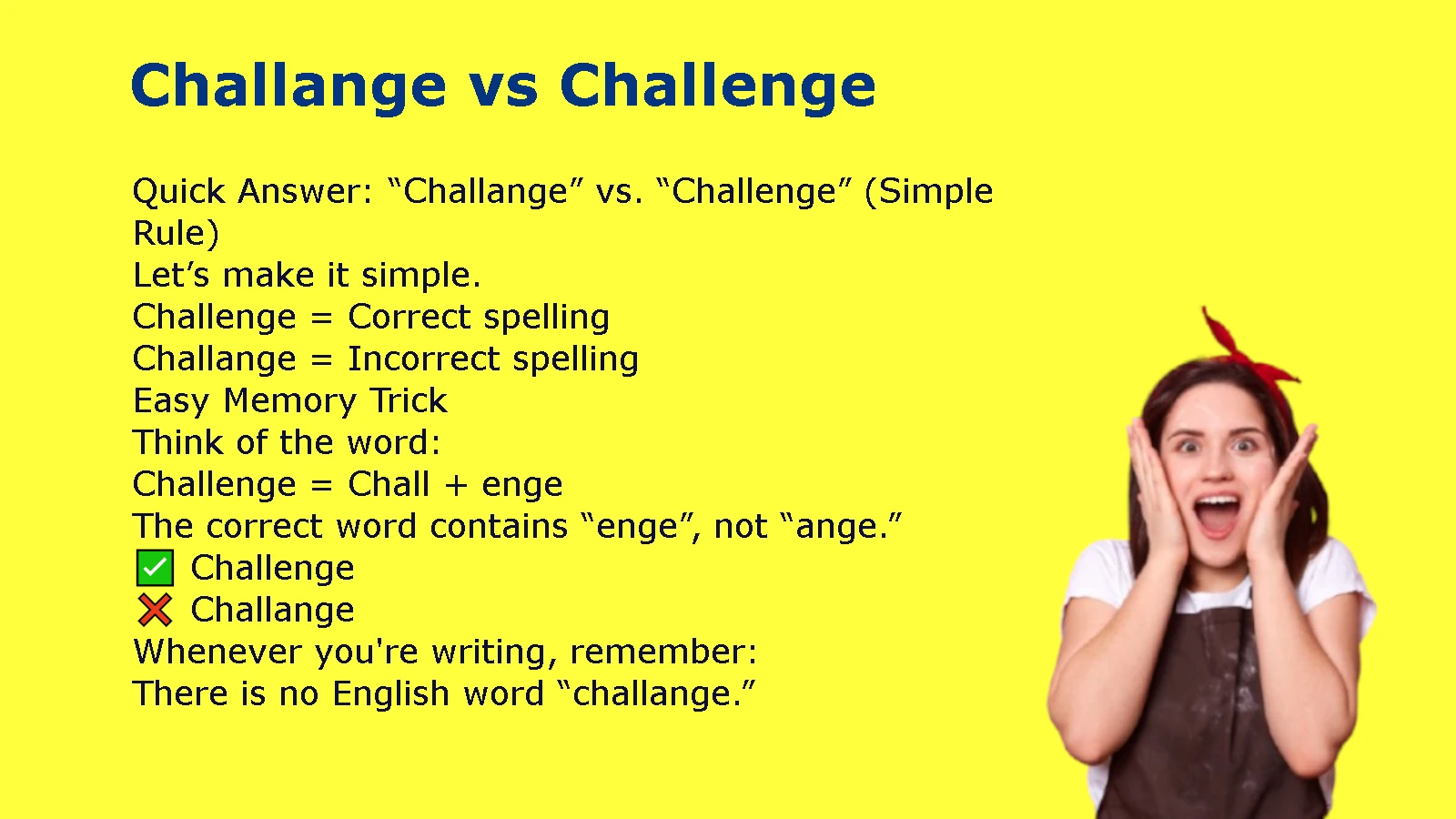
Quick Answer: “Challange” vs. “Challenge” (Simple Rule)
Let’s make it simple.
Challenge = Correct spelling
Challange = Incorrect spelling
Easy Memory Trick
Think of the word:
Challenge = Chall + enge
The correct word contains “enge”, not “ange.”
✅ Challenge
❌ Challange
Whenever you’re writing, remember:
There is no English word “challange.”
Which Spelling Is Correct?
The correct spelling is:
Challenge
This word can be used as both a noun and a verb.
As a Noun
A difficult task or situation that tests your abilities.
Example:
Learning a new language is a challenge.
As a Verb
To question, compete against, or test someone.
Example:
She challenged her friend to a race.
No matter how it’s used, the spelling remains:
Challenge
Why Do People Write “Challange”?
This mistake is extremely common.
The Pronunciation Sounds Similar
When people say:
Challenge
The middle sound can sometimes seem like “an” instead of “en.”
As a result, many writers spell it as:
Challange
instead of:
Challenge
Fast Typing Habits
Another reason is simple typing error.
Many people type quickly and don’t notice they’ve replaced:
e → a
Spellcheck Doesn’t Always Catch It Immediately
Sometimes the mistake slips through drafts, emails, or social media posts before anyone notices.
Key Insight
Most people misspell the word because of pronunciation—not because they don’t know the meaning.
The Dictionary Definition of “Challenge”
According to standard English dictionaries, challenge has several meanings.
Common Meanings
- A difficult task
- A test of ability
- A competition
- An invitation to compete
- A question or objection
Examples
- The mountain climb was a challenge.
- He accepted the challenge.
- The lawyer challenged the decision.
- She enjoys challenging projects.
Notice that every example uses:
Challenge
Never challange.
The Calendar Test: Spot the Correct Spelling
A quick way to check yourself is to imagine the word in a sentence.
Example 1
Correct:
This project is a challenge.
Incorrect:
This project is a challange.
Example 2
Correct:
I challenge you to finish first.
Incorrect:
I challange you to finish first.
Example 3
Correct:
Running a marathon is a challenge.
Incorrect:
Running a marathon is a challange.
If the word appears in professional writing, books, dictionaries, or websites, you’ll always see:
Challenge
“Challenge” as a Noun Explained
Most people first encounter the word as a noun.
Meaning
Something difficult that requires effort or skill.
Common Examples
- A fitness challenge
- A business challenge
- A personal challenge
- A technical challenge
- A learning challenge
Sample Sentences
- Starting a company is a challenge.
- The exam presented a major challenge.
- Time management can be a challenge.
Key Idea
As a noun, challenge refers to a difficulty or test.
“Challenge” as a Verb Explained
The word can also be used as a verb.
Meaning
To test, question, or compete against someone.
Common Examples
- Challenge an opponent
- Challenge a decision
- Challenge an idea
- Challenge authority
- Challenge yourself
Sample Sentences
- I challenge you to try again.
- The team challenged the champions.
- She challenged the ruling in court.
Key Idea
As a verb, challenge means to confront, question, or compete.
The Biggest Mistake People Make
The most common mistake is assuming:
If it sounds right, it must be spelled right.
English doesn’t always work that way.
What Goes Wrong
People hear:
Challenge
But write:
Challange
because they rely on sound rather than spelling.
The Result
- Writing mistakes
- Reduced credibility
- Professional errors
- Lower academic grades
Lesson
Always trust the standard spelling, not the pronunciation.
Side-by-Side Comparison Table
| Word | Correct? | Meaning | Use in Writing |
| Challenge | ✅ Yes | Difficult task, test, or competition | Always use |
| Challange | ❌ No | Not an English word | Never use |
Real-Life Examples of “Challenge”
Let’s see how native speakers use the word.
In School
Math is a challenge for many students.
At Work
Meeting the deadline was a challenge.
In Sports
The athlete welcomed the challenge.
In Personal Growth
I challenge myself to learn something new every day.
Notice the spelling remains exactly the same in every situation.
Common Phrases Using “Challenge”
These expressions appear frequently in English.
Popular Examples
- Accept a challenge
- Face a challenge
- Rise to the challenge
- Challenge yourself
- Challenge accepted
- A challenging situation
- A major challenge
- Challenge the status quo
Example Sentences
- She rose to the challenge.
- Challenge accepted!
- They challenged the old system.
All of these use the correct spelling:
Challenge
Why Correct Spelling Matters
Some spelling mistakes are minor.
Others can affect how people view your writing.
In Academic Writing
Misspellings can lower grades and credibility.
In Professional Communication
Errors in emails and reports can appear careless.
In Online Content
Search engines and readers prefer correctly spelled words.
Key Tip
If you’re unsure, double-check before publishing or sending important content.
What to Do If You Keep Writing “Challange”
Many people make the same mistake repeatedly.
Here are some ways to fix it.
Use Spellcheck
Modern tools usually flag:
Challange
and suggest:
Challenge
Practice the Correct Form
Write the word several times:
Challenge
Associate It With “Engage”
Notice both words contain:
enge
- Challenge
- Engage
This memory trick helps many learners.
Read More
The more you encounter the word in books and articles, the more natural the spelling becomes.
Quick Decision Guide (Use This Instantly)
When writing, ask yourself:
Is the word referring to a difficult task, competition, or test?
If yes:
✅ Challenge
❌ Challange
Simple. Reliable. Done.
FAQ: “Challange” vs. “Challenge”
Is “challange” a real word?
No. It is a misspelling of challenge.
Why do people spell challenge as challange?
Because the pronunciation can make the middle vowel sound unclear.
Which spelling should I use in professional writing?
Always use challenge.
Is “challange” accepted in British English?
No. Both British and American English use challenge.
Can challenge be both a noun and a verb?
Yes. It can describe a difficult task or the act of testing or questioning someone.
Case Study: A Simple Workplace Error
A job applicant submitted a cover letter that said:
“I enjoy taking on new challanges.”
The hiring manager immediately noticed the spelling mistake.
What Happened
- The applicant had strong qualifications.
- The error distracted from the message.
- It created an impression of carelessness.
The Fix
The corrected sentence became:
“I enjoy taking on new challenges.”
A single letter made the writing look more professional.
Lesson
Small spelling mistakes can have a big impact.
Key Facts You Should Remember
- Challenge is the correct spelling.
- Challange is incorrect.
- Challenge can be a noun or a verb.
- The mistake usually happens because of pronunciation.
- Dictionaries recognize only challenge.
- Professional and academic writing should always use the correct form.
Final Takeaway: The One Rule That Never Fails
Here’s the truth.
The debate between “challange” vs. “challenge” is actually very simple. Only one spelling is correct.
Use:
✅ Challenge
Avoid:
❌ Challange
Whenever you’re writing about a difficult task, competition, test, or obstacle, the correct word is always challenge.
Think of it this way: spelling is the first thing readers notice. A single wrong letter can distract from an otherwise excellent piece of writing.
So remember:
Challenge = Correct
Challange = Incorrect
And when in doubt, choose challenge every single time.