Ever wondered whether you should write Hide or Hyde? The confusion between Hide vs. Hyde is surprisingly common because the two words sound exactly alike, yet they have completely different meanings and uses in the English language.
If you’ve ever paused while writing an email, essay, social media post, or even a casual message, you’re not alone. Many writers mix up these homophones, leading to spelling mistakes, grammar errors, and awkward sentences. But here’s the kicker: using the wrong word can change the meaning of your sentence entirely.
The good news? Once you understand the difference, it’s easy to remember.
In this guide, you’ll learn the meaning of Hide vs. Hyde, when to use each word, common examples, and simple memory tricks to avoid confusion. You’ll also discover how these commonly confused words appear in everyday writing, professional communication, and English vocabulary exercises.
So, if you’re ready to improve your word choice, strengthen your writing skills, and stop second-guessing yourself, let’s break down the difference between Hide and Hyde once and for all.
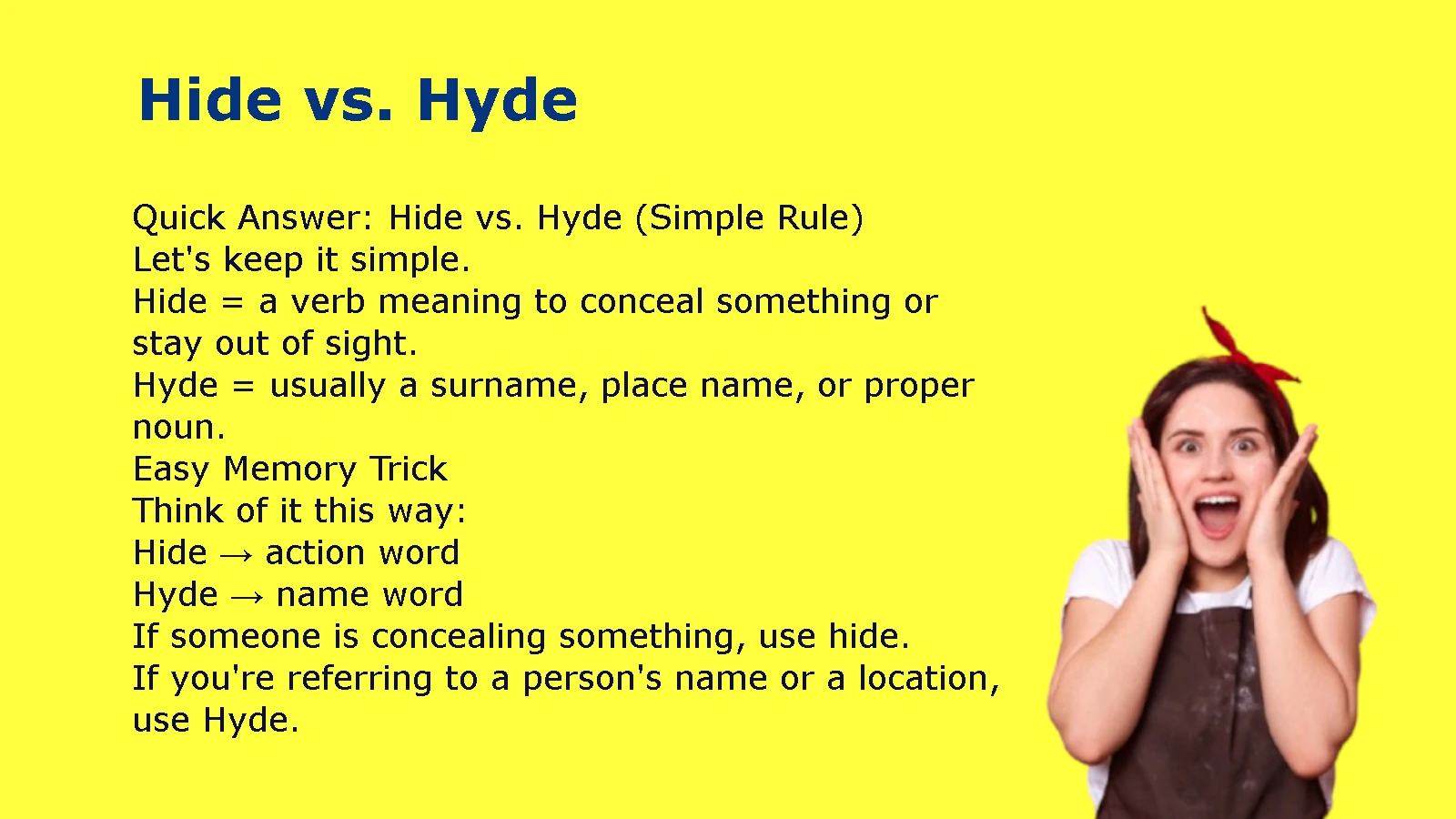
Quick Answer: Hide vs. Hyde (Simple Rule)
Let’s keep it simple.
Hide = a verb meaning to conceal something or stay out of sight.
Hyde = usually a surname, place name, or proper noun.
Easy Memory Trick
Think of it this way:
- Hide → action word
- Hyde → name word
If someone is concealing something, use hide.
If you’re referring to a person’s name or a location, use Hyde.
How People Actually Use Hide and Hyde
Most confusion happens because both words sound identical.
In Everyday Writing
People accidentally write:
- “I need to hyde this gift.”
This is incorrect.
The correct sentence is:
- “I need to hide this gift.”
In Names and Places
You may encounter:
- Hyde Park
- Dr. Jekyll and Mr. Hyde
- Hyde Street
In these cases, Hyde is correct because it is part of a proper name.
Why This Happens
English spelling often doesn’t match pronunciation perfectly.
Because hide and Hyde sound alike, writers sometimes choose the wrong spelling when typing quickly.
The Meaning of “Hide”
The word hide is most commonly used as a verb.
Definition
To hide means:
- To conceal something
- To keep out of sight
- To prevent something from being seen
Examples
- Please hide the birthday present.
- The cat likes to hide under the bed.
- He tried to hide his disappointment.
- Children love to hide during games.
Common Uses
You can hide:
- Objects
- Feelings
- Information
- Yourself
Key Insight
Whenever the word describes an action involving concealment, hide is the correct spelling.
The Meaning of “Hyde”
Unlike hide, Hyde is usually a proper noun.
Definition
Hyde is commonly:
- A family name
- A place name
- A character name
Examples
- Mr. Hyde is a famous literary character.
- We visited Hyde Park during our trip.
- Sarah Hyde wrote the report.
Important Rule
Because Hyde is a proper noun, it is usually capitalized.
Key Insight
If you’re talking about a person, place, or title with the name Hyde, use Hyde.
The Literary Connection: Dr. Jekyll and Mr. Hyde
One reason many people recognize the word Hyde is the famous novel Strange Case of Dr Jekyll and Mr Hyde.
Why It’s Famous
The story features two identities:
- Dr. Jekyll
- Mr. Hyde
Mr. Hyde represents the darker side of human nature.
Common Mistake
Because people frequently encounter the name Hyde in literature, they sometimes mistakenly use it instead of the verb hide.
Example
Incorrect:
- I need to Hyde my keys.
Correct:
- I need to hide my keys.
Side-by-Side Comparison Table
| Word | Meaning | Part of Speech | Example |
| Hide | To conceal or keep out of sight | Verb | Hide the gift in the closet. |
| Hyde | A name or proper noun | Proper Noun | We walked through Hyde Park. |
Real-Life Examples of Hide
Let’s look at common situations.
At Home
- Hide the remote before the dog finds it.
- She hid the surprise decorations.
School
- Students sometimes hide notes in textbooks.
- He tried to hide his nervousness before the presentation.
Work
- Never hide important information from your team.
- The company cannot hide financial problems forever.
What They Mean
In every example, hide refers to an action.
Real-Life Examples of Hyde
Now compare.
Names
- Michael Hyde joined the meeting.
- Professor Hyde published a new study.
Locations
- Hyde Park attracts millions of visitors each year.
- The hotel is near Hyde Street.
Literature
- Mr. Hyde is one of literature’s most famous characters.
What They Mean
In every example, Hyde functions as a name.
The Biggest Mistake People Make
The most common mistake is assuming that because the words sound identical, their spelling doesn’t matter.
Incorrect Examples
- Please hyde the documents.
- She likes to hyde from her friends.
- Can you hyde this package?
Correct Versions
- Please hide the documents.
- She likes to hide from her friends.
- Can you hide this package?
Lesson
If the word means “conceal,” always choose hide.
How to Avoid Confusion Every Time
Want a foolproof method?
Ask Yourself One Question
Is this word describing an action?
If yes:
Use hide.
If no, and it’s a person’s name or place:
Use Hyde.
Look for Capital Letters
A capitalized Hyde often signals a proper noun.
Examples:
- Hyde Park
- Mr. Hyde
- Emma Hyde
Check the Sentence
Replace the word with “conceal.”
If the sentence still makes sense, hide is the correct choice.
What to Say Instead (When You’re Unsure)
Sometimes rewriting can help.
Instead of “hide”
You could use:
- Conceal
- Cover
- Shelter
- Keep secret
Instead of “Hyde”
Use the exact name being referenced if possible.
Why This Helps
Alternative wording can make your meaning clearer and reduce spelling mistakes.
Quick Decision Guide (Use This Instantly)
Follow this simple checklist:
Does the word mean conceal?
→ Use hide
Is it someone’s name?
→ Use Hyde
Is it a place name?
→ Use Hyde
Still unsure?
→ Check whether it can be replaced with “conceal.”
FAQ: Hide vs. Hyde
Are hide and Hyde pronounced the same?
Yes. They are homophones and share the same pronunciation.
Is Hyde ever used as a verb?
No. Hyde is generally used as a proper noun.
Why do people confuse hide and Hyde?
Because they sound identical when spoken.
Is Hyde always capitalized?
Usually yes, because it is typically a name or place.
Which word should I use when talking about concealment?
Always use hide.
Case Study: A Costly Typing Error
A company employee wrote:
“Please Hyde the confidential files.”
The message was sent to dozens of colleagues.
What Happened
Some readers thought “Hyde” referred to a person’s name.
Others understood the intended meaning but noticed the spelling error.
Result
The email appeared less professional and required clarification.
Fix
The corrected version was:
“Please hide the confidential files.”
A single letter made the message instantly clear.
Key Facts You Should Remember
- Hide means to conceal something.
- Hyde is usually a name or place.
- Both words sound exactly the same.
- Hide is a verb.
- Hyde is generally a proper noun.
- Capitalization often helps identify Hyde.
- Most mistakes occur because of pronunciation similarities.
Final Takeaway: The One Rule That Never Fails
Here’s the easiest rule to remember:
If someone is concealing something, use “hide.”
If you’re referring to a person, place, or famous name, use “Hyde.”
That’s it.
The words may sound identical, but their meanings are completely different. One describes an action. The other identifies a name.
Whenever you’re unsure, ask yourself:
“Am I talking about concealment or a name?”
If it’s concealment, choose hide.
If it’s a name, choose Hyde.
Follow that simple rule, and you’ll never confuse Hide vs. Hyde again.