Ever wondered why so many people get confused between Powerfull vs. Powerful when writing, even though only one of them is actually correct? It’s a small spelling difference, but it can completely change how polished and professional your writing looks.
The truth is, many writers accidentally add an extra “l” and end up using the wrong form, which leads to one of the most common spelling mistakes in English. And here’s the kicker: even confident speakers often don’t realize they’re making this error in emails, essays, or social media posts.
You’re not alone if you’ve ever paused mid-sentence wondering which version is right. This confusion is more common than you think, especially when dealing with commonly misspelled words and similar-looking terms in English grammar.
But don’t worry—this is easy to fix once you understand the rule.
In this guide, you’ll clearly learn the difference between Powerfull vs. Powerful, why only one spelling is correct, and how to avoid this mistake forever. You’ll also discover simple memory tricks and real examples so the correct usage becomes automatic.
And it gets better—you’ll also explore related English spelling rules, word formation patterns, and common errors that often confuse learners.
So if you’re ready to stop second-guessing your spelling and write with confidence, let’s break it down.
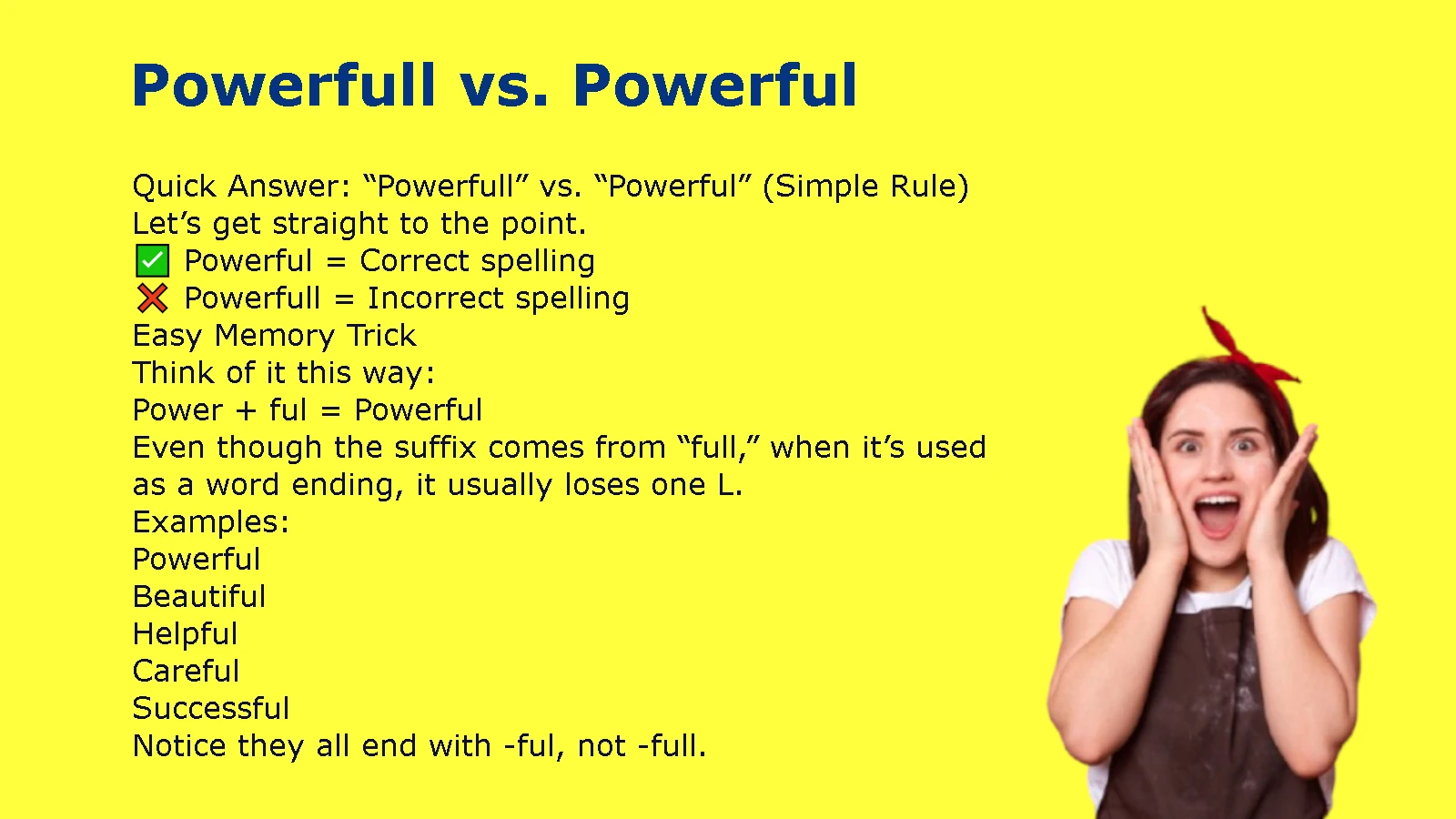
Quick Answer: “Powerfull” vs. “Powerful” (Simple Rule)
Let’s get straight to the point.
✅ Powerful = Correct spelling
❌ Powerfull = Incorrect spelling
Easy Memory Trick
Think of it this way:
Power + ful = Powerful
Even though the suffix comes from “full,” when it’s used as a word ending, it usually loses one L.
Examples:
- Powerful
- Beautiful
- Helpful
- Careful
- Successful
Notice they all end with -ful, not -full.
Why Do People Write “Powerfull”?
The mistake is understandable.
Many English words contain the word full with two Ls:
- Full tank
- Full moon
- Full attention
Because of this, people naturally assume powerfull should also use two Ls.
The Real Reason
When full becomes the suffix -ful, English typically drops one L.
For example:
Base WordCorrect FormPowerPowerfulHelpHelpfulCareCarefulBeautyBeautiful
This is why powerful is correct and powerfull is not.
The Grammar Rule Behind “Powerful”
Understanding the rule makes the spelling easier to remember.
What Does “-ful” Mean?
The suffix -ful means:
- Full of
- Having
- Characterized by
So:
Powerful = Full of power
Examples
- Helpful = Full of help
- Beautiful = Full of beauty
- Skillful = Full of skill
- Hopeful = Full of hope
Key Insight
When creating adjectives with -ful, English usually uses one L, not two.
“Powerful” Explained Clearly
The word powerful is an adjective.
Meaning
It describes someone or something that has:
- Great strength
- Influence
- Authority
- Effectiveness
Examples
- She delivered a powerful speech.
- The storm was extremely powerful.
- He became a powerful leader.
- This computer is surprisingly powerful.
In every case, the spelling remains powerful.
Why “Powerfull” Is Incorrect
You may occasionally see powerfull online.
However, it is considered a spelling error.
Common Places It Appears
- Social media posts
- Informal messages
- Student writing
- Typing mistakes
What Dictionaries Say
Major dictionaries recognize only powerful as the standard English spelling.
Key Takeaway
If you’re writing professionally, academically, or publicly, always use powerful.
The Biggest Mistake People Make
The most common mistake is assuming every word related to full keeps both Ls.
What Goes Wrong
People think:
Power + full = Powerfull
But English spelling changes the suffix:
Power + ful = Powerful
Lesson
Don’t spell by sound alone. Follow the suffix rule.
Side-by-Side Comparison Table
Here’s a quick reference:
WordCorrect?MeaningPowerful✅ YesFull of powerPowerfull❌ NoIncorrect spelling
Quick Rule
One L = Correct
Two Ls = Incorrect
Real-Life Examples of “Powerful”
Let’s see the correct spelling in action.
Common Sentences
- That was a powerful performance.
- The movie delivers a powerful message.
- She is a powerful advocate for change.
- The engine is incredibly powerful.
- His words had a powerful impact.
What They Show
In every context, powerful uses only one L.
Common Words Similar to “Powerful”
Learning similar words helps reinforce the pattern.
Correct Examples
- Beautiful
- Helpful
- Careful
- Useful
- Hopeful
- Successful
- Thoughtful
Notice the Pattern
All these adjectives use:
-ful
Not:
-full
Exceptions That Confuse People
English always finds a way to be interesting.
Words That Keep Two Ls
Some words genuinely use full as a standalone word.
Examples:
- Full-time
- Full moon
- Full capacity
- Full house
Difference
When full stands alone, keep both Ls.
When -ful is a suffix, use one L.
How to Avoid This Mistake Every Time
Want a foolproof method?
Remember the Suffix Rule
If the word means “full of something,” it usually ends in -ful.
Use Spell Check
Most writing tools instantly flag:
❌ Powerfull
And suggest:
✅ Powerful
Read the Word Slowly
Power + ful
Not:
Power + full
Why This Works
Breaking words into parts helps you spot errors before they happen.
What to Say Instead? (If You’re Unsure)
If you forget the spelling, think of related words.
Similar Correct Words
- Helpful
- Useful
- Careful
- Hopeful
Since they all use -ful, powerful follows the same pattern.
Quick Tip
If you’re tempted to type two Ls, stop and double-check.
Quick Decision Guide (Use This Instantly)
When writing:
Does the word mean “full of power”?
➡ Use powerful
Thinking about using powerfull?
➡ Don’t. It’s incorrect.
Simple. Reliable. Done.
FAQ: “Powerfull” vs. “Powerful”
Is “powerfull” ever correct?
No. Standard English recognizes only powerful.
Why do people spell it with two Ls?
Because the word full itself uses two Ls, leading many people to assume the adjective should as well.
Is “powerful” American or British English?
Both American and British English use powerful.
Is “powerfull” accepted in dictionaries?
No. Major dictionaries list only powerful.
How can I remember the correct spelling?
Think of words like helpful, careful, and beautiful. They all use -ful.
Case Study: A Simple Writing Mistake
A university student submitted an essay about influential leaders.
Throughout the paper, they wrote:
“Nelson Mandela was a powerfull leader.”
What Happened
The teacher marked every occurrence as a spelling error.
Why
The correct spelling is:
“Nelson Mandela was a powerful leader.”
Lesson
A small spelling mistake repeated multiple times can affect the professionalism and credibility of your writing.
Key Facts You Should Remember
- Powerful is the correct spelling.
- Powerfull is incorrect.
- The adjective uses the suffix -ful.
- Most English adjectives ending in -ful use only one L.
- Spell checkers usually catch this mistake.
- Learning the suffix rule prevents similar errors.
Final Takeaway: The One Rule That Never Fails
Here’s the truth.
The debate between “powerfull” vs. “powerful” isn’t really a debate at all. Only one spelling is accepted in standard English.
Remember this simple rule:
Powerful = Correct
Powerfull = Incorrect
Think about words like helpful, careful, and beautiful. They all use the -ful suffix, and powerful follows the same pattern.
Whenever you write, keep it simple:
One L → Correct
Two Ls → Wrong
And if you’re ever unsure, let spell check confirm it.
Because when it comes to “powerfull” vs. “powerful,” accuracy is easy once you know the rule.