Ever wondered why Signer vs. Signor confuses so many people, even when the words look completely different? One belongs to legal signing and documentation, while the other is an Italian honorific title—yet they are often mixed up in writing and speech.
That’s where the problem begins. You’re not alone if you’ve ever mistaken legal signer terminology, Italian language honorifics, or even basic spelling variations in formal communication. And here’s the kicker: using the wrong word can instantly change your meaning or make your writing look unprofessional.
But don’t worry—this is easier to fix than it seems.
In this guide, you’ll clearly understand Signer vs. Signor, along with their correct meanings, usage differences, and real examples. You’ll also learn related concepts like formal signing roles in legal documents, Italian courtesy titles, and common mistakes people make when confusing the two.
And it gets better—you’ll also get simple memory tricks to never mix them up again.
So, if you want to write with confidence and avoid embarrassing errors, you’re in the right place. Let’s break it down.
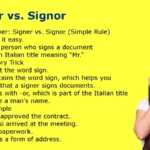
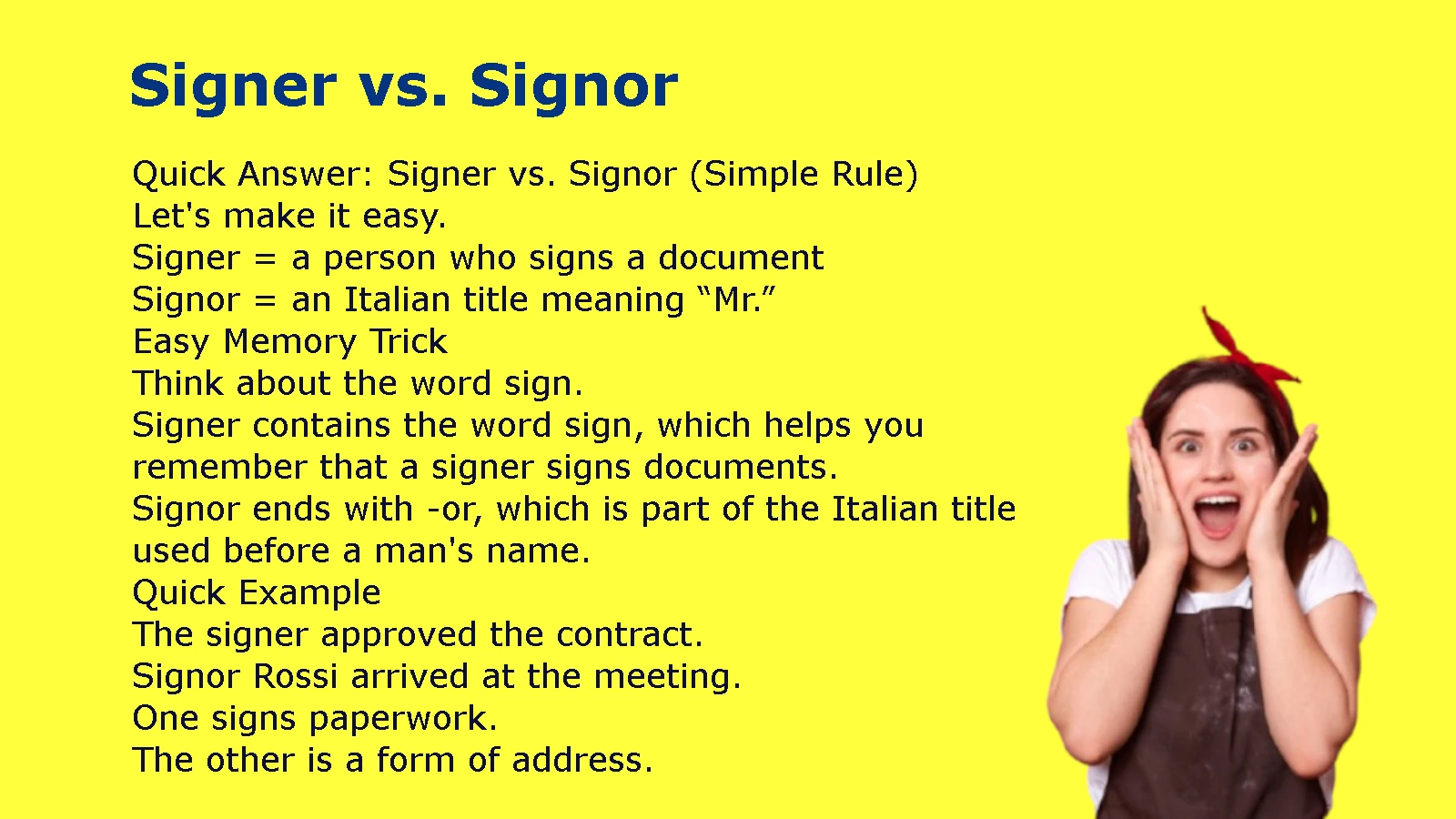
Quick Answer: Signer vs. Signor (Simple Rule)
Let’s make it easy.
Signer = a person who signs a document
Signor = an Italian title meaning “Mr.”
Easy Memory Trick
Think about the word sign.
Signer contains the word sign, which helps you remember that a signer signs documents.
Signor ends with -or, which is part of the Italian title used before a man’s name.
Quick Example
- The signer approved the contract.
- Signor Rossi arrived at the meeting.
One signs paperwork.
The other is a form of address.
What Does “Signer” Mean?
Let’s start with the English word.
A signer is a person who signs a document, agreement, letter, petition, or legal form.
Common Uses of Signer
- Legal contracts
- Business agreements
- Petitions
- Official documents
- Financial paperwork
Examples
- The signer must provide identification.
- Every signer agreed to the terms.
- The contract requires two signers.
- The signer completed all necessary paperwork.
Key Insight
A signer is identified by an action.
The person becomes a signer because they sign something.
What Does “Signor” Mean?
Now let’s look at the Italian term.
Signor is an Italian title used before a man’s surname or full name.
It is equivalent to Mr. in English.
Common Uses of Signor
- Italian conversations
- Formal greetings
- Literature
- Historical writing
- Travel in Italy
Examples
- Good evening, Signor Bianchi.
- Signor Rossi owns the restaurant.
- Thank you for your help, Signor.
- The waiter greeted Signor Moretti warmly.
Key Insight
Signor is not related to signing documents.
It is simply a respectful title for a man.
The Core Difference Between Signer and Signor
The confusion usually happens because the words look nearly identical.
However, they belong to completely different categories.
| Word | Meaning | Language | Usage |
| Signer | Person who signs | English | Legal and business contexts |
| Signor | Mr. (male title) | Italian | Names and formal address |
Simple Rule
If paperwork is involved → Signer
If an Italian title is involved → Signor
Why People Confuse “Signer” and “Signor”
The mistake is understandable.
They Look Similar
Only one letter changes.
- Signer
- Signor
When reading quickly, the difference can be easy to miss.
Similar Pronunciation
In some accents, the words sound somewhat alike.
Autocorrect Issues
Spell-check tools sometimes fail to catch the mistake because both words are legitimate words.
Key Takeaway
The confusion comes from spelling similarity, not meaning similarity.
“Signer” Explained With Real Examples
Let’s see how signer works in everyday situations.
Legal Documents
- The signer accepted the agreement.
- Each signer received a copy of the contract.
Banking
- The account signer must be present.
- The signer provided proof of identity.
Business
- Every signer approved the proposal.
- The signer reviewed the final draft before signing.
Mini Scenario
A company sends a contract.
The employee signs it.
That employee becomes the signer.
Simple.
“Signor” Explained With Real Examples
Now compare that with signor.
Formal Greetings
- Welcome, Signor Romano.
- Good morning, Signor Conti.
Travel Situations
- Signor Ferrari reserved a table.
- The hotel welcomed Signor Ricci.
Literature
- The detective questioned Signor Bellini.
- Signor Moretti entered the room quietly.
Mini Scenario
You visit Italy.
A receptionist says:
“Good afternoon, Signor Rossi.”
They’re using a title, not describing someone who signed a document.
The Biggest Mistake People Make
The most common error is using one word when the other is intended.
Incorrect
- The contract was approved by Signor Smith.
If Smith is signing a contract, this is wrong unless he is actually being addressed with an Italian title.
Correct
- The contract was approved by the signer.
Another Incorrect Example
- Dear Signer Rossi
Correct
- Dear Signor Rossi
Lesson
Always ask:
Am I talking about a person signing something?
Or am I using an Italian title?
Side-by-Side Comparison Table
Here’s a quick reference.
| Feature | Signer | Signor |
| Meaning | Person who signs | Italian title for a man |
| Language | English | Italian |
| Used in Contracts | Yes | No |
| Used Before Names | Rarely | Yes |
| Related to Signatures | Yes | No |
| Equivalent to Mr. | No | Yes |
Real-Life Examples of “Signer”
Common Sentences
- The signer reviewed the agreement carefully.
- Every signer must submit identification.
- The signer accepted the legal terms.
- The signer dated the document correctly.
Professional Example
A lawyer says:
“The signer must complete page three.”
Everyone understands that the lawyer means the person signing the document.
Real-Life Examples of “Signor”
Common Sentences
- Signor Rossi is waiting outside.
- Thank you, Signor.
- Signor Bellini owns the vineyard.
- We met Signor Romano during our trip.
Cultural Example
In Italy, using Signor is a polite and respectful way to address an adult man.
Regional and Language Differences
Understanding the language background helps prevent confusion.
In English-Speaking Countries
Signer appears frequently in:
- Contracts
- Forms
- Legal documents
- Banking paperwork
In Italy
Signor is a common title used in daily conversation.
International Communication
People who work with international clients may encounter both words regularly.
This is where mistakes often occur.
Key Tip
Check whether the context is legal English or Italian naming conventions.
How to Avoid Confusion Every Time
Want a foolproof strategy?
Look for Documents
If contracts, forms, or signatures appear in the sentence, choose signer.
Look for Names
If the word comes before a surname, choose signor.
Read the Full Context
Never decide based on spelling alone.
Double-Check Formal Writing
Professional emails and legal documents deserve an extra review.
Why This Works
Context reveals the intended meaning almost instantly.
What to Say Instead (Clear Alternatives)
Sometimes using alternatives can improve clarity.
Alternatives for Signer
- Signatory
- Contract signer
- Authorized signer
- Participant
Alternatives for Signor
- Mr.
- Mister
- Sir
Examples
Instead of:
- Signor Johnson signed the agreement.
Use:
- Mr. Johnson signed the agreement.
This eliminates potential confusion.
Quick Decision Guide (Use This Instantly)
Ask yourself one question:
Is the person signing something?
Yes → Signer
No →
Am I using an Italian title before a man’s name?
Yes → Signor
Still unsure?
Replace Signor with “Mr.”
If the sentence still makes sense, Signor is probably correct.
FAQ: Signer vs. Signor
Is Signor an English word?
Not originally. It comes from Italian but is commonly used in English writing when referring to Italian men.
Can Signer be used as a title?
No. Signer describes a role, not a title.
Is Signor the same as Mr.?
Yes. Signor is essentially the Italian equivalent of Mr.
Which word appears in contracts?
Signer.
Which word appears before Italian names?
Signor.
Case Study: An Embarrassing Business Email
A company representative wrote:
“Dear Signer Rossi,”
The intention was to politely address an Italian client.
What Went Wrong?
The writer confused:
- Signer (person signing)
- Signor (Mr.)
Result
The greeting looked unprofessional.
Although the client understood the message, the mistake reduced credibility.
Better Version
“Dear Signor Rossi,”
A simple correction made the email appropriate and respectful.
Key Facts You Should Remember
- Signer means a person who signs a document.
- Signor is an Italian title meaning Mr.
- Signer is common in legal and business settings.
- Signor is common in Italian names and greetings.
- The words look similar but have unrelated meanings.
- Context quickly reveals which word is correct.
Final Takeaway: The One Rule That Never Fails
Here’s the easiest way to remember the difference between Signer vs. Signor.
If someone is putting their signature on a document, they are a signer.
If you’re respectfully addressing an Italian man, use Signor.
Think of it this way:
Signer signs.
Signor is a sir.
That single distinction eliminates nearly every mistake.
So the next time you encounter these two similar-looking words, don’t rely on spelling alone. Look at the context.
Documents and signatures point to signer.
Italian names and formal titles point to signor.
Follow that rule, and you’ll never mix them up again.