Have you ever seen Present vs. Presant and wondered which spelling is correct? You’re not alone. Many writers, students, and English learners get confused by these similar-looking words, especially when typing quickly or relying on spelling rules they aren’t completely sure about.
The problem is that a simple spelling mistake can affect the clarity and professionalism of your writing. Whether you’re working on business emails, academic assignments, social media posts, or everyday messages, using the wrong word can leave readers questioning your grammar and vocabulary skills.
But here’s the good news: the answer is straightforward.
In this guide, you’ll learn the difference between Present vs. Presant, discover which spelling is correct in standard English, and understand why this common English language error happens. You’ll also see practical examples, pronunciation tips, and easy memory tricks to help you avoid similar word confusion mistakes in the future.
So, if you’ve ever second-guessed your spelling or wanted to improve your writing skills, keep reading—we’ll clear up the confusion once and for all.
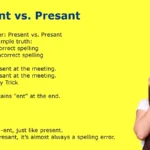
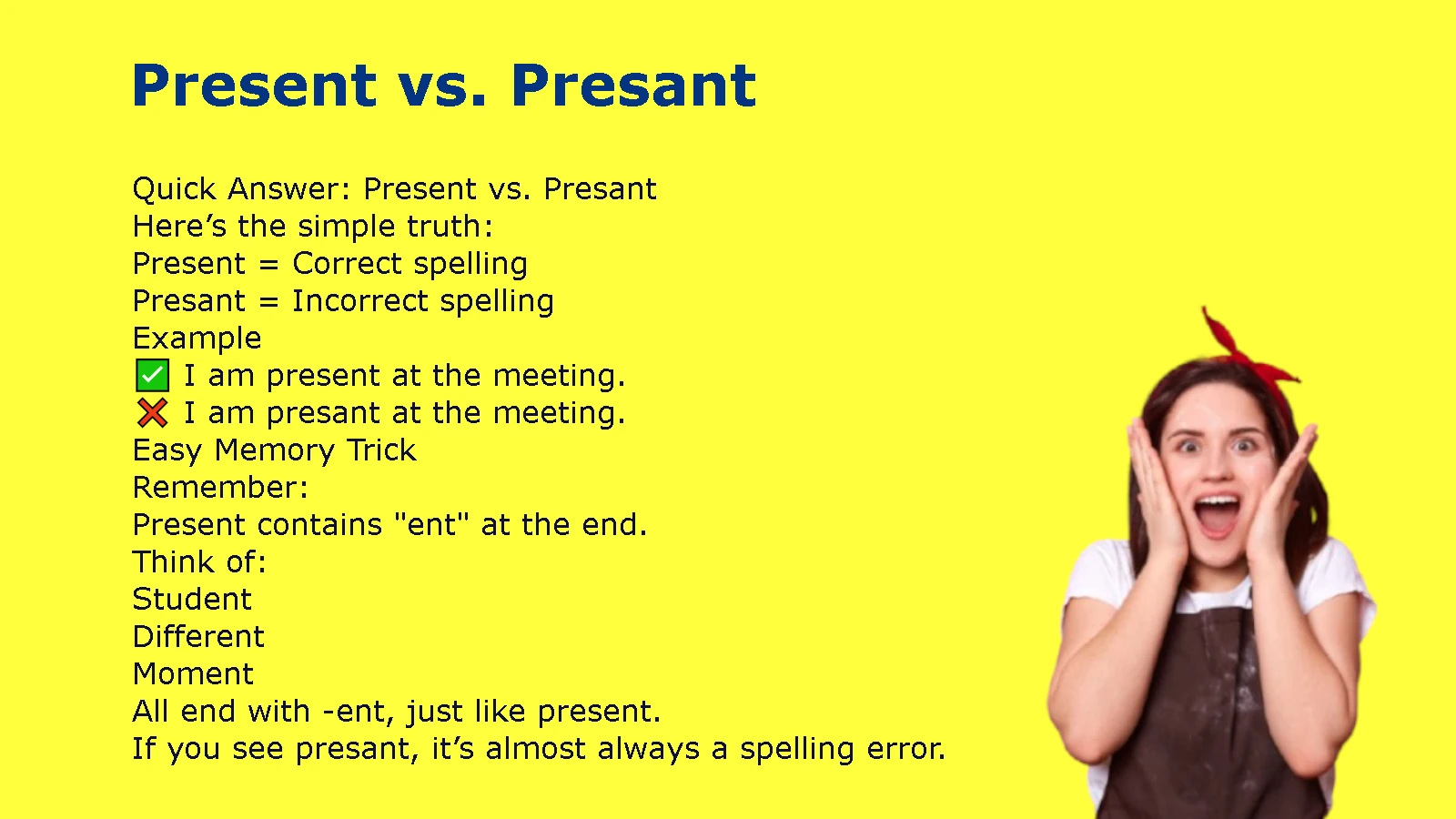
Quick Answer: Present vs. Presant
Here’s the simple truth:
Present = Correct spelling
Presant = Incorrect spelling
Example
✅ I am present at the meeting.
❌ I am presant at the meeting.
Easy Memory Trick
Remember:
Present contains “ent” at the end.
Think of:
- Student
- Different
- Moment
All end with -ent, just like present.
If you see presant, it’s almost always a spelling error.
What Does “Present” Mean?
The word present is a legitimate English word with several meanings.
As an Adjective
It can mean being somewhere physically.
Examples:
- All students were present in class.
- The manager is present at today’s meeting.
- Everyone was present during the ceremony.
As a Noun
It can mean a gift.
Examples:
- She received a birthday present.
- The present was beautifully wrapped.
- Thank you for the wonderful present.
As a Verb
It can mean to give, show, or introduce something.
Examples:
- I will present my project tomorrow.
- The company will present its findings next week.
- She presented an award to the winner.
As a Time Reference
It can refer to the current time.
Examples:
- Focus on the present, not the past.
- We must live in the present.
- The present situation requires attention.
Is “Presant” a Real Word?
No.
Presant is not a standard English word.
Most dictionaries do not recognize it as a correct spelling.
Why People Write “Presant”
People commonly write presant because:
- They spell the word based on pronunciation.
- They type too quickly.
- English spelling patterns can be confusing.
- Autocorrect may not catch the mistake immediately.
Key Fact
If you’re referring to attendance, a gift, current time, or introducing something, the correct spelling is always present.
Why Do People Confuse Present and Presant?
The confusion mainly comes from pronunciation.
Spoken English Can Be Misleading
In everyday speech, vowels often sound weaker than they do in spelling.
For example:
- Present
- Different
- Important
The vowel sound may not be clearly pronounced, causing people to guess the spelling incorrectly.
Common Learner Mistake
Many learners hear:
“PREZ-unt”
and assume the ending should be:
“ant”
instead of:
“ent”
The Result
They accidentally write:
❌ Presant
instead of:
✅ Present
The Grammar Rule Behind the Correct Spelling
English spelling follows established conventions.
Correct Form
Present
Incorrect Form
Presant
There is no accepted grammar rule, dictionary entry, or style guide that supports the spelling presant.
Important Note
Whether you’re using the word as:
- A noun
- A verb
- An adjective
The spelling remains exactly the same:
Present
Present vs. Presant: Side-by-Side Comparison
| Word | Correct? | Meaning |
| Present | ✅ Yes | Gift, current time, attendance, introduce |
| Presant | ❌ No | Misspelling of present |
Quick Rule
If you’re writing presant, replace it with present.
Examples of “Present” Used Correctly
Let’s look at common situations.
In School
- All students were present today.
- The teacher marked everyone present.
- Only two students were absent.
At Work
- The director was present during the meeting.
- Please present your report.
- Everyone was present for the conference call.
As a Gift
- She opened her birthday present.
- The present made him smile.
- They exchanged holiday presents.
Talking About Time
- We should focus on the present.
- The present is all we truly have.
- Enjoy the present moment.
Examples of “Presant” Used Incorrectly
Here are common mistakes.
Incorrect Sentences
❌ She was presant at the meeting.
✅ She was present at the meeting.
❌ I bought a presant for my friend.
✅ I bought a present for my friend.
❌ We must focus on the presant.
✅ We must focus on the present.
Lesson
Whenever you see presant, it should almost always be corrected to present.
Common Places Where This Mistake Appears
Emails
❌ I will be presant tomorrow.
✅ I will be present tomorrow.
Job Applications
❌ Presant Address
✅ Present Address
School Assignments
❌ The presant situation is challenging.
✅ The present situation is challenging.
Social Media Posts
Many users accidentally type presant because they’re writing quickly and not proofreading.
How to Remember the Correct Spelling
Want a foolproof trick?
Think of the Word “Presence”
Notice the connection:
Presence → Present
Both share the same root spelling.
Since presence uses “e”, present does too.
Another Memory Trick
Break it down:
Pre + sent
The word contains sent, not sant.
Visualize:
PRE + SENT = PRESENT
This makes the correct spelling easier to remember.
What Spell Checkers Say
Modern spell-check tools almost always flag presant as incorrect.
Programs That Detect the Error
- Microsoft Word
- Google Docs
- Grammarly
- Most web browsers
Why You Shouldn’t Rely Only on Spell Check
Sometimes mistakes slip through.
Developing strong spelling habits ensures your writing remains professional and accurate.
Quick Decision Guide
When writing, ask yourself:
Are you referring to:
- A gift?
- Being in attendance?
- The current time?
- Showing or introducing something?
If yes, use:
Present
Never:
Presant
Simple. Reliable. Done.
FAQ: Present vs. Presant
Is presant a real English word?
No. It is considered a spelling mistake.
Which spelling is correct?
Present is the correct spelling.
Why do people write presant?
Usually because of pronunciation confusion or typing errors.
Is presant accepted in British English?
No. Both British and American English use present.
Can presant ever be correct?
In standard English, no.
Key Facts You Should Remember
- Present is the correct spelling.
- Presant is a misspelling.
- Present can mean a gift, attendance, current time, or to introduce something.
- Dictionaries recognize only present.
- Spell-check tools typically flag presant as incorrect.
- Using the correct spelling improves professionalism and clarity.
Final Takeaway: The One Rule That Never Fails
The debate between Present vs. Presant is actually very simple.
Only one spelling is correct:
Present
The word presant is a common mistake caused by pronunciation and typing habits. Whether you’re talking about a gift, being present at an event, the current moment, or presenting information, the spelling never changes.
So whenever you’re unsure, remember this simple rule:
Present = Correct
Presant = Incorrect
That single rule will keep your writing accurate, professional, and error-free every time.