Have you ever wondered whether “Practice vs Practise” is just a spelling difference or if both words actually carry different meanings? This is one of the most common confusions in English grammar, especially among learners who encounter American and British English variations in writing, speaking, and exams.
In simple terms, Practice and Practise are closely related but used differently depending on the form of English. In American English, “practice” is used for both the noun and the verb. However, in British English, “practice” is the noun (a regular habit or profession), while “practise” is the verb (the action of doing something repeatedly to improve skill). This small spelling change completely shifts the grammatical role of the word, making it an important distinction for clear and correct writing.
This confusion often appears in searches like practice meaning, practise meaning, difference between practice and practise, how to use practice in a sentence, and British vs American English spelling rules. It is especially important for students, writers, and professionals who want to improve grammar accuracy, spelling consistency, and overall communication skills.
If you’ve ever paused while writing a sentence like “I need to practice/practise English daily,” you’re not alone—this is one of those tricky English word pairs where spelling depends on grammar function and regional usage.
By the end of this guide, you’ll clearly understand when to use Practice and when to use Practise, along with simple examples and memory tricks to never confuse them again.
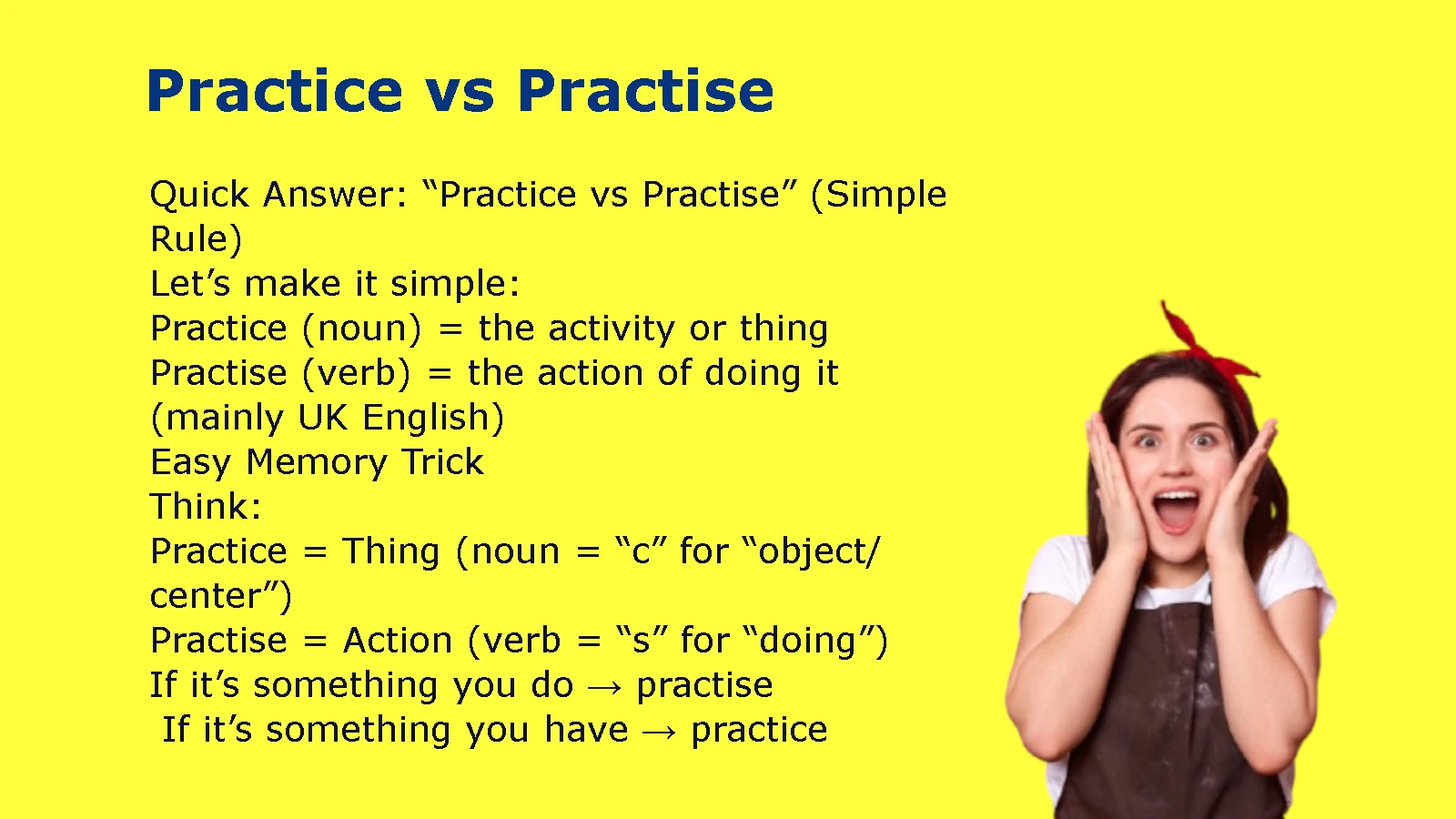
Quick Answer: “Practice vs Practise” (Simple Rule)
Let’s make it simple:
- Practice (noun) = the activity or thing
- Practise (verb) = the action of doing it (mainly UK English)
Easy Memory Trick
Think:
- Practice = Thing (noun = “c” for “object/center”)
- Practise = Action (verb = “s” for “doing”)
If it’s something you do → practise
If it’s something you have → practice
The Core Difference in One Line
- Practice = a noun (US & UK)
- Practise = a verb (UK English only)
That’s the entire system—but let’s break it down properly so it sticks.
How “Practice vs Practise” Actually Works in Real English
Here’s where things get interesting.
In American English
- “Practice” is used for both noun and verb
- I practice football.
- My football practice starts at 5.
In British English
- Clear split:
- Practice = noun
- Practise = verb
So British English is more “rule-based,” while American English simplifies it.
“Practice” Explained Clearly (Noun Form)
When you’re talking about an activity, routine, or session, use practice.
Examples
- Football practice starts at 6 PM.
- Daily practice improves your English.
- She has piano practice every evening.
Key Idea
It’s something you attend, repeat, or schedule.
“Practise” Explained Clearly (Verb Form – UK English)
When you are doing the action, use practise (British spelling).
Examples
- I practise English every day.
- They practise football after school.
- You should practise more speaking.
Key Idea
It’s something you do actively.
The Biggest Mistake People Make
Here’s the real confusion point:
People assume “practice” is always correct everywhere.
What Goes Wrong
- UK student writes: “I practice speaking English” ❌ (should be practise)
- US writer uses: “practise” ❌ (not standard in American English)
Result
- Spelling inconsistency
- Lost marks in exams
- Unprofessional writing in formal documents
Side-by-Side Comparison Table
| Form | Type | UK English | US English | Example |
| Practice | Noun | ✔ | ✔ | I have football practice |
| Practise | Verb | ✔ | ❌ | I practise football |
| Practice | Verb | ❌ | ✔ | I practice football |
Real-Life Examples of “Practice” (Noun)
- “My practice is at 8 AM tomorrow.”
- “She never misses piano practice.”
- “We had a long practice session today.”
👉 Here, you’re talking about the session or activity itself.
Real-Life Examples of “Practise” (Verb)
- “I practise writing every morning.”
- “They practise before the match.”
- “You should practise pronunciation daily.”
👉 Here, you’re talking about the action of doing it.
Regional Differences (Why This Exists)
United States
- Simplified system
- “Practice” used everywhere
- No verb/noun spelling split
United Kingdom & Commonwealth
- Traditional grammar distinction
- “Practice” (noun) vs “practise” (verb)
Global English
- Mixed usage
- Many learners unknowingly switch styles
How to Avoid Confusion Every Time
Use this quick system:
Step 1: Is it a thing or action?
- Thing → practice
- Action → practise (UK only)
2: Know your English type
- US English → always “practice”
- UK English → split rule applies
3: When unsure
- Use “practice” (safer globally)
What to Say Instead (Clear Alternatives)
If you still get confused, use safer phrasing:
- “training session”
- “rehearsal”
- “study session”
- “skill training”
Example:
- Instead of “football practice” → “football training session”
Quick Decision Guide
- Talking about an activity → practice
- Talking about doing something (UK English) → practise
- Writing for global audience → practice
Simple. Clean. No confusion.
FAQ: Practice vs Practise
Is “practise” wrong in American English?
Yes, in modern US English, “practise” is considered incorrect.
Why do both spellings exist?
Because British English preserves older grammar distinctions.
Which one should I use in exams?
Follow your exam system:
- British exams → use both correctly
- American exams → use “practice” for everything
What about professional writing?
Use consistent style based on your audience.
Case Study: A Common Writing Mistake
A student writes:
“I practice English speaking every day to improve my skills.”
If UK English is required
This is incorrect → should be:
“I practise English speaking every day.”
If US English is used
The original sentence is correct.
👉 One word changes depending on region—not meaning.
Key Facts You Should Remember
- “Practice” = noun everywhere
- “Practise” = verb in British English only
- US English uses “practice” for both
- Meaning never changes—only spelling does
Final Takeaway: The One Rule That Never Fails
Here’s the simplest way to remember it:
If it’s a thing, it’s practice
If it’s an action in UK English, it’s practise
But if you want zero risk of mistakes in global writing, just stick with practice and you’ll almost always be safe.
Because in real communication, consistency matters more than complexity—and knowing “practice vs practise” is really about writing clearly, not overthinking spelling.