Have you ever wondered whether sympathy vs. empathy are simply different words for showing kindness or whether they express two distinct emotional responses? This is one of the most common areas of confusion in English vocabulary, psychology, and everyday communication. Although the two terms are closely related and are often used interchangeably, they describe different ways of responding to another person’s feelings and experiences. Understanding the difference between sympathy and empathy can improve your communication skills, emotional intelligence, and ability to connect with others in both personal and professional situations.
In simple terms, sympathy means acknowledging or feeling concern for someone else’s pain, hardship, or misfortune, while empathy means understanding and sharing another person’s emotions by seeing a situation from their perspective. For example, you might express sympathy by offering condolences after a loss, whereas empathy involves imagining how that person feels and responding with deeper emotional understanding. Although both qualities promote compassion, they serve different purposes and should be used in the appropriate context.
This confusion frequently appears in searches such as sympathy meaning, empathy meaning, difference between sympathy and empathy, sympathy vs. empathy examples, how to use sympathy and empathy correctly, and commonly confused English words. It also relates to broader topics like emotional intelligence, communication skills, grammar, vocabulary development, and English word usage, making it an important distinction for learners and professionals alike.
If you’ve ever hesitated while deciding whether to say you “feel sympathy” or “show empathy” toward someone facing a difficult situation, you’re certainly not alone. Because the two words are similar in meaning but differ in emotional depth and application, they are often confused in writing, conversation, counseling, education, and workplace communication.
In this guide, you’ll learn the clear difference between sympathy and empathy, their definitions, real-life examples, key distinctions, grammar tips, and simple memory tricks so you can use both words confidently and accurately in any situation.
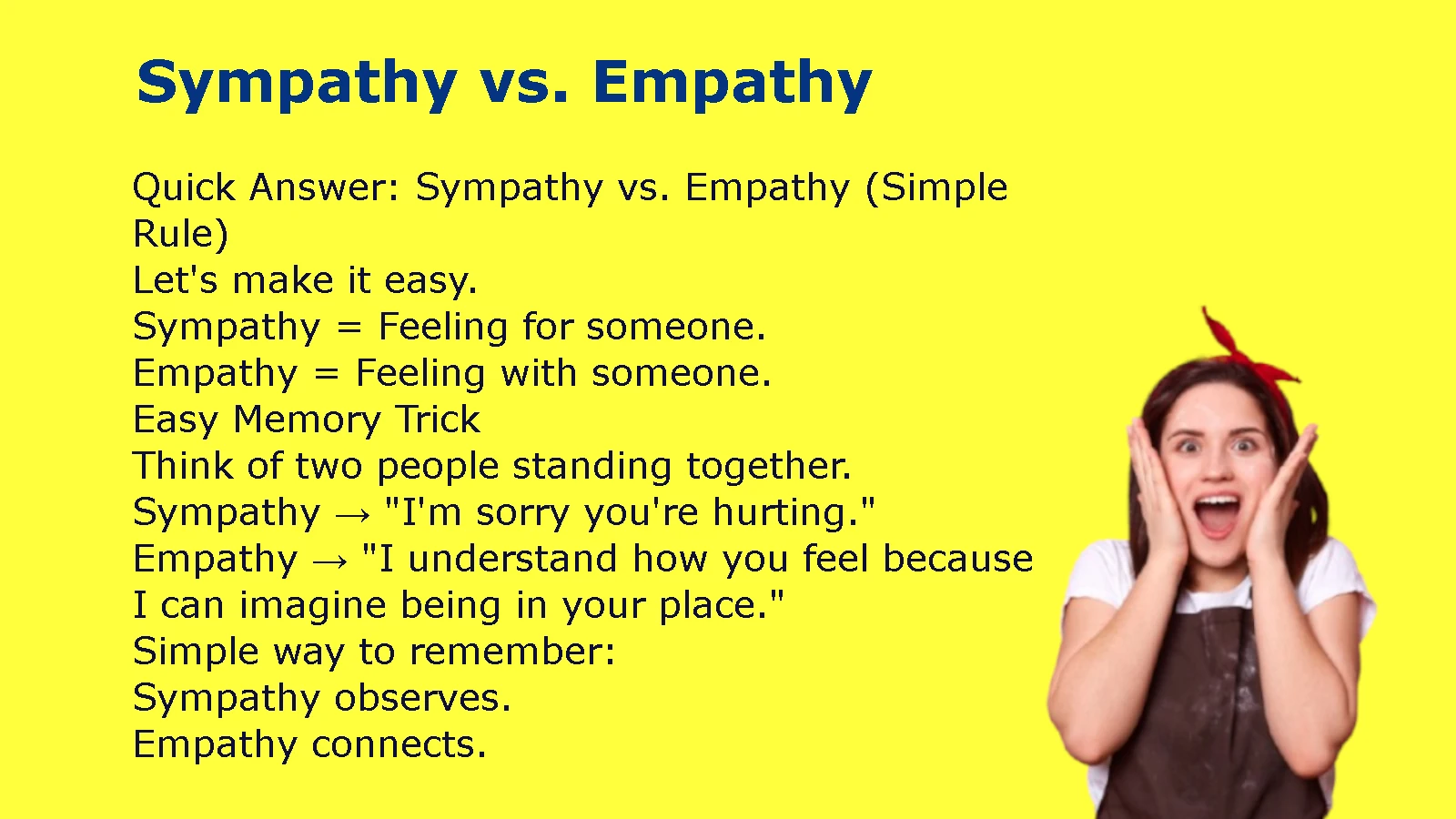
Quick Answer: Sympathy vs. Empathy (Simple Rule)
Let’s make it easy.
Sympathy = Feeling for someone.
Empathy = Feeling with someone.
Easy Memory Trick
Think of two people standing together.
- Sympathy → “I’m sorry you’re hurting.”
- Empathy → “I understand how you feel because I can imagine being in your place.”
Simple way to remember:
- Sympathy observes.
- Empathy connects.
How People Actually Use Sympathy and Empathy
Here’s why people mix them up.
In everyday conversations, both words are often used whenever someone is comforting another person. However, the emotional depth behind each word is different.
In Everyday Conversations
People may say:
“I have so much sympathy for you.”
Others might say:
“I completely empathize with you.”
Both sound caring, but they communicate different levels of emotional understanding.
At Work
Managers often need empathy when supporting employees.
Sympathy alone may sound kind, but empathy usually builds stronger trust.
In Relationships
Friends and family often expect empathy more than sympathy because they want to feel understood, not simply pitied.
The Core Difference Between Sympathy and Empathy
The easiest way to understand these words is to focus on emotional distance.
Think About Where You’re Standing
Sympathy
You stand beside someone and recognize their pain.
Empathy
You mentally step into their shoes and try to experience what they’re feeling.
Key Insight
Sympathy acknowledges emotions.
Empathy understands emotions.
“Sympathy” Explained Clearly (With Examples)
At its core, sympathy means recognizing another person’s suffering and feeling concern for them.
You care about what they’re going through, even if you haven’t experienced it yourself.
Standard Meaning
Someone loses a loved one.
You say:
“I’m so sorry for your loss.”
That’s sympathy.
You’re expressing compassion without claiming to know exactly how they feel.
Common Situations
- Sending a sympathy card
- Expressing condolences
- Comforting someone after bad news
- Donating to disaster victims
Example
Your coworker’s house is damaged in a storm.
You say:
“I’m really sorry this happened to you.”
That’s sympathy.
“Empathy” Explained Clearly (With Examples)
Empathy goes one step further.
Instead of simply recognizing someone’s emotions, you genuinely try to understand what they’re are experiencing.
Standard Meaning
A friend tells you they’re anxious before an important interview.
You remember feeling the same way before your own interview.
You say:
“I remember how nervous I felt. I understand why you’re worried.”
That’s empathy.
Another Example
Your friend fails an important exam.
Instead of saying,
“That’s unfortunate.”
You say,
“I know how disappointing that feels. I’ve been there.”
You’re emotionally connecting with them.
Key Insight
Empathy creates emotional closeness.
The Biggest Mistake People Make
The most common mistake is assuming sympathy and empathy are interchangeable.
They’re related—but not identical.
What Goes Wrong
Someone says,
“I empathize with your loss.”
Even though they’ve never experienced anything similar.
While this isn’t always wrong, it may sound less genuine if they cannot truly relate.
On the other hand,
“I have sympathy for your loss.”
Always works because it simply expresses compassion.
Lesson
Empathy requires understanding.
Sympathy requires kindness.
Side-by-Side Comparison Table
| Feature | Sympathy | Empathy |
| Meaning | Feeling for someone | Feeling with someone |
| Emotional Connection | Moderate | Strong |
| Requires Shared Understanding | No | Usually yes |
| Focus | Compassion | Understanding |
| Best Used For | Offering comfort | Building connection |
Real-Life Examples of Sympathy
Let’s see sympathy in everyday situations.
Common Situations
“I was sorry to hear about your accident.”
“Our deepest sympathies are with your family.”
“I feel sympathy for people affected by the flood.”
“I hope things get better soon.”
What They Mean
Each sentence expresses care without suggesting the speaker fully shares the person’s emotions.
Mini Scenario
A colleague loses their pet.
You say,
“I’m really sorry for your loss.”
This is sympathy.
Real-Life Examples of Empathy
Now compare.
Common Situations
“I know exactly how overwhelming that feels.”
“I’ve experienced something similar.”
“I understand why you’re frustrated.”
“I’d probably feel the same way.”
What They Mean
These statements communicate emotional understanding.
Mini Scenario
Your friend is stressed before giving a presentation.
You remember feeling nervous during your own presentations.
You say,
“I completely understand those nerves.”
That’s empathy.
Psychology Behind Sympathy and Empathy
Psychologists often distinguish these concepts because they affect relationships differently.
Sympathy
- Recognizes suffering
- Offers compassion
- Maintains some emotional distance
Empathy
- Understands another person’s emotions
- Encourages deeper connection
- Helps strengthen trust and communication
Key Insight
Empathy often leads to stronger emotional support because people feel genuinely understood.
How to Choose the Right Word Every Time
Use these simple guidelines.
Choose Sympathy When:
- Offering condolences
- Comforting someone after bad news
- Expressing concern
- Showing compassion
Choose Empathy When:
- You understand someone’s emotions
- You’ve experienced something similar
- You’re actively listening
- You want to build emotional connection
Why This Works
Choosing the right word makes your support feel more genuine and meaningful.
What to Say Instead (Clear Alternatives)
If you’re unsure which word fits best, try these natural alternatives.
Instead of Sympathy
- “I’m so sorry.”
- “My thoughts are with you.”
- “I hope things improve.”
- “I’m thinking of you.”
Instead of Empathy
- “I understand how you feel.”
- “I’ve been through something similar.”
- “That must be incredibly difficult.”
- “I can imagine what you’re experiencing.”
Quick Decision Guide (Use This Instantly)
When you’re unsure, ask yourself one question.
Am I simply expressing concern?
→ Sympathy.
Am I trying to understand and share their feelings?
→ Empathy.
Still unsure?
Use a caring statement without labeling it.
FAQ: Sympathy vs. Empathy
Is empathy better than sympathy?
Not necessarily.
Both are valuable. Empathy often creates deeper emotional connection, while sympathy is appropriate when offering compassion.
Can you have sympathy without empathy?
Yes.
You can genuinely care about someone even if you’ve never experienced what they’re going through.
Can you empathize without having the same experience?
Yes.
Empathy doesn’t always require identical experiences. It involves making an honest effort to understand another person’s emotions.
Which word is better in professional settings?
Both have their place.
Leaders often benefit from showing empathy because it strengthens communication, while sympathy is appropriate during difficult personal situations.
Case Study: Two Different Responses
Imagine an employee whose parent has passed away.
Manager A
“I’m sorry for your loss.”
This expresses sympathy.
Manager B
“I’m so sorry. Losing a parent is incredibly difficult. Please take the time you need.”
This combines sympathy with empathy by acknowledging the emotional experience and offering meaningful support.
Result
The employee feels more understood and supported.
Key Facts You Should Remember
- Sympathy means feeling for someone.
- Empathy means feeling with someone.
- Sympathy focuses on compassion.
- Empathy focuses on understanding.
- Both are valuable but serve different purposes.
- Empathy usually creates stronger emotional connections.
- Choosing the right word improves communication.
Final Takeaway: The One Rule That Never Fails
Here’s the simplest way to remember the difference.
Sympathy recognizes another person’s pain.
Empathy tries to understand and share that emotional experience.
If someone is hurting, sympathy says,
“I’m sorry you’re going through this.”
Empathy says,
“I understand how hard this must feel.”
Neither is inherently better than the other. The right choice depends on the situation. Sometimes people simply need kindness. Other times, they need someone who truly listens and understands.
When it comes to sympathy vs. empathy, remembering one simple rule can help:
Care about the person with sympathy. Connect with the person through empathy.