Have you ever wondered whether “toward” vs. “towards” is just a spelling variation or if there is a real difference between the two? This is a common point of confusion in English, especially because both words look and sound almost identical and are often used interchangeably in everyday writing and speech.
In simple terms, both Toward and Towards have the same meaning—they describe movement, direction, or orientation in relation to something. For example, you can say “She walked toward the door” or “She walked towards the door,” and both are grammatically correct. The only real difference lies in usage preference: “toward” is more commonly used in American English, while “towards” is more frequently used in British English and other regional varieties.
This small variation often appears in searches like toward vs towards difference, how to use toward in a sentence, towards meaning in English, and common American vs British English differences. Understanding this distinction helps improve writing accuracy, grammar confidence, and overall communication clarity.
If you’ve ever paused while writing a sentence like “He moved toward/towards the exit,” you’re not alone—this is one of those subtle English variations where both forms are correct, but context and regional style decide the preference.
In this guide, you’ll learn the exact difference between toward and towards, their usage rules, real-life examples, and easy tips to remember when to use each form correctly.
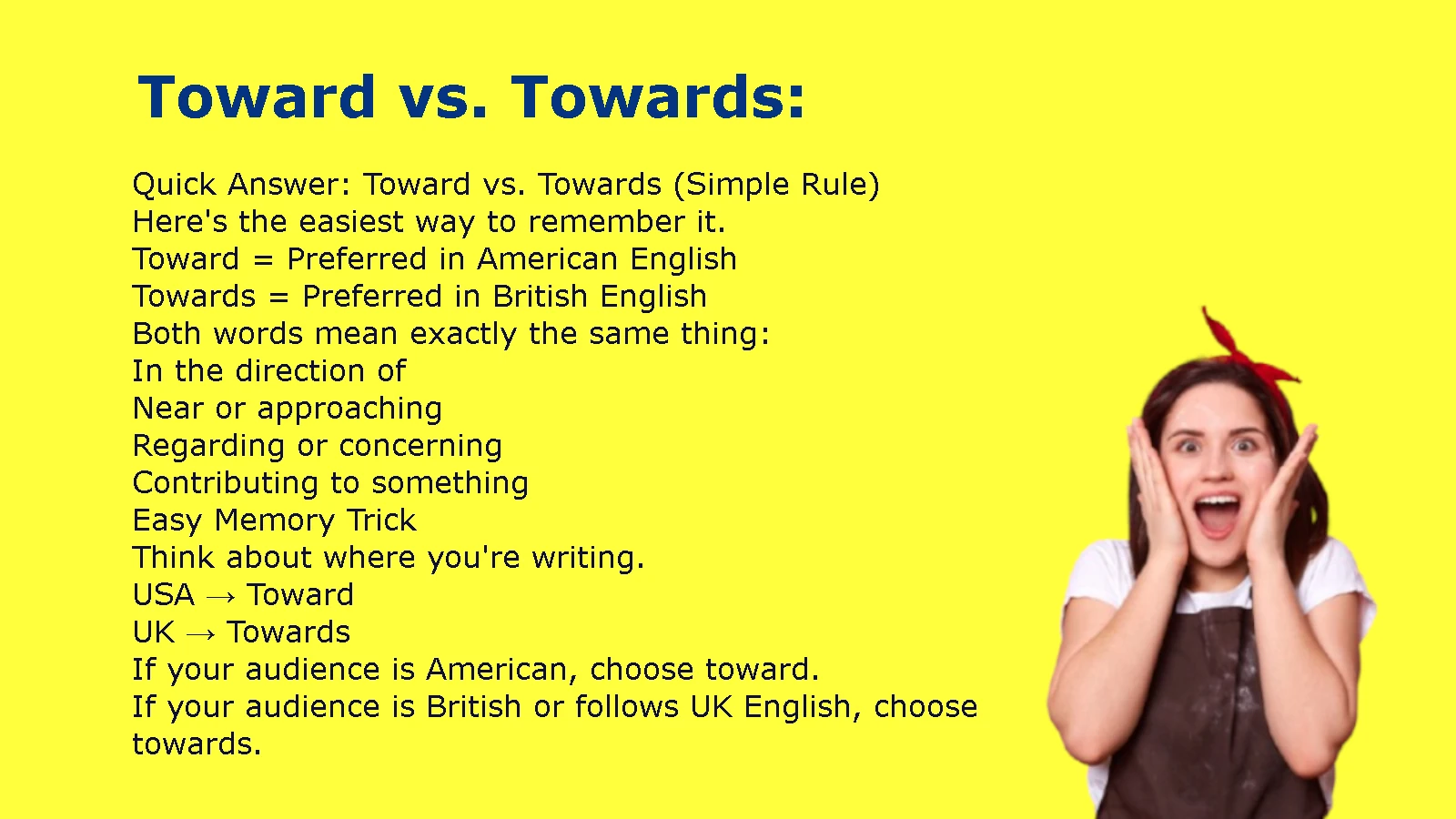
Quick Answer: Toward vs. Towards (Simple Rule)
Here’s the easiest way to remember it.
Toward = Preferred in American English
Towards = Preferred in British English
Both words mean exactly the same thing:
- In the direction of
- Near or approaching
- Regarding or concerning
- Contributing to something
Easy Memory Trick
Think about where you’re writing.
USA → Toward
UK → Towards
If your audience is American, choose toward.
If your audience is British or follows UK English, choose towards.
What Do “Toward” and “Towards” Mean?
Both words function as prepositions and occasionally as adverbs.
They commonly express:
- Movement in a direction
- Progress toward a goal
- Feelings or attitudes
- Approximate position
- Contribution to an objective
No matter which spelling you use, the meaning stays the same.
How People Actually Use “Toward” and “Towards”
Here’s what happens in real life.
Most native speakers don’t consciously think about the difference. They simply use whichever version matches the English variety they’re accustomed to.
In Everyday Conversation
Americans naturally say:
“I walked toward the door.”
British speakers often say:
“I walked towards the door.”
Neither sounds incorrect to its intended audience.
In Professional Writing
Editors usually prefer consistency.
American publications almost always use toward.
British publications generally favor towards.
Why This Happens
The difference comes from language conventions, not grammar.
English allows both spellings, but different regions developed different preferences over time.
The Grammar Behind “Toward” vs. “Towards”
Here’s the good news.
Unlike many confusing word pairs, toward and towards have identical meanings and grammatical functions.
They Both Express Direction
Examples:
- She ran toward the finish line.
- She ran towards the finish line.
Both sentences are equally correct.
They Both Express Attitude
Examples:
- His attitude toward learning improved.
- His attitude towards learning improved.
Again, the meaning doesn’t change.
Key Insight
The choice is about style, not grammar.
“Toward” Explained Clearly
Toward is the standard choice in American English.
You’ll commonly see it in:
- American newspapers
- Business documents
- Academic writing
- Government publications
- School textbooks
Examples
- We walked toward the beach.
- She smiled toward her parents.
- Everyone worked toward the same goal.
- His attitude toward change became positive.
Best Use Cases
Choose toward if you’re writing for:
- American readers
- U.S. universities
- American businesses
- International audiences using U.S. English
“Towards” Explained Clearly
Towards is more common in British English and many other English-speaking countries.
You’ll often find it in:
- British books
- UK newspapers
- Australian publications
- New Zealand English
Examples
- We walked towards the station.
- The children ran towards the playground.
- She showed kindness towards everyone.
- They moved towards a better solution.
Best Use Cases
Choose towards when writing for:
- UK audiences
- British publishers
- Australian readers
- Readers who prefer British spelling
The Biggest Mistake People Make
Many learners believe one spelling is wrong.
It isn’t.
Both words are accepted by major dictionaries and grammar guides.
What Goes Wrong
People often:
- Mix American and British spellings in one document
- Correct others unnecessarily
- Think “towards” is more formal
- Assume “toward” is incomplete
None of these assumptions is true.
Lesson
The key is consistency.
Pick one style and use it throughout your writing.
Side-by-Side Comparison Table
| Feature | Toward | Towards |
| Meaning | Same | Same |
| Grammar | Correct | Correct |
| American English | Preferred | Less common |
| British English | Less common | Preferred |
| Formal Writing | Yes | Yes |
| Everyday Speech | Yes | Yes |
Real-Life Examples of “Toward”
Let’s see how Americans commonly use it.
Common Situations
- The dog ran toward its owner.
- We are working toward a solution.
- She leaned toward the microphone.
- His opinion toward the proposal changed.
Mini Scenario
A manager says:
“We’re moving toward our quarterly goals.”
Everyone understands the company is making progress.
Real-Life Examples of “Towards”
Now compare the British preference.
Common Situations
- The train moved towards London.
- She looked towards the sky.
- Their attitude towards customers improved.
- Donations went towards rebuilding the school.
Mini Scenario
A teacher says:
“Please walk towards the library.”
Students understand the direction immediately.
Common Expressions Using “Toward” and “Towards”
Both forms appear naturally in many everyday expressions.
Examples include:
- toward success / towards success
- toward the future / towards the future
- toward the end / towards the end
- toward the exit / towards the exit
- toward peace / towards peace
- toward improvement / towards improvement
The choice depends only on the English style you’re following.
Regional Differences
English changes around the world.
In the United States
Toward is overwhelmingly preferred.
You’ll rarely see towards in formal American writing.
In the United Kingdom
Towards appears much more frequently.
British readers generally expect this spelling.
In Canada and Australia
Both forms are accepted, though towards is often more common because of British influence.
Key Tip
If you’re writing for a global audience, either spelling works—as long as you stay consistent.
How to Choose the Right One Every Time
Follow these simple guidelines.
Use Toward If:
- You’re using American English.
- You’re writing for U.S. readers.
- Your organization follows American style guides.
Use Towards If:
- You’re using British English.
- Your audience is in the UK.
- Your publication follows British spelling.
Stay Consistent
Avoid switching between the two within the same article, essay, or report.
Consistency always looks more professional.
Quick Decision Guide
Use this simple checklist.
Writing in American English?
→ Use Toward
Writing in British English?
→ Use Towards
Writing for an international audience?
→ Either is correct, but stick with one spelling throughout.
FAQ: Toward vs. Towards
Is “towards” grammatically correct?
Yes. It is completely correct and widely used in British English.
Is “toward” more formal?
No. Both forms are equally formal.
Do they have different meanings?
No. They mean exactly the same thing.
Which spelling should students use?
Use whichever spelling matches your school’s required style guide or the variety of English you’re learning.
Can I use both in the same document?
It’s better not to. Choose one spelling and use it consistently.
Case Study: Consistency Matters
A company prepared marketing materials for customers in the United States.
One brochure said:
“We’re moving toward innovation.”
Another said:
“We’re moving towards innovation.”
Neither sentence was incorrect.
However, the inconsistent spelling made the materials look unedited and less professional.
The Fix
The company adopted American English for all marketing content and changed every instance to toward.
The messaging became consistent and polished.
Key Facts You Should Remember
- Toward and towards have the same meaning.
- Neither spelling is grammatically incorrect.
- Toward is preferred in American English.
- Towards is preferred in British English.
- The difference is based on regional style, not grammar.
- Consistency is more important than the spelling you choose.
Final Takeaway: The One Rule That Never Fails
The debate over toward vs. towards isn’t about right versus wrong—it’s about choosing the spelling that fits your audience. Both words express the same idea, whether you’re talking about movement, progress, attitudes, or direction.
To keep your writing clear and professional, remember one simple rule:
- American English → Toward
- British English → Towards
Once you’ve chosen a style, stick with it throughout your writing. Readers are far more likely to notice inconsistent spelling than your choice between these two perfectly correct words.
When it comes to toward vs. towards, the best choice is the one that matches your audience and remains consistent from beginning to end.